Why Does Plantar Fasciitis Hurt More in the Morning?
Morning heel pain is a sensitivity pattern from hours of unloading, not new overnight damage. Here's what's actually happening in the tissue and how a load-based approach helps you build lasting capacity instead of chasing symptoms.

If your heel pain is worst with the first few steps out of bed and eases as you move around, you’re describing one of the most recognizable patterns in foot and ankle care. It’s a pattern that’s often consistent with plantar fasciitis, or more precisely, plantar fasciopathy once it’s been around for a while. But the “why” behind morning pain gets oversimplified a lot, and understanding it correctly matters for how you actually recover.
What’s really happening overnight
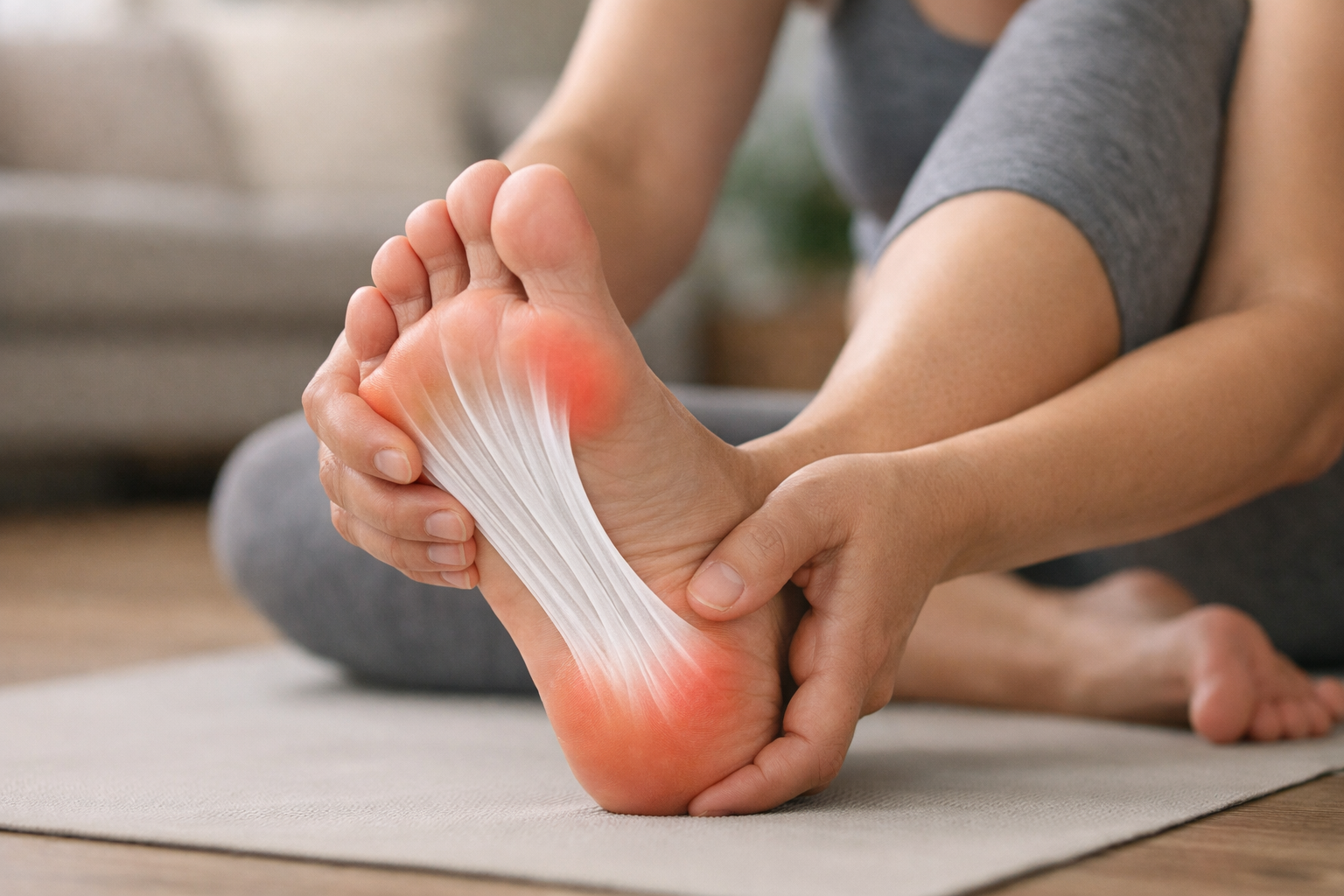
The plantar fascia is a band of connective tissue running along the bottom of your foot, from heel to toes. During the day, it tolerates a huge amount of repetitive load: walking, standing, climbing stairs. At night, that load stops. Your foot sits still for hours, often in a slightly relaxed, plantarflexed position.
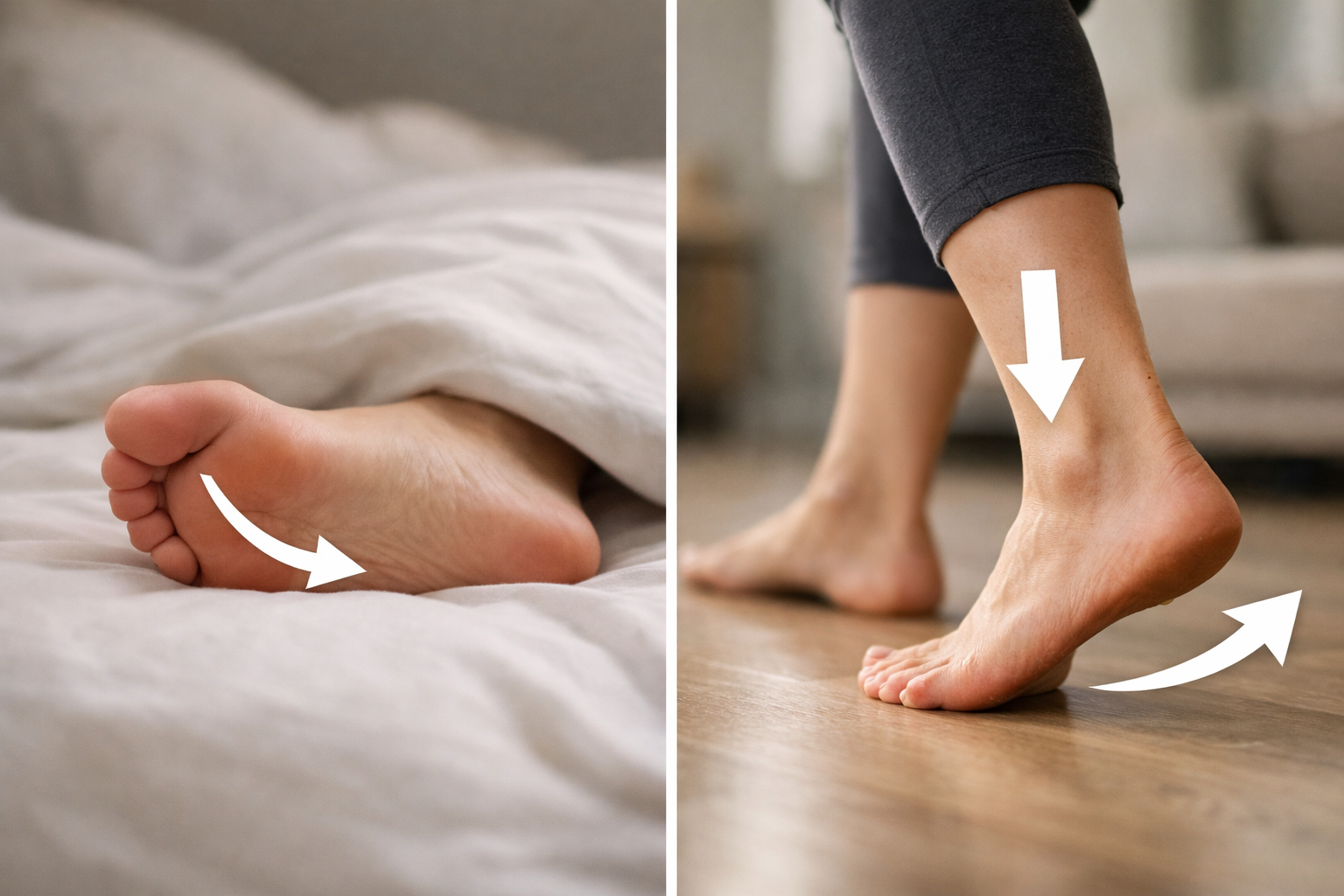
That period of rest isn’t the problem. The problem is what happens the moment load returns. After hours without any mechanical input, the tissue and the nervous system around it become more sensitive to load, not less. Your first steps in the morning are, mechanically, a fairly ordinary stretch and load through the fascia. But your system reacts to that ordinary input with an outsized pain response, because sensitivity has built up overnight.
This is a useful distinction: sensitivity is not the same as structural damage. Nothing tore or worsened while you slept. Your nervous system, which had been protecting a loaded, irritated structure all day, simply recalibrated during a period of disuse, and now reacts strongly to the first real load it encounters. That’s why the pain can feel sharp and alarming, and why it often fades within minutes as you keep walking.
Is it normal for plantar fasciitis to only hurt in the morning?
For many people, yes, at least in the earlier stages. A pattern where pain is sharpest first thing and with the first steps after any period of rest (getting up from a desk, out of a car, off the couch) and then eases with movement is common and doesn’t necessarily mean anything has changed for the worse.
That said, “only in the morning” can shift over time. As total load on the tissue increases relative to its capacity, some people notice pain creeping into the afternoon, after standing for long stretches, or at the end of a run. That progression is worth paying attention to, because it usually means the gap between demand and capacity is widening, not narrowing.
Why does my plantar fasciitis only hurt in the morning?
Same answer as above, framed differently: your fascia has adapted, for better or worse, to a certain level of daily load. Morning pain reflects a sensitivity spike after hours of zero load, not a nightly injury. Once you’re up and moving, the tissue warms up, the nervous system’s alarm settles, and the pain quiets, at least until the next period of prolonged rest (sitting at a desk, driving, sitting through a movie) resets the pattern.
How to prevent heel pain in the morning?
A few practical, low-risk strategies help many people, though none of them address the underlying capacity issue on their own:
- Ease into the first steps. Sitting on the edge of the bed and gently moving your ankle and toes before full weight-bearing can soften that first-step spike for some people.
- A brief calf and foot stretch before standing may take the edge off, though understand this is calming sensitivity temporarily, not changing the tissue.
- Supportive footwear right away, even around the house, reduces sudden strain compared to bare feet on hard floors.
- Consistent, moderate activity during the day matters more than anything you do in the first sixty seconds after waking. Long stretches of total inactivity followed by sudden load are what create the sharpest sensitivity spikes, so breaking up prolonged sitting helps too.
None of these are cures. They’re load-management tools that make the day more comfortable while the real work, rebuilding capacity, happens over weeks.
Stretching and rest calm symptoms, they don’t rebuild the tissue
This is the piece that gets missed most often. Stretching the calf or arch, icing, resting more, these all reduce sensitivity while the tissue is unloaded. That’s genuinely useful for managing a flare. But the moment you put load back through the foot, walking, standing, running, the pain can return, because the underlying capacity of the tissue hasn’t changed. Only progressive, gradual mechanical loading over weeks to months actually changes the structure of the fascia so it can tolerate more before it protests.
Think of it as the difference between turning down an alarm and fixing what’s triggering it. Rest turns down the alarm. Rest in large, prolonged doses (weeks of avoiding walking, sitting out all activity) also lets capacity drift lower, which sets you up for the same pain, or worse, when you return to normal life. The goal isn’t complete rest. It’s staying as active as reasonably tolerable while managing the load intelligently.
What gets mistaken for plantar fasciitis?
Heel and arch pain has several look-alikes, and it’s worth knowing that not everything that hurts under the heel is plantar fasciopathy:
- Fat pad atrophy or contusion, more common with age or after a hard impact, causes deep heel pain without the classic first-step pattern.
- Tarsal tunnel syndrome, a nerve entrapment, can cause burning, tingling, or numbness that plantar fasciitis typically doesn’t.
- Achilles tendinopathy, if pain sits more toward the back of the heel rather than the bottom.
- Stress fractures of the calcaneus, especially in runners or people who’ve recently increased activity sharply, tend to hurt with any weight-bearing, not just the first steps.
- Nerve irritation higher up (like from the low back) can occasionally refer pain into the foot.
A proper evaluation sorts these out. Location, timing, and what aggravates or eases the pain all give useful clues, but self-diagnosing from an article has real limits.
Heel spurs and imaging: what they do and don’t tell you
If you’ve had an X-ray that shows a heel spur, that finding often causes unnecessary alarm. A heel spur is usually a consequence of chronic stress on the fascia over time, not the source of the pain. Plenty of people have heel spurs with no pain at all, and plenty of people with significant heel pain have no spur. Recovery generally looks the same either way. Similarly, if imaging shows fascia thickening, that reflects the tissue’s adaptation to stress, not a verdict on how bad things are or how long recovery will take.
“Stages” of plantar fasciitis: what these labels really mean
You may come across informal staging systems online (sometimes labeled stage 1 through stage 4) that describe plantar fasciitis progressing from mild irritation to chronic degeneration, and in more severe descriptions, to partial tearing of the fascia or significant structural change. These aren't a universally standardized medical classification, and clinicians don’t typically diagnose or treat by a numbered stage. What matters clinically is a combination of how long symptoms have been present, how much they interfere with daily function, and what’s visible on exam or imaging when it’s needed.
What’s more useful than a stage number is this: the longer a problem has been present, the more it behaves like a chronic tissue adaptation issue (plantar fasciopathy) rather than a short-term inflammatory one, and the more patient the reloading process usually needs to be. Chronic does not mean permanent. It generally means starting from a lower baseline and progressing more gradually, not that recovery is out of reach.
Is plantar fasciitis surgery worth it?
Surgery (typically a plantar fascia release) exists for a reason, and for a small subset of people who’ve gone through an extended, genuinely thorough course of conservative care without meaningful improvement, it can be a reasonable option to discuss with a foot and ankle specialist. But it’s not a first step, and it’s not a shortcut around the rehab process.
A few things worth knowing before considering it:
- Most people improve with a structured, progressive loading program, appropriate footwear, and load management, without ever needing surgery.
- Surgery addresses the fascia’s structure directly, but it doesn’t replace the need to rebuild capacity in the surrounding tissues afterward. Recovery still involves a graded return to load.
- Like any surgical procedure, it carries risks and a recovery timeline, and outcomes vary.
If you’ve been told surgery is being considered, it’s worth confirming that a genuinely progressive, adequately dosed loading program (not just stretching and rest) has been tried for a meaningful stretch of time first.
What finally cured my plantar fasciitis?
We won’t pretend there’s one universal fix, because there isn’t, and any single-cause claim you read online should be viewed skeptically. But the pattern that tends to show up across people who improve durably looks like this:
- They stopped treating rest and stretching as the whole plan, and used them as short-term tools for a flare instead.
- They found a level of activity that kept pain during and after movement at a tolerable level, often described loosely as staying at or below roughly a 4 out of 10, and built from there.
- They gave the tissue time. Meaningful structural adaptation in fascia and tendon tends to take roughly 8 to 12 weeks of consistent, progressive loading, sometimes longer for more chronic cases. Early improvement is often more about the nervous system settling than the tissue actually changing.
- They accounted for total daily load, not just their exercises. A long shift on their feet, a new pair of shoes, an increase in walking or running, all of that adds up alongside any specific rehab work. Symptoms can lag a day or two behind the load that caused them, which is why it’s easy to blame the wrong thing.
- They didn’t stop the moment pain went away. Stopping early, before the tissue has actually adapted, is one of the more common reasons plantar fasciitis symptoms come back a few months later.
The principles here are sound and supported by how connective tissue generally responds to graded loading. They’re not a guarantee, and timelines vary quite a bit from person to person depending on how long the problem has been present, activity demands, and other factors.
Footwear, orthotics, and other tools
Supportive shoes and orthotics aren’t a cure, but they’re not something to avoid either. They’re load-management tools. A shoe with adequate support can reduce strain on the fascia during the parts of the day you can’t fully control, long shifts, unavoidable walking, standing jobs. Orthotics can do something similar for certain foot shapes and mechanics. Neither replaces the need to build capacity, but neither deserves to be dismissed as a crutch.
The same goes for other interventions like injections. They can reduce pain and sensitivity for a window of time, which some people use productively to begin a loading program they couldn’t tolerate otherwise. They don’t change the underlying capacity of the tissue by themselves.
A brief safety note
Most heel pain responds well to a sensible, progressive approach over a period of weeks. But if you’re dealing with sudden, severe pain, numbness or tingling, pain that’s worsening despite rest, or symptoms following an injury rather than a gradual onset, it’s worth getting evaluated by a physical therapist or physician rather than trying to self-manage. An evaluation can rule out the other conditions that mimic plantar fasciitis and make sure you’re building your recovery plan on the right diagnosis.