KT Tape for Plantar Fasciitis: How to Apply and Whether It Helps
A practical guide to applying kinesiology tape for plantar fasciitis, plus a clear-eyed look at what taping can and can't do for your recovery.
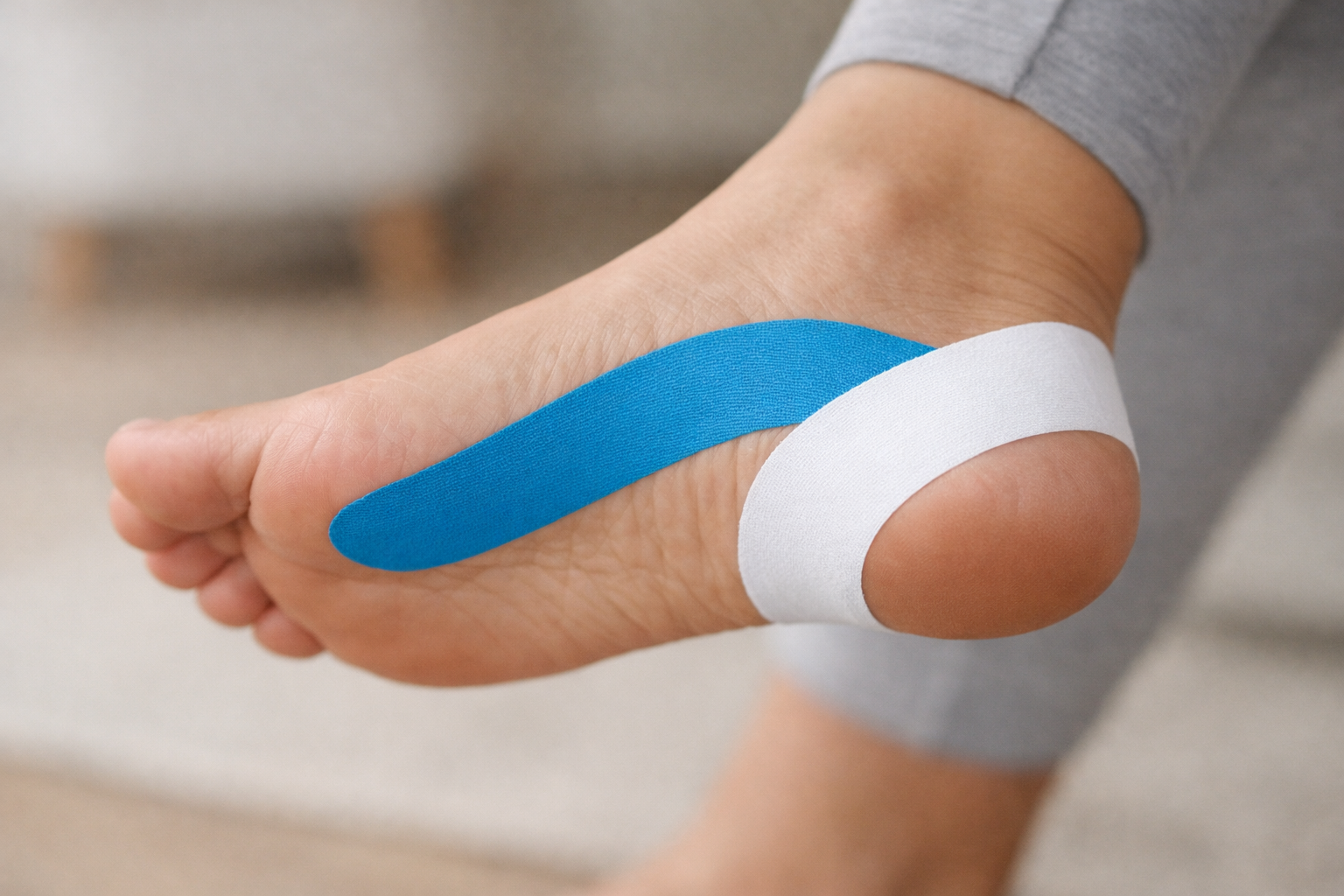
Kinesiology tape shows up in a lot of plantar fasciitis advice, and for good reason. It’s cheap, easy to try, and for many people it takes the edge off pain enough to get through a workday or a walk. But taping is a symptom-management tool, not a treatment for the underlying problem. Understanding the difference will save you money and, more importantly, time.
Will KT Tape Work for Plantar Fasciitis?
For many people, yes, in the sense that it reduces pain in the short term. Kinesiology tape applied to the arch and heel can offload some tension from the plantar fascia and change how the skin and superficial tissue report load to your nervous system. That can translate into a real, noticeable drop in pain during standing or walking.
What it doesn’t do is change the condition itself. Plantar fasciitis, or more accurately plantar fasciopathy once it’s been around a while, develops because the load on the fascia has outpaced its capacity to handle that load. Tape can reduce the sensitivity of the tissue for a few hours. It does nothing to build the fascia’s tolerance for walking, standing, or running over the long run. That only happens through progressive loading over weeks to months. Tape is a bridge, not a destination.
Think of it the same way you’d think about rest or stretching. Both feel good in the moment because they reduce load and calm an irritated system. Neither one rebuilds capacity. Tape belongs in that same category: useful for getting through a rough patch, not a substitute for addressing why the tissue got overloaded in the first place.
Where Do I Place the Tape for Plantar Fasciitis?
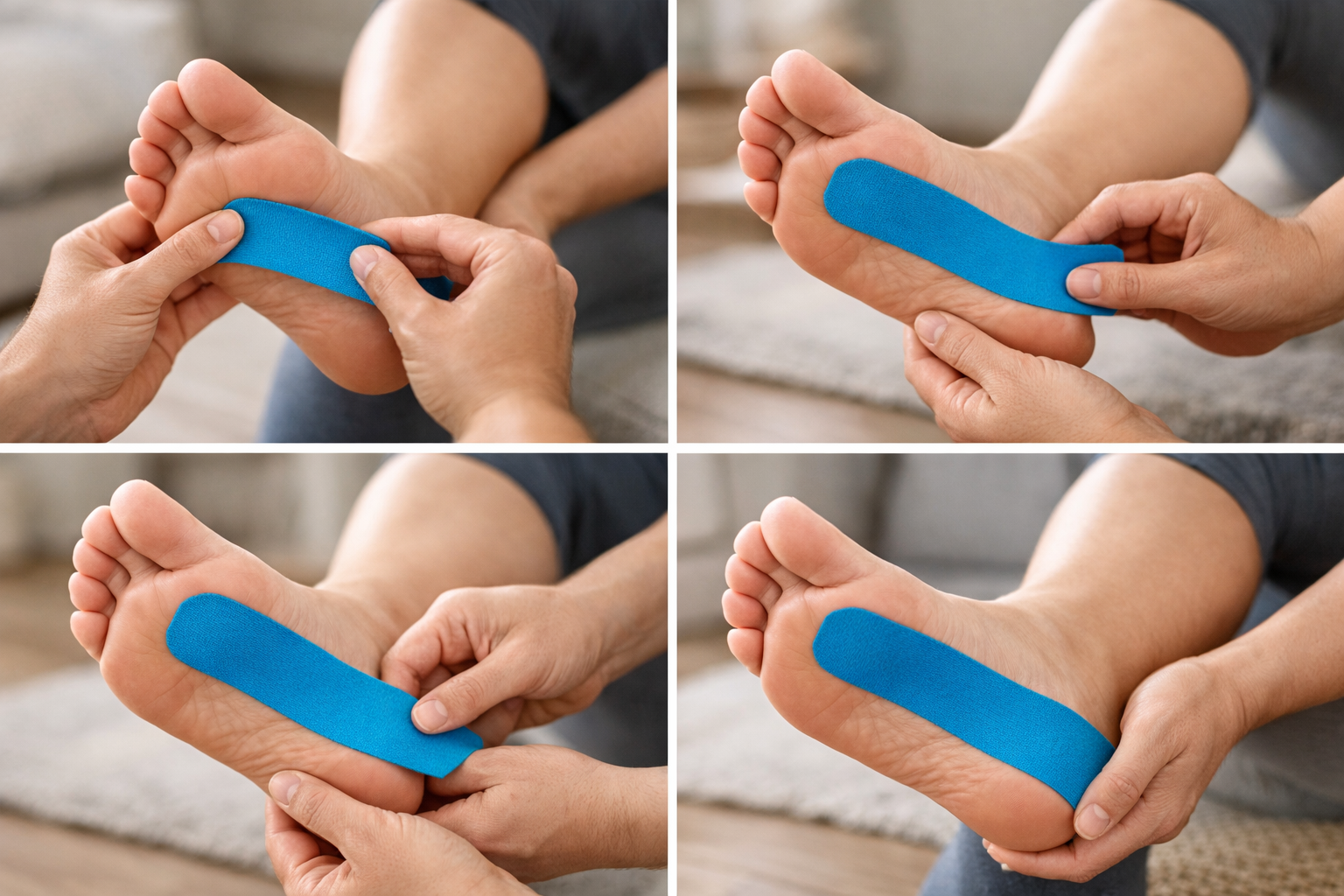
There are a few common taping patterns, and none of them is dramatically superior to the others. The general idea is the same across all of them: support the arch and reduce tension through the plantar fascia and heel.
A basic technique:
- Start with clean, dry skin. Tape sticks poorly to lotion, sweat, or oily skin, and it won’t hold through a full day if the surface isn’t prepped.
- Measure a strip of kinesiology tape from the base of your toes to just past your heel, roughly following the line of the arch. Round the corners of the tape before applying it. Rounded edges resist peeling and snagging on socks.
- Anchor the first end at the ball of the foot with no tension. Lay it down flat.
- Pull the tape with light to moderate tension (many taping guides suggest roughly 25 to 50 percent stretch) as you run it along the arch and around the heel.
- Finish the anchor at the back of the heel or lower calf with no tension again, smoothing the whole strip down with your hand to activate the adhesive.
- A second strip is often applied across the width of the foot, over the arch, for added support. Some techniques extend a strip up the back of the ankle and lower calf, particularly when the Achilles is also irritated.
Rub the tape firmly once it’s applied. The adhesive is heat- and friction-activated, and tape that’s just laid down without being rubbed in tends to lift at the edges within an hour.
A few practical notes: kinesiology tape typically lasts 2 to 4 days with normal wear, less if you’re sweating heavily or swimming. If you notice skin irritation, itching, or a rash, remove it. Some people are sensitive to the adhesive, and there’s no reason to push through a skin reaction for a tool that’s meant to make things more comfortable, not less.
What’s the Worst Thing You Can Do for Plantar Fasciitis?
Two mistakes show up constantly, and they sit at opposite ends of the same problem: mismanaging load.
The first is pushing through pain and doing too much, too soon. Continuing high-mileage running, standing all day on hard floors, or resuming full activity right after symptoms ease often re-irritates a fascia that hasn’t actually rebuilt its capacity yet. Pain calmed down is not the same as tissue adapted.
The second, less talked about, is complete rest for weeks on end. Total inactivity lets pain settle, but it doesn’t build tolerance for the loads you’ll eventually need to return to. When you go back to normal walking or standing, the fascia often can’t handle it and the pain returns, sometimes worse than before. This cycle, rest until it feels better, resume, flare up again, is one of the most common reasons plantar fasciitis drags on for months or years. Our article on plantar fasciitis exercises goes into more detail on building a progression that avoids this trap.
The better path sits between those extremes: stay as active as you reasonably can, keep pain during and after activity in a mild range (many clinicians use a rough guide of 4 out of 10 or below), and progress loading gradually rather than in big jumps.
What Finally Cured My Plantar Fasciitis?
We can’t speak to any one person’s story, and we’d be cautious of anyone who tells you a single product or trick fixed it for good. What tends to hold up across cases that resolve well is consistency: a gradual loading program sustained over roughly 8 to 12 weeks, sensible footwear, and patience through the early phase when pain improves faster than the tissue actually adapts.
Tape, ice, night splints, and stretching all have a role in making the day-to-day more tolerable. None of them, alone, address the load-versus-capacity mismatch that got the fascia irritated in the first place. Recovery that lasts usually comes from rebuilding what the tissue can handle, not from finding the right accessory.
What Is Stage 4 Plantar Fasciitis?
You won’t find an official, universally used four-stage classification for plantar fasciitis in clinical practice. Some patient-facing sources describe informal stages ranging from mild morning stiffness to chronic, constant pain with structural changes like significant fascia thickening or a heel spur visible on imaging. These are useful as a rough mental model but aren’t a formal diagnostic system the way staging works for, say, cancer or pressure injuries.
What matters more than the label is the trend. Pain that’s been present for months, that’s constant rather than activity-related, or that’s accompanied by numbness, tingling, or pain that wakes you at night deserves an evaluation rather than more home remedies. A heel spur on an X-ray, even a large one, is usually a byproduct of chronic stress on the fascia rather than the source of pain, and it doesn’t change the approach to recovery. The same is true of fascia thickening seen on ultrasound. It reflects a tissue that has been under load and is adapting to it, not a verdict on how bad things are.
It’s also worth remembering that not everything felt in the heel or arch is plantar fasciitis. Nerve entrapment, stress fractures, fat pad atrophy, and tendon problems can all produce similar symptoms. If you’re not sure what you’re dealing with, our article on plantar fasciitis vs. tendonitis walks through some simple self-checks, but a hands-on evaluation is the most reliable way to sort out what’s actually going on.
Taping Fits Into a Bigger Picture
Kinesiology tape is a reasonable tool for getting through a long shift, a race, or a flare-up without gritting your teeth all day. It’s inexpensive, low-risk for most people, and easy to learn. Use it that way and it earns its place in your kit.
What it can’t do is replace the slower work of rebuilding the fascia’s tolerance for the loads you put on it every day, walking, standing, working, exercising. Those loads add up across the whole day, not just during a workout, and a flare can show up a day or two after the activity that actually caused it. That lag is normal and doesn’t mean something’s gone wrong.
If your pain has been sticking around for more than a few weeks despite home care, or if it’s getting worse instead of better, it’s worth getting evaluated by a physical therapist or foot and ankle specialist. What feels like a straightforward case of plantar fasciitis can sometimes be consistent with something else entirely, and a proper assessment will point you toward a loading plan built around your actual capacity rather than a generic list of stretches and tape jobs.