Plantar Fasciitis vs. Tendonitis: How to Tell the Difference
A physical therapist's breakdown of how plantar fasciitis and foot or ankle tendonitis differ in location, mechanism, and treatment, with simple self-checks to help you figure out which one you're dealing with.
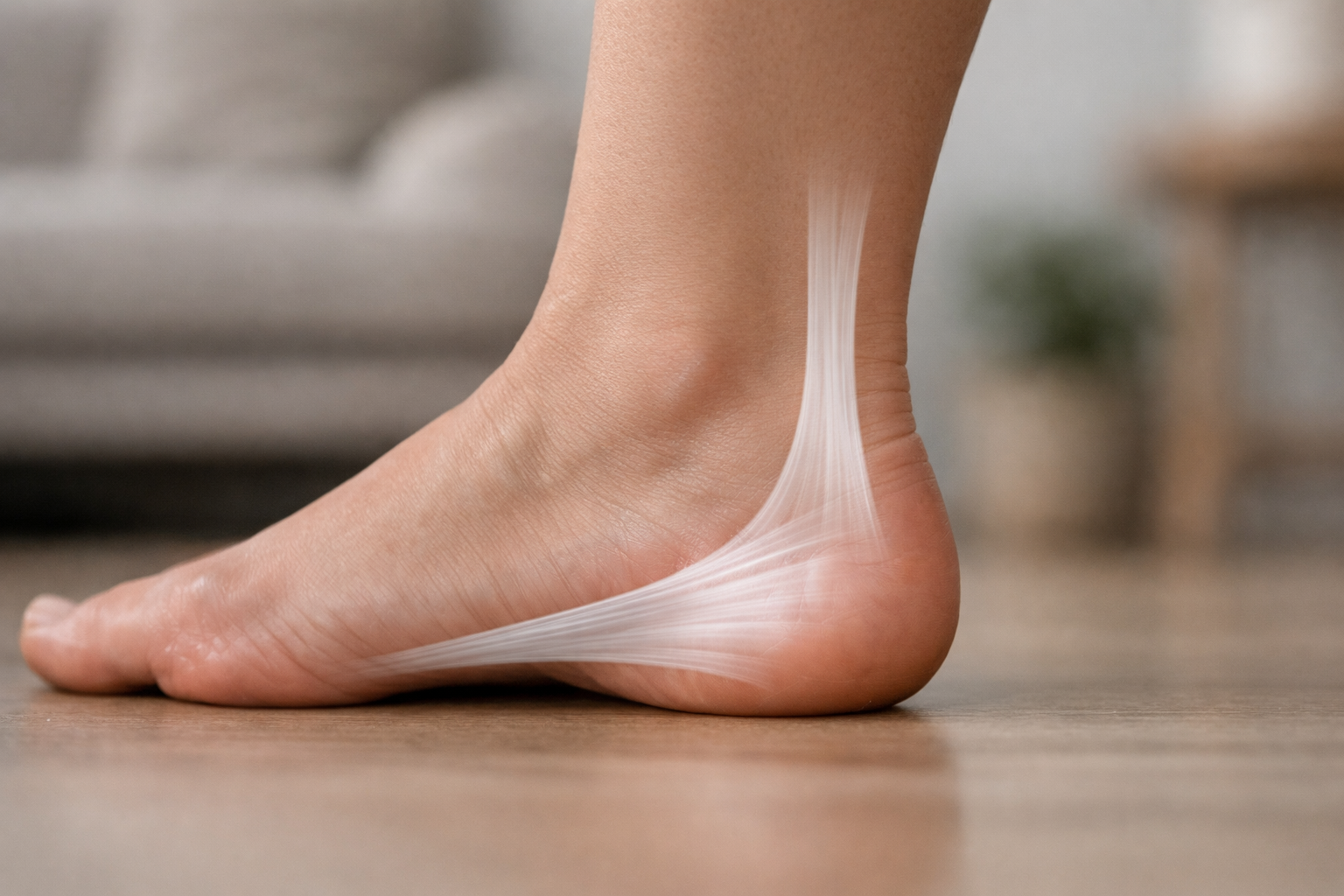
Heel and foot pain gets lumped together a lot, but plantar fasciitis and tendonitis are not the same problem, and treating one like the other usually slows recovery down. Both involve overloaded connective tissue. Both respond to the same general principle: rebuilding capacity through graded loading rather than just calming symptoms down. But the tissue involved, the location of pain, and the loading pattern that helps are different enough that it’s worth sorting out which one you’re actually dealing with.
The Short Answer
Plantar fasciitis (more accurately called plantar fasciopathy once it’s been around a while) affects the thick band of connective tissue along the bottom of your foot, running from the heel to the base of the toes. Pain concentrates on the underside of the heel or arch, and it’s generally worst with the first few steps in the morning or after sitting for a while.
Tendonitis in the foot and ankle can involve several different tendons, and where it hurts depends on which one. Achilles tendonitis causes pain at the back of the heel, above where the fascia attaches, often a few centimeters up the back of the ankle. Posterior tibial tendon issues cause pain along the inside of the ankle and arch. Peroneal tendon problems show up on the outside of the ankle and foot. The pain pattern, more than anything else, is your first clue.
How Do I Know If I Have Plantar Fasciitis or Tendonitis?

Start with location and behavior.
Plantar fasciitis typically presents as:
- Pain on the bottom of the heel, sometimes radiating into the arch
- Sharp or stabbing pain with the first steps out of bed
- Pain that eases after a few minutes of walking, then returns after standing or activity
- Tenderness when you press directly on the bottom of the heel, slightly toward the inside
Tendonitis typically presents as:
- Pain along a tendon’s path rather than under the heel (behind the ankle for Achilles, along the inside or outside of the ankle for the others)
- Stiffness and aching that can also be worse first thing in the morning, but the location is different from fascia pain
- Pain with resisted movement, meaning it hurts more when you actively push against something with that tendon (pointing the foot down for Achilles, turning the foot inward for posterior tibial)
- Sometimes visible thickening or swelling along the tendon itself
The morning stiffness pattern shows up in both conditions and confuses a lot of people. That stiffness isn’t the tissue getting worse overnight. It’s a sensitivity pattern that builds up after hours without load, and it eases as movement resumes. This happens with fascia and with tendon, so morning pain alone doesn’t tell you which one you have.
How Can I Test Myself for Plantar Fasciitis?
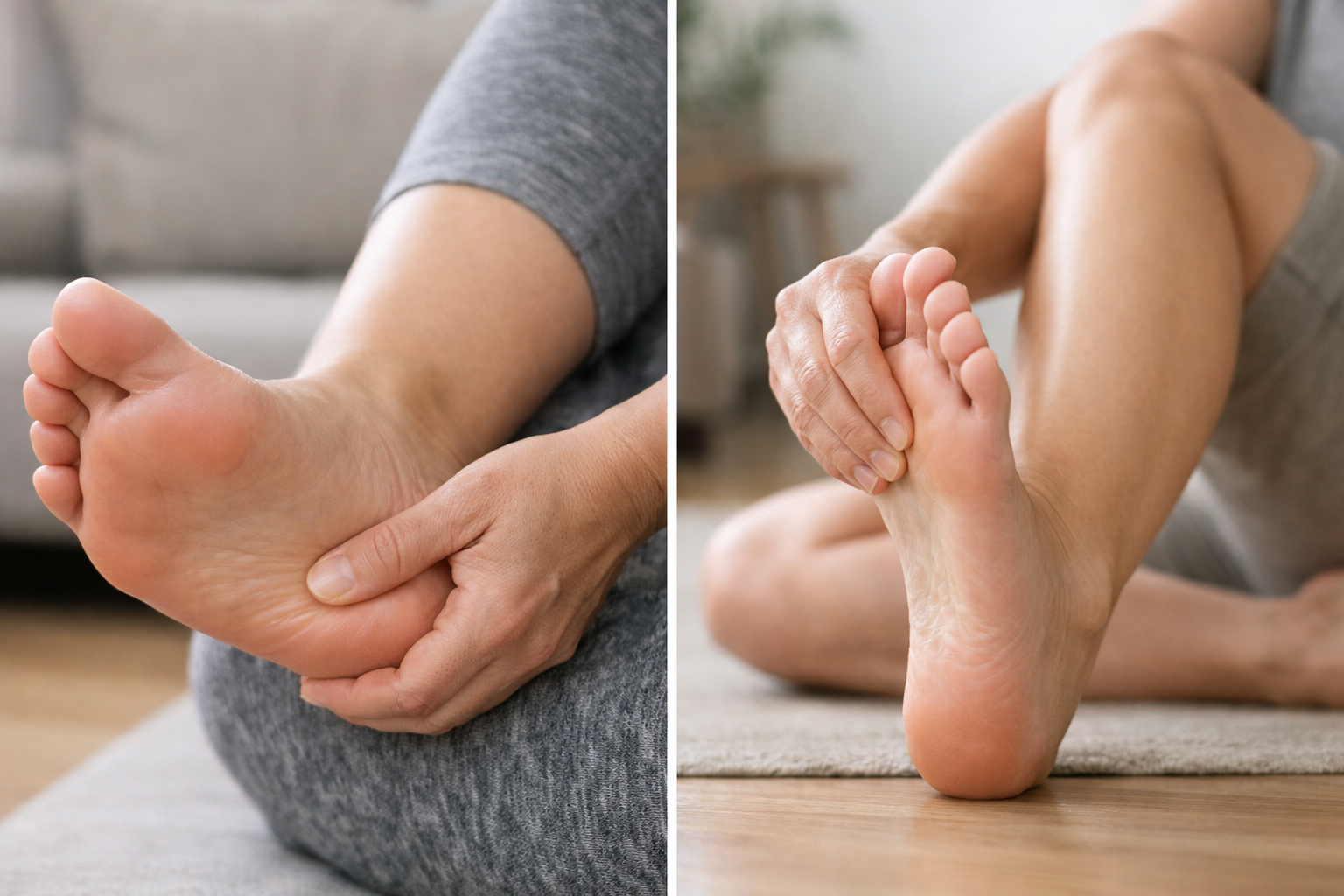
A few simple checks at home can point you in the right direction, though they’re not a substitute for an evaluation if pain persists.
Palpation test: Press your thumb into the bottom of your heel, slightly toward the inner edge, where the fascia attaches to the heel bone. Sharp, localized tenderness here is consistent with plantar fasciitis. Pain further up the back of the heel points more toward Achilles involvement.
Windlass test: Sit down, pull your big toe upward toward your shin while keeping your foot flat, and see if that reproduces pain along the arch or heel. This stretches the fascia and often reproduces symptoms if the fascia is the irritated tissue.
First-step test: Pay attention to what your first several steps feel like after you’ve been sitting or sleeping. Sharp heel pain that eases within a few minutes is a classic fasciopathy pattern.
Resisted movement test: For suspected tendonitis, try gently resisting movement with the tendon in question. Pushing your foot downward against resistance (like a towel or your own hand) that reproduces pain at the back of the heel suggests Achilles involvement. Turning your foot inward against resistance that reproduces inner-ankle pain suggests the posterior tibial tendon.
None of these tests give you a diagnosis on their own. They’re useful for narrowing down which structure is irritated so you (and a clinician, if you see one) know where to direct treatment.
What Is the Daytime “Sock Trick” (Compression Sock or Arch Taping) for Plantar Fasciitis?
The phrase “sock trick” gets used for two different things, so it’s worth being specific. The daytime version, which is what this section covers, is a low-dye taping or compression sock method some people use to reduce arch strain and support the fascia during daily activity. In practice, it’s usually a snug compression sock or a taping pattern applied around the arch, meant to reduce the amount the fascia has to stretch with each step.
The other version people mean by the same nickname is a nighttime dorsiflexion splint sock or sleeve, which does the opposite thing on purpose: it holds the foot and toes gently flexed upward during sleep to keep the fascia in a mild stretch overnight. That’s a separate tool with a separate goal, and our article on plantar fasciitis exercises covers it.
The daytime version can take the edge off discomfort for some people, particularly during a flare, and there’s nothing wrong with using it. But it doesn’t change the underlying capacity of the tissue. It’s a short-term comfort tool, similar to taping or an orthotic insert. If you want more detail on exercises that build actual tissue tolerance rather than just managing symptoms, our article on plantar fasciitis exercises walks through that in depth.
What Is the Fastest Way to Heal Tendonitis in the Foot?
There isn’t a fast fix, and anyone promising one is overselling it. What actually moves the needle is progressive loading of the tendon, meaning controlled exercise that gradually increases the demand placed on it until its capacity catches up to what you’re asking it to do day to day.
A few things matter more than the specific exercise you choose:
Start at a tolerable level. Whether that’s isometric holds (pressing against resistance without moving the joint) or slow, controlled heel raises, the starting point should feel manageable, not aggravating.
Stay at each stage long enough to adapt. Tendon tissue changes slowly, often over a period of many weeks, not days. Moving to the next stage too soon, before the tendon has adapted, is one of the most common reasons tendonitis becomes a repeating cycle instead of resolving.
Watch total daily load, not just your exercise. A day on your feet at work, a long walk, a hilly hike. All of that adds to the same tendon’s workload. Symptoms often lag a day or two behind the activity that caused them, which makes it easy to blame the wrong thing.
Expect some discomfort, but keep it manageable. A general pattern many clinicians use is keeping pain at or below roughly 4 out of 10 during and after activity, and expecting it to settle within about a day. That’s not a guarantee or a hard rule, just a rough guide for staying in a productive zone instead of overloading the tendon.
Rest has a place here, but only in small doses. Complete rest lets pain settle temporarily because the tendon isn’t being asked to do anything, but the tendon doesn’t get stronger sitting still. The moment you go back to normal activity, the same problem tends to resurface, because the underlying capacity never improved.
What’s the Worst Thing You Can Do for Plantar Fasciitis?
The two extremes both cause trouble. Pushing through sharp pain and continuing high-impact activity without adjusting anything tends to keep the fascia irritated and can extend a flare well past where it needed to go. On the other end, going into full rest mode, avoiding walking altogether, and relying only on stretching and rest, calms symptoms temporarily but does nothing for the underlying capacity of the tissue. Pain often comes right back once you resume normal life, because nothing about the fascia’s tolerance actually changed.
We cover this in more detail, including what a smarter middle path looks like, in our article on plantar fasciitis exercises.
Is Walking Good for Plantar Fasciitis?
Generally, yes, for most people, in reasonable amounts. Walking is a normal, moderate load on the fascia, and staying active tends to support recovery better than avoiding movement altogether. The goal isn’t to eliminate walking. It’s to manage the total load so the fascia has a chance to adapt rather than staying constantly irritated.
That might mean shorter walks broken up through the day instead of one long one, better-fitting shoes with adequate support, or adjusting standing time at work if that’s a major contributor. None of this is about blaming your weight, your job, or your shoes. It’s about recognizing that all of it adds up to a total load on a piece of tissue that has a limited capacity to absorb it right now. Reducing the load a bit while building capacity through targeted exercise gives the fascia room to catch up.
When It’s Something Else Entirely
Not all heel or foot pain is plantar fasciitis or tendonitis. Nerve entrapments, stress fractures, fat pad atrophy under the heel, and arthritis in the foot or ankle joints can all produce pain that mimics one or both conditions. If your pain doesn’t fit the typical patterns described here, if it’s associated with numbness or tingling, or if it hasn’t responded to a few weeks of sensible load management, that’s a good reason to have it properly evaluated rather than guessing.
A heel spur showing up on an X-ray, for what it’s worth, is usually a sign of chronic stress on the area over time, not the actual source of pain. Recovery tends to look the same whether a spur is present or not.
The Bottom Line
Location is your best first clue: bottom of the heel points toward fascia, along a tendon’s path points toward tendonitis. Beyond that, the underlying approach to recovery is similar for both. This can be consistent with either condition based on where and how it presents, but a proper evaluation is the only way to know for certain, especially if pain is severe, worsening, or not improving after a few weeks of sensible activity modification.
The principles are sound either way: manage total load, don’t chase complete rest, and give the tissue time, usually measured in weeks to months, to actually adapt. Many people improve with a patient, consistent approach, even when the problem has been around for a while. Chronic doesn’t mean permanent. It usually just means starting from a lower point and progressing a bit more carefully.