What Gets Mistaken for Plantar Fasciitis (And How to Tell)
Heel and foot pain has more than one cause. Here's how conditions like nerve entrapment, stress fractures, and inflammatory disease can mimic plantar fasciitis, and how an evaluation sorts out what's actually going on.

Plantar fasciitis (more accurately called plantar fasciopathy once it’s been around a while) gets blamed for a lot of heel and foot pain that isn’t actually coming from the plantar fascia. That’s not a knock on anyone’s self-diagnosis skills. Heel pain has a fairly narrow range of ways it can present, and several unrelated conditions land in that same territory.
This matters because treatment differs. Loading exercises that help fasciopathy won’t do much for a nerve entrapment, and rest that might calm a stress fracture can let true fasciopathy get more sensitive from disuse. Getting the diagnosis right changes what you actually do about it.
What Else Could It Be If It’s Not Plantar Fasciitis?
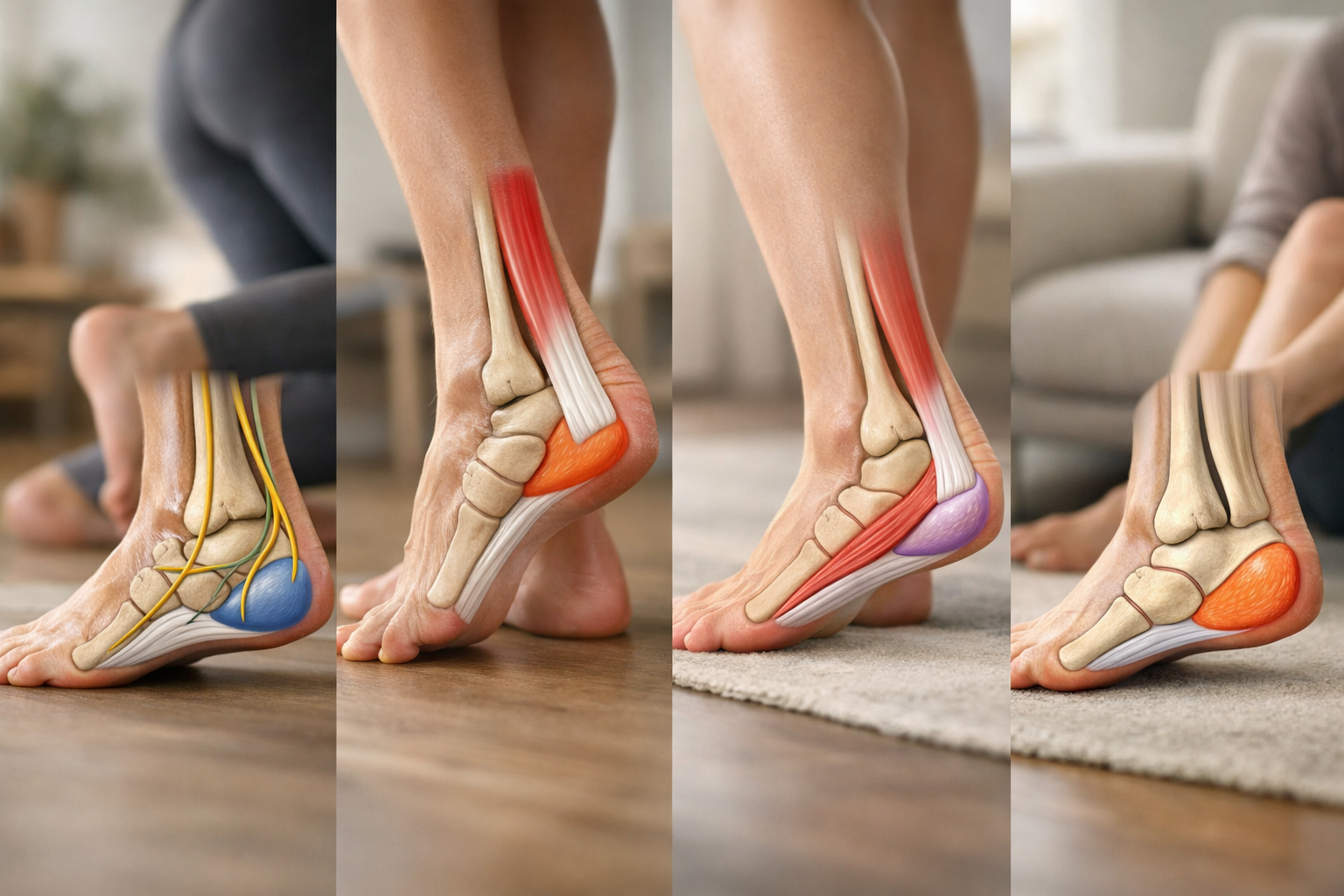
A handful of conditions regularly get mistaken for plantar fasciitis. The most common ones we see:
- Achilles tendinopathy. Pain sits at the back of the heel or a few centimeters up the tendon, not under the heel or arch. It’s often worse with pushing off (stairs, running, calf raises) rather than first-step pain in the morning.
- Tarsal tunnel syndrome. The tibial nerve gets compressed as it runs behind the inner ankle bone. This produces burning, tingling, or electric sensations that can radiate into the arch or toes, which feels different from the dull, deep ache typical of fasciitis.
- Baxter’s nerve entrapment. A smaller nerve branch near the heel gets pinched, causing pain that can mimic fasciitis almost exactly but sometimes includes numbness or a burning quality along the inside of the heel.
- Calcaneal stress fracture. This tends to hurt with every step, including gentle ones, and doesn’t loosen up as you keep moving the way fasciitis symptoms often do after the painful first steps of the morning. It’s more common in runners who’ve ramped up mileage quickly.
- Heel fat pad atrophy. The cushioning under the heel thins with age or from years of high-impact activity. Pain is centered directly under the heel bone and often worse on hard surfaces, barefoot walking, or after standing on concrete.
- Heel spurs. These are usually a red herring. A spur is a bony projection that forms as a consequence of chronic traction stress at the fascia’s attachment, not the source of pain itself. Plenty of people have spurs on imaging with zero symptoms, and plenty of people with significant heel pain have no spur at all. Recovery looks the same whether a spur shows up on an X-ray or not.
We’ve written in more detail about sorting fasciitis from tendon problems specifically in Plantar Fasciitis vs. Tendonitis: How to Tell the Difference, which covers location, mechanism, and simple self-checks.
What Symptoms Mimic Plantar Fasciitis?
The overlapping symptom list is longer than most people expect: heel pain with the first steps in the morning, aching after standing or walking for long stretches, tenderness when you press on the bottom of the heel, and pain that flares after a change in activity or footwear. All of these can show up with fasciopathy, but none of them are exclusive to it.
A few details tend to point away from classic fasciitis:
- Burning, tingling, or numbness (suggests a nerve issue rather than a mechanical fascia problem)
- Pain that’s constant regardless of load or time of day (more consistent with a stress fracture or inflammatory process)
- Pain on only one specific structure you can pinpoint with one finger versus a broader tender area
- Swelling, warmth, or redness (raises the question of an inflammatory or systemic cause)
- Symptoms in both feet that appeared around the same time without an obvious mechanical trigger
None of these are self-diagnostic tools you should lean on heavily. They’re patterns worth mentioning to a clinician, because an in-person evaluation, including how the tissue responds to specific movements and palpation, sorts this out far more reliably than symptom-matching online.
What Foot Condition Mimics Plantar Fasciitis Most Often?
In our experience, nerve entrapment (particularly of the tibial nerve or its branches near the heel) is the one most commonly confused with fasciitis, because the pain location can be nearly identical. The distinguishing features are usually the quality of the sensation (burning or electric rather than dull and achy) and whether the pain radiates. Tapping over the nerve pathway can sometimes reproduce the symptoms, a finding that wouldn’t happen with true fascia irritation.
Can an Autoimmune Disease Cause Heel Pain?
Yes. Heel pain isn’t always mechanical. Several inflammatory and autoimmune conditions can cause plantar fasciitis-like symptoms, and in some cases they cause actual inflammation of the fascia itself (a condition sometimes called enthesitis, inflammation where a tendon or ligament attaches to bone).
Conditions worth knowing about:
- Reactive arthritis and psoriatic arthritis frequently involve heel pain as an early symptom, often from enthesitis at the plantar fascia or Achilles insertion.
- Ankylosing spondylitis and other conditions in the spondyloarthritis family commonly cause heel pain, sometimes years before other joints are involved.
- Rheumatoid arthritis can affect the small joints of the foot and produce pain patterns that overlap with mechanical heel pain.
- Gout can flare in the foot, though it’s classically associated with the big toe joint rather than the heel.
Lupus is not typically the first autoimmune disease that comes to mind for heel pain specifically, but it deserves a mention since it’s a common search question. Lupus more often affects the small joints of the hands and feet, the skin, and other systems, rather than presenting as isolated heel pain. Early signs of lupus in the feet can include joint swelling and stiffness (particularly in the smaller joints, not usually the heel), a purplish or mottled skin discoloration on the legs sometimes described as looking like lace or a net pattern, and Raynaud’s-type color changes in the toes with cold exposure. The first symptom of lupus overall is most often fatigue, joint pain, or a facial rash, not foot pain in isolation.
The reason this matters practically: if heel pain shows up alongside joint swelling elsewhere, skin changes, fatigue, or symptoms in both feet without a clear mechanical cause, that’s a reasonable prompt to bring it up with your primary care physician alongside your physical therapist. This isn’t something to self-diagnose from a symptom list, but it’s also not something to ignore.
What’s the Worst Thing You Can Do for Plantar Fasciitis (Or Something That Mimics It)?
Two mistakes cause the most trouble, and they pull in opposite directions.
The first is pushing through sharp or worsening pain because you assume all foot pain responds the same way to “just working through it.” If what you actually have is a stress fracture or an inflamed nerve, continued loading can make things meaningfully worse rather than building capacity. Fascia responds well to graded load. A stress fracture does not.
The second mistake is complete rest for weeks on end, hoping it resolves on its own. Rest reduces sensitivity temporarily, but it doesn’t build the tissue capacity needed to tolerate normal walking and standing again. For true fasciopathy, that means pain often returns the moment you resume normal activity, sometimes worse than before because the tissue has deconditioned further. The goal with mechanical heel pain is almost always intelligent load management, staying as active as tolerable, not stopping entirely.
The real answer is that the “worst thing” depends heavily on what’s actually causing the pain, which loops back to why getting an accurate diagnosis matters more than finding the right generic advice online.
Why an Accurate Diagnosis Changes the Plan
If your heel pain is consistent with fasciopathy, the path forward involves progressive loading of the fascia and surrounding tissue over roughly 8 to 12 weeks, often paired with short-term tools like footwear changes, taping, or orthotics to manage load while capacity builds. We cover the specific self-tests and daytime management strategies (including the sock trick many people ask about) in our tendonitis comparison article.
If it’s a nerve entrapment, treatment focuses on identifying and relieving the compression point, which might mean different footwear, nerve gliding exercises, or in some cases an injection or referral, rather than fascia-specific loading.
If it’s a stress fracture, the early plan usually involves protected weight-bearing and a much longer, more conservative return to loading than fasciopathy would need.
If there’s an inflammatory or autoimmune component, physical therapy still has a role in managing symptoms and maintaining function, but it works best alongside medical management of the underlying condition.
This is the practical reason a proper evaluation matters more than matching your symptoms to a list. Two people with nearly identical pain descriptions can have completely different underlying issues, and the treatment that helps one can stall or worsen the other.
When to See Someone

Most heel and foot pain builds gradually and improves with sensible load management over weeks to months. But you should get evaluated sooner rather than later if you notice numbness or tingling that doesn’t resolve, pain that’s constant regardless of activity or rest, swelling or redness without an obvious mechanical cause, pain in both feet that started around the same time, or any heel pain alongside joint swelling or systemic symptoms like fatigue or rash. None of this is meant to alarm you. It’s meant to help you know when a conversation with a physical therapist or physician is worth having sooner rather than later, so you’re building capacity in the right tissue with the right plan from the start.