Heel Pain Red Flags: When It's More Than Plantar Fasciitis
Most heel pain builds gradually and responds to load management, but some patterns signal something that needs prompt medical attention. Here's how to tell the difference.

Most heel pain develops slowly, tied to how much walking, standing, or running someone has done relative to what their tissue can currently handle. That kind of pain, often plantar fasciopathy, usually responds well to a patient, progressive approach. But not all heel pain fits that pattern, and a smaller number of cases point to something that needs medical attention sooner rather than later. This article covers how to spot that difference.
How to Tell If Heel Pain Is Serious
The general rule: pain that develops gradually, is worse with the first few steps in the morning or after rest, and eases somewhat once you get moving is a pattern consistent with common overuse-related heel conditions. Pain that shows up suddenly after an injury, comes with visible changes to the foot, or is accompanied by symptoms elsewhere in the body deserves a closer look.
Ask yourself a few questions. Did this start after a specific incident, like a fall, a misstep off a curb, or a hard landing? Is the heel red, hot, or visibly swollen compared to the other side? Do you have a fever, or feel unwell in general? Is the pain constant and unrelated to activity, including at rest or overnight? Any “yes” answers move this from a low risk issue.
Any “yes” answer moves this out of the do-it-yourself category and into something worth having evaluated.
Red Flags That Warrant Prompt Evaluation
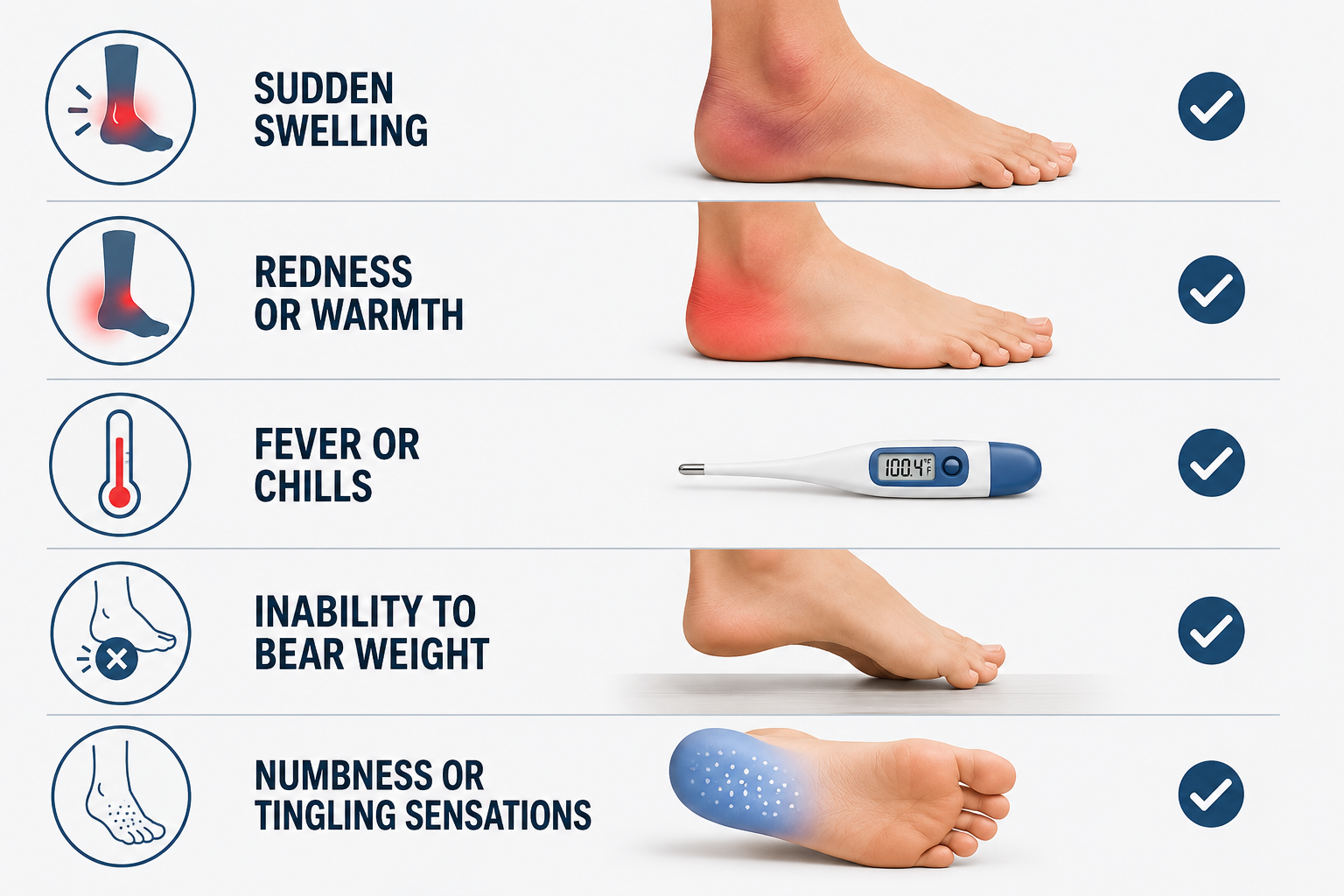
These are the signs that separate ordinary, load-related heel pain from something that needs a clinician’s eyes sooner:
- Sudden, severe pain after a specific trauma, especially if you heard or felt a pop, or if you can’t bear weight at all afterward. This can be consistent with a fracture or a tendon rupture rather than a gradual overuse injury.
- Inability to bear any weight on the heel, as opposed to pain that’s manageable but uncomfortable.
- Visible deformity, significant swelling, redness, or warmth, particularly if it developed quickly. This raises concern for infection, an acute fracture, or an inflammatory process rather than routine tissue irritation.
- Fever, chills, or feeling generally unwell alongside foot pain. Combined with redness and warmth, this can be consistent with an infection, which needs prompt care.
- Numbness, tingling, or a burning quality to the pain, especially if it radiates or follows a specific nerve pathway. This can be consistent with nerve entrapment (like tarsal tunnel syndrome) or, in some cases, a circulation problem rather than fascia irritation.
- Pain that is constant, unrelated to activity, and doesn’t ease with rest, including pain that wakes you at night. Mechanical heel pain typically improves somewhat with rest and worsens with load. Pain that ignores that pattern deserves a second look.
- Heel pain in both feet along with joint pain elsewhere, or a personal history of an inflammatory or autoimmune condition. This pattern can be consistent with a systemic cause rather than a local, overuse-driven one.
- Unexplained weight loss, night sweats, or pain that steadily worsens with no mechanical explanation. These are broader medical red flags that apply to pain anywhere in the body, heel included.
- Known diabetes with any new foot pain, wound, or color change, even if the pain itself seems mild. Reduced sensation can mask more serious problems, so a lower threshold for evaluation is appropriate.
None of these signs mean panic is warranted. They mean an evaluation, rather than a wait-and-see approach, is the right next move.
What Diseases Start With Heel Pain?

Heel pain is occasionally the first noticeable symptom of conditions beyond simple overuse. These include inflammatory arthritis conditions such as ankylosing spondylitis and reactive arthritis, which can cause pain at the point where the plantar fascia or Achilles tendon attaches to the bone. Gout can flare at the heel, though it’s more classically associated with the big toe. Rheumatoid arthritis can involve the heel as part of a wider joint pattern. Stress fractures of the calcaneus (the heel bone) can mimic soft tissue pain but stem from bone overload, common in runners or people who’ve rapidly increased activity. Nerve entrapments, infections, and, less commonly, bone tumors can also present with heel pain. None of these are the most likely explanation for a typical case of heel pain, but they’re worth ruling out when the pattern doesn’t fit the usual mechanical story.
Is Heel Pain Related to Heart Problems?
This question comes up often, and it’s a reasonable one, but the direct connection is weaker than people sometimes assume. Heel pain itself is not a typical symptom of a heart attack or heart failure. Heart failure more commonly causes swelling in the feet and ankles, shortness of breath, fatigue, and a rapid heartbeat, generalized signs rather than localized heel pain. If you’re looking for signs your heart may be struggling, the pattern clinicians watch for typically includes shortness of breath with activity or lying flat, swelling in the legs or ankles, persistent fatigue, and a cough or wheeze that doesn’t resolve. These are broad, general patterns, not a diagnostic checklist, and any concern about heart symptoms should go to a physician promptly.
Where there is a real connection is peripheral artery disease (PAD), which reduces blood flow to the feet and can cause pain, numbness, or a cold sensation in the foot, sometimes including the heel. PAD shares risk factors with heart disease, so if foot pain comes with color changes, coldness, or poor healing of small wounds, that’s worth mentioning to a doctor. But for the vast majority of people with heel pain, the cause is mechanical and local, not cardiac or vascular.
Does Heel Pain Mean Diabetes?
Heel pain alone doesn’t indicate diabetes. But diabetes changes how heel pain should be handled. Long-standing high blood sugar can reduce sensation in the feet (peripheral neuropathy), which means pain signals that would normally prompt someone to rest or seek care can be blunted or absent until a problem is more advanced. People with diabetes are also more prone to poor wound healing and, in less common cases, a serious condition called Charcot foot, where bones weaken and can fracture with minimal trauma, sometimes without much pain due to reduced sensation. If you have diabetes and notice new heel pain, swelling, warmth, or any skin breakdown, it’s worth having evaluated sooner rather than later, even if the pain feels mild.
Why Am I Suddenly Having Heel Pain?
Sudden heel pain usually falls into one of two categories. The first is a genuine acute event: a misstep, a jump landing awkwardly, a sudden increase in a sport or activity. This can be consistent with a fracture, a strain, or an acute flare of an existing issue, and if it came with a pop, significant swelling, or inability to bear weight, it belongs in the red flag category above.
The second, more common scenario is a change in cumulative load that felt sudden but wasn’t really acute. A new pair of shoes, a big increase in walking or standing over a few days, a return to running after time off. Total load on the foot is cumulative, and symptoms can lag a day or two behind the activity that caused them. What feels like it “came out of nowhere” often traces back to a jump in demand that outpaced the tissue’s current capacity.
What Are 5 Common Causes of Heel Pain?
The most frequent causes clinicians see are:
- Plantar fasciopathy (often still called plantar fasciitis), irritation and adaptation changes in the tissue along the bottom of the heel and arch.
- Achilles tendinopathy, particularly where the tendon inserts at the back of the heel.
- Calcaneal stress fracture, a bone overload injury more common with rapid increases in running or high-impact activity.
- Fat pad irritation or atrophy, where the cushioning under the heel becomes less able to absorb impact.
- Nerve entrapment, such as tarsal tunnel syndrome, causing burning or tingling pain rather than the sharp, stabbing quality typical of fascia irritation.
What Gets Mistaken for Plantar Fasciitis?
A number of conditions can mimic the classic pattern of morning heel pain, including Achilles tendinopathy, calcaneal stress fractures, fat pad atrophy, nerve entrapments, and inflammatory arthritis affecting the heel. This is one reason a proper evaluation matters if pain isn’t following the expected course. An accurate diagnosis changes the loading plan, since a stress fracture needs a different approach than fascia irritation, and pushing through the wrong one can slow recovery.
How to Tell If Heel Pain Is Plantar Fasciitis
Plantar fasciopathy typically presents as a sharp or aching pain under the heel, worst with the first steps in the morning or after sitting for a while, that eases somewhat as you warm up and often returns after a long day on your feet. This pattern (pain with initial load, not constant, not radiating, not accompanied by redness or systemic symptoms) is consistent with fascia irritation, though it isn’t a certain diagnosis on its own. If your pattern matches this description and none of the red flags above apply, a progressive loading approach is often a reasonable starting point, ideally guided by an evaluation to confirm the diagnosis and rule out other causes.
When Self-Care Is Reasonable and When It Isn’t
For gradual, activity-related heel pain without red flags, reasonable self-management includes modifying (not eliminating) activity, supportive footwear, and a slow, progressive loading approach over weeks. Complete rest isn’t the goal, since tissue needs some ongoing load to rebuild its tolerance, but pushing through sharp escalating pain isn’t either.
If any of the red flags described above apply, or if heel pain hasn’t budged after several weeks of reasonable self-care, that’s the point to bring in a physical therapist or physician rather than continuing to guess. Persistent, severe, rapidly worsening pain, or pain with any of the systemic signs mentioned, should always be evaluated rather than managed at home. A thorough evaluation can sort out which of the many possible causes is driving your symptoms and set a plan that fits your actual situation, not a generic one.