Why Does the Top of My Foot Hurt? A Runner's Guide
Top-of-foot pain in runners and active people usually comes down to a handful of patterns: tendon irritation, bone stress, joint changes, pressure from shoes, or occasionally something systemic like gout. Here's how to read what your foot is telling you, what deserves a call this week, and how to rebuild what your foot can handle.
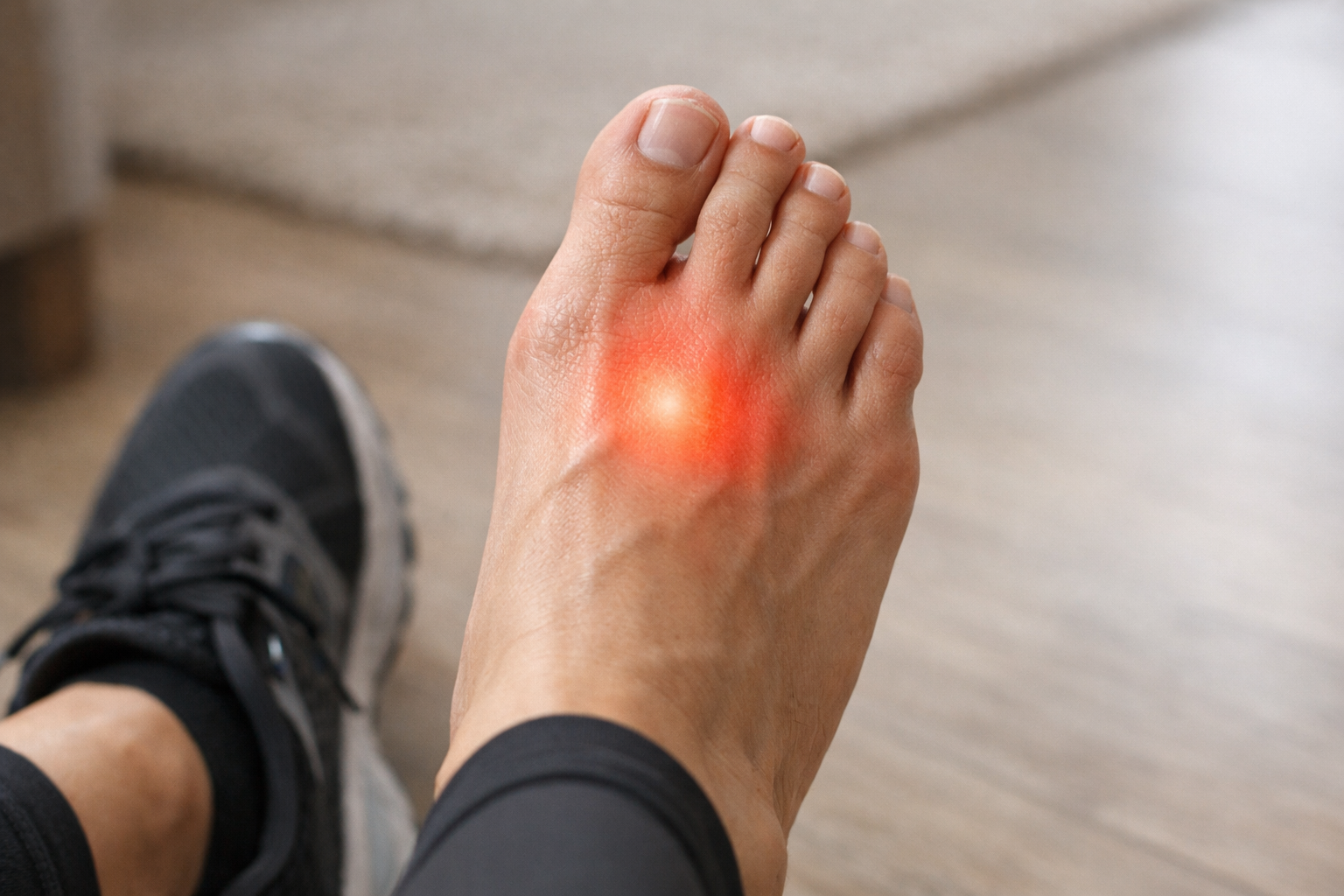
Most people who ask this question have already done a little detective work. You’ve loosened your laces. You’ve poked around the top of your foot and found a spot that lights up. Maybe you’ve taken a few days off and it felt better, then it came right back on the first run.
That pattern is the most useful information you have. Not the exact name of the structure, not what a scan might eventually show. What made it worse, what made it better, and how long it takes to settle after you’re done moving.
Let’s work through what top-of-foot pain usually means, what the different patterns feel like, and what actually changes it.
What does top of foot pain mean?
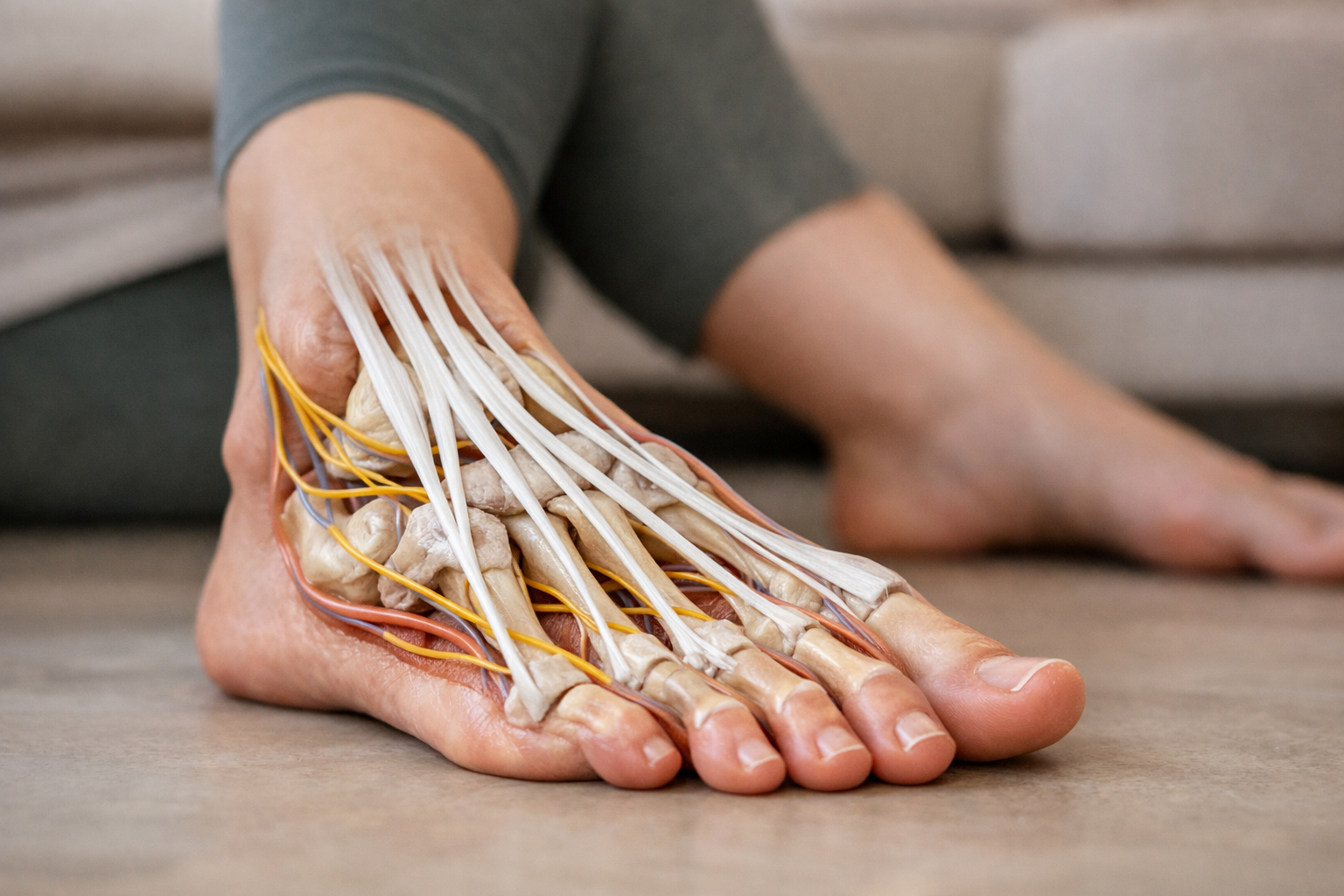
The top of your foot (the dorsum, if you want the anatomical word) is a busy, thin-skinned piece of real estate. Under that skin you’ve got:
- Extensor tendons running from the front of your shin, over the ankle, out to each toe. They lift your toes and foot as you swing your leg through.
- The midfoot bones (navicular, cuboid, the three cuneiforms) and the long metatarsals heading out to your toes. These form the arch and transfer force with every step.
- Small joints between all of those bones, each with a joint surface that can stiffen or develop arthritic changes.
- Nerves running just under the surface, which is why a tight shoe or a snug lace can produce burning or numbness rather than ache.
So top-of-foot pain isn’t one condition. It’s a location. And the useful question isn’t “what’s the name for this,” it’s “what kind of tissue is complaining, and why now?”
Most of the time, the honest answer to “why now” is that something asked more of your foot than it was currently prepared for. New mileage. New shoes. A different surface. A job change that put you on concrete for nine hours. A vacation with a lot of walking in flat sandals. That’s the load versus capacity idea in plain terms: demand went up faster than your foot’s ability to handle it.
Extensor tendonitis: what tendon pain on the top of the foot feels like
This is the most common cause, and the one people recognize once it’s described.
What it feels like:
- A line or band of ache running along the top of your foot, often toward the toes, sometimes up toward the front of the ankle.
- Worse when you lift your toes up, or when you push off at the end of a stride.
- Often sore in the first few minutes of a run, sometimes easing as you warm up, then aching afterward.
- Occasionally you can feel a faint creaking or thickening along the tendon.
- It’s frequently tender along a length of the tendon rather than one pinpoint spot.
That last detail matters. Tendon irritation tends to be tender along a line. Bone stress tends to be tender at a point you can cover with a fingertip. It’s not a perfect rule, but it’s a genuinely useful first pass.
Why does it start? A few common culprits:
- Laces too tight, or tied over the wrong spot. Compression irritates the tendon where it crosses the ankle. This is remarkably common and remarkably easy to change.
- A shoe with a stiff or narrow upper, or a new pair that sits differently across the midfoot.
- Hill running or speed work, which increases how hard those tendons work to clear the ground.
- Calf and Achilles tightness, which means the front of your foot works harder to get your toes up over the ground.
- Ramping up mileage without giving the tendons time to adapt.
Bone stress: when the ache is deeper and more specific
Midfoot and metatarsal bone stress is the other major player, and it’s the one worth taking seriously because it doesn’t respond well to pushing through.
The classic pattern: a localized, deep ache that gets progressively worse the longer you run, hurts when you hop on that foot, and doesn’t fully go quiet with rest days the way tendon irritation often does. Sometimes there’s swelling on the top of the foot. Sometimes pain shows up walking around the house, not only running.
The navicular bone (roughly the top-inner part of the midfoot, just in front of your ankle) is a spot clinicians watch closely because it heals slowly. Pain in that specific area that’s been building over weeks deserves an evaluation rather than another week of experimenting.
I’ve written about this in detail elsewhere on the site, so I won’t repeat it here. The short version: bone stress and tendon irritation need different plans, and guessing wrong in either direction costs you time.
Joint stiffness and arthritic change in the midfoot
This one gets missed in active people, especially in the 40-and-up crowd, because “arthritis” sounds like something for later in life.
What it tends to feel like:
- Stiffness and ache across the midfoot, often worse first thing in the morning or after sitting.
- Loosens up with a few minutes of moving, then can ache again after a long day.
- Sometimes a bony bump or ridge you can feel on the top of the foot.
- Pain more with pushing off or squatting down than with any single sharp movement.
Here’s the part worth hearing clearly. Imaging can show joint changes in the midfoot in plenty of people who have no pain at all. A scan can show structural changes, but it doesn’t always tell us why you hurt. Joint changes on an X-ray are not a sentence. Feet with arthritic change often get substantially more capable with strengthening, footwear adjustments, and a sensible build-up. The joint doesn’t have to look different for you to walk farther and hurt less.
Nerve irritation and pressure from the outside
If the sensation is burning, tingling, electric, or comes with numb patches on the top of the foot, that points more toward a nerve being compressed than a tendon being overworked.
The usual suspects are simple and mechanical: laces cinched tight over the top of the ankle, a shoe with a rigid overlay pressing across the midfoot, ski boots, cycling shoes, dress shoes that are just a bit narrow. The nerves on the top of the foot sit close to the surface and don’t need much pressure to complain.
This is one of the few foot problems where the fix can be genuinely quick. Change what’s pressing on it and the symptoms often fade over days to weeks. If you have numbness that isn’t improving, or symptoms that also involve the lower leg, that’s worth an in-person look.
What does gout feel like on top of the foot?
Gout has a signature that’s different enough from overuse injuries that most people can tell them apart once they know what to look for.
- It comes on fast. Often overnight. You go to bed fine and wake up unable to tolerate a bedsheet on your foot.
- It’s intense. People describe it as severe, sometimes the worst pain they’ve had in a joint.
- The area looks angry. Red, warm, swollen, shiny skin.
- It’s usually one joint. The big toe joint most often, but the midfoot, ankle, and top of the foot happen too.
- It doesn’t track with your training. There’s no mileage jump to explain it.
Overuse pain builds over weeks and correlates with activity. Gout tends to arrive suddenly and hurt whether you move or not. If that description matches what you’re feeling, that’s a medical evaluation, not a training adjustment. Gout is treatable, and blood work plus a clinical exam sorts it out. The same urgency applies if the joint is hot, red, swollen, and you feel unwell or feverish, since joint infection can look similar and needs prompt attention.
Why does the top of only one foot hurt?
This question comes up constantly, and the answer is usually reassuring.
Overuse problems are almost always one-sided, because the load isn’t symmetric. You favor one leg on push-off. You run the same direction on a cambered road every day. One foot pronates a little more. You had an ankle sprain years ago on that side and never fully got the calf strength back. You drive with that foot. The shoe on that foot broke down first.
Asymmetry is the normal presentation for a mechanical problem. It would be stranger if both feet hurt identically.
What raises my eyebrows a little is the opposite: symptoms in both feet, coming on without an obvious increase in activity, especially with burning, numbness, or swelling. That pattern makes me want to consider things beyond training, including inflammatory conditions and nerve or circulation issues. Not alarming. Just a reason for a real evaluation instead of a shoe change.
How do you fix pain on the top of your foot?
Here’s where most advice falls short. The usual list (rest, ice, stretch, anti-inflammatories) can absolutely calm things down. But calming down and becoming capable aren’t the same thing, and the gap between them is where people get stuck for months.
When you rest, the tissue is unloaded and sensitivity drops. That feels like healing. Then you run again, load returns, and so does the pain, because nothing about the tissue’s ability to handle that load actually changed. Rest reduces sensitivity. Progressive loading changes capacity. You usually need both, in the right order and the right amounts.
So the plan looks like this.
1. Take the obvious pressure off first
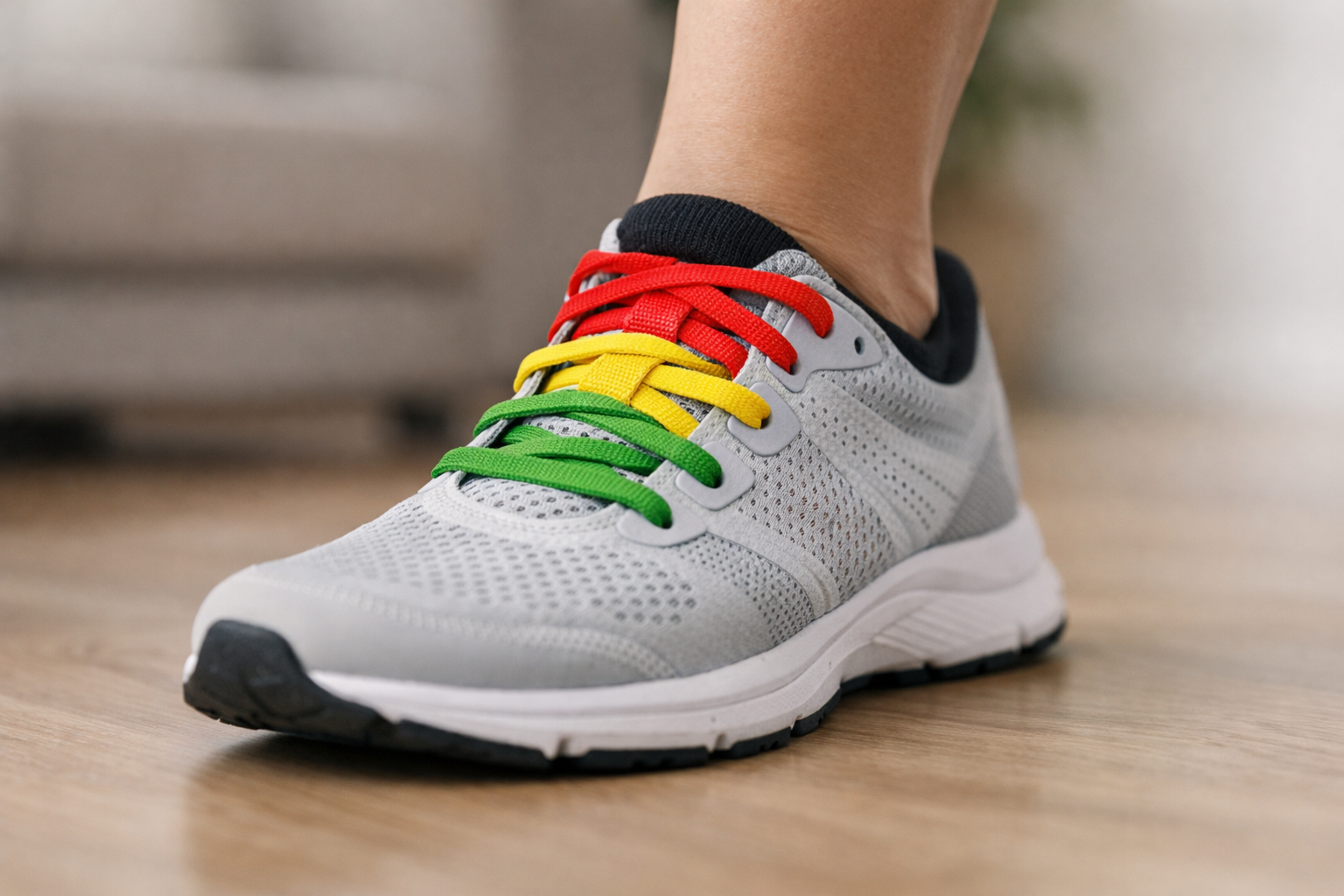
Cheap, fast, and often surprisingly effective for tendon and nerve problems on the top of the foot:
- Loosen your laces, or skip an eyelet where the pressure sits. Lacing around the sore spot rather than over it helps a lot of people.
- Check the shoe itself. A stiff overlay, a low-volume upper, or a shoe that’s a half size short can press on the top of the foot with every step.
- Look at what’s new. New shoes, new insoles, new orthotics, new sandals in the summer, new hiking boots. If symptoms started within a few weeks of a footwear change, that’s your lead suspect.
2. Reduce load without going to zero
Complete rest is a poor long-term strategy. It’s useful in small doses and costly in large ones, because tendons, bone, and muscle all lose capacity when nothing is asked of them. Rest equals rust.
Better: find the version of activity your foot can tolerate right now. That might be shorter runs, flatter routes, fewer days, more walking and less running, or temporarily swapping to cycling or pool work while you rebuild strength. The aim isn’t to eliminate all discomfort. It’s to stay in the game at a level your foot can handle.
For many people I use a rough guide: keep pain at or under about a 4 out of 10 during activity, and expect it to settle back toward your normal baseline within roughly 24 hours. If you’re sore for two days, that particular dose was too much. That’s not a rule handed down from anywhere, just a practical filter that works for a lot of people.
3. Build strength, deliberately and boringly
For extensor tendon problems, that usually means strengthening the front of the shin and the foot’s ability to control the toes and ankle, alongside the calf, which does the lion’s share of work in running. Calf strength matters more than people expect for top-of-foot pain, because a calf that can’t handle the load shifts work forward into structures that weren’t built for it.
For midfoot joint pain, it means loading the foot in positions it has been avoiding, plus building the intrinsic foot muscles and the calf to share the work.
The details should match your exam, not a generic list. What’s universal is the progression logic: start at a level you tolerate, stay there long enough to adapt, then add. Two or three sessions a week, consistently, will beat heroic efforts twice a month. Consistency beats intensity.
4. Rebuild the specific thing you want to do
Strength in the clinic doesn’t automatically transfer to mile eight on a hilly route. Capacity is task-specific. If your goal is running, your plan eventually needs to include running, built up in small enough increments that the tissue can keep pace.
This is the step that gets skipped most often, and it’s the reason a lot of foot pain comes back. The pain resolved, so the rebuilding stopped, and the foot went straight back to the load that overwhelmed it in the first place.
Why won’t the top of my foot stop hurting?
Four reasons, in rough order of how often I see them.
Something is still pressing on it. If you’ve strengthened, rested, and stretched but haven’t changed the shoe that’s compressing the tendon, you’re treating around the cause.
Total load never actually came down. People cut their running and forget that they stand on concrete for eight hours, chase a toddler, walk the dog four miles a day, and hit 14,000 steps before dinner. Your foot doesn’t separate exercise from life. It adds everything up. A flare-up often traces back to the day rather than the workout, and symptoms can lag a day or two behind whatever caused them, which is exactly why the cause seems mysterious.
Capacity was never rebuilt. The pain went quiet, the rehab stopped, and the tissue never got past the sensitivity-reduction stage into actual adaptation. Early improvements come partly from your nervous system settling down. Real tissue change takes longer, often in the range of eight to twelve weeks of consistent loading for many people, sometimes longer. Stopping at week three because it feels better is the single most common reason these things recur.
It isn’t what you think it is. Bone stress treated as tendonitis won’t improve. Gout treated as overuse won’t improve. Nerve compression treated with stretching won’t improve. If eight weeks of reasonable self-management hasn’t moved the needle at all, the diagnosis deserves a second look rather than more of the same.
One more thing worth saying: if you’ve had this for months, that doesn’t mean it’s permanent. Persistent problems usually mean a lower starting point and a more patient build, not an impossible one.
How long does it take for top of foot pain to go away?
I can’t give you a date, and anyone who does is guessing. What I can give you is realistic ranges and the honest variables.
- Pressure or lacing problems: often days to a couple of weeks once the pressure is removed.
- Extensor tendon irritation caught early: frequently a few weeks with load management and strengthening.
- Tendon problems you’ve had for months: often two to three months of consistent work, sometimes more, because the tissue needs time to actually change.
- Bone stress: dictated by bone healing, not by how you feel, which is exactly why it needs proper diagnosis and a structured return rather than a self-designed one.
- Midfoot joint pain: usually improves in function substantially, though some stiffness may remain. Plenty of people run comfortably with midfoot joint changes.
What moves you along the fast end of those ranges: catching it early, actually reducing total load rather than just running less, staying consistent with strengthening, and resisting the urge to jump back to your old mileage the week pain disappears.
And track function, not just pain. Can you walk farther before it starts? Does it settle faster afterward? Did you get through a workday standing that would have wrecked you a month ago? Those are real signs of progress even on days when the pain number hasn’t budged. Function matters as much as pain.
When to worry about top of foot pain
Most top-of-foot pain is mechanical and manageable. A few patterns should move you from self-management to a professional evaluation, and a couple should move you there quickly.
Get seen promptly if:
- You can’t put weight on the foot, or walking makes you limp badly.
- The foot is hot, red, and swollen, especially with fever or feeling generally unwell.
- Pain started with a specific traumatic moment (a fall, a twist, dropping something on it) and there’s swelling or bruising.
- You have numbness that’s spreading or isn’t improving, or you notice weakness lifting your foot or toes.
- You have diabetes or known circulation or nerve problems in your feet. The threshold for getting foot symptoms checked is lower, and that’s appropriate.
Book an evaluation this week if:
- There’s a pinpoint tender spot on a bone that’s getting worse over weeks, particularly in the midfoot or along a metatarsal.
- Pain now shows up during everyday walking, not only during exercise.
- You’ve given it four to six weeks of sensible self-management with no change at all.
- Night pain, unexplained swelling, or symptoms in both feet that don’t track with your activity.
That covers the honest version of “5 symptoms you should never ignore”: inability to bear weight, a hot and swollen joint with feeling ill, numbness or weakness, pain that’s clearly worsening week over week despite backing off, and any foot symptom in someone with diabetes or poor circulation. Everything else usually deserves a measured response rather than alarm, but it still deserves a plan.
The part that actually changes things
Top-of-foot pain in runners rarely resolves because enough time passed. It resolves because something changed: the pressure came off, the load came down to a level the foot could handle, and then the foot was gradually asked to do more until it could handle what you wanted from it again.
That middle step, the gradual rebuilding, is the piece most people never got a plan for. Not because anyone treated them badly, but because “rest and see how it goes” is where a lot of advice ends. Recovery is built.
If your foot has been talking to you for more than a few weeks, an in-person exam is worth it. Not all top-of-foot pain is the same problem, and the treatment paths genuinely diverge. Someone watching you walk, testing the specific structures, and pressing on the specific spots can sort out in twenty minutes what’s hard to sort out from the internet, including whether what you’re describing could be consistent with tendon irritation, bone stress, or something else entirely.