Plantar Fasciitis Relief: What Actually Helps, and Why
A practical guide to plantar fasciitis relief that separates what calms your heel down from what actually builds it back up, including why mornings hurt, what causes flare-ups, and what to do when you have tried everything.
Most people arrive at this topic with a specific version of the same question: “I’ve been icing it, stretching it, and staying off it for weeks. Why does it still hurt every morning?”
That’s a fair question, and the answer is usually not that you’ve been doing the wrong things. It’s that icing, stretching, and resting all work on how sensitive your foot feels right now. None of them change what your foot can actually handle. So the moment you go back to a normal day of walking and standing, the pain comes back, and it feels like you’re starting over.
So let’s separate the two halves of plantar fasciitis relief. There’s calming things down. And there’s building things back up. You need both, and most self-care advice only covers the first one.
What Is Actually Going On Under Your Heel
The plantar fascia is a thick band of connective tissue running from your heel bone to the base of your toes. It works like a spring. Every step you take, it loads, stores tension, and releases.
When the demand you place on it over time outpaces what it can currently tolerate, it gets irritated. Not torn. Not shredded. Irritated, and then, over weeks and months, gradually changed at the tissue level. That’s why clinicians often call the persistent version plantar fasciopathy rather than plantar fasciitis. “Itis” implies active inflammation, and in a foot that’s been hurting for six months, inflammation usually isn’t the main story anymore. The tissue has become less tolerant of load.
This matters for a practical reason. If the problem were purely inflammation, anti-inflammatories and rest would solve it. For many people, they don’t. They help for a while, and then symptoms return. That pattern isn’t a failure of the treatment. It’s a clue about what the problem actually is.
One more thing worth saying clearly: heel pain isn’t always plantar fasciitis, and an in-person evaluation is what sorts that out. More on the impostors later.
Why It Hurts Most in the Morning
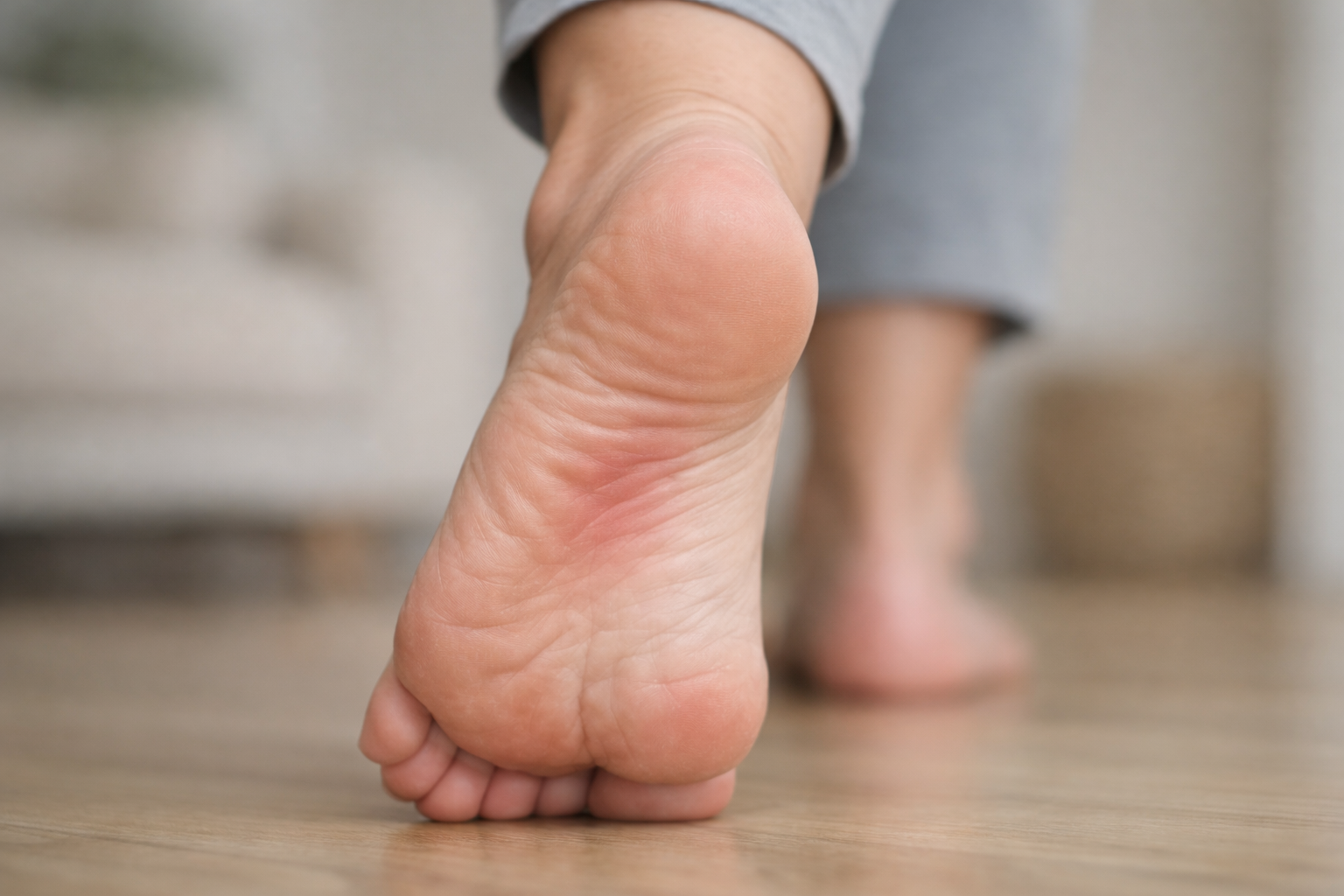
This is the symptom almost everyone describes. First few steps out of bed feel like stepping on glass or a stone bruise. Then after five or ten minutes of walking, it eases.
Here’s what’s happening. Your foot spent seven or eight hours with essentially no load through it. The tissue sits in a shortened, unloaded position. When you stand up and suddenly put your full body weight through it, that’s a big change in demand in about half a second. A sensitive tissue responds to that.
What this pattern does not mean is that your foot got worse overnight. Nothing was damaged while you slept. You’re feeling a sensitivity pattern, not fresh injury. That distinction is worth holding onto, because morning pain is the single most demoralizing part of this condition, and people read it as evidence of ongoing harm.
A useful side note: morning pain often improves before daytime pain does. When someone tells me their first steps went from an 8 to a 3 but standing at work still bothers them, that’s real progress, not a plateau.
What Is the Fastest Way to Relieve Plantar Fasciitis Pain?

I’ll answer this honestly rather than optimistically.
For short-term relief, meaning today and this week, a few things tend to work reasonably well for many people:
- Reduce the spikes, not all the activity. If your foot hurts most after long barefoot stretches on hard floors, put shoes on in the house. If it’s worst after you stand for three hours straight, break it into shorter blocks. You’re not trying to do less overall. You’re trying to smooth out the peaks.
- Supportive footwear, all day, including at home. This is unglamorous and it’s often the single most effective quick change. A shoe with a firm heel counter and some cushioning reduces how much tension the fascia has to absorb per step.
- Calf and plantar fascia loading, not just stretching. Gentle work first thing in the morning before you stand up (pulling your toes back toward your shin, holding for 20 to 30 seconds) can take the edge off those first steps.
- Ice or a cold roller if it feels good. It’s a symptom tool. Use it because it’s comfortable, not because you think it’s healing anything.
- Short-term taping or an over-the-counter insert. Both reduce the strain going through the tissue while you build tolerance elsewhere.
What I won’t tell you is that there’s a fast route to lasting relief. Tissue adaptation takes time. For many people, meaningful change in what the foot can tolerate takes something in the range of 8 to 12 weeks of consistent loading, sometimes longer if this has been going on for a year or more. The fast things buy you comfort. The slow things buy you your life back.
What Causes Plantar Fasciitis to Flare Up?
Flare-ups feel random. They’re usually not.
The thing to understand is that load is cumulative. Your foot doesn’t keep separate ledgers for “exercise” and “life.” It adds up everything: your steps, your standing, the surfaces you were on, the shoes you wore, the stairs, the airport, the yard work, the exercise you did, and how much recovery time sat between all of it.
Common flare triggers I hear about constantly:
- A travel day. Airports, hard terminal floors, dress shoes, and hours of walking with a bag.
- A footwear change. New shoes, worn-out shoes, switching to sandals in spring, going barefoot on vacation.
- A weekend that looked nothing like the week. Five sedentary days followed by a Saturday festival or a long hike.
- A surface change. Treadmill to pavement, carpet to tile, grass to a hard court.
- Going back to a previous activity level too fast because the pain had settled down.
And here’s the part that makes flares feel mysterious: symptoms often lag a day or two behind the load that caused them. You feel fine Saturday night and terrible Monday morning. So you blame Monday. The real culprit was Saturday.
When a flare happens, the question isn’t “what did I ruin?” It’s “what changed?” Usually you can find it in about thirty seconds of honest review. Then you dial back, not to zero, and rebuild from a slightly lower rung.
A temporary increase in symptoms doesn’t erase the work you’ve done. Recovery is not a straight line, and expecting it to be is what makes people quit in week five.
Is Walking Good for Plantar Fasciitis?
Usually yes, in the right amount.
Walking loads the fascia in exactly the way it needs to be loaded to adapt. Complete avoidance of walking does the opposite: it reduces the demand, so the tissue’s tolerance drifts further down, and then even less activity feels like too much. That’s the trap. The foot gets more fragile the longer you protect it.
The practical version looks like this. Find an amount of walking your foot can handle without a meaningful flare, and use that as your starting point. For many people, keeping pain at or below roughly a 4 out of 10 during the activity, and having symptoms settle back to baseline within about 24 hours, is a reasonable working guide. If you walked 20 minutes and you’re the same or better the next morning, that was an appropriate amount. If you’re noticeably worse for two days, that was too much for right now.
Then build. Add a little distance or a little time, hold it for several days to a week, let the tissue catch up, and add again. Consistency beats intensity here, by a wide margin.
A few adjustments that make walking more tolerable early on:
- Shorter, more frequent walks beat one long one.
- Softer surfaces (track, treadmill, packed dirt) are often easier than concrete at first.
- Good shoes matter more than you think for a mile-long walk.
- Don’t walk fasted and cold first thing out of bed without warming the foot up a bit.
What Not to Do for Plantar Fasciitis
These two questions come up in slightly different forms, so let me take the big ones together.
The worst thing you can do is stop using your foot entirely and wait for the pain to leave. Rest calms irritation. It doesn’t build anything. Two weeks off might feel good. Two months off leaves you with a foot that tolerates even less than it did before, and now you have deconditioning stacked on top of the original problem. Rest equals rust.
Other things I’d steer you away from:
- Aggressive, painful tissue work. Digging a lacrosse ball into your heel until your eyes water isn’t more effective than doing it gently. Rolling can feel great and reduce sensitivity. Bruising yourself doesn’t accelerate anything.
- Only stretching, for months. Stretching can reduce sensitivity while your foot is unloaded. It doesn’t change what the tissue tolerates under weight. If stretching is the whole plan, the pain tends to come back when the load does.
- Chasing relief without ever progressing. The gap for most people isn’t that they haven’t tried enough treatments. It’s that nothing in the plan ever asked their foot to get stronger over time.
- Barefoot on hard floors all day while you’re irritable. Save that for later, when tolerance is higher.
- Going back to full activity the week the pain stops. Pain often resolves before the tissue has finished adapting. That’s the most common recipe for recurrence I see.
- Judging progress only by the pain number. More on this below.
I’m deliberately not putting orthotics, injections, or night splints on this list. Each of those can genuinely help in the right situation, especially for calming a very irritable foot enough that you can start loading it. The issue is never that the tool is bad. It’s when the tool becomes the whole plan and nothing follows it.
“What Finally Cured My Plantar Fasciitis?”
I see this searched constantly, and I understand the hope behind it. People want to know which single thing did it.
The honest pattern, from people who get durably better, is less satisfying and more useful: it wasn’t one thing. It was calming the foot down enough to work with, then progressively loading it over a couple of months while managing total daily load, and then continuing long enough that the tissue actually changed instead of just quieting down.
What that looks like in practice:
- Reduce the spikes. Footwear, surface, activity distribution. Get the foot out of constant irritation.
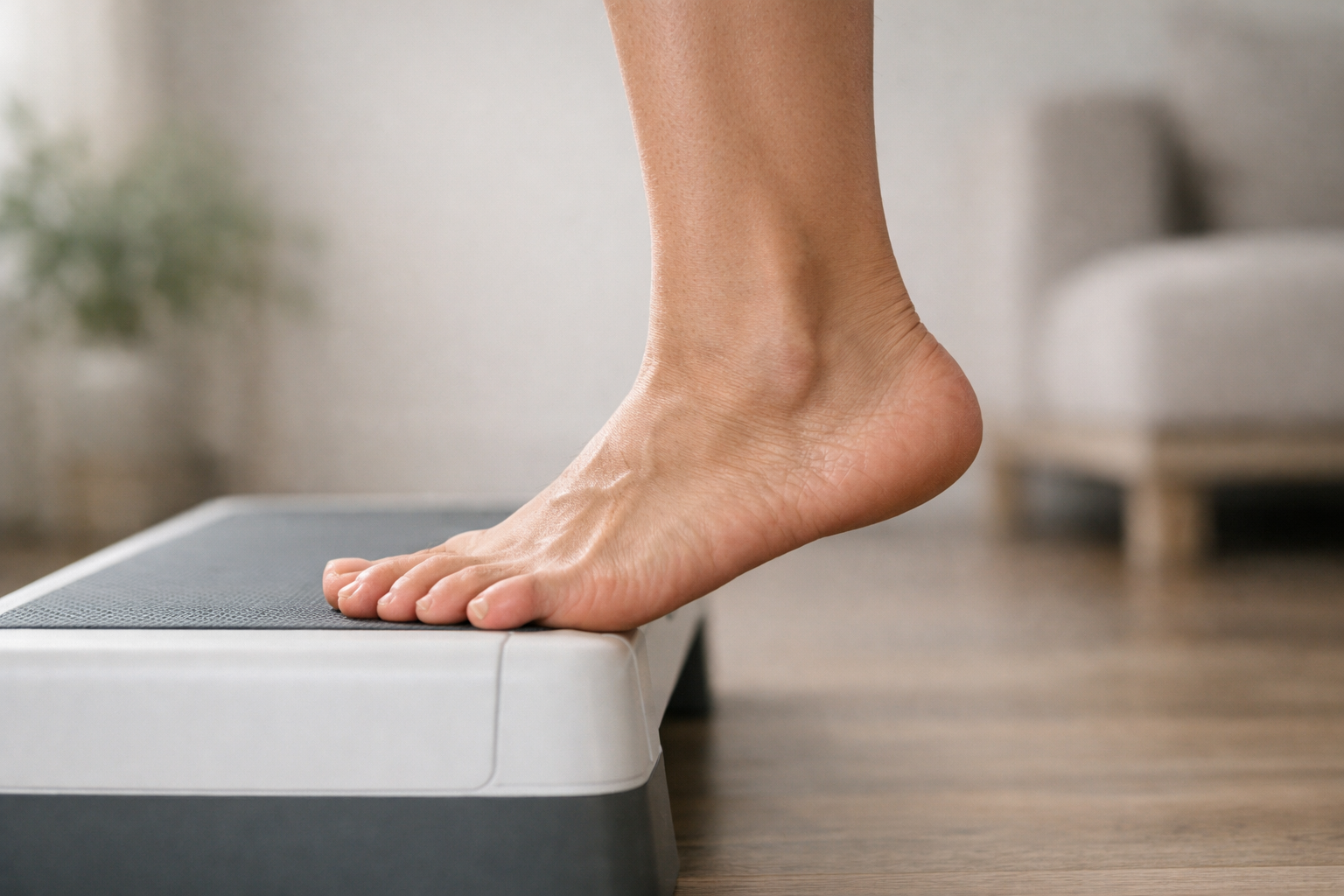
- Start loading at a level you can tolerate. Calf raises, often starting with both feet, sometimes seated, sometimes on a step. Big toe and arch work. Gradual return to walking volume.
- Progress deliberately. More weight, more range, slower tempo, single leg, then eventually impact if that’s your goal. Hold each level long enough to adapt.
- Keep going past the point where it stops hurting. Early improvements are largely your nervous system getting less protective. Actual structural change in fascia and tendon comes later. That’s why week seven matters even though week four felt fine.
If you’re someone who has “tried everything,” it’s worth considering that the missing piece may not have been another treatment. It may have been a plan for progression. Recovery is built.
Function Matters as Much as Pain
Here’s a conversation I have often. Someone says they’re not improving. I ask what they can do now versus six weeks ago. They can stand through a full shift, walk the dog twice a day, and get through a grocery store without planning their exit. Six weeks ago none of that was true.
They’re better. Their pain number just hasn’t moved much yet.
So track more than pain:
- How far can you walk before it complains?
- How long can you stand?
- How bad are the first steps in the morning, and how many steps until it eases?
- How quickly does it settle after a hard day?
That last one is my favorite marker. When a big day used to cost you three bad days and now costs you one, your foot’s tolerance is going up, regardless of what the pain scale says on any given afternoon. Pain is information about sensitivity. It’s not a direct readout of tissue damage, and it’s not the only measure of progress.
Why Do I Have Plantar Fasciitis in Only One Foot?
This surprises people, because both feet get the same number of steps. But they don’t get the same load.
Small asymmetries add up over thousands of repetitions: a stiffer ankle on one side, weaker calf strength on one leg, an old sprain you’ve long forgotten, a hip that doesn’t extend as well, a habit of standing with more weight on one side, the camber of the road you run on. Any of those can shift more demand to one foot. Do that for a few hundred thousand steps and one side crosses its tolerance threshold while the other doesn’t.
This is actually useful clinical information. If one foot is affected, comparing the two gives us a built-in reference for ankle mobility, calf strength, single-leg balance, and toe strength. Often the affected side is measurably weaker or stiffer, and that gap becomes part of the plan.
What Gets Mistaken for Plantar Fasciitis?
Plenty. Heel pain has several possible sources, and they don’t all respond to the same approach. Things that can look similar:
- Fat pad irritation or atrophy. Pain is more at the bottom center of the heel, often described as bruised, and it tends to be worse the longer you’re on your feet rather than worst in the morning.
- Nerve irritation. Baxter’s nerve entrapment or referred symptoms from the lower back can produce burning, tingling, or numbness alongside the pain. That mix points away from a purely fascial problem.
- Heel bursitis. Inflammation of a bursa at the back or bottom of the heel. It can coexist with fascial pain and behave differently. If your pain sits at the back of the heel rather than underneath, that’s worth reading about separately.
- Achilles tendon problems. Back of the heel, often worse with pushing off or going up stairs.
- Tarsal tunnel syndrome. Nerve compression on the inside of the ankle, often with tingling into the arch.
- A calcaneal stress fracture. Less common, but important. Pain with squeezing the sides of the heel, pain at night, and a history of a sudden jump in running or walking volume are reasons to get evaluated promptly.
- Inflammatory arthritis. Especially if both heels hurt, other joints are involved, or there’s significant morning stiffness throughout the body.
This is a big part of why an evaluation matters. Doing fascia-specific loading for a nerve problem or a stress fracture won’t help, and in one of those cases it could make things worse.
What About Heel Spurs and “Stage 3” Plantar Fasciitis?
Two things people often bring in from imaging or from the internet.
Heel spurs. A bony projection on the heel shows up on plenty of X-rays, including in people with zero heel pain. A spur is generally understood as a consequence of long-term stress through the area, not the source of the pain. Recovery looks about the same whether or not you have one. If you were handed an X-ray and told the spur explains everything, that’s worth a second conversation.
Fascia thickening on ultrasound or MRI. Also common, also not a verdict. Thickening reflects the tissue adapting to stress it’s been under. It can be present in people who feel fine and absent in people who hurt. Imaging can show structural changes, but it doesn’t always tell us why you hurt. What it can do is help rule other things in or out, which is genuinely valuable.
“Stage 3” plantar fasciitis. You’ll see staging systems online, usually describing something like: stage 1 as occasional pain that warms up and goes away, stage 2 as pain that persists through activity and interferes with daily life, and stage 3 as long-standing pain, lasting many months or years, present most of the time, with tissue changes visible on imaging and significant limits on standing and walking.
These staging descriptions aren’t a single standardized medical classification, and different sources define them differently. Treat them as a rough way to describe severity and duration, not a diagnosis of how bad your situation is.
What I’d rather you take from it: the longer this has been going on, the lower your starting point and the more patient the progression needs to be. That’s the practical consequence. It is not a statement about whether you can improve. Persistent doesn’t mean permanent. I’ve worked with plenty of people who had heel pain for two years and got meaningfully better, they just needed to start smaller and build longer than someone six weeks in.
A Reasonable Framework for the Next Few Months
Not a prescription, and not a substitute for having someone actually look at your foot. Just the logic.
Phase one: settle the irritation while staying active. Fix footwear. Reduce the sharpest load spikes. Keep walking at a tolerable level. Use ice, rolling, taping, or inserts for comfort. Start gentle calf and foot loading. This is where most self-care advice stops.
Phase two: build tolerance. Load the calf and the plantar fascia with real resistance, progressed over weeks. Slow, controlled calf raises, eventually with the toes extended over a step to bring the fascia in, eventually on one leg with added weight. Big toe strength. Walking volume built up in small increments. Expect some discomfort during the work. Expect it to settle within about a day.
Phase three: return to what you actually want to do. Standing shifts, hiking, running, court sports, whatever the goal is. This phase is about asking the foot to handle speed, impact, and duration, in that order, with your response guiding the pace. Skipping this phase is how people end up back here next year.
What determines your speed through that isn’t a calendar. It’s how your foot responds. The calendar gives you structure. The response tells you what comes next.
When to Get It Looked At
Self-care is reasonable for a while. But go see a clinician if:
- You’ve been at this consistently for six to eight weeks with no meaningful change in pain or in what you can do.
- The pain is severe, or it wakes you at night.
- You have numbness, tingling, burning, or weakness in the foot.
- There’s visible swelling, redness, or warmth, or you had a specific injury that started it.
- Both heels hurt, or other joints are involved as well.
- You noticed a sudden jump in your training or standing volume right before it started, which raises the question of a bone stress injury.
An in-person exam sorts out what’s actually driving your pain and, just as importantly, gives you a starting load you can build from. That’s the part that’s hard to figure out on your own, and it’s usually the part that’s been missing.
Your foot isn’t broken. It’s currently able to handle less than you’re asking of it. Those are very different problems, and the second one you can do something about.