Bottom of Heel Pain: How to Sort It Out and Rebuild
Pain on the bottom of the heel usually means the tissue is being asked to do more than it can currently handle. Here's how that happens, what actually changes it, and how to progress without spending months guessing.
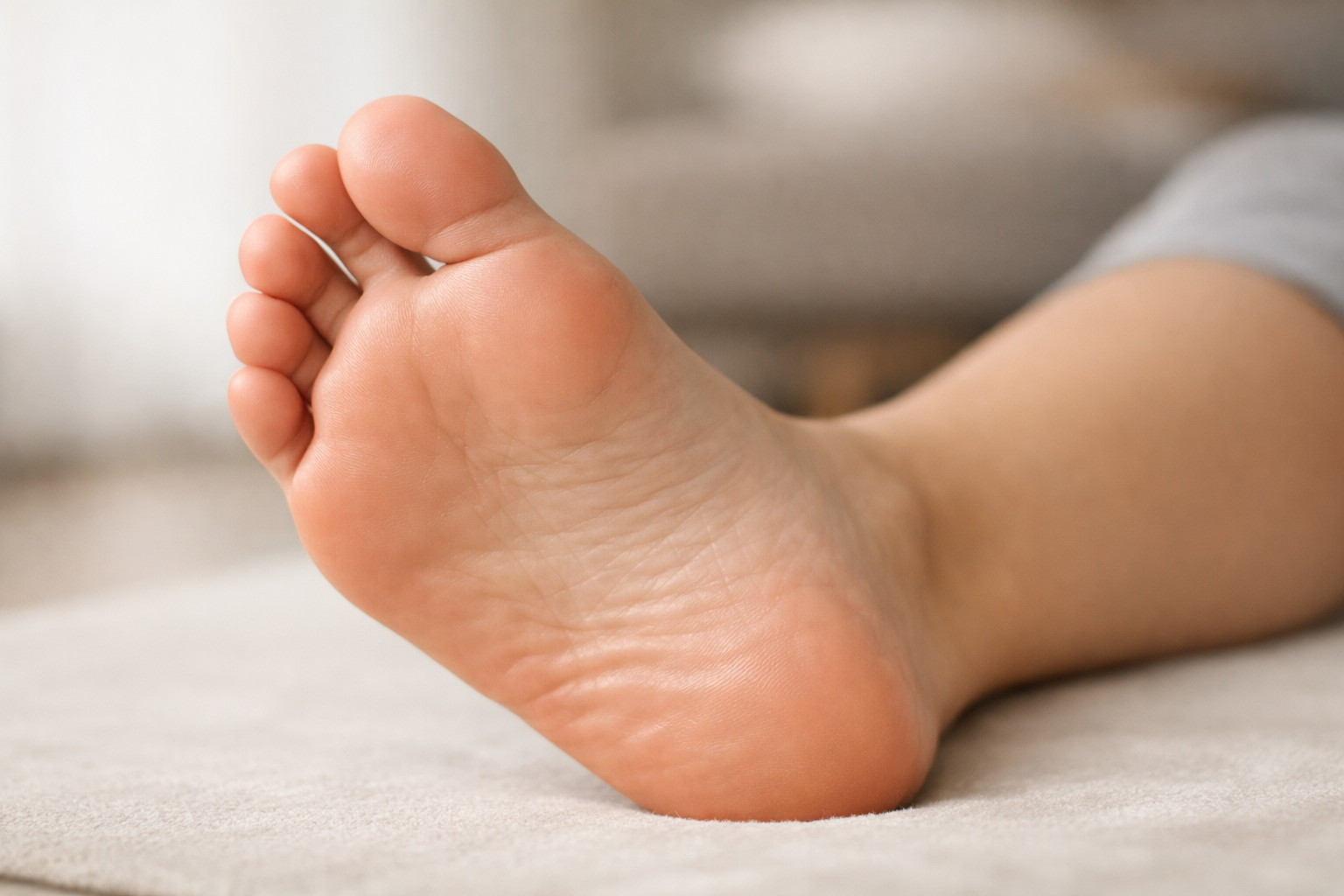
You put your feet on the floor in the morning and the first few steps feel like stepping on a stone. Or a nail. It eases after a minute or two of walking, and you think maybe it’s gone. Then you stand up after lunch and it’s back.
That pattern brings more people into my clinic than almost anything else. It’s frustrating in a specific way, because it isn’t constant. It comes and goes just enough to make you think each day might be the day it stops. Months pass.
Let’s talk about what’s actually happening under your heel, why the usual advice gets you partway and then stalls, and what tends to move the needle.
What’s Under Your Heel
The plantar fascia is a thick, fibrous band running from the bottom of your heel bone forward into the base of your toes. It isn’t a muscle. It’s more like a dense sheet of rope fibers that helps hold your arch and store energy every time you push off.
Every step loads it. Walking, standing, climbing stairs, pushing off to run. Across a normal day that’s thousands of repetitions, and the fascia handles them without complaint as long as the demand stays within what it can currently tolerate.
Pain on the bottom of the heel, right where the fascia attaches, can be consistent with plantar fasciitis. Though the more accurate term for what we usually see, especially when it’s been going on a while, is plantar fasciopathy. Not much active inflammation. More a tissue that’s been overloaded, has changed a bit in structure, and has become sensitive.
That distinction matters more than it sounds. If the problem were mainly inflammation, anti-inflammatory approaches would reliably solve it. They often help symptoms and then the pain returns, which tells you something about what’s really going on.
Why It Hurts So Much
People are frequently surprised by how sharp this is. It’s a small area of tissue and the pain can be genuinely startling, enough to change how you walk.
A few reasons.
The heel is where the fascia narrows down and attaches to bone. Force concentrates there. Whatever load your arch is managing gets funneled into a fairly small footprint of tissue.
You also can’t avoid it. A sore shoulder can be rested by not reaching overhead. Your heel takes your body weight every time you cross the kitchen. There’s no natural break in the day, which is part of why this drags on.
And sensitized tissue behaves differently from healthy tissue. When an area has been irritated for a while, the nerves supplying it turn up their gain. The same amount of pressure produces more pain than it used to. That’s a real, physical process, and it means pain intensity isn’t a clean readout of how much tissue damage exists. A very painful heel is not necessarily a badly damaged heel.
Why Mornings Are the Worst
This is the question I get most, and the answer reassures people once they hear it.
While you sleep, your foot sits in a relaxed position for hours with essentially no load through it. The fascia settles. Then you stand, and in a fraction of a second you go from zero load to full body weight through tissue that’s been completely offloaded all night.
It’s a sensitivity pattern, not overnight deterioration. Your foot did not get worse while you slept. It got quiet, and the first steps are an abrupt reintroduction.
Same thing happens after you’ve been sitting at a desk for an hour, or after a long drive. First steps hurt, then it settles. That settling is worth noticing. It means the tissue tolerates load once it’s warmed into it.
When mornings get shorter and less intense, that’s often one of the earliest signs things are heading the right direction, sometimes before your worst-day pain changes much at all.
How This Starts: Load Versus What You Can Handle
Here’s the frame I use for nearly every foot problem I see.
Your tissue has a certain capacity, meaning the amount of a specific task it can tolerate before it starts to complain. That capacity is built over time by doing the task. Problems begin when demand climbs above capacity, or capacity drops below the demand you’re still placing on it.
Typically it’s one of these:
- Demand went up. You started running again. Took a vacation with six hours of walking a day. Got a job where you’re on concrete for ten hours. Moved houses.
- Demand shifted. New shoes with a different heel height. Switched from cushioned trainers to something flatter. Went barefoot on hard floors all summer.
- Capacity dropped. Time off after illness or injury, then straight back into full activity.
- Total load crept up quietly. Nothing dramatic. Slightly more walking, slightly more standing, slightly less sleep, over months.
Body weight, standing jobs, and footwear changes all show up on the demand side of that equation. Not as personal failures. As inputs into how much your foot is being asked to do each day. More total load means the tissue needs more capacity to match it, and that’s a mechanical fact, not a judgment.
Almost nobody remembers a single moment when it started. That’s characteristic. This builds.
How Do You Get Rid of Pain on the Bottom of Your Heel?
Short answer: you calm the tissue down enough to work with, then you rebuild what it can tolerate. Both halves. Most people who stay stuck did the first half well and never really got to the second.
First, reduce what’s irritating it, without shutting down
If your heel is angry, taking some load off it helps. Shorter walks. Fewer hours barefoot on tile. A more supportive shoe for a few weeks. Maybe less running, or none for a stretch.
But there’s a version of this that backfires, and it’s common. Complete rest. Weeks of avoiding walking, staying off it, waiting for it to feel normal before doing anything.
Rest lowers sensitivity while the tissue is unloaded. It does not build capacity. In fact, capacity drifts downward with disuse. So you feel better resting, return to your life, and the pain comes right back, often within days, because the gap between what you’re asking and what your foot can handle got wider, not narrower.
Rest equals rust. Use it as a short-term dial, not a strategy.
Second, load it deliberately

This is the part that changes tissue. Progressive, gradually increasing loading over weeks to months is what makes fascia, tendon, and muscle structurally more capable. Nothing passive does that. Not ice, not massage, not a boot, not an insole.
What that looks like in practice varies a lot person to person, which is why I’m not going to hand you a specific exercise prescription in an article. But the shape of it is consistent:
- Loading through the calf and foot, done slowly and with control
- Enough resistance to actually challenge the tissue, not just move it around
- Held at each level long enough to adapt before you make it harder
- Repeated most days, over a couple of months
Strengthening the calf matters more than most people expect. The calf and Achilles work with the plantar fascia through the back of the heel. A calf that can absorb and produce more force means less demand landing on your fascia with each step.
Third, rebuild the actual thing you want to do
Capacity is task-specific. Being able to do heel raises in your kitchen doesn’t automatically mean you can stand at a trade show for nine hours or run five miles. Those need their own progression.
So if the goal is walking the dog for forty minutes, we build toward forty minutes of walking. If the goal is a 10K, the running itself gets progressed alongside the strengthening. This is where a lot of otherwise good rehab stops short.
How Much Pain Is Acceptable While You Work?
This question stops people cold, because most of us were taught that pain means stop.
For persistent tendon and fascia problems, some discomfort during loading is generally acceptable and often unavoidable. The guideline I use with most patients: keep it at or below roughly a 4 out of 10 during the activity, and pay close attention to what happens over the next day.
That 24-hour window is the useful signal. If your heel is more sore right after, then settles back to your normal baseline by the next morning, the load was reasonable. If you’re noticeably worse for two or three days, or your morning pain jumps up and stays up, that was more than the tissue was ready for. Scale back and build from a lower rung.
These are general patterns, not precise rules, and they need adjusting for the individual. But they give you a way to make decisions instead of guessing.
One more thing about pain: it’s information, not a damage meter. An increase after a longer walk doesn’t mean you tore something or undid your progress. It means the tissue got asked for more than it was ready for that day. That’s data. Now we adjust.
Is Walking Good for Plantar Fasciitis?
Usually yes, in an amount your foot can handle.
Walking loads the fascia in a way it’s designed for. It maintains capacity. It keeps you moving, which matters for the rest of your body and for your mood, both of which affect how pain feels.
The problem isn’t walking. It’s walking amounts that outpace where your foot currently is. Four hours around a museum when your comfortable ceiling is thirty minutes will flare things, and the flare might not show up until the next morning.
So find your current ceiling and work under it. If thirty minutes is fine and forty-five leaves you sore for two days, live around thirty for a while and then nudge upward. Break walking into chunks across the day if that helps. Wear shoes that reduce the load while you’re building.
What I don’t want is someone deciding to walk as little as possible for three months. Their foot gets less capable, and the world doesn’t get any easier.
Will Plantar Fasciitis Go Away by Itself?
Sometimes. If the cause was a clear, temporary spike in load, a marathon of walking on vacation, a two-week stretch of long shifts, and then life goes back to normal, the tissue often settles on its own within weeks.
When it doesn’t resolve in that window, it tends to persist. Many people describe six months, a year, several years of it coming and going. Usually the same cycle: it flares, they back off, it calms down, they return to normal activity, it flares again. The tissue never gets more capable, so the same activities keep exceeding the same ceiling.
That cycle is not a sign your case is hopeless. It’s a sign that the missing piece was a way to progress, not another treatment.
And persistent doesn’t mean permanent. If you’ve had this for two years, it usually means we start at a lower level and move more patiently, not that the tissue can’t adapt. Fascia and tendon respond to loading regardless of how long they’ve been sore. Meaningful structural adaptation generally takes something like eight to twelve weeks of consistent work, often longer for long-standing cases, and the timeline is genuinely individual.
Which brings up the most common way people accidentally set themselves back: stopping when the pain resolves. Early improvements come largely from the nervous system settling down, and they arrive well before the tissue itself has changed. Pain gone at week five with the loading abandoned at week five is a recipe for the same problem in three months. Keep going past the point where it feels necessary.
What’s the Worst Thing You Can Do?
A few candidates, and none of them are what people expect.
Waiting for it to feel normal before you do anything. Recovery is built. If the plan is to be pain-free first and then resume activity, you’re waiting on something that generally arrives in the other order.
Only doing passive treatments. Ice, rolling on a frozen bottle, massage, night splints, taping, insoles. These can genuinely reduce symptoms, and I use several of them. They lower sensitivity. None of them make the tissue stronger. If everything in your plan is something done to your foot, the plan is incomplete.
Aggressively stretching a very irritated heel and nothing else. Stretching can feel good and can help with a stiff calf or restricted ankle motion. But stretching alone is a sensitivity intervention, and hammering a cranky fascia attachment with hard stretching sometimes keeps it stirred up.
Big, sudden jumps. Feeling good for a week and going straight to a six-mile run. This is the single most common cause of the flares I see.
Ignoring the total load. People do their exercises perfectly and can’t figure out why they’re not improving, when the real story is twelve-hour shifts on a concrete floor. Everything counts. Exercise plus work plus errands plus life. The exercise is often not the thing that flared you.
What Gets Mistaken for Plantar Fasciitis?
Not all bottom-of-heel pain is plantar fasciopathy, and treating the wrong thing wastes months. Some of the more common lookalikes:
- Fat pad irritation or atrophy. The cushion under your heel bone can get bruised or thin out. The pain sits more centrally under the heel, feels deeper and more bruise-like, and hurts most on hard surfaces. It often does worse with barefoot walking than plantar fasciopathy does, and it does not respond the same way to fascia-focused work.
- Calcaneal stress reaction or stress fracture. Pain in the heel bone itself, often more constant, worse with impact, sometimes sore when you squeeze the sides of the heel. More likely after a big training jump, and worth taking seriously.
- Nerve involvement. The nerve branches running near the inner heel can get irritated. Suspect this when there’s burning, tingling, numbness, or pain that shows up at rest and at night rather than with first steps.
- Achilles or insertional problems. Pain at the back of the heel rather than underneath, though people sometimes describe it vaguely enough that it’s worth clarifying.
- Referred pain from the low back or hip. Less common, but real, especially when the heel exam is unremarkable.
- Inflammatory conditions. Some systemic conditions affect tendon and fascia attachment points, sometimes in both feet at once, sometimes with joint symptoms elsewhere.
A reasonable exam sorts most of this out. Where it hurts to press, what makes it worse, what the pattern looks like across a day, what changed before it started. If you want more detail on the patterns that warrant prompt attention, we’ve written separately about heel pain red flags.
What About Heel Spurs?
Briefly, since this comes up in every conversation about heel pain: a spur on the bottom of the heel is usually a consequence of long-term stress at the fascia attachment, not the source of pain. Plenty of people have spurs and no symptoms at all. Plenty of people have significant heel pain and no spur.
Recovery looks about the same either way. Same goes for a thickened fascia on ultrasound, which reflects tissue adapting to stress rather than a verdict about your future. A scan can show structural changes, but it doesn’t always tell us why you hurt. We’ve covered spurs in more depth in a separate article if that’s your specific question.
What Is Stage 4 Plantar Fasciitis?
You’ll see staging systems floating around online, usually describing something like stage one as occasional morning pain and stage four as constant, severe pain that limits daily activity.
There’s no universally accepted clinical staging for this. It isn’t like cancer staging or arthritis grading. The labels are mostly descriptive shorthand for how long you’ve had it and how much it’s limiting you.
What I actually care about is more useful than a stage number:
- How easily does your heel get stirred up? Does it take a long day to flare, or ten minutes of walking?
- How long does it take to settle back down afterward? An hour, or three days?
- What can you currently do without a meaningful flare?
- Which direction has it been going over the past few months?
Those four answers tell me where to start and how fast to move. “Stage four” tells me almost nothing except that you’re having a hard time. If a system like that made you feel like you’re too far gone, set it aside. A more irritable, longer-standing foot means starting lower and progressing more patiently.
What Are the Best Shoes for Plantar Fasciitis?

There’s no single best shoe, and I’d be suspicious of anyone who names one.
A shoe changes how much load reaches your fascia and how that load is distributed. That’s it. It’s a tool for managing demand while you build capacity, not a treatment.
What tends to help while a heel is irritated:
- Some cushioning under the heel, particularly if you’re on concrete or tile a lot.
- A modest heel-to-toe drop. A slightly raised heel reduces the stretch demand on the fascia and Achilles. Very flat, minimal shoes tend to increase it. Not wrong forever, just often more than an irritated heel wants right now.
- A shoe that doesn’t collapse. You should not be able to twist it like a dishrag or fold it in half.
- Actually comfortable, right now, to you. Comfort turns out to be a decent guide. -** A shoe with a wide toe box.**
On orthotics and inserts: they can help, sometimes noticeably. An off-the-shelf insert with decent arch contour is a reasonable thing to try, and custom orthotics have a role for certain foot structures and certain jobs. They reduce load on the tissue. What they don’t do is make your foot more capable. If you use one, use it while you’re building, and understand it as support rather than the plan itself.
One practical thing: when you find shoes that let you move comfortably, don’t change everything about your footwear at once, especially if you’re improving. Introduce new shoes gradually, the way you’d introduce anything else your foot has to adapt to.
Also worth wearing something supportive around the house if you’re on hard floors. Hours of barefoot walking on tile is a real load, and it’s one people rarely count.
When a Flare Happens
It will. Recovery is not a straight line, and a bad week does not erase two good months.
When your heel flares, the useful move isn’t panic and it isn’t pushing through. It’s a short investigation.
What changed in the last two or three days? Different shoes. A longer walk. A day of travel with airport terminals and hard floors. A jump in your loading. Poor sleep and a stressful week, which genuinely affect how much pain you feel from the same input.
Remember symptoms often lag a day or two behind the load that caused them. What flared you Wednesday morning frequently happened Monday.
Then adjust. Drop back to a level you handled well, hold there for several days to a week, and build again from there. You’re not starting over. You’re stepping back one rung on a ladder you’ve already climbed.
The trend over months is what matters. Not any single day. When I’m evaluating whether someone is improving, I’m looking at things like: how many minutes can you walk before it complains, how long do the mornings last now, how fast do you recover after a hard day, what have you gotten back that you’d stopped doing. Function matters as much as pain. People often become substantially more capable while their pain number is still hovering in the same place, and then the number drops later.
Getting Someone to Look at It
Most bottom-of-heel pain responds well to intelligent load management, and a lot of people can make real progress with a clear plan and some patience.
Worth getting evaluated if: the pain came on suddenly with a pop or after a fall, you can’t put weight through the foot, there’s significant swelling, redness, or warmth, you have numbness or tingling, the pain is constant and wakes you at night, it’s in both heels along with joint pain elsewhere, or you’ve been working at it consistently for a couple of months without any movement in the right direction. Also if you have diabetes or circulation issues, get foot pain looked at earlier rather than later.
None of that is meant to alarm you. It’s meant to give you a clear line for when a guess isn’t good enough and someone should actually put hands on your foot.
If you’ve already tried rest, stretching, inserts, a night splint, maybe an injection, and you’re still where you started, that history isn’t wasted. Each of those things does something specific, and most of them do it well. What they don’t do on their own is make your foot capable of the life you want to walk through. That part gets built, and it takes a plan that moves forward instead of holding still.