Why Does My Heel Hurt When I Walk? Causes and Solutions
Heel pain when walking has several common causes, from plantar fasciopathy to Achilles issues, and understanding load versus capacity helps explain why it flares and how it improves.
Heel pain that shows up when you walk is one of the most common reasons people end up searching for answers at 11 p.m., foot propped up, wondering if something is torn or if they just need new shoes. Most of the time it’s neither dramatic nor mysterious. It’s usually a tissue that’s being asked to do more than it currently has the capacity to handle.
That idea, load versus capacity, is the frame we use for almost every foot and ankle problem we see. A tissue develops pain when the demand placed on it (how much you’re standing, walking, running, or the surfaces and shoes you’re doing it in) outpaces its ability to tolerate that demand. The fix isn’t just to calm things down. It’s to rebuild capacity so the tissue can handle your normal life again.
The Most Common Cause: Plantar Fasciopathy
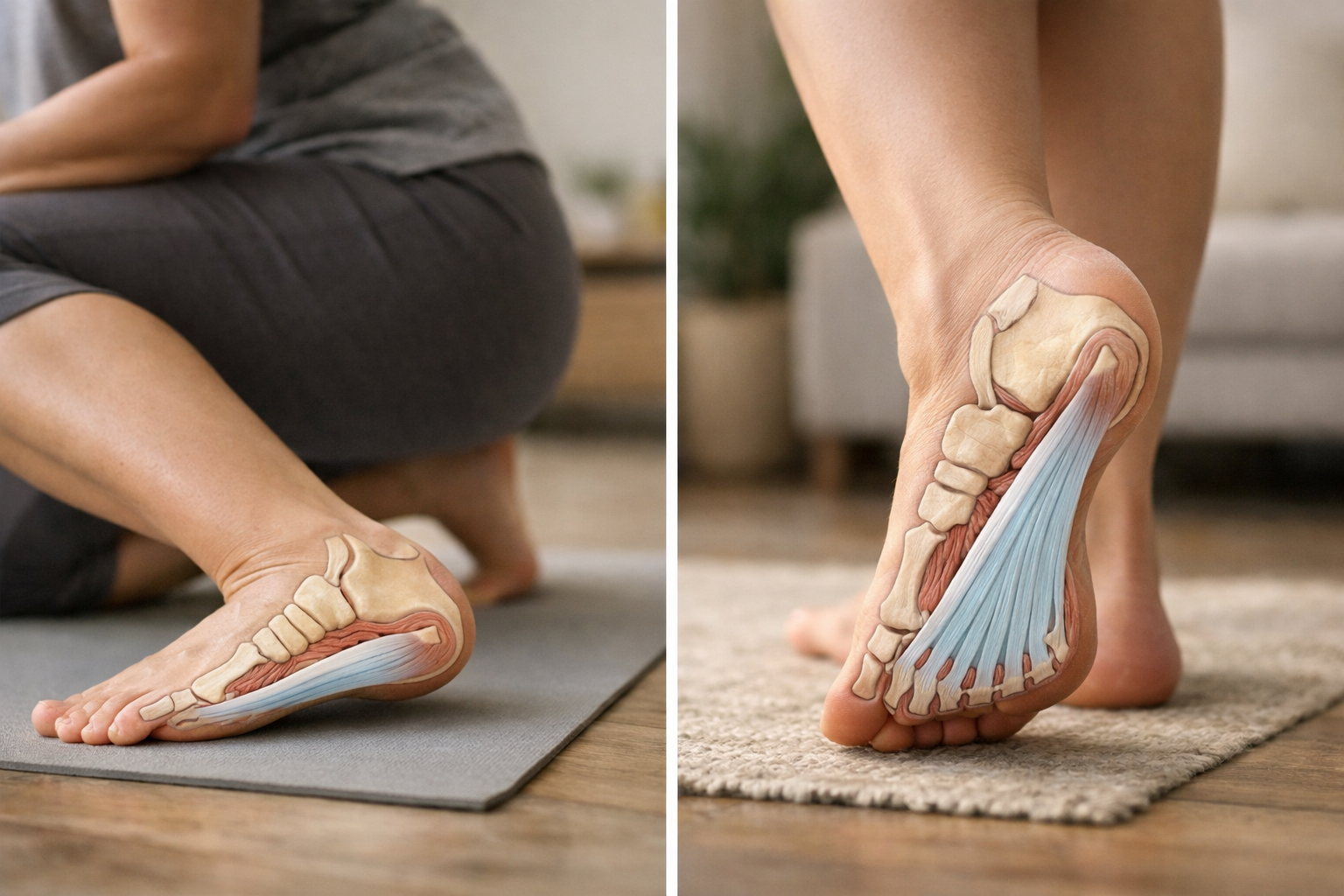
If your heel pain is worst with your first steps in the morning or after sitting for a while, and it eases somewhat as you keep moving, this can be consistent with plantar fasciopathy. We use that term instead of “plantar fasciitis” deliberately. Fasciitis implies active inflammation, but in cases that have been around for more than a few weeks, what’s usually going on is a change in the tissue’s tolerance to load, not an inflamed structure that needs to be cooled down.
The morning pain pattern trips people up. It feels like the fascia got worse overnight, so many assume they need more rest. In reality, that sharp first-step pain is a sensitivity pattern. Hours without load lets the tissue settle, and the first load of the day (your foot hitting the floor) triggers a protective pain response. It’s not a sign of new damage.
Other patterns that often go along with plantar fasciopathy:
- Pain concentrated at the bottom of the heel, sometimes radiating slightly into the arch
- Worse after long periods of standing, especially on hard floors
- A day or two delay between a big activity day and a flare, since symptoms often lag behind the load that caused them
- Gradual onset over weeks, rather than a sudden injury
What About Heel Spurs?
If you’ve had an X-ray and been told you have a heel spur, it’s natural to assume that’s the source of the pain. Usually it isn’t. A heel spur is typically a consequence of chronic stress at the point where the plantar fascia attaches to the heel bone, not the cause of your pain. Plenty of people have heel spurs on imaging with zero symptoms, and plenty of people with significant heel pain have no spur at all. Recovery generally looks the same whether or not a spur shows up on your films.
The same logic applies to fascia thickening seen on ultrasound or MRI. That thickening reflects the tissue adapting to stress over time. It’s information, not a verdict, and it doesn’t change the basic approach: rebuild the tissue’s capacity gradually.
Other Conditions That Get Mistaken for Plantar Fasciitis
Not all heel pain is plantar fasciopathy, even though it’s the most common cause. A few conditions that mimic it and are worth ruling out:
- Achilles tendinopathy: pain at the back of the heel or up into the calf, often worse with pushing off during walking or running, rather than under the heel.
- Fat pad atrophy or bruising: a deep, bruise-like pain directly under the heel, sometimes from a hard landing or from age-related thinning of the heel’s natural cushioning.
- Tarsal tunnel syndrome: burning, tingling, or numbness that can extend into the arch or toes, suggesting a nerve component rather than a purely mechanical one.
- Stress fracture: pain that’s more constant, doesn’t ease with movement the way fasciopathy often does, and may be tender to direct pressure on the bone itself rather than the soft tissue.
- Nerve entrapment or referred pain from the lower back: less common, but worth considering if the pain doesn’t fit the usual pattern or doesn’t respond to typical loading strategies.
An evaluation from a physical therapist or physician helps sort out which of these you’re dealing with, especially if your pain doesn’t follow the classic “worse with first steps, better as you warm up” pattern.
What Causes Heel Pain in Only One Foot?
Heel pain is often one-sided because load rarely distributes evenly. A favored stance, a job that has you pivoting more on one side, an old ankle sprain that changed how you walk on that foot, or simply doing more miles on that leg over the years can all shift demand toward one heel. It doesn’t necessarily point to a structural problem on that side. It usually just means that foot has been asked to absorb more than the other one, relative to its current capacity.
How Can I Tell If My Heel Pain Is Plantar Fasciitis?
A few questions can help you get a rough read, though they’re not a substitute for an exam:
- Is the pain worst with your first steps in the morning or after sitting?
- Is it located at the bottom of the heel, not the back or sides?
- Does it ease somewhat once you’ve been walking for a few minutes, then sometimes return later in the day with fatigue?
- Did it come on gradually rather than from a specific injury?
If you answered yes to most of these, this can be consistent with plantar fasciopathy. If your pain is at the back of the heel, involves numbness or tingling, or came on suddenly with swelling and bruising, it’s worth getting evaluated before assuming it’s fasciopathy.
How Do I Get Rid of the Pain in My Heel When I Walk?

The honest answer is that it depends on what’s causing it, but for the common case of plantar fasciopathy, the approach generally has a few parts:
Manage total load, don’t eliminate it. Total load is cumulative. It’s not just your exercise, it’s your job, your errands, how much you’re on your feet, and everything else in your day. A flare often comes from a long day of standing or an unusually active weekend, not from a specific exercise you did. Reducing your overall load a bit while keeping the tissue moving tends to work better than shutting activity down completely.
Stretch for symptoms, load for capacity. Stretching has a real role here. Plantar fascia-specific stretching, ideally done first thing in the morning before your first steps, along with calf stretching, is one of the better-supported ways to bring heel pain down over a period of weeks, and it’s worth doing consistently rather than only on bad days. What stretching doesn’t do on its own is change how much load the tissue can tolerate, which is why relief can fade during long days on your feet if nothing else changes. Actual structural change in the fascia and surrounding muscle comes from progressive loading over weeks to months, typically in the range of 8 to 12 weeks for many people, sometimes longer for pain that’s been around a while. Calf raises, foot-specific strengthening, and controlled walking progressions are the usual tools, started at a manageable level and increased gradually.
Use a pain guideline, not a zero-pain rule. A common pattern we use is keeping pain at or below roughly a 4 out of 10 during and after activity, and expecting it to settle within about 24 hours. Pain that’s climbing higher than that or lingering longer suggests the load was more than the tissue could handle that day, which is useful information for adjusting the next day’s activity, not a sign of damage.
Consider footwear and orthotics as tools, not fixes. Supportive shoes or an orthotic insert can reduce load on the fascia while you rebuild capacity. They’re useful for managing demand during recovery. They’re not a permanent substitute for building the tissue’s tolerance, and you shouldn’t expect them alone to solve a problem that’s been building for months.
What Is the Fastest Way to Heal Plantar Fasciitis?
There isn’t a shortcut that skips the biology. Daily plantar fascia and calf stretching, started in the morning before your first steps, is the piece most likely to lower your pain over the first several weeks, and it pairs well with sensible load management. Icing and rest can also take the edge off in the short term, but that relief tends to disappear the moment you resume normal activity because the underlying capacity hasn’t changed. The most reliable path for lasting change, even if it’s not the fastest, is a structured, progressive loading program that starts at a level your foot can currently tolerate and builds from there. Chronic doesn’t mean permanent. It usually means you’re starting from a lower point and need a more patient progression, not that recovery is out of reach.
Should I Stop Walking If I Have Heel Pain?
Generally, no. Complete rest calms symptoms while you’re off your feet, but it doesn’t build the tissue’s capacity to tolerate walking again, so pain often returns as soon as you resume. The goal is intelligent load management: staying as active as you reasonably can while adjusting volume, pace, surface, or footwear so the pain stays in a tolerable range. Total rest for a day or two during a bad flare is fine. Total rest for weeks tends to leave you deconditioned and no better off than when you started.
Red Flags in Heel Pain
Most heel pain is a load and capacity problem that responds to a graded plan. A smaller number of cases need medical attention sooner. See a clinician promptly if you have:
- Sudden, severe heel pain after a specific event, especially with a popping sensation
- Inability to bear weight on the foot at all
- Significant swelling, redness, or warmth suggesting infection
- Numbness, tingling, or weakness spreading into the foot
- Heel pain that’s constant, unrelated to activity, or worse at night
- Fever or systemic symptoms along with foot pain
- A history of diabetes with any new foot pain, wound, or color change
These don’t automatically mean something serious, but they’re outside the pattern of ordinary fasciopathy and deserve a proper look.
Where to Go From Here
Heel pain that shows up when you walk usually isn’t a sign that something is broken. It’s more often a signal that your foot’s current capacity hasn’t caught up to what you’re asking of it, whether that’s a new walking routine, a job that keeps you on your feet, extra weight the system is carrying, or a change in footwear. None of those are personal failures. They’re just load, and load can be managed.
Many people improve with a patient, progressive approach that respects how tendons and fascia actually adapt. The principles are sound even when progress feels slower than you’d like. If your pain doesn’t fit the usual pattern, or it’s not responding after a few weeks of sensible adjustments, an evaluation with a physical therapist can help confirm what’s actually going on and build a plan suited to your foot, your activity level, and how long this has been building.