Plantar Fasciitis or Heel Pain: How to Know What You're Dealing With
A practical guide to recognizing the pattern of plantar fasciitis, telling it apart from other sources of heel pain, and understanding what actually changes it. Learn what the symptoms mean, what confirms the picture, and what to do next.
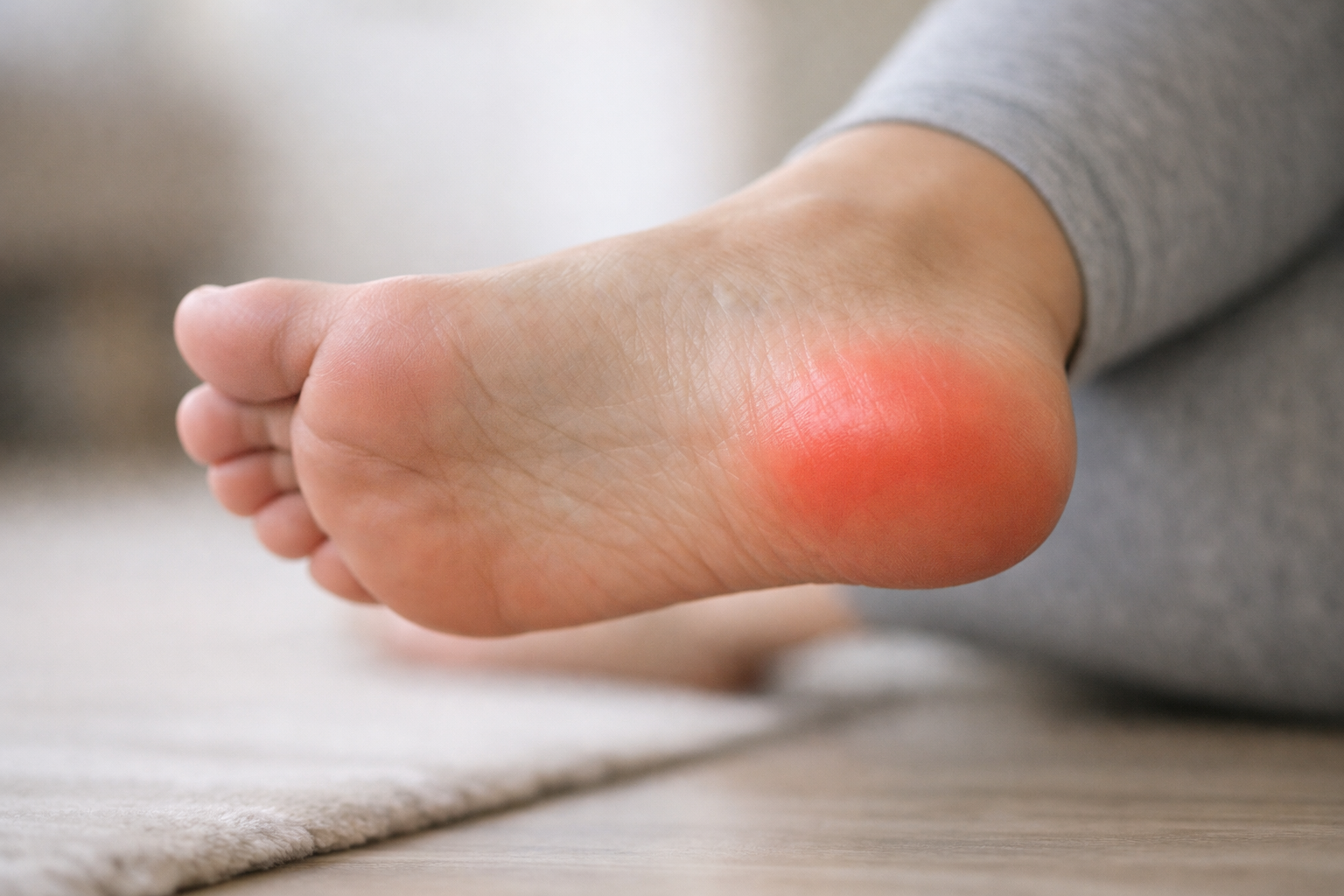
You got out of bed this morning, put your foot down, and something in your heel bit back. By the time you’d made coffee it had eased off. By the end of the day it was grumbling again. And somewhere in there you typed “how to tell if heel pain is plantar fasciitis” into your phone.
That’s a reasonable question, and it’s answerable. Plantar fasciitis (more accurately called plantar fasciopathy when it has been going on a while) has a recognizable pattern. Not a single symptom. A pattern. Once you can see the pattern, you can usually tell whether your heel fits it, and you can also tell when it doesn’t.
Let’s go through what that pattern actually looks like, and what it means for what you do next.
The pattern, not the symptom
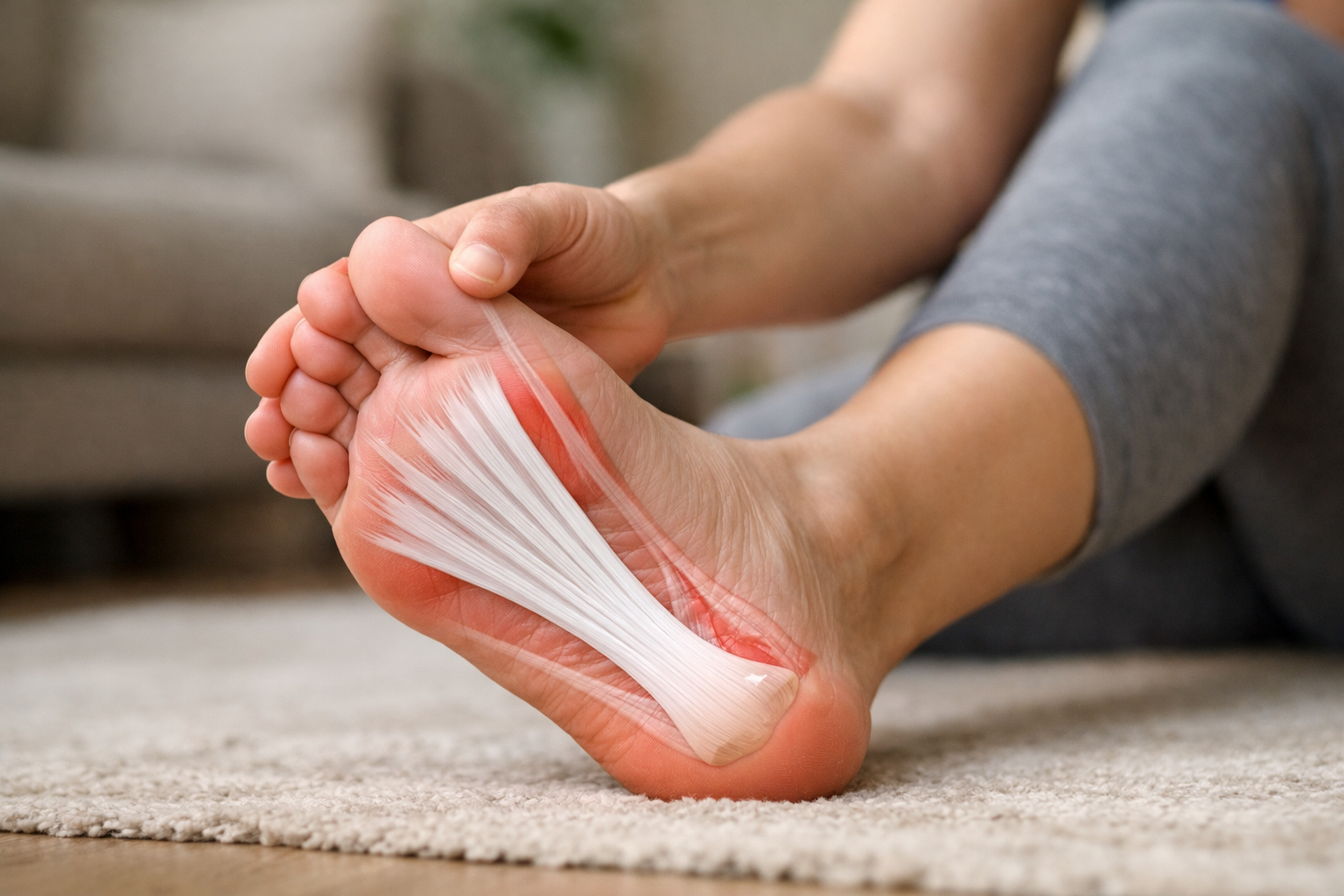
Most articles will tell you plantar fasciitis hurts in the morning. True, and not enough. Plenty of things hurt in the morning. What makes this condition recognizable is how several features line up together.
Where it hurts. The bottom of the heel, usually toward the inside edge, sometimes spreading forward into the arch. If you press with your thumb on that inside-front corner of the heel bone, it’s often distinctly tender. Not vaguely sore. Specific.
When it hurts. First steps in the morning are the classic. Also first steps after sitting at your desk for an hour, after a long drive, after a movie. The common thread is that the foot was still, then you asked it to carry you.
How it behaves once you’re moving. For most people, those first ten or twenty steps are the worst, and then it eases. Not gone, but noticeably better. This warm-up effect is one of the more useful clues.
What happens later. Then it comes back. After a long day on your feet, after a longer walk than usual, often in the evening or the next morning. Prolonged standing tends to aggravate it more than moving does.
How it started. Usually gradually. A twinge you ignored. Then a twinge you noticed. Then a heel that announces itself daily. There’s often a change in the weeks before it began: new job with more standing, new shoes, a return to running, a vacation with a lot of walking, a training bump.
When those pieces stack up together, the picture can be quite consistent with plantar fasciopathy. One piece alone tells you much less.
Why the morning pain happens (and why it isn’t damage)
This is the part that frightens people, and it shouldn’t.
Overnight, your foot does nothing. Hours of no load. The tissue on the bottom of your foot settles into a shortened, quiet, unloaded state. Then you stand up and, in one step, go from zero demand to carrying your whole body weight. The tissue is sensitive and the load arrives instantly.
That’s a sensitivity pattern. It is not evidence that something tore in your sleep or that the condition worsened overnight. Morning pain is often at its most dramatic when the tissue is irritable, and it tends to shrink as capacity improves. Many people find that the length of their morning stiffness (how many steps or how many minutes until it eases) is a better progress marker than the pain number itself.
What heel pain can be mistaken for plantar fasciitis?
Quite a lot, honestly. This matters because the treatment plan diverges depending on what’s driving it.
A few of the more common look-alikes:
- Fat pad irritation. The heel has a natural cushion under it. When that pad gets bruised or thins with age, the pain sits more in the center of the heel than the inside edge, and it feels deep, achy, and bruise-like. It often hurts more on hard floors and barefoot on tile, and it doesn’t always show the classic morning warm-up.
- Achilles or insertional tendon pain. Pain at the back of the heel rather than underneath. If you’re sore where the tendon attaches, or the back of the heel hurts when shoes press on it, that’s a different tissue with a different loading plan.
- Nerve irritation. A branch of a nerve runs along the inside of the heel. When it’s involved, people often describe burning, tingling, numbness, or pain that lingers at rest and sometimes at night. Plantar fasciopathy usually quiets down when the foot is still. Nerve pain often doesn’t.
- Bone stress injury. A stress reaction in the heel bone tends to hurt with impact, gets worse the longer you’re on it rather than warming up, and can be tender when you squeeze the heel from both sides rather than press underneath. Recent large jumps in running or walking volume raise the suspicion.
- Inflammatory conditions. Some systemic conditions cause heel pain, often in both feet, often with morning stiffness lasting well beyond a few minutes, and sometimes with symptoms elsewhere in the body.
If you want the deeper breakdown of these, we have a whole article on what gets mistaken for plantar fasciitis, and another on the specific heel pain red flags that deserve prompt attention. I’d rather send you there than half-cover it here.
The short version: pain that burns or tingles, pain that’s worse at rest, pain that started after a specific injury, pain with visible swelling or redness, both heels at once with long morning stiffness, or heel pain that keeps escalating despite sensible activity changes. Any of those, get it looked at rather than assuming.
How do I confirm I have plantar fasciitis?
Here’s something that surprises people: this is mostly a clinical diagnosis. It’s made by history and hands, not by a machine.
A good evaluation walks through when it started, what changed in your life around then, what your day actually demands of your feet, what makes it better and worse, and how it behaves across a full 24 hours. Then it involves an exam: pressing in specific places, testing how the foot moves, checking calf and ankle mobility, watching you walk, testing strength in the foot and calf, and often loading the tissue on purpose to see how it responds.
That last piece matters. Watching how your foot responds to a specific load tells us more than a static picture does.
What about imaging?
Ultrasound or MRI can show thickening of the plantar fascia. X-ray may show a heel spur. Neither one closes the case by itself.
A scan can show structural changes, but it doesn’t always tell us why you hurt. Thickened fascia often reflects tissue adapting to years of stress. Plenty of people have thickened fascia and no pain at all. Heel spurs are similar: they’re usually a consequence of long-term stress at that attachment point, not the thing generating your symptoms, and recovery follows the same path whether you have one or not.
Where imaging genuinely earns its place is when the story doesn’t fit. Suspected stress fracture. Suspected tear after a sudden pop. Symptoms that aren’t responding to a well-built plan. Signs pointing toward something systemic. In those situations, a scan answers a real question. As a routine first step for a textbook presentation, it usually just confirms what the exam already showed.
A few things you can check yourself
Not a diagnosis. Just information worth bringing to an appointment.
- Map it. Point with one finger to the exact worst spot. Inside-front of the heel pad? Center of the heel? Back of the heel? Along the arch? Write it down.
- Time your mornings. How many steps or minutes until it eases? Track it for a week. This is one of the more honest measures of irritability.
- Test the toe stretch. Pull your big toe up toward your shin while feeling along the arch. In plantar fasciopathy, this often reproduces familiar tenderness. Sharp, unfamiliar pain elsewhere is worth mentioning.
- Notice the 24-hour response. Do a normal amount of walking and see where you are the next morning. Symptoms that settle back to baseline within about a day suggest the tissue handled it. Symptoms clearly elevated for two or three days suggest that day asked for more than your foot was ready for.
- Look backward. What changed four to eight weeks before this started? Shoes, mileage, job, floors, travel, a fitness push, a weight change, a period of inactivity followed by a sudden return. There’s almost always something.
That last one is not a hunt for who’s to blame. It’s information about load. Your foot has a certain amount it can currently handle, and something in your life recently asked for more than that. Understanding what shifted is how we figure out where to start.
Will plantar fasciitis go away by itself?
Sometimes. A meaningful number of cases do settle over months, particularly when the thing that caused the overload was temporary and gets removed on its own. The vacation ends. The busy season at work passes. The worn-out shoes get replaced.
But “often resolves eventually” and “resolves well” are different statements. When it resolves purely by removing load, the tissue’s capacity hasn’t necessarily changed. The heel calms down because you’re asking less of it. Then life asks more again, and the pain comes back. That’s the pattern behind the person who says they’ve had this off and on for three years.
This is the difference between sensitivity and structure. Rest, stretching, ice, a supportive shoe, a night splint: these can genuinely reduce how sensitive the tissue is, and that’s not nothing. Feeling better is worth something. But sensitivity comes back down fast and goes back up fast. Changing the actual capacity of the tissue, its ability to tolerate standing for eight hours or running four miles, takes weeks to months of gradually asking your foot to do more.
Rest calms things. It doesn’t build anything.
How do I get rid of plantar fasciitis in my heel?
Not with one intervention. With a sequence.
Step one: bring the irritation down enough to work. If every step is a 7 out of 10, we’re not in a position to load anything productively. This phase might involve temporarily reducing the highest-load activities, adding cushioning or support in shoes, adjusting how much standing happens in a stretch, and gentle loading that stays comfortable. Short duration. Days to a couple of weeks, usually, not months.
Step two: start loading, deliberately. This is the part most often missing. The tissue needs progressively greater mechanical demand to change. For the plantar fascia and the muscles supporting the arch, that generally means calf and foot strengthening done with real resistance, done slowly, done consistently, and done at a level your foot can currently tolerate.
Step three: keep raising the ceiling. Once a level feels manageable, it stops being a stimulus. More weight, more range, more speed, or more of the specific activity you want back. Stay at each level long enough to adapt before moving up.
Step four: rebuild the actual task. If your goal is standing a twelve-hour shift, you eventually need to practice standing longer. If it’s running, you need a running progression. Strength in the gym doesn’t automatically transfer to tolerating your Tuesday.
The frustrating truth is that step two often produces early improvement within a few weeks (much of that early change is your nervous system getting more comfortable, not the tissue rebuilding), and that’s exactly when people stop. Then it recurs, and it feels like the plan failed. It didn’t fail. It got abandoned partway. For many people, meaningful tissue adaptation runs somewhere in the range of eight to twelve weeks of consistent loading, sometimes longer if this has been going on a long time.
Recovery is built, not waited for.
What is the best exercise to heal plantar fasciitis?

There isn’t one. I know that’s an unsatisfying answer, so let me give you the useful version.
The best exercise is the one that loads the right tissue, at a level your foot can handle today, that you’ll actually do several times a week. That last clause disqualifies more programs than the first two.
That said, a few categories tend to carry the most weight:
- Calf strengthening. The calf and Achilles absorb an enormous portion of the force your foot deals with. A weak or poorly conditioned calf pushes more demand onto the fascia. Heel raises, progressed from both legs to one leg to added weight, done slowly, are a workhorse here.
- Loading the fascia directly. Heel raises performed with the toes propped up on a rolled towel put the plantar fascia under tension while the calf works. Slow tempo. Controlled up, controlled down.
- Foot intrinsic work. The small muscles inside the foot support the arch. They’re often underused and they respond to being asked to work.
- Progressive walking or standing tolerance. Underrated as “exercise,” but if standing is what hurts, standing has to eventually be trained.
Stretching has a role, mostly for comfort and for calf mobility if you’re genuinely tight, but stretching alone rarely changes capacity. It reduces sensitivity while it’s happening. That’s why the relief is often temporary.
How much load is right? A general guide many people find workable: discomfort during and after exercise sitting at or below roughly a 4 out of 10, and settling back to your usual baseline within about a day. If it’s still elevated 48 hours later, that was too much. Adjust and continue. Not stop. Adjust.
Is walking good for plantar fasciitis?
Usually yes, in an amount your foot can handle.
Walking is loading. That’s the whole point and also the whole problem. Too much of it, too soon, on hard surfaces, in unsupportive shoes, is exactly what tips a foot into this condition. But complete avoidance of walking isn’t the answer either. Feet that stop being asked to do anything get less capable, not more.
So the question isn’t walking versus no walking. It’s how much, how fast, on what, and how does it respond.
Practical adjustments that help while you’re rebuilding:
- Break long walks into shorter bouts with breaks rather than one long block.
- Prioritize softer surfaces early on if hard concrete is aggravating.
- Pay attention to the day after, not just how it felt during.
- If your job has you standing in one spot for hours, shifting position, using a mat, or finding brief opportunities to sit often does more than any stretch.
Standing still, for what it’s worth, is frequently harder on an irritated heel than walking is. Static load with no variation. If your worst days are the ones where you barely moved but stood in one place, that’s why.
What’s the worst thing you can do for plantar fasciitis?
Two things, at opposite ends.
The first is pushing straight through significant pain with no modification at all. Running the same mileage on an angry heel, standing the same twelve hours, changing nothing, hoping it sorts itself out. Load matters, but load that keeps outpacing capacity just keeps the tissue irritated.
The second, and in my experience more common, is doing nothing. Complete rest, indefinitely. Waiting for the pain to be gone before you start strengthening. This one feels responsible and often makes things worse in the long run, because the foot’s capacity keeps drifting down while you wait. Then when you return to normal life, the gap between what you’re asking and what your foot can do is even wider than before.
Rest calms. Rest also lets things rust.
What not to do with plantar fasciitis
A short list of things worth reconsidering:
- Aggressive rolling on a frozen bottle or a hard ball until it hurts. Gentle soft tissue work can feel good and reduce sensitivity. Grinding an irritated area hard, daily, mostly just keeps it irritated.
- Barefoot on hard floors during a flare. Especially first thing in the morning. Keeping a supportive shoe or sandal by the bed is a small change that a lot of people notice.
- Chasing a new treatment every two weeks. Nothing gets a fair trial. A loading program needs a run of consistent weeks before you can judge it.
- Treating a flare-up as proof you’re back to square one. A temporary increase in symptoms doesn’t erase what you built. Look at what changed (a long day, new shoes, a jump in mileage), adjust the dial, keep going.
- Stopping the moment it stops hurting. That’s usually when the tissue work is only partly done.
On injections and other passive treatments: they can have a legitimate place, particularly when pain is severe enough to block any productive loading. The gap isn’t that they’re used. It’s when they’re used alone, with no plan for rebuilding what the foot can do afterward. Same with orthotics. A supportive insert can genuinely reduce strain and make a rebuilding phase more tolerable. It just doesn’t make the tissue stronger on its own.
What shoes are good for plantar fasciitis?
This question gets more attention than it deserves and less nuance than it needs.
There’s no single best shoe. What helps most people during an irritable period:
- Enough cushioning that hard floors don’t feel punishing. A worn-out midsole makes every step a little more demanding.
- Reasonable arch support, meaning the shoe contacts and supports your arch rather than leaving a gap. Not maximum support. Just contact.
- A modest heel-to-toe drop, which slightly reduces demand on the calf and fascia. Very flat, zero-drop shoes are not inherently bad, but they ask more of the foot, and an irritated foot may not be ready for that yet.
- A firm heel counter, the back part of the shoe that cups your heel. Squeeze it. If it collapses easily, the shoe isn’t giving your heel much.
- Something you’ll actually wear all day, including at home. The barefoot hours on tile often matter more than people realize.
Here’s the part that gets skipped: the goal isn’t to depend on the shoe permanently. The shoe reduces demand while you rebuild capacity. As the foot becomes more capable, most people find footwear matters less. And if you’re planning to move toward more minimal shoes eventually, that’s a transition to make gradually over months, not a switch to flip.
One more note on shoes. A surprising number of these cases start with a footwear change: new work boots, a switch to different running shoes, a summer of flat sandals, or replacing a broken-in pair with something structurally different. If your heel pain began within a couple months of a shoe change, that’s worth mentioning at an evaluation.
When to get it looked at
Most heel pain that fits the pattern described here responds well to sensible load management and a real strengthening progression. Many people improve substantially. The principles are sound.
Still, get an evaluation if:
- The pain came on suddenly, especially with a pop or a specific injury
- You have numbness, tingling, or burning
- It hurts significantly at rest or wakes you at night
- There’s swelling, redness, warmth, or fever
- Both heels hurt with prolonged morning stiffness, or you have joint pain elsewhere
- You have diabetes, a history of cancer, or reduced sensation in your feet
- It’s been six to eight weeks of reasonable self-management with no meaningful change
- It’s getting worse rather than better
None of that is meant to alarm you. Most heel pain is a load problem, not a scary one. But heel pain has more than one cause, and getting the category right early saves months of working the wrong plan.
The question underneath the question
When someone asks how to tell if their heel pain is plantar fasciitis, what they usually want to know is: is this serious, and is it going to end?
Most of the time, no and yes. This is generally a tissue that got asked to do more than it could handle, and got irritated, and got a bit less capable while it was irritated. That’s a solvable problem, even when it’s been going on for two years. Longer duration usually just means starting lower and progressing more patiently. It doesn’t mean the door is closed.
What changes it is building the foot back up to the demands of your actual life. Slowly enough that the tissue can keep up. Consistently enough that it adds up. Watching how your foot responds along the way, and letting that response, not a calendar, decide what comes next.
And if your heel doesn’t fit the pattern in this article, that’s genuinely useful information too. Better to find out now than after twelve weeks of the wrong plan.