Should I Keep Walking With Heel Pain, or Rest It?
A practical, load-based guide to deciding when to keep moving on heel pain and when to back off, including how much pain is okay and why complete rest usually backfires.
The short answer
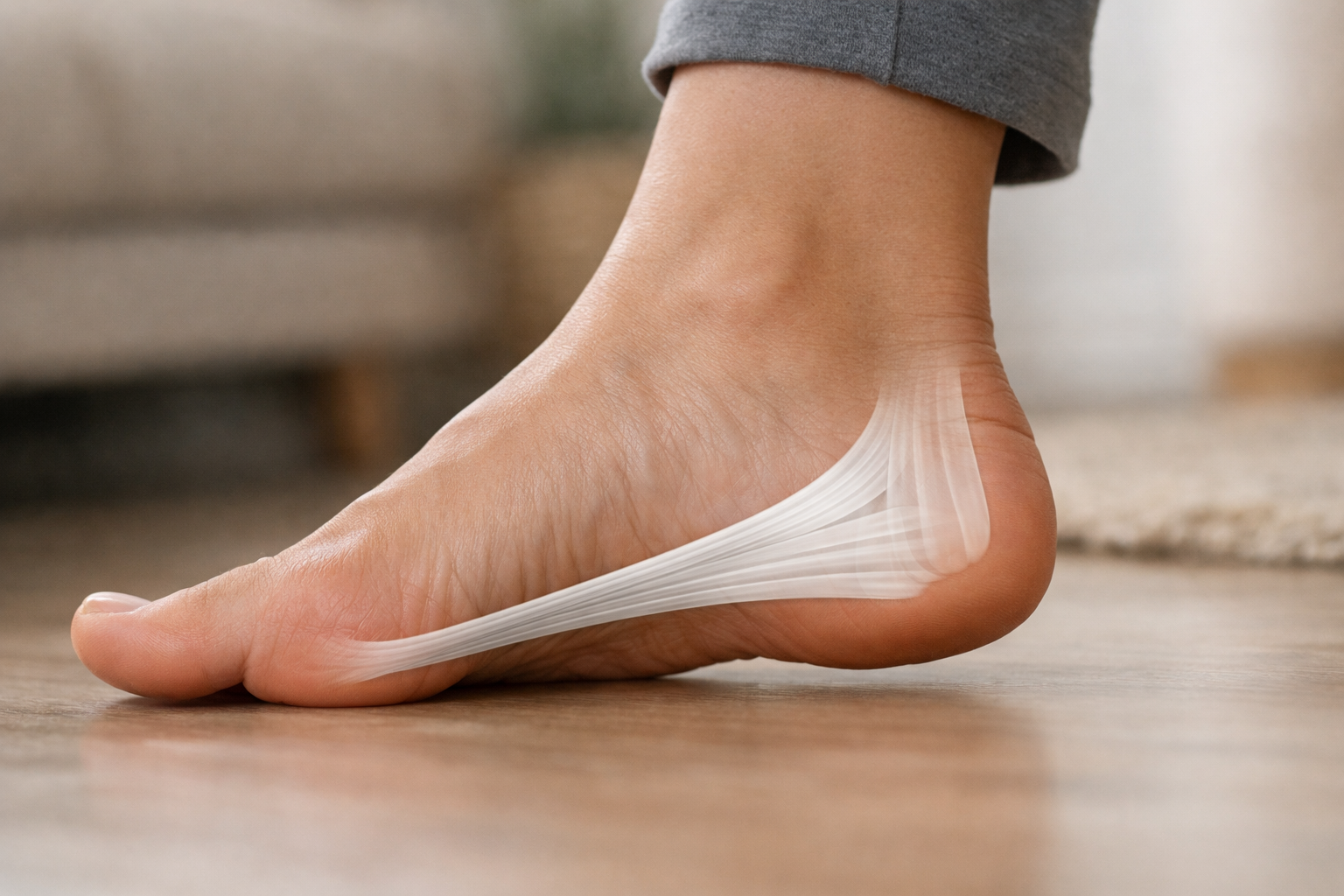
For most people with ordinary heel pain, especially the kind that’s consistent with plantar fasciopathy, walking isn’t dangerous and complete rest isn’t the fix. The real question isn’t “walk or rest,” it’s how much walking your foot can currently tolerate, and how you adjust that amount as your tissue adapts.
This comes down to load versus capacity. Your plantar fascia, like any connective tissue, has a certain capacity to handle daily demand: standing, walking, stairs, work on your feet. When the demand exceeds that capacity, day after day, the tissue gets irritated and sensitized. Pain shows up. The fix isn’t to eliminate load entirely. It’s to bring the load back in line with what the tissue can currently handle, then rebuild capacity so it can handle more.
Is it better to rest or walk with heel pain?

Neither extreme works well. Complete rest calms symptoms temporarily because you’ve removed the stimulus that irritates the tissue, but it does nothing to build the fascia’s tolerance for load. The moment you resume normal walking, the pain tends to come right back, because the tissue never adapted. It just went quiet.
On the other end, ignoring pain and pushing through long walks, hard days on your feet, or a return to running without adjustment usually keeps the tissue too sensitized to calm down and adapt.
The middle ground is intelligent load management: stay as active as you reasonably can, but modify volume and intensity so the total daily load stays within a range your foot can handle. That might mean shorter walks broken into two sessions instead of one long one, more sit-down breaks during a standing shift, or swapping a hilly walk for flat ground while things settle.
How much pain during walking is okay?
A pattern many clinicians use as a general guide: pain at or below roughly 4 out of 10 during and after activity is often acceptable, especially if it settles back to baseline within about a day. Pain that climbs higher, that lingers well beyond 24 hours, or that keeps getting worse walk after walk is a sign the current load is outpacing capacity, and it’s worth scaling back.
This isn’t a precise rule for every person or every foot. It’s a rough compass, not a lab value. Some people tolerate more, some less, and an evaluation can help you calibrate it to your specific situation.
Why does my heel pain get better when I walk?
This is one of the more confusing patterns for people, and it’s actually a useful clue. Many people with plantar fasciopathy notice pain is worst with the first steps in the morning or after sitting a while, then eases up once they’re moving.
That’s a sensitization pattern, not a sign the fascia is “getting warmed up” in a healing sense. After hours of no load, the tissue becomes more reactive. The first steps re-introduce load and the nervous system responds with a sharp protective signal. As you keep walking, that signal often settles, sometimes because of mild fascia loading effects, sometimes because your gait adjusts. It doesn’t mean the tissue is fixed. It means the sensitivity fluctuates with the loading pattern.
What not to do with heel pain
A few patterns tend to slow recovery down more than they help:
- Going from mostly inactive to a long walk or run because you “feel fine that day.” Sudden spikes in load, even on a good day, are a common trigger for flares.
- Chasing pain relief with rest alone for weeks on end. It feels productive because symptoms drop, but it doesn’t rebuild capacity.
- Ignoring total daily load. The exercises or walk you did might not be the problem. A long day on your feet at work, a shopping trip, a home project, all of that adds up in the same tissue.
- Switching footwear abruptly, especially into something with much less support or a different heel height, without giving your foot time to adjust.
- Stopping a loading program the moment pain disappears. Early relief is often a sensitivity change, not a structural one. Tissue adaptation generally takes longer, often in the range of 8 to 12 weeks of consistent, progressive loading, so stopping early is a common reason symptoms come back.
Why won’t my heel pain go away?
A few reasons come up again and again. Total load isn’t being managed, so the tissue never gets a stable window to adapt. Rest and stretching are being used as the whole plan, which reduces sensitivity temporarily but doesn’t change tissue capacity. Or the progression stopped too early, right when symptoms felt manageable, before the fascia had time to actually strengthen.
It’s also worth remembering that pain is a protective output of the nervous system, not a direct measurement of tissue damage. A flare-up doesn’t necessarily mean the fascia is worse than it was last month. Often it just means the tissue got more load than it could tolerate that particular week, and symptoms can lag a day or two behind the activity that caused them. That lag is part of why people misjudge what’s actually driving their pain.
If pain has been present for months or longer, that’s frustrating but it doesn’t mean it’s permanent. Chronic usually just means you need a lower starting point and a slower, more patient progression, not that recovery is off the table.
Why did I suddenly get plantar fasciitis?
“Sudden” is often misleading. Most heel pain builds gradually as load quietly outpaces capacity, and you only notice it once it crosses a threshold. Common contributors include a new walking or running routine, a job change that puts you on your feet more, weight gain or loss that shifts load patterns, a new pair of shoes, or simply more total time standing than your foot has been used to.
None of these are personal failures. They’re just changes in total load on a system that had a certain capacity before the change. If you want a deeper look at the specific mechanisms behind heel pain when walking, our article on why your heel hurts when you walk covers that ground.
What is the fastest way to cure heel pain?
There isn’t a shortcut, and we’d be doing you a disservice to promise one. What tends to work, for many people, is consistent, progressive loading of the fascia and calf-Achilles complex over weeks, combined with keeping daily activity within a tolerable range rather than avoiding it altogether. Early loading programs often start low, sometimes with simple isometric holds or gentle stretching, and increase gradually as the tissue tolerates more.
The progression matters as much as the specific exercise. Early improvements are often driven by changes in the nervous system’s sensitivity, not yet by structural change in the fascia. That structural adaptation takes longer. Rushing the timeline usually just resets the flare cycle.
What finally cured my plantar fasciitis?
We can’t speak to any one person’s experience, and be wary of any source that claims one fix works for everyone. What we can say is that for most people, recovery comes from a combination of things working together: managing total load so the tissue isn’t constantly overwhelmed, a structured and progressive loading program, appropriate footwear or temporary support where useful, and patience through the adaptation window. Orthotics, taping, or a night splint can play a helpful supporting role for some people, but they’re tools for load management, not a standalone cure. The same goes for injections. They can reduce symptoms for a period, but they don’t build tissue capacity on their own.
What can I rub on my foot for plantar fasciitis?
Topical treatments like anti-inflammatory creams, arnica, or CBD-based products are commonly used, and rubbing or massaging the arch with a lacrosse ball or frozen water bottle can feel good and may reduce sensitivity for a short window. That’s worth knowing: these approaches manage sensitivity temporarily. They don’t change the structure of the fascia, and they’re not a substitute for a loading program. Think of them as a way to make the foot more comfortable so you can keep moving, not as the treatment itself.
What is the sock trick for plantar fasciitis?
This usually refers to daytime compression socks or sleeves, sometimes combined with arch taping, used to provide light support and reduce strain on the fascia during activity. It’s a reasonable load-management tool for some people, particularly during flare periods or a return to walking after time off. We go into more detail on this, along with self-tests to distinguish plantar fasciitis from tendonitis, in our article comparing plantar fasciitis and tendonitis.
What actually helps day to day
A few practical, general patterns:
- Keep moving, but in doses your foot can currently handle. Short, frequent walks often beat one long walk.
- Watch your pain during and the day after activity, not just in the moment. A 24-hour tolerance window is a reasonable general check.
- Use supportive footwear as a load-management tool, not a permanent crutch or a sign of failure. Rotating out worn-down shoes matters more than most people expect.
- Don’t demonize a standing job or extra body weight as the cause of your pain. Both simply add to the total load your foot manages each day, and that’s a factor to plan around, not something to feel bad about.
- If you’re returning to running or a more demanding activity, do it gradually, with clear check-ins on pain and next-day response, rather than jumping back to your old volume.
When to get it checked out
Most heel pain follows a predictable, manageable pattern and responds to load management over time. But not all heel pain is plantar fasciitis. Other conditions, including nerve entrapment, stress fractures, and tendon problems elsewhere in the foot and ankle, can produce similar symptoms and need a different approach. If your pain is severe, came on suddenly with swelling or bruising, isn’t improving after a reasonable period of sensible load management, or is affecting your ability to bear weight, it’s worth having a clinician take a look rather than guessing on your own.
The fascia in your heel is not fragile, and walking with heel pain, done thoughtfully, is rarely the enemy. The goal is matching your activity to what the tissue can handle today, then patiently building it up so it can handle more tomorrow.