What Is Plantar Fasciitis? Symptoms, Causes, and How It Develops
A plain-language explanation of what plantar fasciitis actually is, why the tissue gets irritated in the first place, how the problem builds over weeks before you feel it, and what the early warning signs look like. Includes what commonly gets mistaken for it and what the evidence-based path back to walking, standing, and running usually involves.
Most people don’t come in asking for a definition. They come in because the first ten steps out of bed feel like stepping on a stone, and it’s been going on for six weeks, and they want to know what’s happening and whether it’s going to keep happening.
So let’s start there, and work backward into the anatomy.
The short answer
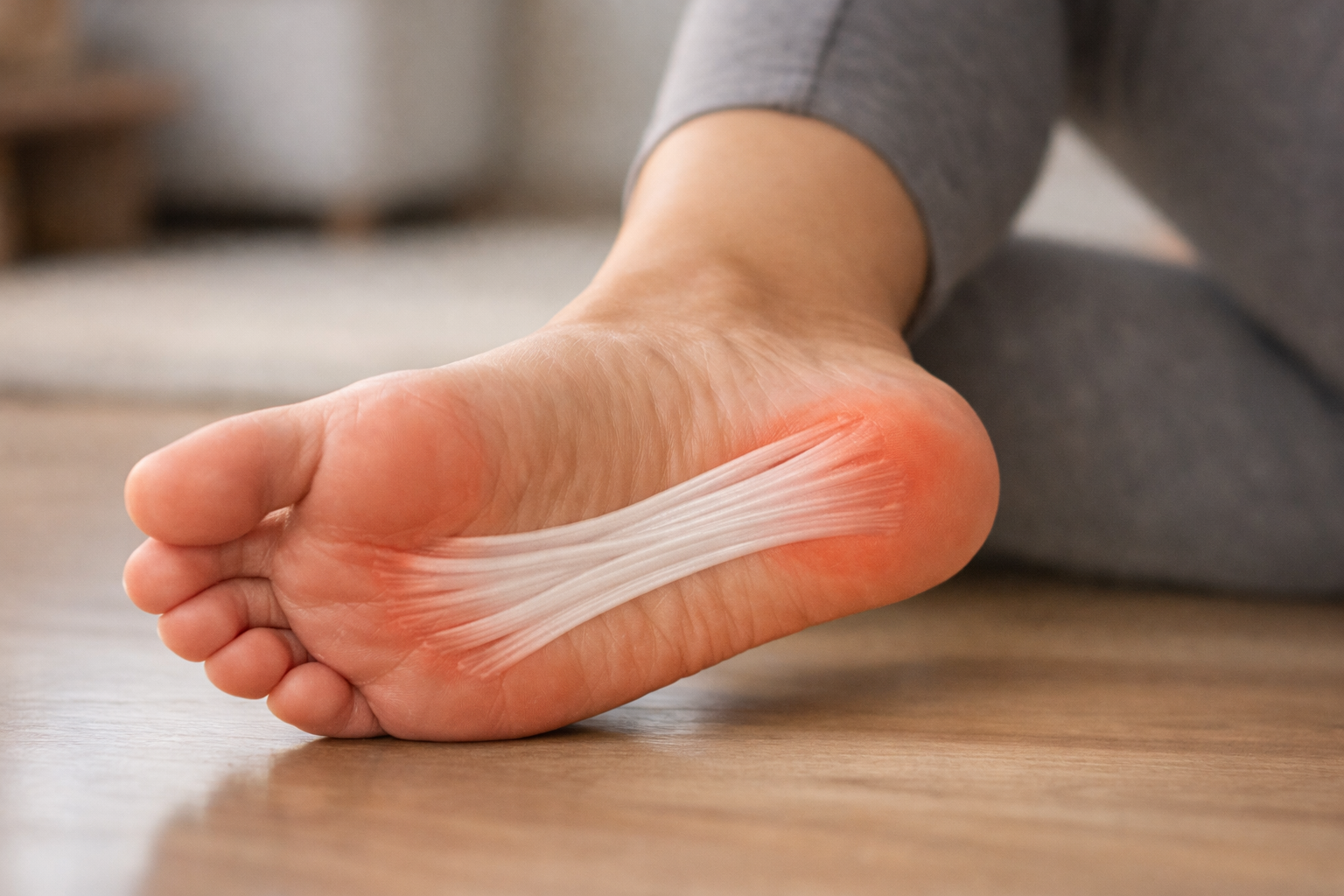
Plantar fasciitis is pain and irritation of the plantar fascia, the thick band of connective tissue that runs along the bottom of your foot from your heel bone forward to the base of your toes. It’s the most common reason people develop bottom-of-the-heel pain.
The name has an “-itis” ending, which implies inflammation. That’s part of the story early on, but it isn’t the whole story, especially once the problem has been around for a few months. When we look at tissue that’s been irritated for a long time, we tend to see changes in the structure of the fascia itself: it gets thicker, the fibers get more disorganized, and it becomes less tolerant of stress. That’s closer to a wear-and-adapt problem than a swelling problem. The more accurate term for that state is plantar fasciopathy.
Why does the terminology matter to you? Because it changes what actually helps. If the problem were purely inflammation, anti-inflammatory measures would resolve it and it would stay resolved. For a lot of people, that isn’t what happens. They rest, it calms down, they go back to walking, and it comes right back. That pattern isn’t bad luck. It’s a clue about what the tissue actually needs.
What the plantar fascia does all day
Stand up. Right now, if you can.
The arch of your foot is under load. The plantar fascia is one of the main structures keeping that arch from flattening out. Every step you take, it stretches slightly, stores energy, and recoils, helping push you forward. It’s doing this thousands of times a day without you thinking about it.
So this isn’t a passive strap. It’s a working tissue under repeated mechanical stress, more like a tendon than a ligament in terms of how it behaves and how it responds to training. That last part matters a lot, and we’ll come back to it.
What is the main cause of plantar fasciitis?
Here’s the frame I use with almost every foot patient, and it explains more than any single anatomical detail:
The demand you placed on the tissue exceeded what the tissue could currently handle.
That’s it. Not a mysterious defect in your foot. Not a punishment for having flat feet. A mismatch between load and capacity.
Capacity is what your foot can tolerate right now, for a specific task, over time. It’s not the same as strength. Someone can squat a respectable amount of weight and still have a foot that can’t tolerate eight hours on a concrete floor. Capacity is task-specific and it’s built through repetition over weeks and months.
The mismatch usually shows up in one of two ways.
Demand went up. Something changed. You started running again after a layoff. You took a new job that has you standing. You went on a vacation where you walked twelve miles a day in flat sandals. You added hills. You moved from a carpeted office to a warehouse. You bought a house and spent three weekends on ladders and hardwood.
Capacity went down. You were off your feet for a while after an illness, a surgery, a busy season at work. Calf and foot strength drop faster than most people expect. Then you resume your normal life at your normal volume, and your normal life is now more than the tissue is ready for.
Often both happen at once, which is why plantar fasciitis so frequently follows a period of relative inactivity followed by a burst of activity.
The risk factors, honestly framed
You’ll see lists of risk factors everywhere: standing occupations, higher body weight, tight calves, very high or very flat arches, sudden increases in running volume, unsupportive footwear, age over forty.
Every one of those is really the same thing said differently. They either increase the total load going through the fascia or reduce how much load the fascia can absorb before it complains. None of them is a character flaw, and none of them means you’re stuck. A standing job isn’t something to feel bad about. It’s a load number we have to account for when we build a plan.
Total load is cumulative
This is the piece people miss most often.
Your foot doesn’t file your activity into categories. It doesn’t know the difference between “my exercises” and “walking the dog” and “grocery shopping” and “standing at my daughter’s soccer game.” It adds everything up.
So when someone tells me their heel flared and they can’t figure out why, because they did their exercises exactly as prescribed, my first question is about the rest of the day. Usually we find it. A long day at a conference. A stint on a hard kitchen floor. A weekend of yard work. The exercise wasn’t the problem. The exercise plus everything else was.
Symptoms also lag. It’s common for the flare to show up a day or even two after the load that caused it, which makes people blame the wrong thing. If your heel is angry on Tuesday morning, look at Sunday and Monday, not just this morning.
How do you tell if you got plantar fasciitis?
There’s a recognizable pattern. It’s not a diagnosis you should make alone, but it’s worth knowing what the pattern looks like.
- First steps in the morning hurt the most. Sharp, stabbing, or bruised-feeling pain under the heel that eases over the first several minutes of walking.
- The same thing happens after sitting. Get up after a long meeting or a car ride and the first thirty seconds are rough, then it settles.
- The pain is worse at the beginning of activity and often better once you’re warm, which is a very different pattern from most joint problems.
- It’s usually worst at the inside of the heel, right where the fascia attaches to the heel bone, and pressing there reproduces it.
- Long days on your feet make the evening and the next morning worse, even if the middle of the day felt fine.
- It came on gradually. Most people can’t name a specific moment of injury. It nagged, then it nagged more.
Why mornings are the worst, and why that’s reassuring
People assume the pain is worse in the morning because something got worse overnight. It didn’t.
Overnight, your foot is completely unloaded for seven or eight hours. The tissue sits in a shortened position, and the whole system gets more sensitive when it goes that long without any stress. Then you stand up and ask it to take your full body weight instantly, with no warm-up. The tissue isn’t more damaged at 6 a.m. It’s more sensitive, and sensitivity responds to being eased into load.
That’s also why the pain fades after a few minutes of walking. Nothing structurally repaired itself in four minutes. The system just calmed down once it got some movement. Once you understand that, the morning pain stops feeling like a verdict on how the healing is going.
The warning signs that came before it
Most people can look back and spot the early version, now that they know what to look for:
- A mild ache under the heel after long days that vanished by morning
- Brief stiffness on the first few steps that you dismissed because it went away
- Tenderness only when you pressed on your heel, not while walking
- Discomfort at the start of a run that disappeared once you got going
That last one fools a lot of runners. Pain that warms up and goes away feels like permission to keep going. Sometimes it is. But if that same pattern shows up on consecutive runs and the post-run soreness is getting longer, that’s the tissue telling you demand is currently above capacity. Adjusting the load at that stage is far easier than adjusting it six months later.
What is commonly mistaken for plantar fasciitis?
Not all heel pain is plantar fasciitis, and getting this wrong sends people down the wrong path for months. A few of the more common look-alikes:
Fat pad irritation. The heel has a built-in cushion of specialized fat. It can get bruised or thin out with age. This tends to hurt in the center of the heel rather than the inside edge, feels more like a deep bruise, and often gets worse the longer you’re on hard surfaces, rather than being worst first thing in the morning.
A calcaneal stress reaction or stress fracture. This is the one that most needs ruling out, particularly in runners who ramped up quickly. Bone pain tends to be more constant, doesn’t warm up and disappear with activity, and often hurts when you squeeze the sides of the heel bone together. Night pain and pain with hopping are flags worth an in-person evaluation.
Nerve irritation. Branches of the tibial nerve run near the inside of the heel. Nerve-driven pain often has a burning, tingling, or electric quality, may radiate, and can bother you at rest or at night, which plantar fascia pain typically doesn’t.
Achilles or insertional tendon problems. Pain at the back of the heel rather than the bottom. Different tissue, similar underlying load-versus-capacity story.
Referred pain from the low back or nerve root. Less common, but it happens, and it doesn’t respond to foot treatment because the foot isn’t the source.
The way you sort this out is with an actual examination: where it hurts to press, what movements reproduce it, what your history looks like, how it behaves across a day. If you’ve been treating a heel for two months with no change in the pattern, that’s worth a second look rather than more of the same. If your pain is more in the arch than the heel, we have a separate article on telling arch pain apart from plantar fasciitis that goes deeper on that specific question.
What about heel spurs?
Someone gets an X-ray, sees a spur on the heel bone, and assumes they’ve found the culprit. A bony point, jabbing into soft tissue. It’s a vivid image and it’s usually wrong.
Heel spurs are common in people with no heel pain at all. They’re generally a response to long-term stress on the area, not the source of the symptoms, and they typically don’t need to be removed. People recover from heel pain with spurs still present, all the time. The presence of a spur doesn’t change the plan and it isn’t a sentence.
Same with imaging that shows a thickened plantar fascia. Thickening is the tissue adapting to sustained stress. It’s information about what the tissue has been through, not a prediction of how you’ll do. A scan can show structural changes, but it doesn’t always tell us why you hurt.
Will plantar fasciitis go away by itself?
Sometimes. Genuinely.
If you caught it early, and the cause was a temporary spike in load (a vacation, a busy week, a shoe you’ve since stopped wearing), backing off can be enough. The load drops below what your foot can handle, the tissue settles, and you carry on.
But here’s the pattern I see over and over in people who’ve had this for months or years. Rest calmed it down. They felt better. They went back to normal life. It came back within a few weeks. Then they rested longer. Same result.
That cycle makes sense once you separate two things:
Sensitivity is how easily the tissue complains. Rest, ice, stretching, and taking pressure off the heel all reduce sensitivity, sometimes quite quickly.
Capacity is how much the tissue can actually tolerate. Rest doesn’t build capacity. If anything, extended rest lowers it, because the fascia, the small muscles of the foot, and the calf all get weaker when they’re not being asked to do anything.
So you come off a rest period feeling better with a foot that can handle less than it could before. Then you return to your regular load, which was already too much, and now the gap is wider. The pain comes back and it feels like nothing works.
Nothing was broken about your effort. The missing piece was rebuilding what the foot could handle, not just quieting it down.
Rest, in small, strategic doses, is useful. It buys you a calmer starting point. As a long-term strategy, it works against you. Rest equals rust.
How do you get rid of plantar fasciitis?
I’ll be straight with you about what I can and can’t say. There’s no timeline I can promise, and anyone giving you a specific number of days without examining you is guessing. What I can tell you is what the path generally looks like, because the principles are sound and many people improve substantially when they follow them.
1. Calm the tissue down enough to work with it
If your heel is furious, we don’t start by loading it heavily. Short-term measures help here: temporarily trimming the parts of your week that spike the load, supportive shoes indoors instead of bare feet on tile, a heel cushion, ice after long days. Taping or a temporary insert can meaningfully reduce day-to-day irritation while you build.
This is a starting point, not the treatment. It makes the real work possible.
2. Load the tissue progressively
This is what changes the structure of the fascia over time, and there’s no shortcut around it. Only sustained, gradually increasing mechanical load produces the tissue adaptation you need.
In practice this usually means loading the calf and the foot together, working through positions where the toes are bent back so the fascia is actually engaged, with enough resistance and enough time under load to be a real stimulus. Slow, controlled, heavy enough to matter.
A few principles that make this work:
- Start below what you think you can do. The goal is to find an amount your foot can handle and build from there, not to prove something on day one.
- Keep discomfort in a manageable range. For many people, staying at or below roughly a 4 out of 10 during and after the work is a reasonable guide. Some discomfort is acceptable. Sharp, escalating pain isn’t.
- Use the next 24 hours as your feedback. If the foot is back to its usual baseline by the following morning, the load was appropriate. If it’s noticeably worse for two days, it was too much, and we scale back and build again.
- Stay at a level long enough to adapt. Early improvement is largely your nervous system getting more comfortable with the movement. Actual tissue change takes longer, often in the range of eight to twelve weeks or more. This is why stopping the moment pain resolves is the single most common reason it comes back.
- Count everything. If you’re on your feet all day Thursday, Thursday isn’t the day to add volume to your program.
Consistency beats intensity here. A moderate amount done four or five days a week for three months will do far more than heroic sessions you can’t sustain.
3. Rebuild toward the thing you actually want to do
Being able to do heel raises in a clinic isn’t the goal. Walking the dog, standing your shift, running your route, getting through an airport, that’s the goal. So the progression has to eventually look like those things: more walking, more standing tolerance, then impact if impact is what you need.
Progress isn’t only measured in pain. Someone can still have some morning stiffness and be objectively better: walking twice as far, standing through a full shift, recovering by the next morning instead of the next weekend. Function matters as much as pain. If we only track the pain number, we miss most of the story and people quit right when they’re improving.
What about other treatments?
Orthotics, night splints, injections, shockwave, manual therapy, dry needling, taping. Each of these can help the right person in the right context, and I’m not going to tell you they’re useless. What they mostly do is reduce sensitivity or offload the tissue, which can be genuinely valuable, especially early or when someone is stuck.
What they don’t do on their own is make the fascia more capable. Used alongside a progressive loading plan, they can be very useful. Used instead of one, they tend to produce the same rest-and-relapse cycle.
Is walking good for plantar fasciitis?
Usually yes, in the right amount, which is the entire question.
Walking is load. Load is what builds capacity. Complete avoidance of walking makes the foot less capable, not more. So the answer isn’t “don’t walk.” It’s “find your current walking tolerance and work upward from there.”
Practically:
- Wear supportive shoes rather than going barefoot on hard floors, at least while things are irritable.
- Break long distances into shorter chunks with breaks.
- Watch the 24-hour response. Back to baseline next morning? That distance is fine, and probably ready to grow a bit.
- Prefer even surfaces early on. Hills, sand, and uneven trails ask more of the fascia.
- Ease into the first steps of the day rather than sprinting to the bathroom. Some gentle ankle movement before your feet hit the floor helps more than people expect.
Movement is medicine, but dose matters as much as it does with any medicine.
What’s the worst thing you can do for plantar fasciitis?

Two things, and they’re opposites.
Shutting down completely and waiting. Weeks of avoiding everything that hurts. It feels responsible. It leaves you with a foot that tolerates less than it did before, and the pain comes back the moment life resumes.
Pushing straight through it with no adjustment. Running the same mileage, standing the same hours, ignoring a foot that’s flaring for three days after every outing. That keeps the tissue in a constant state of irritation and never gives it a window to adapt.
The useful path runs between them. Do something appropriate. Watch how the foot responds over the next day. Adjust. Repeat. The response tells us what comes next, not the calendar.
One more thing worth saying: aggressive, painful stretching or digging into a hot, angry heel with a lacrosse ball for twenty minutes rarely helps and often makes the next two days worse. More force isn’t more progress.
Is massage good for plantar fasciitis?
It can help, with realistic expectations.
Rolling the bottom of the foot on a ball, working on the calf, and general soft tissue work tend to reduce sensitivity and often make the foot feel looser and more comfortable for a while. That’s a real benefit. Feeling better makes it easier to walk, easier to work, easier to do your loading program.
What massage doesn’t do is build capacity. If you roll your foot every morning and nothing else changes, the pain generally keeps returning, because the underlying mismatch hasn’t moved. Think of it as something that helps you tolerate the work, not something that replaces it.
Keep the pressure moderate. If you’re wincing, you’re past the point of usefulness.
What are the best shoes for plantar fasciitis?
There isn’t one brand or model, and I’d be skeptical of anyone who names one without watching you walk. But there are principles.
What tends to help:
- A shoe with a firm, supportive midsole that doesn’t collapse when you press on it
- Some heel-to-toe drop, meaning a slightly raised heel, which reduces demand on the fascia and calf while things are irritable
- A sole that doesn’t twist easily when you wring it like a towel
- Enough room in the toe box that your foot isn’t crowded
- A shoe that fits your foot, which matters more than the marketing on the box
What often makes irritable feet worse in the short term:
- Flat, unsupportive flats and thin sandals
- Completely worn-out shoes with a collapsed midsole
- Going barefoot on tile, hardwood, or concrete for hours
- A sudden switch to zero-drop or minimalist shoes
That last one deserves a note. Minimalist shoes aren’t inherently bad. They ask considerably more of the foot and calf, which can be a good thing over time. But switching suddenly is a large jump in demand, and a large sudden jump in demand is how a lot of people arrive at heel pain in the first place. If you want to go that direction, go slowly, over months.
Also: supportive footwear indoors matters more than most people realize. If you spend ten hours a day at work in good shoes and then four hours barefoot on kitchen tile every evening, that evening block might be the biggest single load on your fascia all day. A supportive house shoe or sandal is a small change with an outsized effect.
And on orthotics, since it always comes up: over-the-counter inserts help plenty of people, custom ones help some people, and neither one is a permanent requirement. They reduce stress on the tissue while you build. Many people gradually need them less as capacity improves. Using one isn’t a failure and stopping one isn’t a rule.
If you’ve had this for a year or more
A long duration doesn’t mean the tissue can’t change. It usually means two things: your starting point is lower than someone who’s had it for three weeks, and the progression needs to be more patient.
That’s it. Persistent doesn’t mean permanent. I’ve worked with people who assumed they’d been dealing with this too long for anything to help, and the honest reason previous attempts stalled was often that they never got past the calming-down phase into the building phase. Not because anyone treated them badly. Because the plan ended when the pain quieted, which is exactly when the tissue work should have been ramping up.
Recovery is built. It’s rarely a straight line, and a flare along the way isn’t evidence that you’ve undone your progress. It’s information about what that particular week asked of your foot. Look at what changed, adjust, and keep watching the larger trend.
When to get it looked at
Most heel pain is manageable and responds well to a sensible plan. Some situations deserve an in-person evaluation sooner rather than later:
- Pain that started suddenly with a pop or a sharp tearing sensation
- Numbness, tingling, or burning in the foot
- Pain that wakes you at night or is present constantly at rest
- Pain that doesn’t warm up with activity and worsens the more you walk
- Heel pain after a significant increase in running, especially with pain when squeezing the sides of the heel
- Swelling, redness, warmth, or fever
- Symptoms that haven’t shifted at all after several weeks of reasonable self-management
An evaluation sorts out whether this is consistent with plantar fasciopathy or whether something else is driving it, and it gives you a starting load rather than a guess. If you’re not sure, get it checked. Knowing what you’re dealing with is most of the anxiety gone right there.