Achilles Tendonitis or Plantar Fasciitis? How to Tell
A physical therapist's guide to sorting out heel pain at the back of the heel from heel pain underneath it, including self-checks, why the two so often show up together, and how loading rebuilds each one.
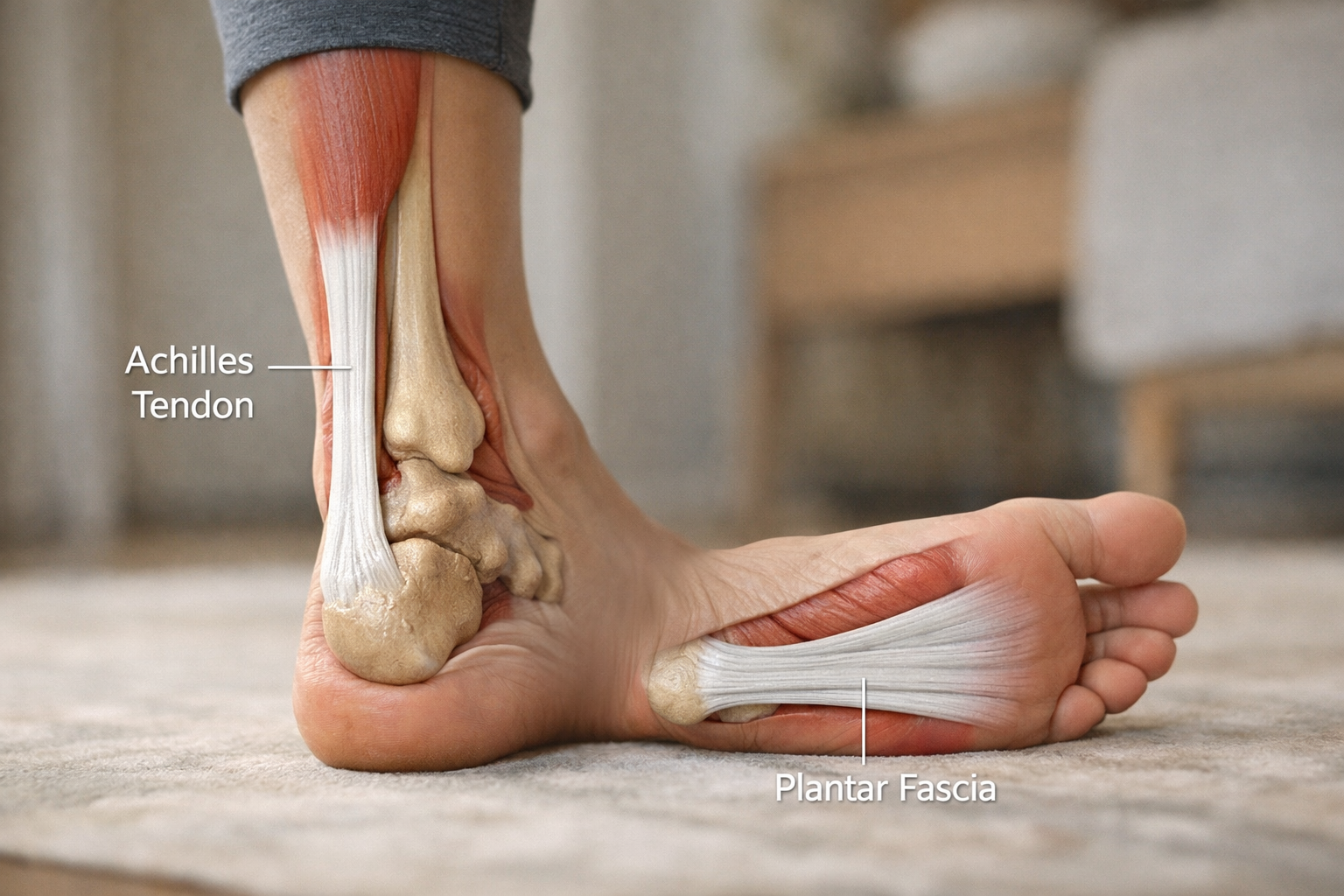
Most people who ask this question already know something is wrong with the back of the foot. They just can’t say exactly where. The pain lives somewhere in that zone behind and below the ankle, worse in the morning, worse after sitting, and it seems to move depending on the day. So they search, find two conditions that both cause heel pain and both hurt first thing in the morning, and end up more confused than when they started.
Here’s the good news. These two are usually easier to separate than they look, and you can do most of the sorting yourself with your hands and a few minutes of honest attention.
Start With One Question: Where Exactly Does It Hurt?
Not “my heel.” Point to it with one finger.
Underneath the heel, on the bottom, often slightly toward the inside edge. That’s the area where the plantar fascia attaches to the heel bone. Pain there, especially with those first steps out of bed, can be consistent with plantar fasciitis (more accurately called plantar fasciopathy when it’s been hanging around a while).
Behind the heel, on the back, in the cord you can pinch between your thumb and finger. That’s the Achilles tendon. Pain there, or a couple of inches up where the tendon narrows, can be consistent with Achilles tendinopathy.
The two structures nearly touch. The Achilles attaches to the back of the heel bone, the plantar fascia attaches to the bottom, and the bone sits between them like a corner. That corner is why people get confused. But the pain itself usually stays loyal to one side of it. Bottom of the heel, or back of the heel. If you press with your thumb, one of those spots will make you flinch and the other usually won’t.
A few other clues that separate them
- The first-step pattern. Both hurt in the morning, so morning pain alone won’t tell you anything. Plantar fascia pain tends to be sharp and located under the heel for the first ten or twenty steps, then eases. Achilles pain in the morning is more often stiffness in the back of the ankle, like the cord needs to be warmed up before it will lengthen.
- What makes it worse mid-activity. Achilles pain often gets angrier with hills, stairs, pushing off, and faster walking or running. Anything that asks the calf to work hard through range. Plantar fascia pain is more provoked by standing still on hard floors, long walking, and barefoot on tile.
- Swelling and thickness. You can sometimes feel a thickened, tender segment of the Achilles tendon. The plantar fascia is harder to feel and rarely looks swollen from the outside.
- Toe extension. Pulling your big toe back toward your shin tightens the plantar fascia across the arch. If that reproduces the pain under your heel, that points toward the fascia.
Can Achilles Tendonitis Be Mistaken for Plantar Fasciitis?
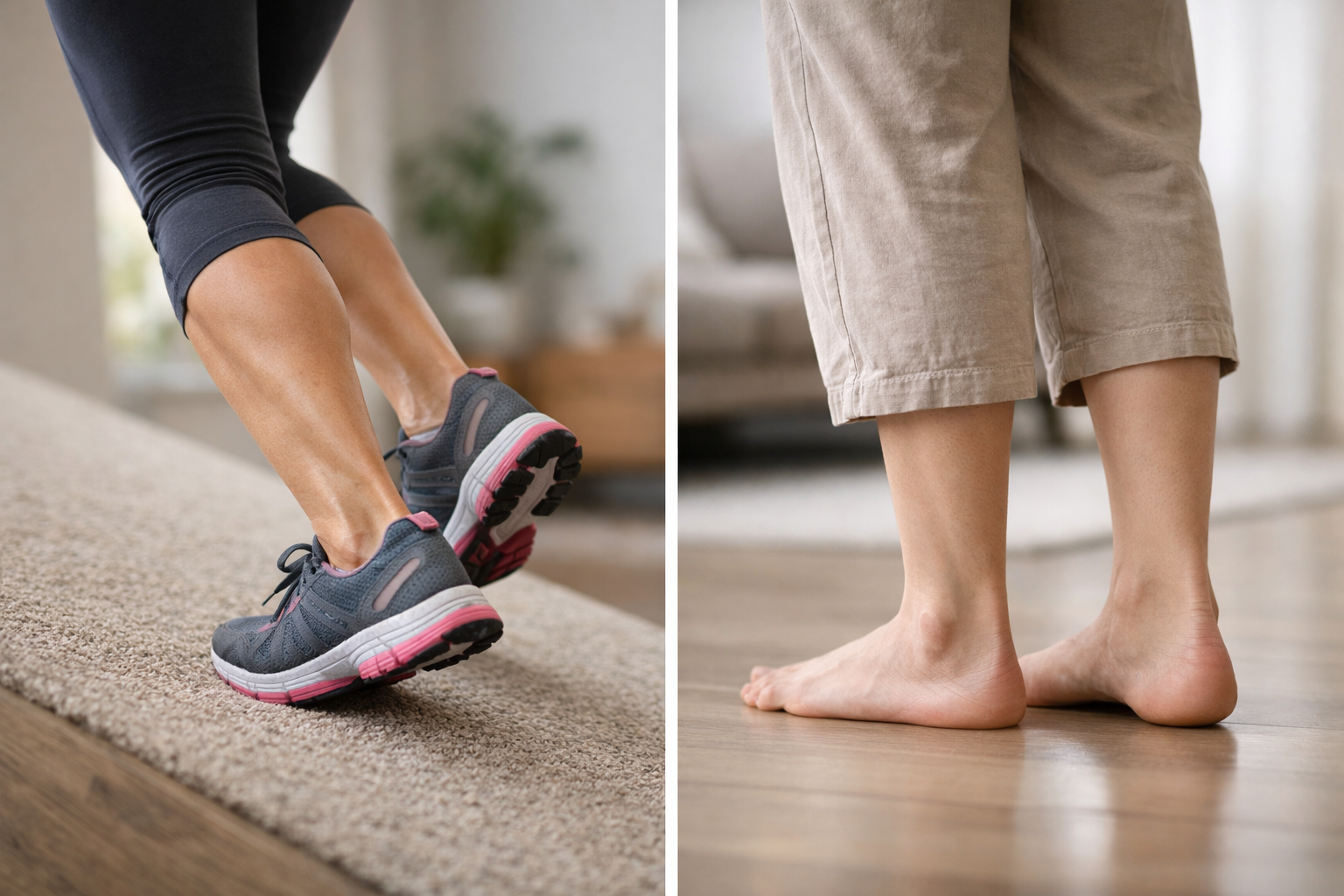
Yes, and it happens often, in both directions.
Part of it is geography. Pain around the heel gets referred to loosely as “heel pain,” and once someone has heard of plantar fasciitis (almost everyone has), that’s the label the brain reaches for. Achilles problems at the very bottom of the tendon, right where it inserts into the heel bone, can feel like the pain is inside the heel rather than behind it.
Part of it is that the two share a lot of the same setup. A tight, weak, or overworked calf increases the pull on the Achilles and changes how your foot handles the ground, which loads the plantar fascia differently. Someone who ramped up walking, changed shoes, started a new job on concrete, or added hill running is stressing both structures at once.
And honestly, plenty of people have both. Not as a coincidence. As one story: the whole back chain of the foot and ankle got asked to do more than it was ready for.
There’s also a third possibility worth knowing about. Not all heel pain is either of these. Nerve irritation on the inside of the ankle, a stress reaction in the heel bone, fat pad irritation (pain right in the center of the heel that feels like a deep bruise), and bursitis behind the heel can all look similar from the outside. If your pain doesn’t behave the way this article describes, that’s a reason to get looked at rather than a reason to guess harder.
What Is the Pinch Test for the Achilles Tendon?
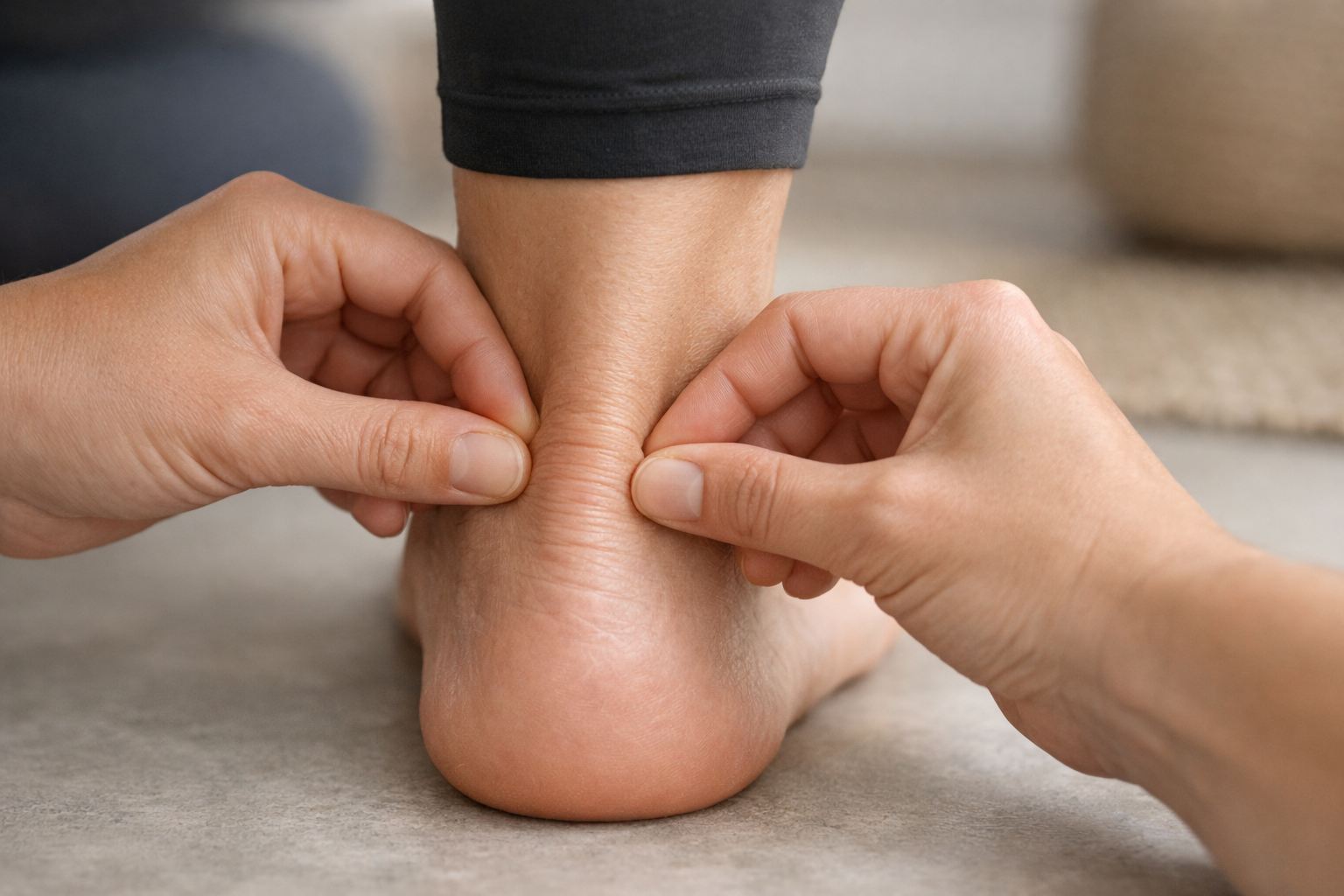
It’s simple, and you can do it right now.
Sit down, cross your ankle over your opposite knee so the back of the heel is easy to reach. Take your thumb and index finger and gently pinch the Achilles tendon from both sides, starting just above the heel bone and working up two or three inches. Compare with your other leg.
What you’re looking for:
- A focal spot of tenderness in the tendon itself, not the surrounding skin or the bone.
- A section that feels thicker, more swollen, or more “solid” than the same spot on the other side.
- Pain that stays in the tendon when you squeeze from side to side.
If pinching the cord reproduces your pain, that’s meaningful. If pinching the cord feels fine but pressing the bottom of your heel with your thumb makes you jump, the tendon is probably not the main story.
One useful add-on: if the tender spot moves up and down as you point and flex your foot, it tends to be the tendon itself. If the tender spot stays fixed in place while the tendon slides past it, the problem may be at the tendon’s attachment or in the tissue around it. That distinction matters for how aggressively we load early on, and it’s part of what an in-person exam sorts out.
The pinch test is a clue, not a verdict. It doesn’t tell you how irritable the tendon is, how much it can currently handle, or why it got that way.
Will Walking Help Achilles Tendonitis?
Usually yes, in the right amount. That last part carries all the weight.
Tendons respond to load. They adapt to it, they get stronger from it, and they get less capable without it. Completely resting an angry Achilles will often reduce your pain in the short run, because you removed the thing that provokes it. Then you go back to normal life, and the pain comes right back, because nothing about what the tendon can handle actually changed. Rest calms sensitivity. It doesn’t build capacity.
So walking is generally good. Walking on hills, on soft sand, in completely flat shoes, or for twice as far as usual is a different question, because all of those increase the demand on the tendon specifically.
How to judge it:
- Pain during the walk that stays at or below roughly a 4 out of 10 is often acceptable rather than harmful.
- The more useful measure is the next morning. If your first steps are about the same as usual, the walk was within what your tendon could handle. If the next morning is clearly worse and stays worse into the afternoon, the load was too much for that day.
- Symptoms can lag. A Saturday of walking around a city can show up on Sunday night or Monday morning. When you’re trying to figure out what set you off, look back a day or two, not just at the last hour.
A temporary bump in symptoms is information, not damage. It tells you where the ceiling currently sits. You adjust and go again.
How Do You Actually Get Rid of Plantar Fasciitis and Achilles Tendonitis?
The treatments differ in the details, but the logic is identical for both, so it’s worth understanding once.
Both problems come from the same equation. The demand you placed on the tissue outgrew what that tissue could currently tolerate. That happens through a jump in mileage, a new job standing on concrete, a shoe change, weight change, a return to sport after a layoff, or just accumulating years of low-grade stress on a structure that never got strong. Nothing about that is a personal failure. It’s arithmetic.
Which means calming things down is step one, not the whole plan. The tissue has to become capable of what you want to do.
Where the two diverge
For the Achilles, loading is fairly straightforward and the tendon tends to like it. Calf raises are the backbone: two legs before one leg, flat ground before a step, slow and controlled before fast. Heavy and slow tends to be well tolerated. Bent-knee variations bring in the deeper calf muscle. Progression is a matter of adding load, adding range, then eventually adding speed and spring if you want to run or play sports again.
For the plantar fascia, the loading looks a little different. Work often includes calf strength (because the calf and the fascia share responsibility for the arch during push-off), foot intrinsic strength, and loaded work with the big toe held in extension, which puts tension through the fascia itself. Standing tolerance is trained separately from walking tolerance, because they aren’t the same skill for your foot.
For both, the same rules apply. Start at a level you can tolerate. Stay there long enough for your body to adapt before moving up. Expect the first few weeks of improvement to come mostly from your nervous system settling down and your muscles coordinating better. The tissue itself changes more slowly, often over something like eight to twelve weeks or longer, which is exactly why so many people feel better in a month, stop, and are back to square one by spring.
One more thing that matters more than any specific exercise: total load. Your foot doesn’t distinguish between the exercise you did on purpose and the four hours you spent on your feet at a wedding. It all counts. If your exercises feel fine but you’re flaring anyway, look at your week, not your program.
Will Achilles Tendonitis Ever Go Away?
Many people improve substantially, including people who have had it for a year or more. The principles are well established. But I want to be honest about what improvement usually looks like, because the expectation people carry into it often sets them up to quit early.
Most people don’t wake up one morning with the pain simply gone. What happens is that the morning stiffness gets shorter. Then the hills stop bothering them. Then they realize they walked four miles on vacation and only noticed it that evening. Then a few weeks pass and they realize they haven’t thought about their heel at all.
Progress shows up in what you can do before it fully shows up in the pain number. That’s normal, not a sign of failure.
Something that’s been there for two years usually means a lower starting point and a slower, more patient progression. It does not mean it’s permanent. Persistent is not the same as fixed in place.
And yes, you’ll have setbacks. A busy weekend, a new pair of shoes, a longer run than planned. A flare-up is not the erasure of your progress. It’s one bad week inside a good trend. Look at what changed, dial back for a few days, and pick the thread back up.
What’s the Worst Thing You Can Do for Plantar Fasciitis?
A few candidates, and the biggest one surprises people.
Doing nothing but resting and waiting. This is the most common path and the one that quietly costs people the most time. Six weeks off your feet will feel better while you’re off your feet. The moment you return to normal life, the demand comes back and the tissue is, if anything, less prepared than before. Rest in small doses calms an irritated foot. Rest as the entire strategy leaves you exactly where you started.
Pushing hard through sharp, escalating pain. The opposite error. If the pain climbs during activity rather than warming up, if it’s clearly worse the following morning, and if that pattern repeats, you’re above the line. Back off the volume, not out of the activity.
Changing five things at once. New shoes, new orthotics, new stretch routine, new exercise program, new walking schedule, all in the same week. When you feel better you won’t know why, and when you flare you won’t know what did it. Change one variable at a time and watch what your foot says.
Stopping the moment the pain stops. This is why plantar fasciitis has such a reputation for coming back. Pain leaves before capacity arrives. If you stop loading at week four because you feel great, you’ve trained your nervous system and left the tissue behind.
Stretching as the only intervention. Stretching often feels good, and calf flexibility genuinely matters for both of these problems. But a stretch temporarily reduces how sensitive the area feels; it doesn’t change what the tissue can tolerate under load. Keep it. Don’t expect it to be the whole plan.
What About the “Sock Trick”?
People usually mean one of two things. Either the night sock (a soft brace or a sock rigged to hold the ankle at neutral overnight so the fascia doesn’t sit in a shortened position for eight hours), or a daytime compression sock. Both can help some people feel better in the morning, and neither is doing anything structural. They’re managing sensitivity, which is a reasonable thing to do while the real work happens elsewhere. If you want the practical detail on the daytime version and taping, we cover that in our article on plantar fasciitis versus tendonitis.
Which leads to the thing worth understanding about morning pain in general. Your heel doesn’t get worse overnight. Nothing is tearing while you sleep. The tissue simply spends hours completely unloaded, and unloaded tissue becomes temporarily more sensitive to the sudden reintroduction of your body weight. That’s why the first ten steps are the worst and step forty is fine. It’s a sensitivity pattern, not a damage pattern. Knowing that takes a lot of the fear out of getting out of bed.
“What Finally Cured My Plantar Fasciitis?”
This is one of the most searched phrasings, and I understand exactly why people type it. You want the thing. The one intervention that flipped the switch for someone else.
I’ll give you the most honest answer I have. For people who get better and stay better, it’s rarely one thing. It’s usually a period of weeks where the demand on the foot got managed sensibly and the capacity of the foot got built deliberately, at the same time. The night splint, the orthotic, the shoe change, the injection, the manual therapy, the stretching, each of these can help in the right context. They tend to work best as support around a loading plan, and least well as substitutes for one.
The piece that’s missing most often isn’t another treatment. It’s a plan for how to progress: what to do this week, how to know whether it went well, and what to change next week based on the answer. Recovery is built.
What Is “Stage 4” Plantar Fasciitis?
You’ll see staging systems online, usually describing something like stage 1 as occasional morning pain and stage 4 as constant, daily pain that limits walking and has been present for a long time. They can be a rough way of describing severity, but there’s no universally accepted four-stage classification for this condition, and no clinician is going to look at your foot and hand you a number that determines your outcome.
What actually matters clinically is different, and more useful to you:
- How easily does it get irritated? How much does it take to stir it up, how bad does it get, and how long does it take to settle?
- What can you currently do? Minutes of standing. Distance of walking. Stairs. Recovery time afterward.
- How long has it been going on? Longer duration typically means starting lower and progressing more patiently.
Those three things shape a plan. A stage number doesn’t. And if you’ve been told your imaging shows a heel spur or a thickened fascia, that’s not a sentence either. Spurs are common in people with no pain at all and are generally a consequence of long-term stress rather than the source of the symptoms. A thickened fascia reflects tissue that has been responding to load. A scan can show structural changes; it doesn’t always explain why you hurt, and people with the same imaging findings have very different outcomes.
Sorting It Out in Real Life
If I had to compress this into what to actually do:
- Point to the pain with one finger. Bottom of the heel or back of the heel.
- Pinch the Achilles and press the bottom of the heel. See which one reproduces your symptom.
- Notice what provokes it. Hills, stairs, and push-off lean Achilles. Standing on hard floors and long walks lean fascia.
- Track the next morning, not just the moment. That’s your best signal for whether yesterday’s activity was within range.
- Keep moving at a level you can tolerate, and build from there rather than waiting for the pain to disappear first.
Some situations deserve a proper look sooner rather than later: pain that came on suddenly with a pop or a feeling of being kicked in the back of the ankle, an inability to push off or rise onto your toes, numbness or tingling in the foot, night pain that isn’t related to activity, significant swelling or redness, or heel pain that’s steadily worsening despite sensible management. Those are worth an in-person evaluation, both to confirm what you’re dealing with and to rule out the things that mimic these two conditions.
And if you’ve been doing the right general things for months without progress, the answer usually isn’t that you need a different diagnosis. It’s that somebody needs to look at where your foot is starting from and build a progression from there.