Plantar Fasciitis Pain Location: Where It Hurts and Why
A location-by-location map of heel and arch pain, why plantar fasciitis concentrates where it does, and what a different pain spot might be telling you instead. Plus how the pattern (not just the spot) points toward what's going on and what to do next.
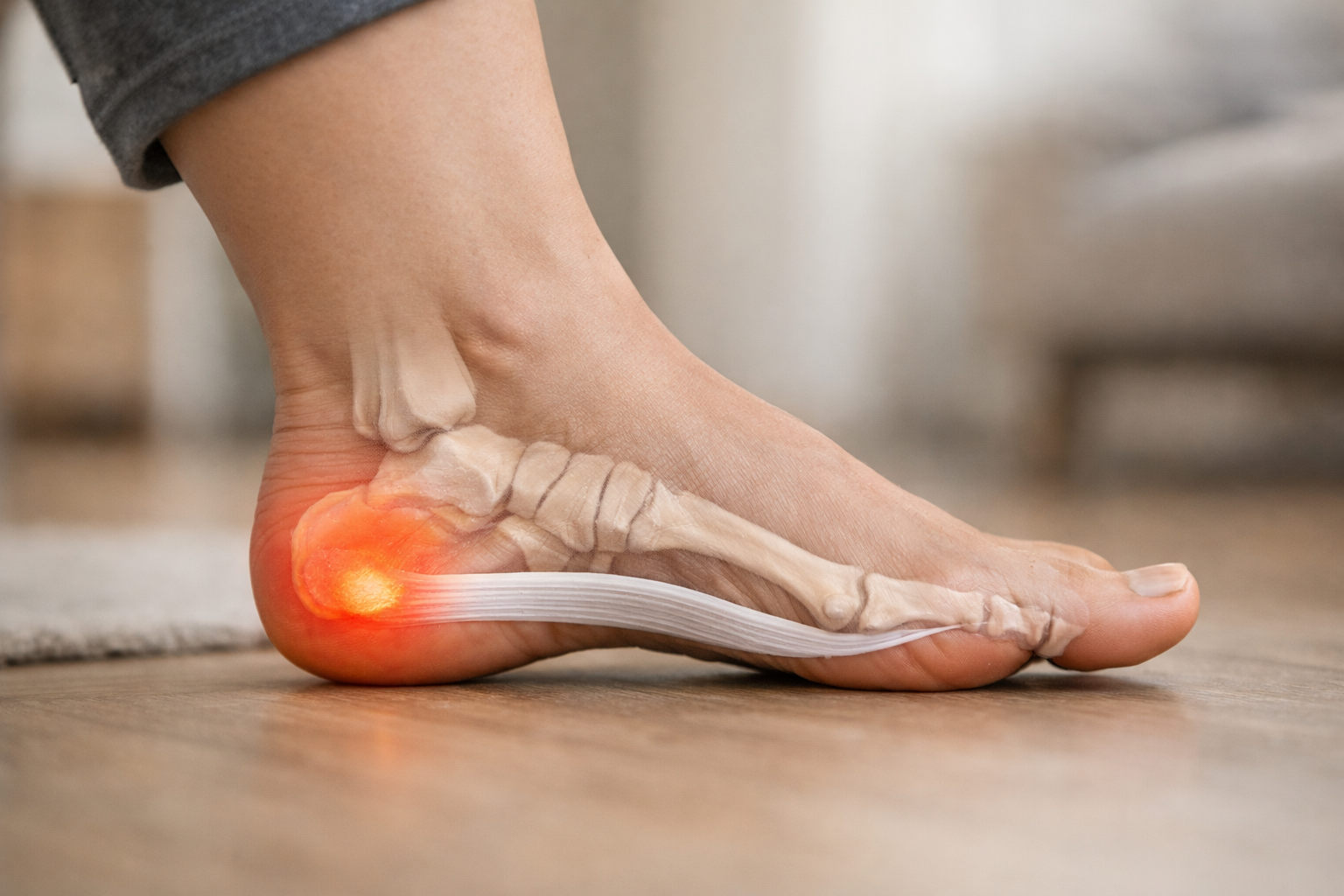
When someone sits down across from me with heel pain, one of the first things I ask is: point to it with one finger.
Not the general area. The spot.
That answer tells me a surprising amount. Plantar fasciitis has a fairly predictable address in the foot, and when pain shows up somewhere else, or spreads in a way that doesn’t match, that’s useful information too. Pain location alone won’t hand you a diagnosis. But combined with when it hurts and what makes it worse, it gets you a lot closer to understanding what your foot is actually telling you.
A quick tour of the tissue involved
The plantar fascia is a thick, fibrous band running along the bottom of your foot. It starts at the underside of your heel bone, runs forward through the arch, and fans out into several strands that attach near the base of your toes.
It isn’t a muscle. It doesn’t contract. It works more like a tie-rod, resisting the flattening of your arch every time your body weight passes over that foot. When you push off and your toes bend upward, the fascia pulls tighter and helps stiffen the foot into a lever. That happens thousands of times a day without you noticing.
The amount of tension is not spread evenly. It concentrates where the band is narrowest and most anchored, which is right at the heel attachment. That’s the mechanical reason the pain has a favorite spot.
The most common plantar fasciitis pain location: the inside of the heel
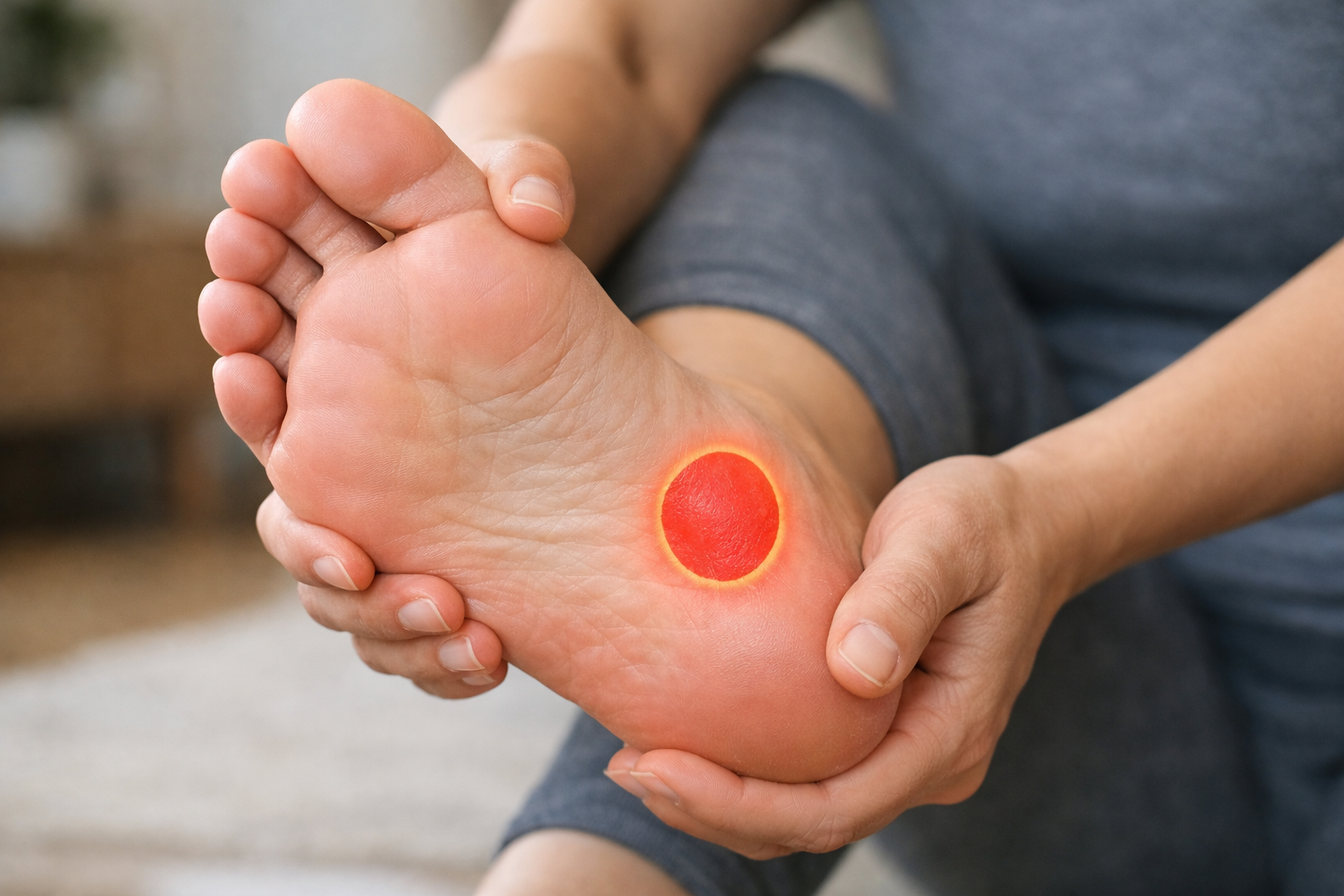
If I had to describe the classic presentation in one sentence: pain on the bottom of the heel, slightly toward the inner edge, in an area about the size of a thumbprint.
People describe it a few different ways. Sharp. Stabbing. Like stepping on a stone. Like a deep bruise. A few describe a burning or pulling sensation that runs forward from the heel into the arch.
What makes this location distinctive is how localized it usually is. If you press your thumb firmly into that inner heel area, you can often find the tender spot and then move a centimeter away and find normal tissue. Diffuse, hard-to-pinpoint heel pain that hurts everywhere you press is less typical and worth a closer look.
The second most common location: along the arch
Some people never have much heel pain at all. Instead they feel a band of soreness running along the inner arch, sometimes described as tight, ropey, or like a cord that needs to release.
This can absolutely be consistent with plantar fascia irritation. The tissue runs the whole length of the foot, and the point of highest strain isn’t identical in everybody. Foot shape, gait, footwear, and what you do all day all shift where the load piles up.
Arch-dominant symptoms also open up a wider list of possibilities, since several other structures live in that neighborhood. If that’s where your pain sits, the article on this site about foot arch pain digs into that territory in more depth.
Where plantar fasciitis usually does not hurt
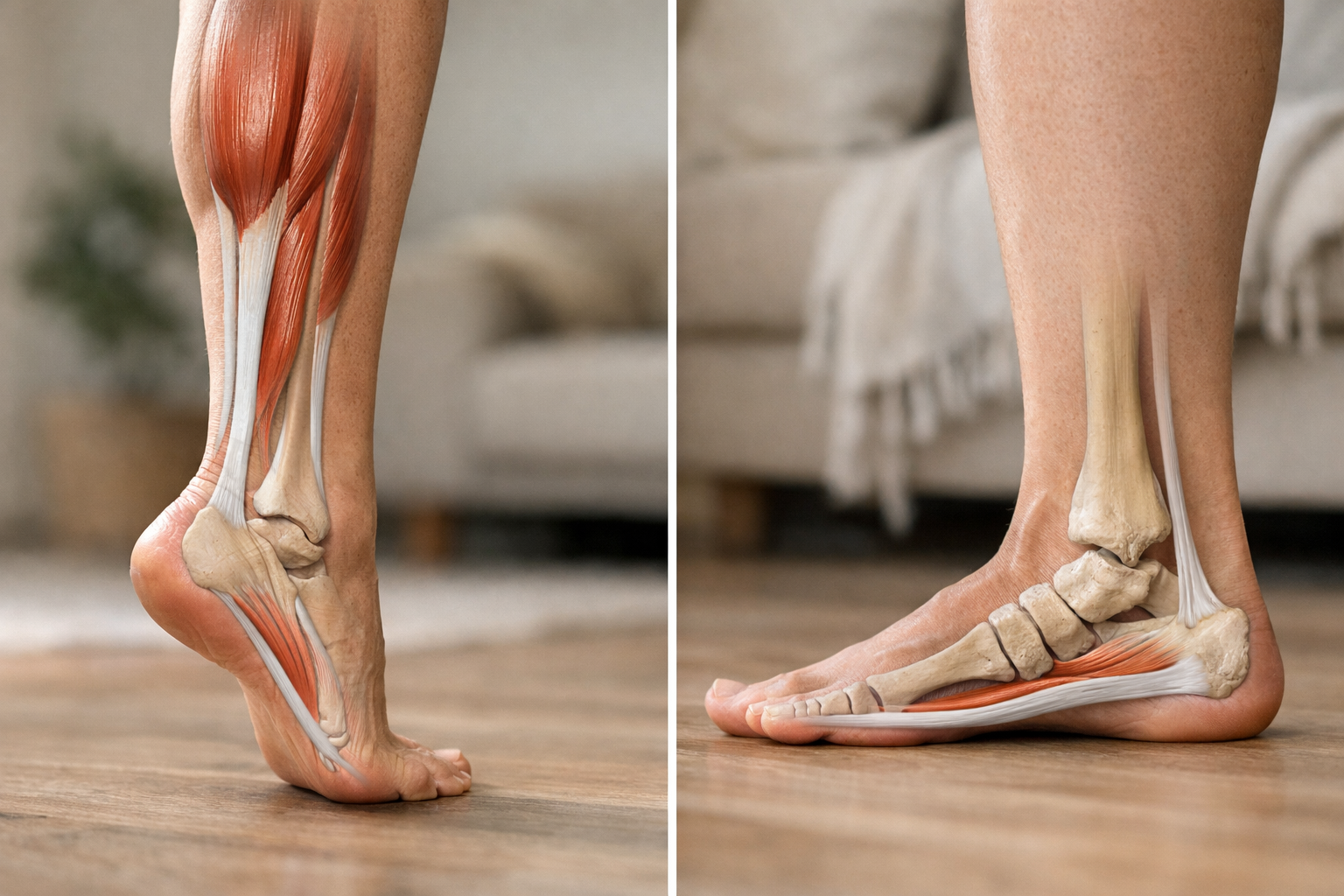
This is where the location map earns its keep. Certain spots point away from the fascia:
- The back of the heel, where the Achilles tendon attaches. That’s a different tissue with a different rehab approach.
- The top of the foot. The fascia is on the bottom. Pain across the top of the midfoot is usually joints, tendons, or bone.
- The ball of the foot, under the toe knuckles. The fascia has strands that reach forward, but pain concentrated under the metatarsal heads generally points elsewhere.
- Wrapping around the outside of the heel or ankle. The fascia’s heel attachment sits toward the inner side.
And two quality descriptions that shift my thinking regardless of location: numbness and pins and needles. Irritated fascia hurts. It doesn’t typically make your foot go numb or send electric shooting sensations into your toes. When those show up, I’m thinking about nerves.
Why the pain seems to move around during the day
A lot of people find this confusing. Morning it’s a sharp point in the heel. By afternoon it’s a dull ache spread across the whole bottom of the foot. By evening the arch is what’s complaining.
That’s not the problem migrating. It’s the difference between a tissue that’s been unloaded for hours and one that’s absorbed a full day of standing and walking. Freshly loaded tissue after a long rest tends to produce sharp, focal pain. Accumulated fatigue produces a broader, achier version. Both can come from the same source.
The same reasoning explains the classic first-step pain in the morning. Nothing gets worse overnight. Your foot spends seven or eight hours with no load at all, the tissue settles into a shortened, quiet state, and then you ask it for full body weight in a single step. That’s a big jump from zero. The sensitivity spikes, then eases over the next several minutes of walking as the tissue gets used to being loaded again. It’s a sensitivity pattern, not evidence of overnight damage. The same thing happens after a long meeting, a movie, or a car ride.
One foot or both?
Both happens more often than people expect, and it doesn’t mean anything is wrong with you as a person. Usually it means whatever changed in your load changed for both feet at once: a new job on concrete, a move to a house with hardwood floors, a training block, a vacation with a lot of walking.
When only one side hurts, I’m curious about asymmetry. Old ankle injury. A calf that’s stiffer on one side. A hip that doesn’t extend as well, quietly changing how that foot pushes off. Not always findable, but often worth asking about.
What can be mistaken for plantar fasciitis, mapped by location
This is the practical value of pinpointing the spot. Several conditions in this area behave differently and need different handling.
Deep, central, bruise-like pain right under the heel bone, worst barefoot on hard floors. This can be consistent with heel fat pad irritation. The fat pad is a shock-absorbing cushion, and when it gets irritated or thins out, the pain sits more centrally than the fascia’s inner-heel spot and often feels less sharp and more like walking on a stone bruise. Cushioning tends to help more here than stretching does.
Burning, tingling, or radiating pain, sometimes at night, sometimes with numbness. Nerve irritation can show up in this region, including branches that run near the inner heel and ankle. What flags it for me is symptoms that don’t follow load in the usual way (present at rest, present in bed) and sensations that are electrical rather than achy.
Pain that hurts when you squeeze the sides of the heel together, following a rapid ramp-up in running or walking. A bone stress injury in the heel is uncommon but real, and it behaves differently: pain with impact more than with first steps, and it tends to get progressively worse with continued activity rather than warming up.
Pain along the inner ankle and arch, worse with prolonged standing, sometimes with the arch looking flatter. The posterior tibial tendon runs through there and can get irritated. It responds to loading too, but the loading is different.
Pain that started suddenly during a sprint or jump, with a distinct pop and bruising. That’s a different conversation and worth prompt evaluation.
One more that’s worth naming: heel spurs. A lot of people get an X-ray, see a spur, and decide that’s their answer. Spurs are common in people with no pain at all, and they’re generally a consequence of long-term stress on the area rather than the thing generating your symptoms. A scan can show structural changes without telling us why you hurt. Recovery follows the same path with or without a spur on the film.
So how do you tell if the pain is plantar fasciitis?
Location gets you partway. The pattern gets you the rest.
The picture that fits most strongly:
- Pain concentrated at the inner bottom of the heel, sometimes extending into the arch
- Worst with the first steps in the morning or after sitting a while
- Eases within a few minutes of walking, then often creeps back later in the day
- Worse barefoot on hard surfaces, better in supportive shoes
- Tender to firm thumb pressure in a specific spot
- Started gradually, often within a few weeks of some change in activity, footwear, or standing time
No single item on that list is conclusive. The combination is what makes it convincing. And it’s worth saying plainly: not all heel pain is plantar fasciitis, and a hands-on evaluation sorts out the ones that aren’t.
Why did I suddenly get plantar fasciitis?
Because it usually isn’t sudden, even when it feels that way.
The underlying frame is simple. Every tissue has an amount of work it can currently handle. When the demand you place on it goes past that, over days or weeks, it starts to protest. Symptoms often lag behind the load that caused them by a day or two, which is exactly why it feels like it came out of nowhere.
The changes I hear about most often:
- A new job, or the same job with more standing
- Ramping up walking or running faster than usual
- Switching shoes, including switching to less supportive ones at home
- A vacation or conference with far more walking than normal
- A layoff from training followed by jumping back in at the old level
- Changes in body weight, which raise the demand per step across the whole system
None of these are mistakes or personal failings. They’re just increases in total load on a system that hadn’t yet built the capacity for them. Total load counts everything: your exercise, your commute, your grocery trip, the hour you spent cooking. Your foot doesn’t separate rehab from life.
What is stage 3 plantar fasciitis?
You’ll see staging systems for this online, and I want to be straightforward: there isn’t one universally agreed-upon staging scale that clinicians all use. Different sources define the stages differently. Generally, higher-numbered stages describe symptoms that have been around a long time, that limit daily activity, and where the tissue itself has changed in structure rather than simply being inflamed.
That later state is more accurately called plantar fasciopathy. It reflects a tissue that has become disorganized and less tolerant of load, which is a different problem than acute inflammation and needs a different solution.
Here’s what I actually want you to take from a “stage 3” label: it describes where you’re starting, not where you can end up. Persistent does not mean permanent. Longer-standing symptoms usually mean starting lower and progressing more patiently. It doesn’t mean the door is closed.
The fastest way to heal it (an honest answer)
People ask this hoping for a shortcut, and I understand why. The honest version is less exciting than the internet’s version but more reliable.
Rest, ice, stretching, taping, and supportive shoes reduce how sensitive the tissue is. That’s genuinely valuable, especially early, when everything hurts and you need some breathing room. But reducing sensitivity is not the same as increasing what the tissue can handle. That’s why the pain so often comes right back the moment normal activity returns. The foot got quieter, not stronger.
Changing the tissue itself takes gradually increasing mechanical load over time. For many people that means calf and foot strengthening done with real resistance, progressed slowly, alongside intelligent management of how much walking and standing you’re doing. Early improvements in the first couple of weeks are largely your nervous system getting more comfortable. The structural change comes later, often over something like eight to twelve weeks, and that gap is exactly why people who stop the moment the pain quiets down tend to see it return.
Two rough guideposts I use with a lot of people, offered as general patterns rather than rules:
- Keep discomfort during and after loading at roughly a 4 out of 10 or below. Some symptom presence is acceptable. Sharp, escalating pain is not.
- Judge by the next 24 hours. If your foot settles back to its usual baseline by the next morning, that load was reasonable. If it’s clearly angrier for a day or two, back the amount down and rebuild from there.
That’s the whole method, repeated. Do an appropriate amount, watch how the foot responds, adjust, build. Recovery is built, not waited for. And it isn’t a straight line: a flare-up doesn’t erase progress, it tells you something about what that day asked of your foot.
When people tell me what finally worked for them, the answer is almost never one treatment. It’s usually that they finally had a plan with a next step in it, and they stayed with it long enough for the tissue to change. Consistency beats intensity here, by a wide margin.
What’s the worst thing you can do?
Complete, extended rest.
Small doses of rest are useful. They calm an irritated foot down. But weeks of avoidance lowers what your foot can tolerate, so when you return to normal life the same activities now exceed a smaller capacity, and it hurts again. That cycle convinces a lot of people their foot is fragile when the real issue is that nothing was ever rebuilt.
The close runner-up is the all-or-nothing swing: rest until the pain is gone, then immediately return to full activity, flare badly, rest again. That pattern can go on for years without ever building anything.
Waiting for zero pain before you start loading is the version of this I see most often. You usually don’t need pain-free to start. You need an amount your foot can handle today.
What about the sock trick, and what do the Chinese do for plantar fasciitis?
The sock trick is a homemade version of a night splint. People use a long sock, a strap, or a wrap to keep the foot from settling into a fully pointed position overnight, which for some reduces that first-step morning sharpness. Some people find real relief from it. Some find it wrecks their sleep, which is its own problem. It’s worth a try if mornings are your worst part of the day, with one caveat: it’s managing sensitivity, not building capacity. Keep it in the supporting role.
Traditional Chinese approaches you’ll come across include acupuncture, herbal foot soaks, tui na (a manual therapy) and gua sha. These are used widely for foot pain, and some people report meaningful relief from them. They generally work on the sensitivity and comfort side of the equation. I don’t dismiss that, because feeling better makes it easier to move, and movement is what drives the change. Just pair anything in that category with a plan that progressively rebuilds what the foot can tolerate, otherwise you’ll likely be back where you started once your activity picks up.
When to get it looked at
Most heel and arch pain builds gradually and responds well to sensible load management over time. Some patterns deserve prompt attention rather than patience: pain following a specific injury or a distinct pop, numbness or spreading tingling, significant swelling or redness with warmth, pain that’s constant and unrelenting at rest or at night, fever, an inability to bear weight, or symptoms that keep worsening despite reasonable changes on your part. If you have diabetes or another condition affecting circulation or sensation in your feet, get foot pain evaluated sooner rather than later.
And if you’ve been dealing with this for months, pointing at the same spot, doing the same stretches, the missing piece may not be another treatment. It may be someone helping you figure out what the next step up should be, and when.