Why Does the Bottom of My Foot Hurt? A Runner's Guide
A practical, location-by-location guide to bottom-of-foot pain in runners and active people, covering what each pattern usually means, which symptoms deserve a same-week phone call, and how to rebuild what your foot can handle instead of waiting for the pain to disappear on its own.
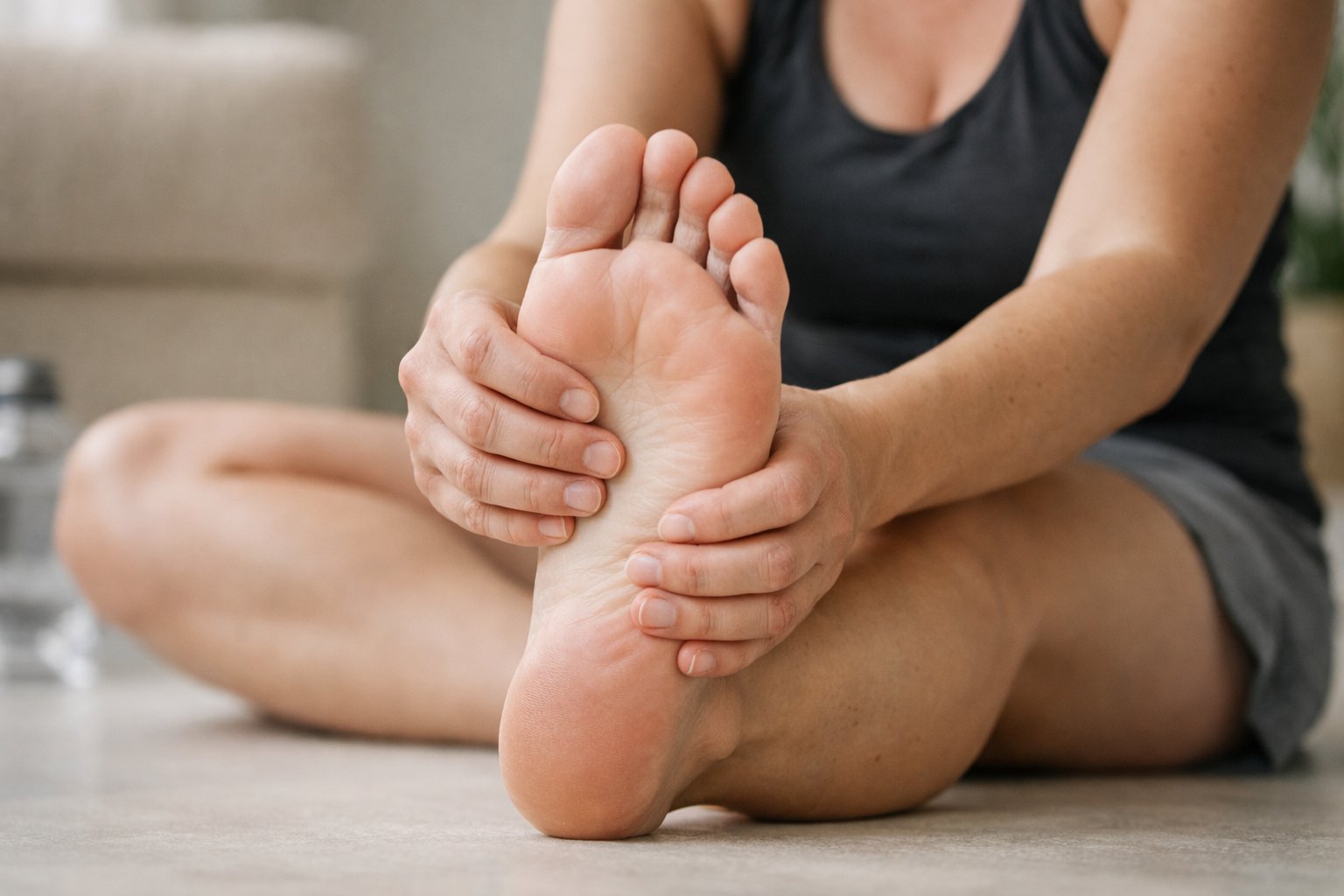
Most people don’t come in asking about the plantar fascia. They come in saying something more like this: the bottom of my foot hurts, I didn’t do anything to it, and I’d like to keep running.
That’s a fair place to start. So let’s start there.
The bottom of your foot is a small area doing an enormous amount of work. Every mile you run puts thousands of loading cycles through a few square inches of tissue. When something down there starts complaining, it’s usually not because you broke it on a specific day. It’s because the demand you’ve been placing on it drifted past what it could comfortably handle, and the tissue started letting you know.
That’s the frame worth holding onto while you read the rest of this. Not “what’s damaged,” but “what’s being asked to do more than it’s currently built for.”
First question: where exactly does it hurt?
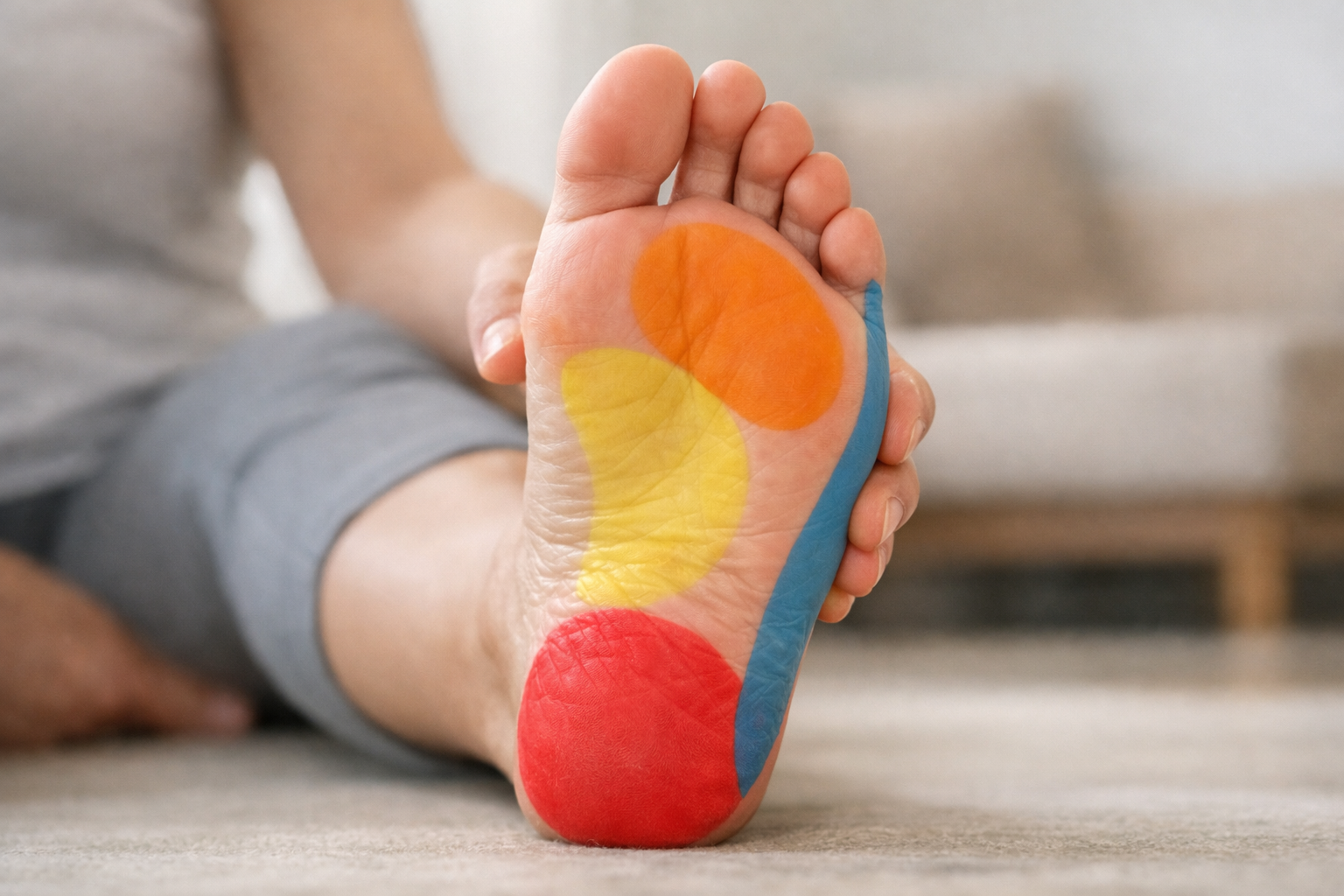
Point to it with one finger. Not “the bottom of my foot,” but the actual spot. Location narrows things down faster than almost anything else.
The inside of the heel, or just in front of it
This is the classic plantar fascia territory. The fascia is a thick band of tissue running from the heel bone forward toward the toes, and where it attaches at the heel is where it usually gets irritated.
If you’re wondering what two symptoms of plantar fasciitis look like, the two that show up most consistently are:
- Pain with the first steps in the morning or after sitting for a while, which eases after a few minutes of walking.
- A tender, findable spot on the inside of the heel that hurts when you press on it.
That combination is common enough that it’s often the first thing we check. It can be consistent with plantar fasciitis, though the more accurate term for the longer-standing version is plantar fasciopathy, because after the first few weeks it’s less about inflammation and more about tissue that hasn’t kept up with what’s being asked of it.
The morning pain confuses people the most. It feels like the foot got worse overnight. It didn’t. The tissue spent seven or eight hours with no load at all, and it’s simply sensitive when load returns suddenly. That’s a sensitivity pattern, not overnight damage.
The arch itself
Arch and instep pain has its own set of possible culprits, and it isn’t always the fascia. We’ve covered that ground in detail in Foot Arch Pain: Causes, Assessment, and What to Do About It, so I’ll keep it short here and point you there if the arch is your main problem area.
The ball of the foot
This is different territory, and for runners it’s common.
- Diffuse aching under the ball of the foot, worse in thin shoes or on hard surfaces, often gets called metatarsalgia. That’s less a diagnosis than a description: the front of the foot is taking more pressure than it’s ready for.
- Burning, tingling, or the feeling of a sock bunched under the ball of the foot, usually between the third and fourth toes, can be consistent with a nerve being compressed between the metatarsal heads (a Morton’s neuroma). People often describe pulling their shoe off mid-run to rub it.
- Pinpoint pain under the big toe joint, especially pushing off, can involve the small sesamoid bones sitting under there.
- A sharp, localized ache over one metatarsal that got worse week over week deserves more caution. More on that below.
The outside edge
Pain along the outer border of the foot, especially in a runner who recently increased mileage or changed shoes, is worth taking seriously rather than stretching more aggressively. Bone along that outer column can get irritated by repetitive load, and it tends to behave differently than soft tissue: it hurts more as you go, not less.
Everywhere, vaguely, in both feet
When pain is burning, numb, tingly, symmetrical, and not clearly tied to activity, the conversation shifts away from training load and toward nerve and circulation questions. That section is coming.
What the timing tells you
Location narrows the list. Timing often tells you more about what’s going on.
Worst in the morning, better after moving. Typical sensitivity pattern from tissue that was unloaded for hours. Common with plantar fascia problems.
Sore at the start of a run, warms up, then returns worse afterward. Very common with tendon and fascia problems. The warm-up feeling is real, but it doesn’t mean the tissue is fine. It means it’s temporarily less sensitive.
Fine during the run, hurts the next morning. This is total load catching up with you. Symptoms often lag a day or even two behind the activity that caused them, which is why people blame the wrong workout.
Worse the longer you go, every single time, and doesn’t warm up. Pay attention to this one. Progressive worsening within a session, especially with a spot you can cover with a fingertip, is the pattern that makes me think about bone rather than soft tissue.
Worse at night, at rest, unrelated to what you did. That pattern doesn’t fit a loading problem, and it should be evaluated.
What would cause foot pain without an injury?
This is the question I hear most, and the honest answer is that most overuse foot pain has no injury moment. It has an accumulation.
Think about everything the bottom of your foot absorbed in the three weeks before it started hurting:
- Mileage or pace that went up faster than usual
- A new pair of shoes, or an old pair with 500 miles on them
- A switch from cushioned trainers to something flatter, or the opposite
- More hills, more track work, more of anything with a hard push-off
- A vacation with a lot of walking in bad sandals
- A move to a job where you’re on your feet all day
- A new house, a new baby, a garden project, a concrete floor
Exercise is only part of the total. Your foot doesn’t distinguish between miles run and hours standing. It counts everything. A flare often comes from the day around the run, not the run itself.
Body weight, standing work, and footwear changes all show up on that list, and none of them are moral failures. They’re inputs into a system that has a certain capacity on a given day. More input than capacity, and the tissue objects. That’s the whole mechanism.
Foot pain that isn’t a training problem
Sometimes the bottom of the foot hurts for reasons that have nothing to do with mileage. These are less common in active people, but they matter, and I’d rather you recognize them than wonder.
Signs of diabetic feet
Diabetes affects nerves and small blood vessels, and the feet are usually where it shows first. The things worth knowing:
- Burning, tingling, or pins and needles, typically in both feet, often worse at night
- Numbness or reduced sensation, including not feeling a pebble in your shoe
- Dry, cracked skin or changes in how much the feet sweat
- Sores, blisters, or cuts that heal slowly or that you didn’t feel happen
- Color or temperature changes in the feet
- Changes in foot shape over time
A wound you didn’t feel is the one that concerns clinicians most, because protective sensation is what normally keeps small problems small. Anyone with diabetes and a new foot sore should be seen promptly, not next month.
Diseases that can announce themselves through foot pain
Several conditions do show up in the foot before anywhere else:
- Gout, often a sudden, intensely painful, red, swollen big toe joint, sometimes overnight
- Rheumatoid and psoriatic arthritis, which can start with pain and morning stiffness across the forefoot joints, usually in both feet, often with stiffness lasting well past an hour
- Peripheral neuropathy, from diabetes or other causes, with the burning and numbness described above
- Peripheral artery disease, where narrowed arteries cause cramping or aching in the calf or foot with walking that reliably stops with rest
- Nerve irritation coming from the low back, which can produce foot symptoms with a completely normal-looking foot
Is foot pain a symptom of heart problems?
Not in the way people usually mean. Heel pain is not a heart symptom.
But there are two connections worth knowing. First, swelling in both feet and ankles that builds through the day can relate to heart, kidney, or liver function, and that deserves a medical evaluation rather than a new pair of insoles. Second, peripheral artery disease shares its underlying causes with coronary artery disease, so foot or calf pain that comes on predictably with walking and eases with rest is a vascular symptom worth mentioning to your physician.
Also worth knowing: pain, swelling, redness, and warmth in one calf or foot, particularly after surgery, illness, or a long flight, needs urgent assessment to rule out a blood clot.
What vitamin are you lacking when your feet hurt?
Usually none, if you’re an otherwise healthy runner whose heel started hurting three weeks after a mileage jump. That pain is mechanical, and no supplement will change what your foot can handle.
That said, two deficiencies genuinely relate to foot symptoms. Low vitamin B12 can contribute to nerve symptoms like burning and numbness. Low vitamin D relates to bone health and can accompany aching, diffuse bone pain, and it’s relevant in runners with repeated bone stress problems. Both are blood tests, not guesses, and they’re worth asking your physician about if your symptoms fit the picture or you’re at risk. Taking supplements on the assumption that a deficiency is the explanation for heel pain is usually a way to spend several weeks not addressing the actual problem.
How to tell if foot pain is serious
Here’s the short version of what makes me want to see someone sooner rather than later.
Five foot symptoms worth not ignoring:
- Numbness or loss of sensation that doesn’t resolve, especially in both feet.
- A sore, blister, or wound that isn’t healing, particularly with diabetes or known circulation problems.
- Sudden inability to bear weight, obvious deformity, or bone pain you can cover with one fingertip that’s been getting worse week by week.
- Redness, heat, and swelling with fever or feeling unwell, which can indicate infection.
- Pain at rest or at night that’s unrelated to activity, or one-sided calf and foot swelling with warmth.
Most bottom-of-foot pain in runners is none of these. It’s a loading problem with a cranky heel or forefoot. But the list is short for a reason, and none of it should be managed with patience and a foam roller.
One more note for runners specifically: not all heel pain is plantar fasciitis, and a suspected bone stress injury changes the plan entirely. If pain is localized to bone, worsens within each run, and hurts when you hop on that foot, get it assessed before you push through another week.
How do you get rid of pain in the bottom of your foot?
Here’s where most advice goes sideways. The common recommendations (rest, ice, stretch, roll a ball under the arch, new insoles) aren’t wrong. They calm things down. The problem is that calming down and building up are two different jobs, and only one of them lasts.
When you rest, the tissue is unloaded, sensitivity drops, and it feels better. Then you run again and it hurts again, because nothing about the tissue’s actual capacity changed while you were waiting. Rest in small doses helps. Rest as the whole strategy is how people end up at month eight of a problem that started as a bad two weeks.
Recovery is built. The foot has to become capable of the thing you want to do.
What that looks like in practice
Turn the volume down, don’t turn it off. Reduce the parts that provoke it most (usually speed, hills, and long runs, in that order) while keeping something going. Staying as active as you can tolerate beats shutting down entirely.
Use a ceiling instead of a zero. For many people, keeping symptoms at or under roughly a 4 out of 10 during activity works well, with the important part being what happens afterward. If your foot is back to its usual baseline within about 24 hours, that load was reasonable. If it’s still elevated the next evening, that was too much for now. Not a failure. Just information about where the line currently sits.
Load it deliberately. Strengthening for the bottom of the foot is not the same as stretching it. Stretching reduces sensitivity for a while. Loading (calf raises, including with the toes propped up on a towel for plantar fascia problems, progressing slowly into heavier and slower work) is what gradually changes the tissue’s tolerance. For forefoot problems, the calf and big toe work matters just as much, along with buying the foot some temporary relief with a stiffer shoe or a metatarsal pad while the capacity catches up.
Stay at each level long enough to adapt. This is where most people go wrong. Early improvements in the first couple of weeks are largely about your nervous system getting more comfortable, not about the tissue being any stronger. Real structural change tends to take something closer to 8 to 12 weeks of consistent loading, often longer for problems you’ve had for a year. Stopping when the pain goes away, but before the tissue has adapted, is the single most reliable route back to the same problem in the spring.
Count everything. If you add mileage in the same week you start a new job standing on concrete, your foot doesn’t care which one was the culprit. Change one input at a time when you can.
Judge progress by more than the pain number. Can you walk farther before it speaks up? Are the mornings shorter and milder? Does it settle faster after a run than it did a month ago? Those are real signs of a foot with more capacity, and they often improve before the pain score does.
About flare-ups
You’ll have one. Probably several. A bad week does not erase the previous six.
When it happens, don’t restart from zero and don’t panic about re-injury. Look at what changed: a longer run, new shoes, a travel day, a hard surface, a week where sleep fell apart. Drop back a level, hold there for a few days, and come back in. Recovery is not a straight line, and expecting it to be is what makes normal bumps feel like evidence of failure.
If you’ve been at this a while
Long-standing foot pain isn’t a different disease. It usually means a lower starting point and a more patient climb. People who’ve had heel pain for two years often improve with the same principles as people who’ve had it for two months. They just need to start smaller and stay consistent longer.
And if you’ve already tried the stretching, the night splint, the orthotics, the injection, and the rest, it’s worth considering that each of those things can help in the right context. What often goes missing isn’t another treatment. It’s a plan for progressing, and a way to know whether what you did yesterday was the right amount.
If your foot pain has stuck around for more than several weeks, is getting worse, keeps you from doing what you need to do, or fits any of the warning signs above, get evaluated in person. Someone needs to watch you walk, press on the actual spot, and test how the foot responds under load. That’s what sorts out which of the many possible sources of bottom-of-foot pain you’re actually dealing with, and it’s the part no article can do for you.