Heel Pain When Walking: Causes, Relief, and Recovery
Heel pain when walking usually means the demand you're putting on your foot has outpaced what it can currently handle. Here's how relief actually works, what to do in the first two weeks, and how to rebuild your foot's tolerance for walking, standing, and life.
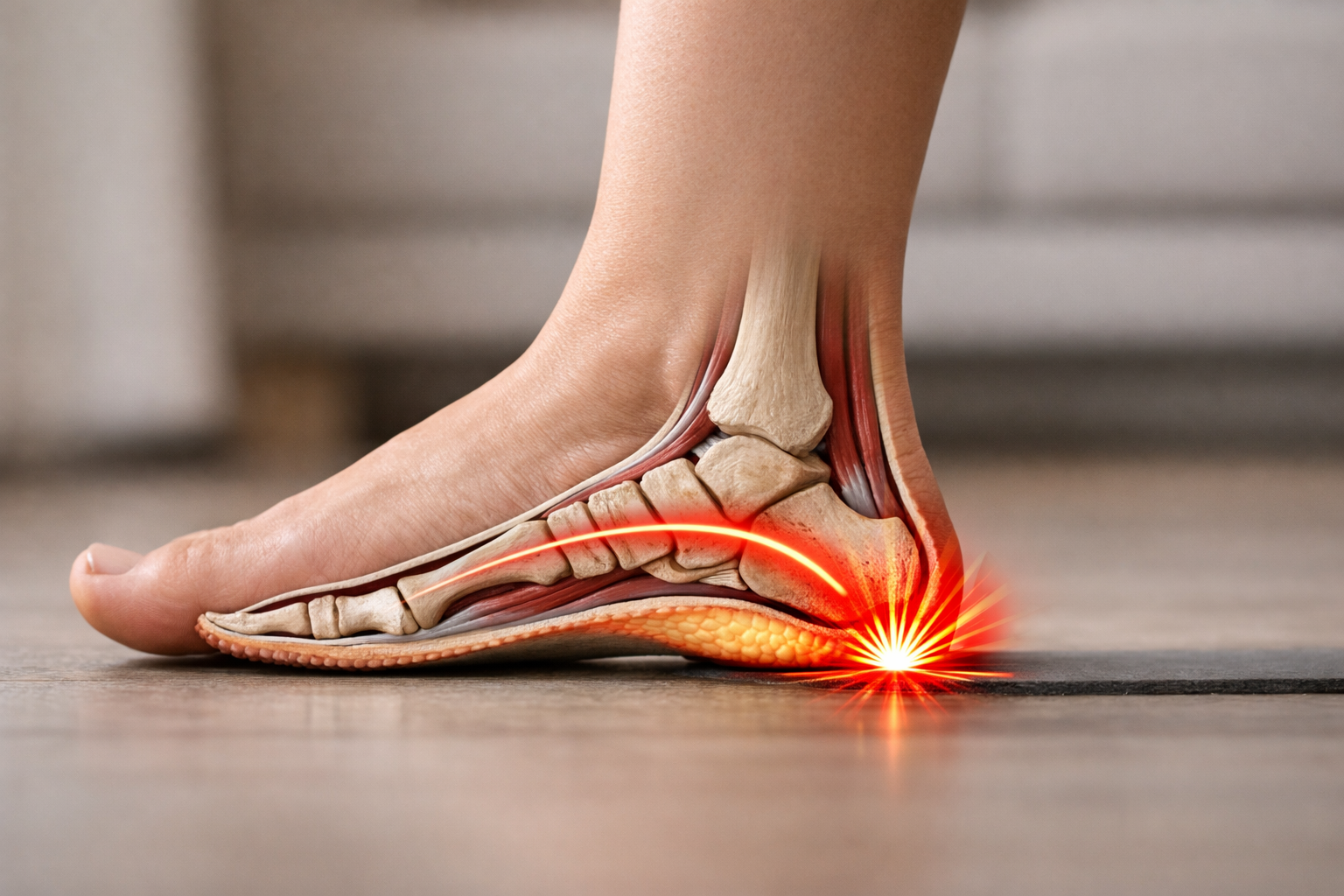
Most people don’t come in because their heel hurts. They come in because their heel hurts and they still have to walk the dog, get through a shift, catch a connecting flight, or chase a toddler across a parking lot. The pain is annoying. What it’s costing you is the real problem.
So let’s talk about heel pain when walking in those terms. Not just what it is, but what to actually do about it, in what order, and how to tell whether you’re getting somewhere.
Why walking is often the thing that hurts
Walking looks gentle. Mechanically, it isn’t.
Every step, your heel strikes the ground, your arch flattens slightly to absorb the load, then stiffens back up so your foot can push you forward. The plantar fascia (the thick band of tissue running from your heel to the base of your toes) is central to that. So is the Achilles, so are the small muscles inside your foot, so is the fat pad under your heel.
Walk 6,000 steps and you’ve asked those tissues to do that job 6,000 times. That’s the piece people miss. Walking isn’t a low-demand activity. It’s a low-intensity activity repeated an enormous number of times, and repetition is exactly what irritated tissue struggles with.
The underlying frame is simple: pain shows up when the demand on a tissue outruns what that tissue can currently tolerate. Not what it could tolerate two years ago. What it can handle right now.
That’s why the same walk feels fine one week and awful the next. Nothing broke. The math changed.
“Why did I suddenly get this? I didn’t do anything different”
You almost certainly did, but the change is rarely dramatic enough to feel like a cause.
Things that quietly shift the load:
- A new job, or an old job with more standing than before
- A vacation with a lot of walking on hard surfaces, often in worse shoes than usual
- Switching from supportive shoes to sandals, slides, or barefoot at home when the weather turns
- Ramping up running or walking mileage faster than usual, even by a modest amount
- A shoe you’ve worn for two years finally wearing out
- A period of being less active (an illness, a busy stretch, an injury elsewhere) followed by returning to your normal activity level
- Weight change, which changes what every step asks of the foot
That last one deserves a clear word: this is arithmetic, not a moral judgment. More load through the system means the tissue needs more capacity to handle it. Same as carrying a heavier backpack. It’s one input among several, and it’s not a character flaw.
The sneaky one on that list is the layoff followed by the return. Tissue capacity drops when you stop using it. Then you come back at your old level and the foot, which quietly downgraded while you weren’t looking, complains. People describe this as sudden. It was actually a gap that opened up gradually and then got exposed all at once.
One more thing about “sudden”: symptoms often lag behind the load that caused them by a day or two. The Saturday hike shows up as Monday morning heel pain. If you’re only looking at what you did that morning, you’ll never find the culprit.
How do I get rid of the pain in my heel when I walk?
Here’s the honest answer, in the order it usually works.
First, bring the irritation down without shutting the foot off. If your heel is screaming, you’re not going to make progress by pushing through 12,000 steps a day. Trim the volume. Not to zero. Trim the part of the day that’s clearly over the line and keep the rest.
Second, change the mechanical environment while things settle. Better shoes, more of the day. Less barefoot on hard floors. Shorter time on your feet in one continuous block, even if the daily total stays similar. Breaking up load matters more than people expect.
Third, and this is the part that actually changes the outcome, rebuild what the foot can tolerate. Calf and foot strengthening, loaded through a range that challenges the tissue, done consistently over weeks. This is the phase most people skip, because by then the pain has faded and it feels unnecessary.
Fourth, walk back into your real life gradually. Add distance, time on feet, or intensity in small steps. Watch how the foot responds over the next 24 hours. Adjust.
Steps one and two make you feel better. Steps three and four are why you stay better. Rest calms things down; recovery is built.
The 24-hour rule, and what pain during walking actually means
Patients ask constantly whether it’s okay for something to hurt. Reasonable question. Here’s how I generally think about it.
For many people, discomfort in the range of about a 4 out of 10 during and after activity is workable, provided it settles back toward your normal baseline within roughly 24 hours. If Tuesday’s walk leaves your foot sore Tuesday night but Wednesday morning feels like it usually does, you probably found an appropriate dose. If Wednesday and Thursday are noticeably worse, that was too much for right now.
These are general patterns, not precise laws. Some feet are more sensitive and need a lower ceiling. Some tolerate more.
What matters is the principle underneath: pain is information. An increase in symptoms doesn’t automatically mean you damaged something. Sensitive tissue reports loudly, and how loudly it reports is influenced by sleep, stress, how much you were on your feet yesterday, what shoes you wore, and a dozen other things. The 24-hour response tells you far more than the number in the moment.
What’s actually worth doing in the first two weeks
When a heel is angry, people go looking for the one thing that helps. There isn’t one thing. There’s a stack of small things that lower the total load while you get the real work started.
Shorten your longest standing block. If you stand for three hours straight at work, find a way to sit for four minutes at the ninety-minute mark. Same total time on feet, very different demand.
Stop going barefoot on tile and hardwood at home. This is one of the highest-yield changes and it costs nothing but a supportive pair of house shoes. People are careful about their shoes all day and then spend three hours barefoot on kitchen tile every evening.
Use ice or a frozen bottle if it helps you. It reduces the sensitivity for a while. It isn’t changing the tissue, and that’s fine. Comfort has value, especially early on.
Warm the foot up before your first steps in the morning. Before you stand, do 15 or 20 slow ankle circles and gently pull your toes back a few times. Morning pain is a sensitivity pattern from hours of no load, not evidence that something got worse overnight. Easing the tissue back into work makes those first steps less brutal.
Keep stretching in perspective. Calf and fascia stretching often feels good and can reduce symptoms in the short term. It doesn’t build capacity. If stretching is the entire plan, the pain tends to come back the moment normal loading returns, and people conclude they failed. They didn’t. The plan just stopped short of the part that changes the tissue.
How you fix plantar fasciitis: the part that actually rebuilds
The accurate term for the persistent version of this problem is plantar fasciopathy. It’s not primarily an inflammatory condition after the first few weeks. It’s a tissue that has been overloaded relative to its capacity and hasn’t been rebuilt since.
Which tells you what the treatment has to be. You have to load it.
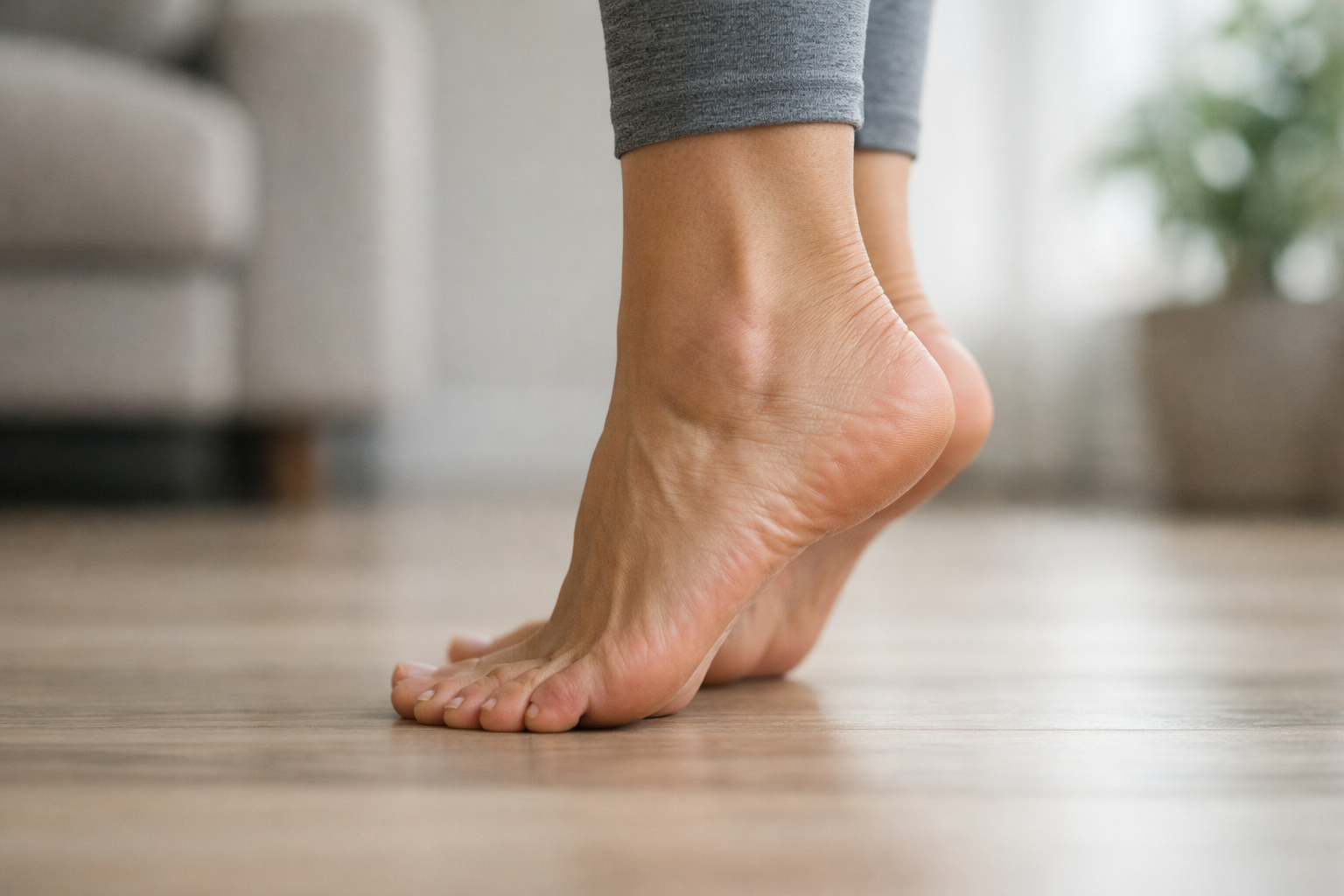
In practice that usually means progressive calf and foot strengthening, most often centered on heel raises, done slowly and with enough resistance to be genuinely challenging. Many people do these with a rolled towel under the toes, which puts the fascia on stretch while the calf works. Load transfers through the fascia that way instead of around it.
A few principles matter more than the exact exercise:
- Start at a level your foot can handle today, even if that level feels embarrassingly modest. Two-legged before one-legged. Flat ground before a step.
- Go slow. Three seconds up, three seconds down beats fast repetitions.
- Stay at each level long enough to adapt before making it harder. A week or two, generally, guided by how the foot is responding.
- Expect the timeline to be measured in months, not days. The first few weeks of improvement come largely from your nervous system getting more comfortable with the movement. Actual structural change in tendon and fascia takes longer, often in the range of 8 to 12 weeks of consistent work for meaningful adaptation, sometimes longer for a problem you’ve had for years.
That last point explains the most common failure pattern I see. Pain resolves at week four, the person stops, and the tissue never finished adapting. Three months later it’s back and they assume the problem is untreatable. It isn’t. The work stopped in the middle.
Consistency beats intensity here. Three sessions a week for ten weeks does more than a heroic two weeks followed by nothing.
Can plantar fasciitis go away?
Yes. Many people improve substantially, including people who’ve had it for a year or more.
But let’s be precise about what “go away” means, because the expectation shapes how people interpret their progress.
If it means the tissue gets more tolerant, the morning pain fades, you walk normally, and you stop thinking about your heel, then yes, that’s a realistic goal for a lot of people. If it means the foot becomes permanently immune to ever being irritated again, no tissue in your body works that way. Ramp up mileage aggressively enough and any structure will complain.
Having dealt with this for a long time doesn’t mean it’s permanent. Persistent usually means two things: your starting point is lower, and the progression needs to be more patient. Not that recovery is off the table.
What’s the worst thing you can do for plantar fasciitis?
Complete rest, waited out indefinitely.
It’s a genuinely reasonable-sounding plan. Something hurts, so you stop using it. And it works, briefly. Symptoms drop because the tissue isn’t being asked to do anything.
The problem is that capacity drops right along with the symptoms. So when you return to walking, standing, or running, you’re returning with a foot that’s less capable than the one that got hurt in the first place. The pain comes back, often faster, and now the story in your head is that walking causes damage. That belief does its own harm.
Rest is a legitimate tool in small doses. As the whole strategy, it backfires. Rest equals rust.
Other things worth avoiding:
- Aggressive stretching or rolling on a very irritated heel. More is not better with sensitive tissue.
- Changing five variables at once. New shoes, new orthotics, new exercises, a new walking program, and a new stretching routine all in the same week. When something changes, you’ll have no idea what did it.
- Chasing a new treatment every two weeks. Most approaches need consistent time to show what they can do. Rotating through them at speed guarantees none of them get a fair trial.
- Only measuring pain. More on that in a moment.
What shoes actually help

Shoes matter, but not in the way the marketing suggests. There is no correct shoe for plantar fasciitis. There are shoes that reduce the demand on an irritated foot, and right now that’s what you want.
What generally helps:
- Some cushioning. Hard surfaces plus thin soles is a rough combination for an irritated heel.
- Meaningful arch support, either built in or added. This isn’t correcting your foot. It’s sharing some of the work while your tissue is sensitive.
- A modest heel-to-toe drop. A slightly raised heel takes some tension off the fascia and Achilles. Very flat and very minimal shoes ask more of both.
- A stiff-ish forefoot. If the shoe folds in half easily, your foot is doing more work with every step.
- Actually wearing them. The best shoe in your closet does nothing while you’re barefoot on the kitchen floor.
A word on orthotics, since people expect me to have a strong opinion. They can be genuinely useful, particularly early on when reducing demand helps you stay active. They’re a support, not a repair. If they get you walking comfortably enough to do the strengthening work, they’ve earned their place. If they’re the entire plan and nothing else is happening, you’ll likely still be wearing them in three years with the same foot underneath.
A note on the minimalist and barefoot conversation: those shoes aren’t inherently harmful, and some people do very well in them. The trouble is almost always the transition. Going from supportive shoes to minimal ones over a weekend is a large jump in demand with no corresponding build in capacity.
How do you know if it’s plantar fasciitis, and what else it could be
The pattern that’s most consistent with plantar fasciopathy: sharp pain at the inside-front of the heel, worst with the first steps in the morning or after sitting, easing somewhat after a few minutes of walking, then returning later in the day after you’ve been on your feet a while. Pressing on that spot reproduces it.
But plenty of things mimic that. Achilles problems (pain behind the heel rather than underneath), fat pad irritation (a deeper bruise-like ache right in the center of the heel, often in people who’ve lost some of that natural padding), nerve irritation (burning, tingling, or pain that doesn’t follow the classic morning pattern), and bone stress injuries (pain that gets worse the longer you’re on it rather than warming up, sometimes with night pain). These are handled in more depth in our article on why your heel hurts when you walk, so I won’t repeat the whole sorting process here.
The practical point: if your pain doesn’t follow the typical pattern, or if it’s been treated as plantar fasciitis for months with nothing changing, that’s a good reason to get it evaluated rather than to keep going with a plan built for a different problem.
And if you’re wondering why only one foot hurts when you use both of them equally, the usual answer is that you don’t actually use them equally. Small differences in strength, ankle motion, old injuries, and how you distribute weight when you stand mean the two feet aren’t running the same numbers.
What to watch besides the pain number
If pain is your only measuring stick, you’ll misread your own progress constantly. Pain fluctuates for reasons that have nothing to do with tissue health.
Better questions to ask yourself every couple of weeks:
- How far can I walk before it starts talking to me?
- How long do those first morning steps stay rough? Two minutes, or twenty?
- How quickly does it settle after a long day?
- Am I doing things I’d stopped doing?
- How much am I thinking about my foot?
Those can all improve while your worst-moment pain score stays roughly the same. That’s real progress, and if you’re not tracking it, you’ll miss it and conclude nothing is working. Function matters as much as pain.
Flare-ups
You will have them. Plan on it now so it doesn’t derail you later.
A flare-up is a temporary rise in symptoms. It is not the erasure of your progress. Weeks of tissue adaptation don’t vanish because of one long day at a wedding.
When it happens, do three things. Look back two or three days and find what changed, because there’s almost always something (new shoes, a longer walk, a day of concrete floors, a jump in your exercises, or several of those stacked). Back the load down enough that you’re comfortable again, not to zero. Then rebuild from a slightly lower point, a bit more gradually than last time.
And keep the longer trend in view. Compare this month to two months ago, not today to yesterday. Recovery is not a straight line, and the graph looks alarming if you zoom in too far.
When to get it looked at
Most heel pain responds well to sensible load management and consistent strengthening. Some situations deserve a professional set of eyes sooner:
- Pain that came on after a specific injury or a distinct pop
- Numbness, tingling, or burning through the foot
- Pain that’s worse at night or at rest, or that gets steadily worse the longer you’re on it rather than warming up
- Swelling, redness, warmth, or fever
- Heel pain in both feet in someone with other joint pain, morning stiffness elsewhere, or a family history of inflammatory conditions
- No meaningful change after two or three months of consistent, sensible work
Also worth knowing: imaging often finds things that don’t explain your pain. Heel spurs are common in people with no symptoms at all, and they’re generally a consequence of long-term stress rather than the source of the pain. Thickened fascia on an ultrasound reflects tissue adapting to load. A scan can show structural changes, but it doesn’t always tell us why you hurt, and it doesn’t decide how well you’ll do.
Where to start this week
If you take one thing from this: figure out what amount of walking your foot can handle right now, do that consistently, and start building strength alongside it. Not what you did last year. What today’s foot can absorb without punishing you tomorrow.
Then add a little. See what happens. Adjust.
That loop, repeated over a few months, is what changes heels. It’s less satisfying than a single treatment that makes the pain disappear. It’s also the thing that tends to hold.