What Does Peroneal Tendonitis Feel Like? Signs and Early Steps
A detailed, plain-language description of how peroneal tendonitis actually feels, how it behaves across a day, and what else it can be confused with. Plus what the early window is good for, and honest answers on braces, ice, massage, walking, and how long recovery usually takes.

Most people don’t arrive with a question about tendons. They arrive with something more specific: “There’s a spot on the outside of my ankle that’s been bugging me for three weeks. It’s fine in the morning, it’s annoyed by the time I get home, and I can’t tell if I should keep walking on it or leave it alone.”
That’s the real question. So let’s start with what this actually feels like, because recognizing the pattern early changes how straightforward the next few months tend to be.
Where it hurts, and what it feels like
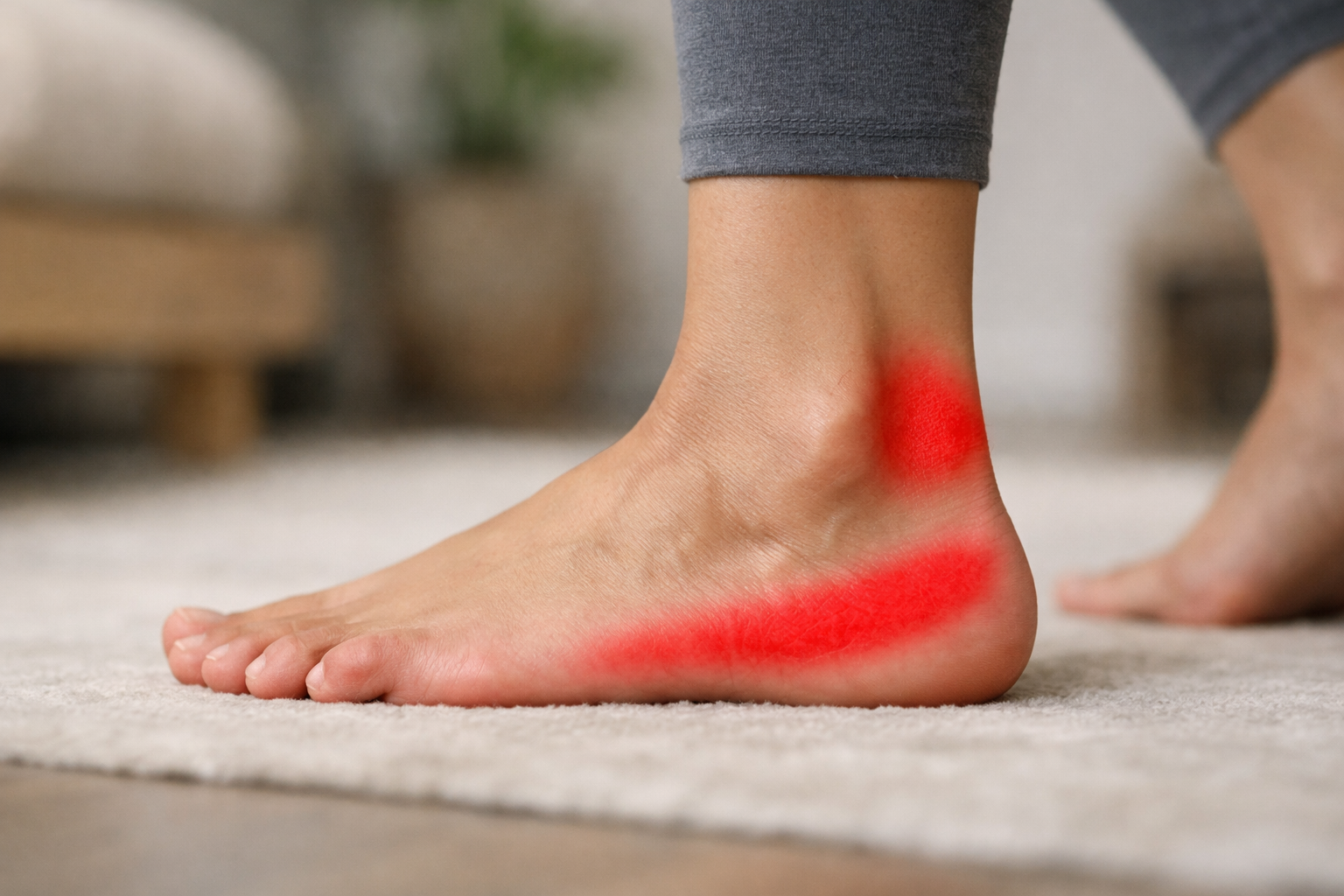
The peroneal tendons run down the outside of your lower leg, hook around behind the bony bump on the outside of your ankle, and travel forward along the outer edge of your foot. One of them tucks underneath and crosses to the arch. They help you push off, they control your foot rolling inward, and they do a lot of quiet stabilizing work on every single step over uneven ground.
When those tendons get irritated, the pain usually shows up in one or more of these places:
- Just behind or just below the outer ankle bone
- Along the outer border of the foot, heading toward the bony bump at the base of the fifth toe
- Sometimes tracking up the outside of the lower leg, a few inches above the ankle
- Occasionally under the arch, if the tendon that crosses beneath the foot is the irritated one
People describe the sensation differently, but a few descriptions come up again and again. A deep ache that sits in one specific spot. A sharper catch when you push off or turn a corner. A burning or warm feeling along the tendon’s path, especially after a long day. Sometimes a sense that the ankle is tender to the touch in a narrow line, not a broad area.
Some people notice a puffiness behind the outer ankle bone, a slight fullness compared to the other side. Some notice a snapping or clicking as the tendon moves. And a lot of people report a vague feeling that the ankle isn’t quite trustworthy on uneven ground, like it might wobble, even though it has never actually given way.
All of that can be consistent with peroneal tendonitis. None of it confirms it on its own, which matters, and I’ll come back to why.
The behavior pattern is more telling than the sensation
How the pain moves through your day usually tells me more than how it feels in any single moment.
The classic early pattern looks like this. You feel stiff or mildly tender in the first few minutes of walking. It eases as you get going. Then somewhere in the back half of the day, or in the hour after a run or a long walk, it comes back louder than it started. You sit down for dinner, get up, and it’s stiff again.
That’s a load pattern. The tendon handles a certain amount of work fine, and then the accumulated total tips it over. Notice that the trigger isn’t usually one dramatic moment. It’s volume.
A few specific things tend to provoke it:
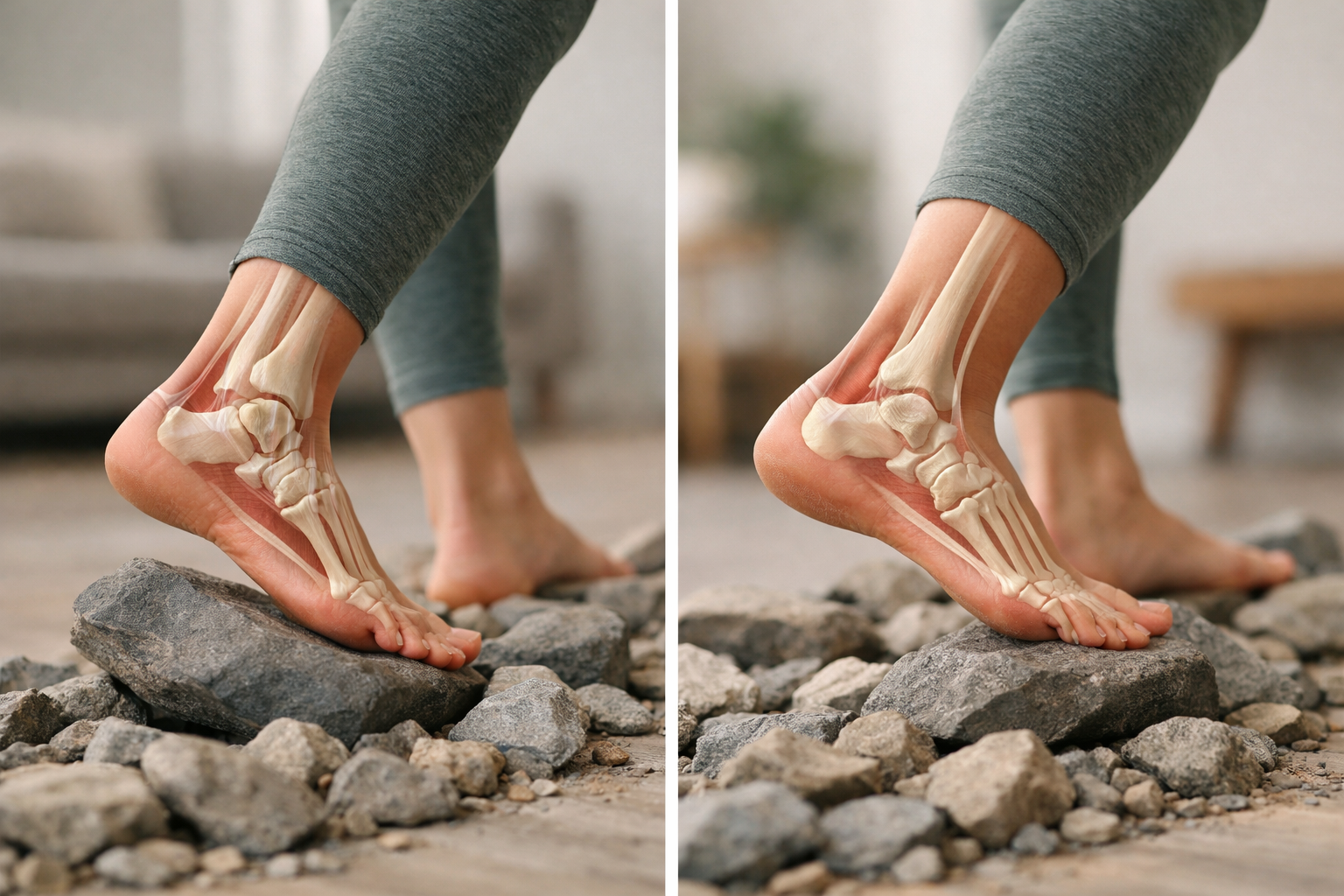
- Walking on a cambered road or a sloped beach, where one foot is constantly tilted
- Trails, gravel, sand, anything that makes your ankle work harder to keep you upright
- Turning, cutting, pivoting, or pushing off hard
- Stairs and curbs
- A new shoe, a worn-out shoe, or a shoe with a narrow heel that lets the ankle move more than it used to
And one more detail worth knowing: symptoms often lag. The hike on Saturday can show up as Sunday-evening or Monday-morning soreness. If you’re trying to figure out what set your ankle off, look back a day or two, not just at the last hour.
What this usually isn’t
Some features point away from tendon irritation and toward something that needs a closer look.
Numbness, pins and needles, or an electric, radiating quality suggests a nerve is involved rather than a tendon. Pain that’s severe at rest and wakes you at night is not the usual tendon behavior. A sudden twist followed by immediate swelling, bruising, and real difficulty putting weight through the foot deserves an in-person evaluation before you start loading anything. So does a distinct snap followed by weakness pushing off or turning the foot outward.
And pain that is sharply localized to one small point on bone, that gets worse week over week with no good days, that hurts even with gentle hopping or a few steps, should be evaluated rather than trained through. Bone doesn’t respond to load the way tendon does.
What can peroneal tendonitis be mistaken for?
A fair amount. The outside of the ankle is a crowded neighborhood, and several problems there produce a similar-sounding complaint. What separates them is usually the exact location and what makes them worse.
Leftover problems from an old ankle sprain. This is probably the most common mix-up. After a lateral sprain, the ligaments, the joint capsule, and the peroneals can all stay sensitive. If your pain lives slightly more forward, in the dip in front of the outer ankle bone, and feels more like joint pinching at end range than tendon soreness with load, that’s a different story.
Sinus tarsi irritation. A deep, poorly localized ache in the hollow just below and slightly in front of the outer ankle bone. Often worse on uneven ground, often lingering after a sprain, and frequently described as “in” the ankle rather than along a line.
Bone-related pain. A stress reaction in the fibula or in the fifth metatarsal can sit remarkably close to where the tendons run. The tell is usually point tenderness on bone, pain that doesn’t warm up, and a trend that keeps getting worse regardless of how you manage it.
Nerve irritation. The sural nerve travels through the same general area. Burning, tingling, or a patch of altered sensation on the outside of the foot points here rather than to tendon.
The tendon slipping out of its groove. If you feel a distinct pop or shift behind the outer ankle bone that you can sometimes reproduce on demand, and it comes with a real sense of the ankle letting go, that’s worth an evaluation. It’s managed differently.
Joint arthritis, either in the ankle or the joint just below it. More morning stiffness, more of a global ache, less of a specific tender line along a tendon.
I’m not listing these to make you anxious. I’m listing them because the treatment plans genuinely differ, and because a fifteen-minute hands-on exam, testing specific movements against resistance and pressing in specific places, usually sorts this out quickly. Guessing for four months does not.
The early window, and why it’s worth using
Here’s the thing about tendon problems on the outside of the ankle. The symptoms tend to escalate through a recognizable series of patterns, and which pattern you’re in when you start doing something about it has a lot to do with how long the road is. A quick note on wording: this is a description of how symptoms behave day to day, which is a separate thing from the three-stage tendon model described elsewhere on this site, which describes what’s happening inside the tissue.
Pattern one: it only bothers you after activity. Pattern two: it shows up during activity, warms up, then comes back worse afterward. Pattern three: it’s there most of the time, activity is limited, and you’ve started avoiding things. Pattern four: you’ve been avoiding things for so long that the calf, the peroneals, and your tolerance for uneven ground have all quietly downgraded, and now the problem isn’t just an irritated tendon, it’s a tendon with much less to work with than it had a year ago.
None of those patterns are hopeless. But pattern one takes less patience than pattern four. People who’ve had this for a year aren’t stuck, they just start from a lower point and progress more gradually. Longer-standing doesn’t mean permanent. It means the plan needs to be built more carefully.
What makes the early window valuable is that you can usually keep doing most of what you care about while you build the tendon’s tolerance back up. You’re adjusting, not stopping.
Three things worth tracking
If you want to know whether you’re moving in the right direction, watch these instead of watching the pain number alone.
How long it takes to settle. A useful general guide: whatever you do, it shouldn’t leave you meaningfully worse the next day. If your ankle is back to its usual baseline within about 24 hours, that activity was probably within reach. If it’s still louder two days later, that was too much this week. It’s not a moral judgment, just information.
How loud it gets. For many people, keeping discomfort at or below roughly a 4 out of 10 during and after movement works well as a practical ceiling. Some discomfort is expected and acceptable. Sharp, escalating pain that changes how you walk is not.
What you can actually do. How far did you walk before it spoke up? How long did you stand at work? How quickly did it calm down afterward? These numbers often improve before the pain fully quiets, and that’s genuine progress. Function matters as much as pain.
Can I still walk with peroneal tendonitis?
Usually, yes, and in most cases you should.
What I’d change first isn’t the distance, it’s the conditions. Flat, even, predictable surfaces ask much less of the peroneals than trails, sand, or a sloped sidewalk. A shoe with a stable heel and a reasonably wide base asks less than a worn-out running shoe or a flat with no structure. Two shorter walks often go over better than one long one, because the tendon gets a break in the middle.
Then watch the response. If your usual thirty-minute walk leaves you fine the next day, that’s your current working amount. If it doesn’t, drop to twenty and see. You’re looking for the level your ankle handles today, so you have somewhere to build from.
What I’d avoid is the all-or-nothing version, where you stop walking entirely for two weeks, feel better, jump straight back to your normal route, and land right back where you started. That pattern is incredibly common and it’s not your fault. It happens because rest lowers sensitivity without changing what the tendon can tolerate.
Does walking help heal tendonitis?
Walking helps in the sense that it keeps the tendon in the game. It maintains circulation, it preserves your tolerance for being on your feet, and it keeps you from losing ground. That’s not nothing.
But walking alone rarely rebuilds a tendon’s capacity, because your ankle already knows how to walk. Tendons adapt when you ask them to do progressively more than they’re comfortably used to, in a way that’s specific to what they do. For the peroneals, that eventually means resisted work turning the foot outward, calf and push-off strength, single-leg balance and control, and gradual exposure back to the uneven, unpredictable surfaces that actually provoked things.
So: keep walking. Just understand it as your baseline, not your rehab.
How to quickly fix peroneal tendonitis?
I’ll be straight with you. There’s no quick fix, and anyone offering one is either selling something or misunderstanding how tendons work.
There is, however, a fastest available path, and it has two parts that run at the same time.
First, bring the irritation down. That means trimming the specific things that are overloading the tendon right now (the sloped route, the pace, the volume, the unsupportive shoe) without shutting down entirely. Often that’s a matter of cutting 20 or 30 percent of total load, not 100 percent.
Second, start loading it early. Not aggressively. Early. Gentle, controlled, progressive work, done most days, is what actually shifts the tissue over time. Waiting until you’re completely pain-free before you start strengthening is the single most common reason this drags on, because the pain often quiets well before the tendon is genuinely capable again.
Consistency beats intensity here. Ten thoughtful minutes most days for two months will do far more than three punishing sessions and a week off.
Should I wear a brace for peroneal tendonitis?
A brace can be genuinely useful as a short-term tool. If you have a work shift you can’t get out of, a travel day, a wedding, a hike you’ve committed to, external support can reduce how much the tendon has to do and keep you moving through it.
What I wouldn’t do is treat it as the plan. If a brace becomes the only way your ankle gets through the day for months, you’ve outsourced the stability instead of rebuilding it, and the tendon adapts to doing less. Same logic applies to taping.
Honestly, for most people, shoe choice does more day-to-day work than a brace does. A shoe with a firm heel counter and a stable base takes real demand off the peroneals on every step, and you don’t have to think about it.
Is heat or ice better for tendonitis?
Neither one changes the tendon. Both can change how you feel, which has value, because feeling better lets you move more.
Ice tends to help when the area is hot, swollen, and freshly angry, usually after activity. Heat tends to help when the ankle is stiff and achy, particularly before you move, and it can make the first few minutes of walking or your exercises more comfortable.
My practical suggestion: use whichever one lets you do more, and don’t spend much mental energy on the choice. It’s comfort management. The loading is the treatment.
Should you massage out tendonitis?
Massage, foam rolling, and soft tissue work on the calf and the outside of the lower leg can feel good and can temporarily turn the volume down. That’s a legitimate reason to do it.
What it won’t do is remodel the tendon. And there’s a version of this that backfires: digging hard directly into an already irritated tendon, especially where it wraps around the bone behind the outer ankle, where there’s very little cushion between your thumb and the tendon. If it’s sharply painful while you’re doing it and more sore afterward, you’re adding load to a structure that’s already complaining.
Work on the calf and the muscle higher up the outside of the leg if it feels helpful. Go gently over the tendon itself. Then go do the strengthening.
How long does it take to recover from peroneal tendonitis?
Honest answer: it depends heavily on how long you’ve had it and how irritable it currently is, and I can’t give you a number without examining your ankle.
The general patterns look roughly like this. Something caught in the first few weeks, where the pain only shows up after activity, often responds within several weeks to a couple of months. Something you’ve had for six months or a year usually takes longer, often a few months of consistent work, sometimes more.
There’s a reason for that timeline. Early improvement tends to come quickly and comes largely from your nervous system getting better at recruiting and coordinating the muscles, not from the tendon itself changing. Actual tissue change is slower. For many people, meaningful structural adaptation needs something in the range of 8 to 12 weeks of consistent, progressive loading, and often longer for a tendon that’s been irritated for a while.
Which is exactly why so many people get better, stop, and then find it back three months later. They stopped at the point the pain resolved, which arrived well before the tendon was ready for their full life again.
The calendar gives structure. Your ankle’s response to each step determines what the next step is.
Does tendonitis ever fully go away?
Yes. Plenty of people get back to running, hiking, playing sports, and standing all day without thinking about their ankle at all. That’s a realistic outcome, not a consolation prize.
The nuance is that a tendon that’s been irritated once often stays a little more opinionated than it used to be. Come back from a two-week vacation, jump straight into a long trail run, and it may let you know. That’s not the old injury returning. That’s a load spike on a tendon that hadn’t been doing that work recently, which is true of everyone’s tendons, just slightly more so for yours.
The practical protection isn’t avoidance. It’s keeping some strength work in your week, respecting big jumps in volume or terrain, and knowing what an early warning sign feels like so you can adjust at the whisper instead of the shout.
And when symptoms do flare, a flare-up is not failure. Look at what changed in the days before, scale back briefly, and rebuild. The trend over months is what counts, not any single bad week. Recovery is not a straight line for anyone.
When to get it looked at
Most outer-ankle pain that follows the pattern described here responds well to a sensible plan. A few situations deserve an in-person evaluation sooner rather than later:
- You can’t put meaningful weight through the foot, or there’s significant swelling and bruising after a twist
- A distinct snap or pop followed by weakness turning the foot outward
- Sharp, pinpoint pain on bone that’s getting worse week by week
- Numbness, tingling, or spreading changes in sensation
- Pain that’s severe at rest or wakes you at night
- Redness, warmth with fever, or feeling generally unwell
- Several weeks of consistent, sensible effort with no change in what you can do
One more thing worth saying. If you’ve been managing this on your own for a while and haven’t moved the needle, the missing piece often isn’t another treatment to try. It’s a clear picture of what’s actually irritated, and a plan for how to move from where your ankle is now to where you want it to be, one manageable step at a time. That’s a conversation and an exam, not a guess from a symptom list.