How Painful Is Tendonitis? What Your Pain Level Actually Tells You
Tendon pain ranges from a mild morning ache to pain sharp enough to stop you mid-stride, and the number you'd give it doesn't always match how much is wrong. Here's what drives severity, what the pain pattern tells you, and when it's worth getting looked at.
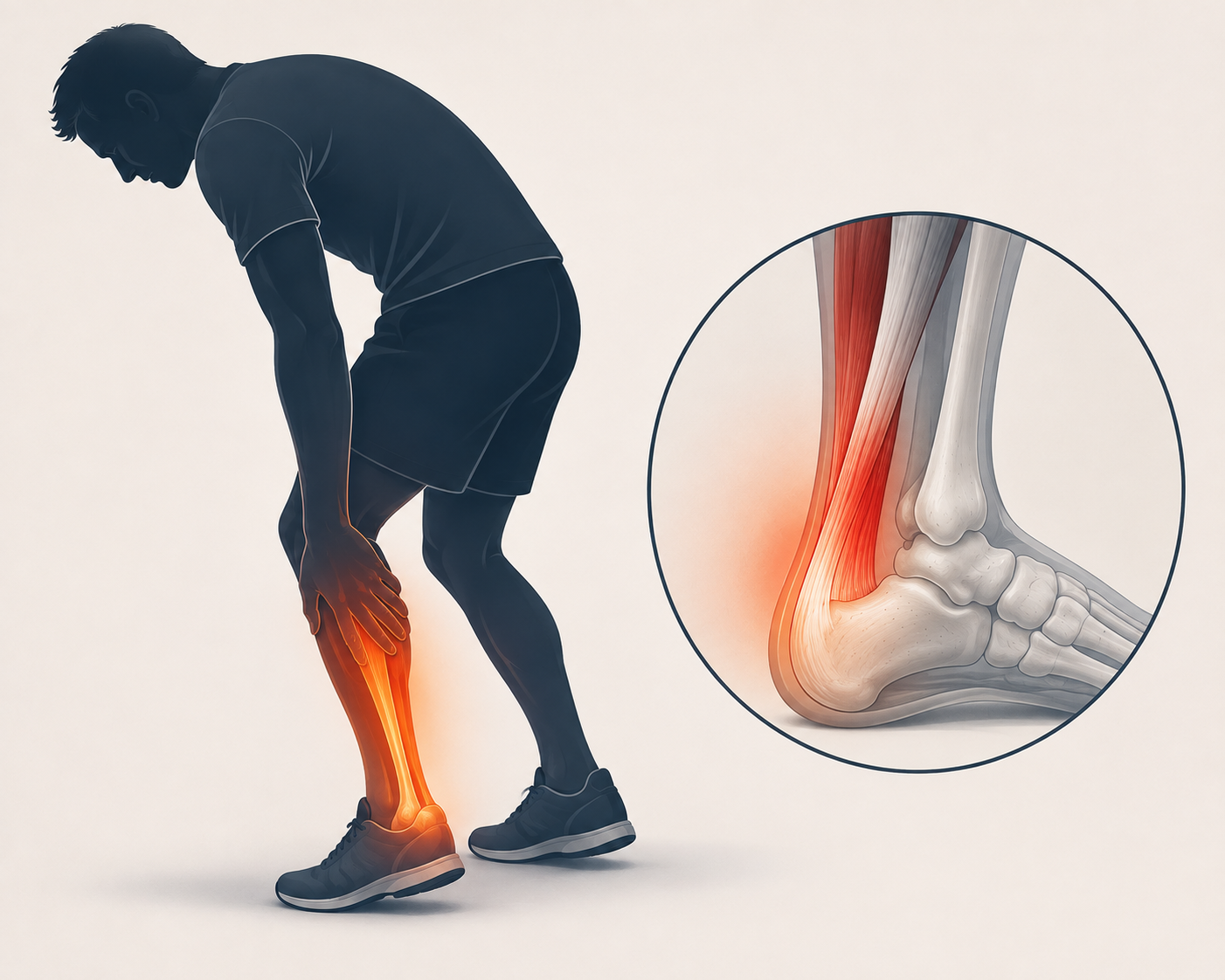
Most people who ask this question are asking for one of two reasons. Either they’re hurting a lot and want to know if that means something is seriously damaged. Or they’re hurting a little and wondering whether they’re overreacting by paying attention to it.
Both are fair questions. And the honest answer is that tendon pain covers an enormous range. Some people describe a dull ache in the back of the heel that only shows up for the first ten steps out of bed. Others can’t push off their foot to climb a stair without a sharp, hot, stop-you-in-your-tracks pain. Same tissue. Same general problem. Wildly different experience.
What matters more than the number is the pattern. Tendon pain behaves in fairly recognizable ways, and once you can read that behavior, the pain stops feeling random and starts telling you something useful.
So how painful is tendonitis, really?
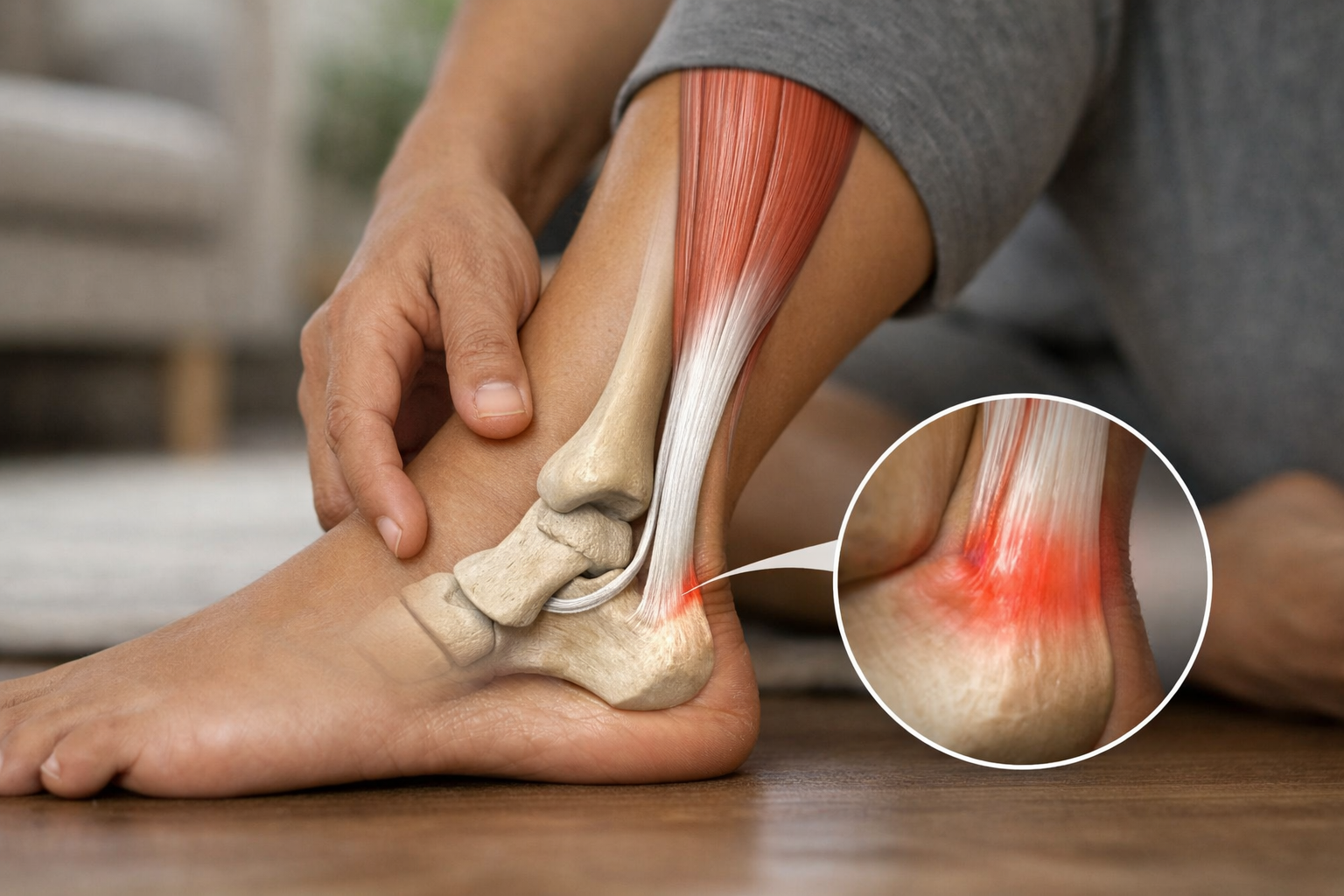
Think of it as a spectrum rather than a single sensation.
At the mild end: stiffness and soreness after sitting a while, a warm ache in the morning that loosens up within a few minutes of walking, some tenderness if you press right on the spot. Annoying. Easy to ignore. Often ignored for months.
In the middle: pain that shows up predictably with certain activities. Going up stairs. The first mile of a run. Standing on concrete for the second half of a shift. It fades with rest and comes back with load, which is the single most characteristic thing about tendon pain.
At the severe end: yes, tendon problems can be genuinely, sharply painful. People limp. People change how they walk without realizing it. Some can’t tolerate the pressure of a shoe against the back of the heel. Some describe pain that wakes them if they roll onto that foot.
Can tendinitis be extremely painful?
It can. And an irritable tendon is one of the more misleading things in musculoskeletal medicine, because the intensity of the pain doesn’t map neatly onto the amount of tissue trouble.
A tendon that’s highly reactive, meaning recently overloaded and freshly angry, can hurt a lot while the tissue itself is in reasonable shape. Meanwhile a tendon that’s been quietly degrading for two years can feel like a 3 out of 10 that never quite goes away. The loud one often has more room to calm down quickly. The quiet one usually needs a longer, more patient rebuild.
So a high pain number is worth respecting. It is not a verdict on how damaged you are.
The four symptoms people usually mean
When you see “the four symptoms of tendonitis” listed, it’s generally some version of these:
- Pain at or near where the tendon attaches to bone, worse when you use it. Achilles pain sits at the back of the heel or a couple inches above it. Patellar tendon pain sits just below the kneecap.
- Tenderness to touch over that specific spot. Usually you can put a fingertip on it.
- Stiffness, particularly after rest, and particularly in the morning.
- Reduced strength or a sense of weakness in that movement, sometimes with swelling or a slight thickening you can feel compared to the other side.
Some people also notice a creaking or grating sensation with movement. That one alarms people more than it should. It’s often just tissue gliding through a slightly irritated sheath.
Here’s what I’d add to that list, because it’s the most diagnostically useful thing of all: tendon pain typically warms up. It hurts at the start of activity, eases somewhat as you keep going, and then shows up again later that evening or the next morning. That warm-up-then-rebound pattern is close to a signature.
What actually drives how much it hurts
When two people have the same tendon problem and one is miserable while the other shrugs, the difference usually comes down to a handful of things.
How recently the load changed. A tendon that got asked to do something new and much bigger last week is more irritable than one that’s been mildly overloaded for a year. New spikes hurt more.
Whether the tendon is being compressed. This one is underappreciated. Tendons that wrap around bone, like the Achilles at the back of the heel or the peroneal tendons on the outside of the ankle, hurt substantially more when they’re squeezed as well as stretched. That’s why a stiff shoe counter, a deep stretch, or downhill walking can spike Achilles pain more than flat running does. It’s not a sign of more damage. It’s a mechanically nastier position for that tendon.
Your total daily load, not just your workout. This is the one people miss most often. Everything counts: the exercises, yes, but also the standing job, the airport, the yard work, the walk to the parking garage, the new shoes. Tendon pain often lags a day behind the thing that caused it, so people blame the exercise they did this morning when the real culprit was six hours on their feet yesterday.
How sensitive the whole system currently is. Poor sleep, a stressful stretch at work, and months of persistent pain all lower the threshold at which your nervous system decides something is worth reporting. Nothing about that is imaginary or “in your head.” It’s the same tendon, with the volume dial turned up.
Where the tendon is. A weight-bearing tendon that you can’t avoid using, like the Achilles or plantar fascia region, tends to produce more day-to-day misery simply because you load it a few thousand times before lunch.
Pain scores are useful, but not as a report card
I ask people to keep a rough number in mind, but the number’s job is to guide decisions, not to grade progress.
For most people, a practical working rule is to keep pain at or below about a 4 out of 10 during activity, and to expect it settled back near your baseline within roughly a day. If it’s higher during, or if it’s still elevated 24 to 48 hours later, that was likely more than the tendon was ready for that day. Not a catastrophe. Information.
And here’s the part that surprises people: you can be getting genuinely better while your pain number barely budges. If you’re walking farther before it starts, taking fewer minutes to loosen up in the morning, recovering faster after a long day, or standing through a shift you couldn’t handle a month ago, that tendon is becoming more capable. The pain number often improves last. Function matters as much as pain, and function tends to be the more honest early signal.
How long does tendonitis take to stop hurting?
This is where I have to be careful, because the honest answer is a range, not a date.
The irritability, the sharp-and-angry part, often calms within a few weeks once the load is managed sensibly. That’s the fast part, and it’s why people so often feel better and go straight back to what they were doing.
The tissue itself is slower. Tendon adapts to loading over months, not days. For many people, meaningful structural change takes somewhere in the range of 8 to 12 weeks of consistent, progressive loading, and longer-standing problems take longer still. Early improvements come mostly from your nervous system getting better at the task and from the tendon settling down. The actual remodeling of the tissue trails behind.
Is it normal for an inflamed tendon to take 2 months to heal?
Completely normal. Two months would be a fairly ordinary timeline, and plenty of persistent tendon problems take longer than that. I’d rather you hear that up front than measure yourself against a two-week expectation you were never going to meet.
What’s not normal is two months of no change at all. Slow is expected. Static usually means something in the plan needs adjusting: the load is too low to drive adaptation, or too high for the tissue to recover from, or something else is going on entirely.
The most common reason tendon pain comes back is stopping when the pain stopped. Symptoms resolve before capacity is rebuilt. The tendon feels fine at your current activity level and then fails at the level you actually want to live at. Rest can quiet a tendon down beautifully, but a quiet tendon is not the same as a capable one. Recovery is built.
What is the most effective treatment for tendonitis?

If I could only keep one intervention, it would be progressive loading. Not rest. Not stretching. Not a modality. Structured, gradually increasing work for the muscle and tendon, held at each level long enough for the tissue to adapt before advancing.
That’s the piece with the strongest reasoning behind it, and it’s the piece most often missing. Not because anyone did anything wrong, but because “rest it, ice it, stretch it, come back if it still hurts” is easy advice to give and it does help in the short term. The gap is what happens after the irritation settles. Somebody has to rebuild what that tendon can handle, and that requires a plan with a progression in it.
The other pieces earn their place around that core:
- Short-term load reduction. Backing off the aggravating activity for a stretch is genuinely useful for calming an angry tendon. In small doses it’s a tool. As a long-term strategy it just lets capacity drift downward. Rest equals rust.
- Modifying what you can modify. Temporarily adding a small heel lift for an irritable Achilles, avoiding the deepest compressive positions early, changing which shoes you wear for a standing shift, spreading a big activity across the week instead of stacking it into one day.
- Isometrics early. Holding a contraction without much movement is often well tolerated when moving through range hurts, and it gives you something to do on bad days.
- Injections, shockwave, medication. Each has a context where it’s reasonable, usually as a way to lower the pain enough to load the tendon properly. They work best alongside a loading plan, not instead of one.
What helps tendons heal faster?
Mostly unglamorous things.
Consistency, first. Loading a tendon three or four times a week for three months does more than loading it hard for nine days and then stopping. Consistency beats intensity, especially with tissue this slow to change.
Then: sleep, enough protein, managing the total load across your week rather than just your workouts, and not letting a flare-up talk you into two weeks off. Building slowly enough that you can keep going matters more than any individual session.
What doesn’t speed things up much: passive treatments on their own, stretching a compressed tendon aggressively, and switching plans every three weeks because the pain hasn’t vanished yet.
What is the hardest tendon to heal?
There’s no single winner, but some are reliably slower, and it’s worth knowing why so you can calibrate your patience.
Tendons that get compressed against bone tend to be more stubborn: the Achilles right at its insertion on the heel bone, the gluteal tendons at the hip, the posterior tibial tendon on the inside of the ankle. Compression limits which loading positions you can use early, so the progression has to be more careful.
Tendons with a modest blood supply and constant mechanical demand are slower too. The Achilles takes a beating simply because you can’t stop walking on it.
And the strongest predictor of a long road isn’t which tendon it is. It’s how long it’s been going on. A tendon that’s been irritable for three years starts from a lower point and needs a more patient climb. That’s a longer timeline, not a closed door. Persistent doesn’t mean permanent.
What can be mistaken for tendonitis?
Quite a lot, which is why guessing from a symptom list has limits.
Around the foot and ankle specifically:
- Plantar fascia problems get called Achilles tendonitis and vice versa. Both hurt near the heel, both hurt in the morning. The location of the tenderness and what provokes it usually separates them.
- Nerve irritation. Tarsal tunnel or a compressed nerve can produce burning, tingling, or pain that spreads rather than staying on one tender spot.
- Bone stress injuries. A stress reaction in the heel or a metatarsal often hurts with impact, keeps hurting rather than warming up, and doesn’t follow the tendon pattern. This one matters, because the loading plan is different.
- Bursitis, especially the retrocalcaneal bursa sitting just in front of the Achilles insertion. It often travels with tendon irritation, so it’s less either-or than people assume.
- Joint arthritis at the ankle or midfoot, which tends toward more diffuse, deeper stiffness.
- Referred pain from higher up the chain, and less commonly inflammatory conditions that affect tendon attachments throughout the body. If several tendons in different places are angry at once, or there’s significant morning stiffness everywhere, that’s worth mentioning to a clinician.
Symptoms that can be consistent with tendon overload can also be consistent with several of these. An evaluation, meaning hands on the area, testing which movements reproduce the pain, and going through your recent activity history, sorts it out far better than a symptom checklist can.
How to know if it’s tendonitis or a torn tendon?
The distinction people worry about most is a complete rupture, and full ruptures usually announce themselves. There’s typically a sudden event: a pop or a snap, a sensation of being kicked or struck in the back of the leg, immediate and dramatic loss of function. With a complete Achilles rupture, people generally can’t push off at all or rise onto that toe, and there may be a visible gap or dent where the tendon should be. That’s an urgent evaluation, not a wait-and-see.
Partial tears are murkier, and honestly, the line between “partial tear” and “degenerated tendon” on imaging is blurrier than the words suggest. Many tendons that have been overloaded for a long time show some fiber disruption on a scan. It doesn’t automatically mean surgery, and it doesn’t mean the tendon can’t be loaded. It usually means starting lower and progressing more carefully. A scan can show structural changes without telling us exactly why you hurt.
The practical version: gradual onset, warms up with activity, tender in one spot, still able to use the limb, points toward overload. Sudden onset with a pop and a real loss of function points toward something that needs looking at promptly.
Pain going up isn’t the same as damage going up
This reframe changes how people move more than almost anything else I say.
When a tendon flares, most people read it as re-injury. Progress erased. Back to square one. That interpretation drives the stop-start cycle that keeps these problems going for years.
A flare is usually just a mismatch. You asked for slightly more than the tendon could handle that particular day, and the day had more in it than you noticed: the extra walking, the poor sleep, the shoes you don’t normally wear. The tissue didn’t unravel. The dial went up.
So when it happens, don’t audit your character. Audit the week. What changed? Then reduce a notch, hold there until things settle, and build again. The response guides what comes next, and a few days of higher pain inside three months of upward trend is a normal-looking recovery, not a failed one. Recovery is not a straight line.
When your pain level does warrant a closer look
Most tendon pain is a load problem you can work with. Some things deserve a real evaluation rather than more patience:
- A sudden pop or snap with immediate loss of strength or the inability to push off
- Pain that’s severe at rest, at night, or unrelated to activity
- Pain that keeps escalating week over week despite sensibly backing off
- Marked swelling, redness, warmth, or fever
- Numbness, tingling, or pain that spreads rather than staying local
- Inability to bear weight
- Several tendon areas becoming painful at once, or significant widespread morning stiffness
- Two months of consistent effort with no change in either pain or function
None of those mean something dire. They mean the situation needs eyes on it rather than another guess.
If you’re somewhere in the middle, hurting enough to be frustrated but not enough to be alarmed, the most useful next step is usually getting a clear read on what the tissue can currently tolerate and a plan for building on it. Not a plan to wait it out. Tendons don’t get stronger while you avoid them. They get stronger when you give them a reason to, in an amount they can handle.