The Four Main Symptoms of Tendonitis to Watch For
Tendon pain has a recognizable pattern: pain you can point to that tracks with use, stiffness after rest, tenderness or thickening you can feel, and a quiet loss of strength or function. Here's how those four symptoms show up in different tendons, what gets mistaken for them, and what actually moves the needle.
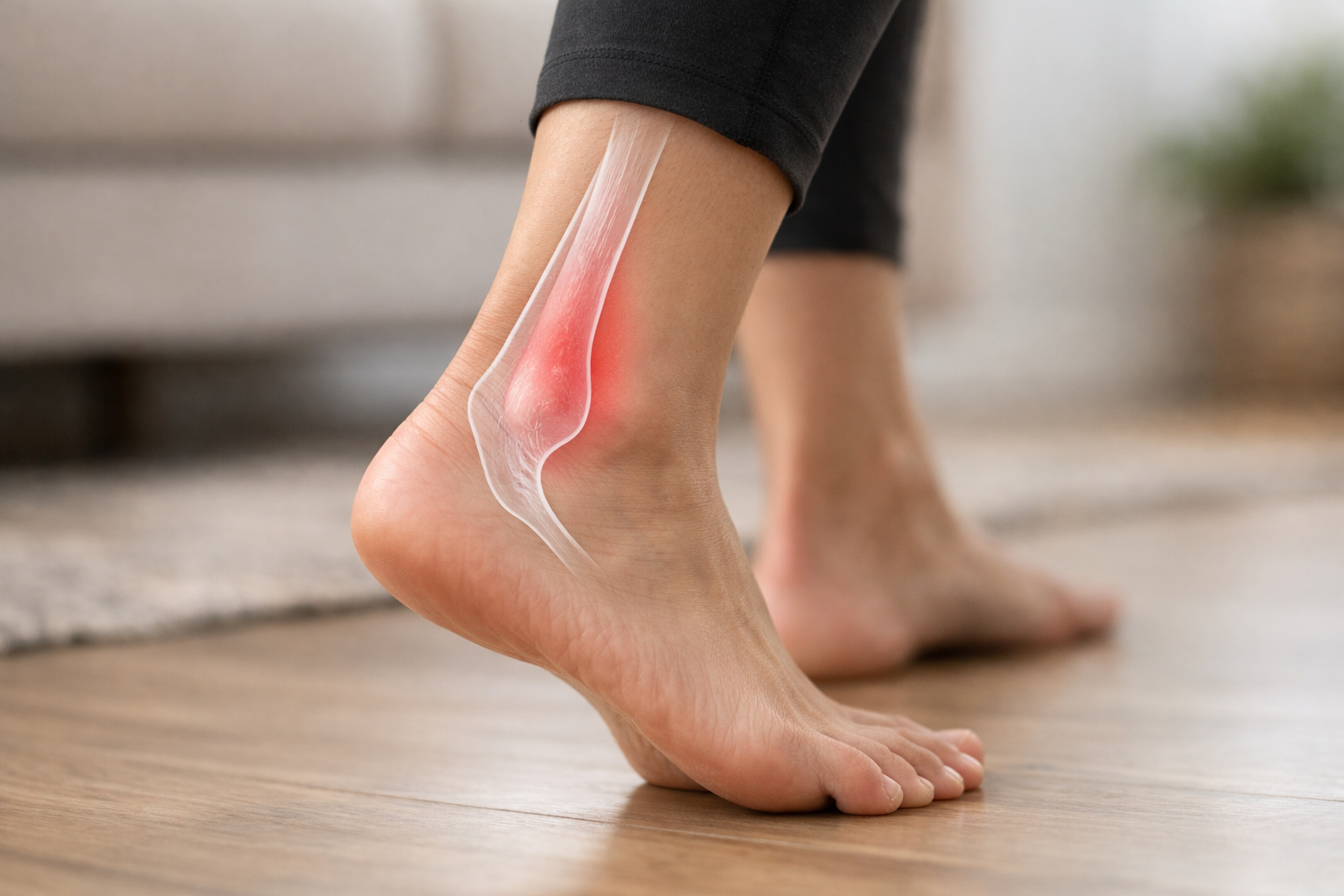
Most people don’t arrive with a question about tendons. They arrive with a story.
“It hurts for the first ten minutes of a run, then it settles down, then it’s awful the next morning.” “I can point to the exact spot with one finger.” “It doesn’t hurt when I’m sitting, only when I push off.” That pattern is so consistent that experienced clinicians start forming an impression before anyone touches the foot.
So let’s go through the four symptoms people usually mean when they say tendonitis, what each one is actually telling you, and how the same four look different depending on which tendon is involved and how irritable it currently is.
The four symptoms, in plain terms

1. Pain you can point to, and it tracks with what you did
Tendon pain is usually local. Not a vague region, not the whole ankle, but a spot you can cover with a fingertip. Two inches above the heel bone for a midportion Achilles. Right where the tendon meets the bone for an insertional one. Just behind and below the inner ankle bone for the posterior tibial tendon. On the outside of the elbow for the classic “tennis elbow.”
The second half matters just as much. Tendon pain tracks with load. It shows up when you use the tendon and quiets when you don’t. Many people describe a warm-up effect: the first few minutes hurt, things loosen, and then the real bill arrives later that evening or the next morning.
That lag confuses people constantly. You feel fine during the hike and terrible the next day, so you blame the stairs you climbed that morning instead of the hike. Tendons are slow reporters. Symptoms often show up a day or so behind the load that caused them.
2. Stiffness after you’ve been still
The classic version: the first steps out of bed. Also the first steps after a long meeting, a movie, a flight, or a drive home.
This one gets misread as a sign the tendon got worse overnight. It didn’t. Hours of no load leave a sensitive tendon feeling stiff and sore when you suddenly ask it to carry your body weight again. That’s a sensitivity pattern, not overnight damage. It’s also one of the most useful things to track, because morning stiffness tends to shrink as a tendon gets more capable, and it often improves before the exercise pain does.
If you want a single symptom to watch week to week, watch this one. How long does it take to feel normal in the morning? Fifteen minutes instead of forty-five is real progress, even if your pain score hasn’t budged much.
3. Tenderness, and sometimes swelling or thickening you can feel
Squeeze the tendon between your thumb and finger and it’s tender in a way the same tendon on the other side isn’t. In some cases you can feel a thickened section, a bump, or mild puffiness. Some tendons, particularly around the wrist and ankle, can produce a faint grating or creaking feeling when the sheath around them is irritated.
Thickening scares people. It shouldn’t, on its own. A thickened tendon is a tendon that has responded to stress. It’s an adaptation, not a verdict about your future. Plenty of people have thickened tendons on imaging and no pain at all, and plenty of people get back to full activity while the tendon still measures thicker than the other side.
One honest caveat: obvious redness, heat, rapid swelling, or pain that keeps you up at night is a different picture and deserves an in-person look.
4. Weakness, or a quiet loss of what you used to be able to do
This is the symptom people report last and notice first, if that makes sense. You stop doing single-leg calf raises without thinking about it. You take the stairs differently. You can’t hop on that side. You avoid pushing off hard. Grip strength drops with elbow or wrist tendon problems.
Some of that is true strength loss from weeks of avoiding the movement. Some of it is the nervous system protecting a sore area by recruiting muscle less forcefully. Either way, this is the symptom that explains why calming the pain down isn’t the finish line. You can rest a tendon until it stops hurting and still be less capable than you were before it started hurting. That’s the gap where recurrences live.
Where does tendonitis hurt the most?
The most painful spot is usually where the tendon is under the most mechanical stress, and that’s often where it attaches to bone or where it wraps around a corner.
- Achilles: either the midportion, a few centimeters above the heel, or right at the heel bone attachment. The attachment version is usually more stubborn, partly because it gets compressed against bone whenever the ankle bends up, which is why deep stretching and steep hills often aggravate it.
- Posterior tibial: behind and below the inner ankle bone, sometimes tracking into the arch. Often worse on uneven ground or when standing all day.
- Peroneal: behind the outer ankle bone, common after an ankle sprain or a jump in walking volume.
- Patellar: just below the kneecap, worse with jumping, squatting, and descending stairs.
- Shoulder and elbow: the rotator cuff tends to hurt with overhead reaching and lying on that side; the elbow tendons hurt with gripping and lifting.
Heel pain deserves its own note. The plantar fascia isn’t a tendon, but it behaves much like one, and pain underneath the heel with those first morning steps is more often plantar fasciopathy than an Achilles problem. Pain at the back of the heel points toward the Achilles. Where it hurts matters more than what you call it.
Why did I get tendonitis out of nowhere?
It almost never comes out of nowhere. It comes out of a change you didn’t register as a change.
Tendons adapt to what you ask of them, but slowly. Trouble shows up when demand rises faster than capacity. So the honest question isn’t “what did I do wrong,” it’s “what changed in the four to eight weeks before this started?”
Common culprits:
- Adding mileage, hills, speed work, or jumping in a short window
- Coming back to something after a layoff at the level you left it
- A new job, a new floor surface, a new shoe, or a shoe that finally wore out
- A vacation with far more walking than usual, or a week in flat, unsupportive sandals
- Something on the other side of the body changing: an old knee problem, a healed sprain, a new brace
Total load is cumulative. Your workout is one input. Standing eight hours on concrete, walking the dog twice, carrying a toddler, and a weekend of travel all add to the same account. Changes in body weight, a standing job, or a long commute shift how much the tendon carries every day, not because anyone did anything wrong, but because they change the math on the demand side.
A handful of medications, certain antibiotics in particular, have been associated with tendon problems. If your symptoms started shortly after a new prescription, mention it to your prescriber.
What gets mistaken for tendonitis?
Quite a lot, which is why an evaluation is worth it if things aren’t moving.
- Bone stress injuries. These tend to hurt in a smaller, deeper spot, get worse the longer you’re on them rather than warming up, and can ache at rest or at night.
- Nerve pain. Burning, tingling, numbness, or pain that radiates rather than staying put. Nerve irritation near the ankle or coming from the low back can mimic tendon pain convincingly.
- Joint problems. Arthritis or a cartilage issue often brings deeper, more diffuse ache plus swelling inside the joint and stiffness that doesn’t settle with a few minutes of movement.
- Bursitis, which sits right next to many tendons and can coexist with tendon irritation.
- A partial tear, which may follow a distinct moment rather than a gradual build.
- Inflammatory conditions. Multiple tendons flaring at once, morning stiffness lasting well over an hour, or symptoms in other joints are worth a medical workup.
None of that means self-assessment is useless. It means that if the pattern doesn’t fit, or you’re not improving, don’t assume you just need to try harder at the same plan.
The three stages people ask about
Tendon problems are often described as moving through three phases: an early, angry, easily irritated tendon; a middle phase where the tissue starts changing structurally; and a persistent phase where parts of the tendon have remodeled and capacity has dropped. The words shift depending on who’s writing (tendonitis, tendinopathy, tendinosis), but the practical meaning is the same: how irritable is this tendon right now, and how much has it changed.
That’s a topic in itself, and there’s a full article on this site about the three stages of tendonitis and what each one means for your progression. The short version here: the stage doesn’t change the four symptoms, it changes how much you can do before symptoms show up, and how long the road back tends to be.
What’s the fastest way to get past tendonitis?
The fastest route is usually the one that starts loading the tendon sooner, at an amount it can actually handle.
That surprises people who’ve been told to rest. Rest does something real: it reduces sensitivity. That’s why a tendon feels better after two weeks off and hurts again in the first week back. Sensitivity came down, capacity didn’t. Structural change in a tendon comes from repeated mechanical load over weeks and months, not from time off.
Some practical anchors I use often, offered as general patterns rather than rules:
- Aim to keep pain at or below roughly 4 out of 10 during and right after loading. Some discomfort is usually acceptable. Sharp, escalating pain is not.
- Use about a 24-hour window as your feedback. If the tendon has settled back to its usual baseline by the next morning, that dose was reasonable. If it’s still worse two days later, it was too much for that day.
- Expect meaningful change over something like 8 to 12 weeks, often longer for tendons that have been bothering you a year. Early improvement in the first few weeks is largely your nervous system getting comfortable again. The tissue change comes later, which is exactly why people who stop the moment pain disappears tend to end up back where they started.
- Consistency beats intensity. Three moderate sessions a week for three months does far more than two brutal weeks followed by a flare.
A flare along the way isn’t failure. It’s information about what that day asked of the tendon. Look at what changed, adjust the dose, keep the longer trend in view.
Does massage help tendonitis?
It can help you feel better, and feeling better is not nothing. Massage, soft tissue work, and dry needling can reduce sensitivity and muscle guarding around an irritated tendon, which sometimes makes it easier to load it well afterward.
What massage doesn’t do is build capacity. If hands-on work is the whole plan, the relief tends to last until the tendon meets real demand again. Think of it as something that can make the loading work more comfortable, not as a replacement for it. Aggressive cross-friction directly on an angry tendon, for what it’s worth, often makes things worse for a few days.
Does tendonitis ever fully go away?
Many people get fully back to what they want to do, including things they’d written off. That’s the realistic expectation, not a guarantee.
Here’s the nuance worth holding onto. A tendon that’s been through this may always look a little different on imaging, and it may complain occasionally when you do something new or ramp up quickly. That isn’t the problem returning. It’s a tendon telling you it needs a slightly more gradual on-ramp than the other side. People who keep some strength work in the rotation long after symptoms end tend to have far less trouble down the road.
Persistent doesn’t mean permanent. A tendon that’s been sore for two years usually means a lower starting point and a more patient progression, not a closed door.
What’s the hardest tendon to heal?
In my experience, the stubborn ones share a few features: they attach right onto bone, they get compressed against that bone in certain positions, and they’re asked to carry a lot of body weight every single day whether you’re training or not. Insertional Achilles problems, gluteal tendon problems at the hip, and posterior tibial issues tend to fall into that group. High hamstring tendon pain at the sit bone is another one people struggle with, partly because sitting itself loads it.
Those take longer and require more thought about which positions to avoid early on. They still respond to the same principles.
What’s the average age for tendonitis?
There isn’t one clean number, and the honest answer is that it depends more on load history than on birthdays. Broadly, the pattern I see falls into two groups. Younger, active people get it from sudden jumps in training volume or intensity. Adults from roughly their late thirties into their sixties get it because tendons adapt more slowly with age while life demands stay the same, and because that’s often when people restart an activity after years away.
Age changes the speed of adaptation, not the possibility of it.
When to get it looked at
A few things warrant an in-person evaluation rather than another few weeks of waiting: a sudden pop or snap followed by weakness, inability to push off or bear weight, significant redness and warmth with fever, numbness or tingling, pain that’s consistently bad at night, or symptoms that are getting worse despite sensible effort over several weeks. Recovery is built, and building requires knowing what you’re building. If the pattern doesn’t add up, get someone to sort it out with you.
If your symptoms do fit the four described here, the most useful thing you can do this week is stop asking only “how much does it hurt” and start tracking what you can do. How long can you stand before it talks to you? How many calf raises before form breaks down? How long does the morning stiffness last? Those numbers move before the pain number does, and they’re the ones that tell you whether the tendon is actually getting more capable.