What Does Tendonitis in the Foot Feel Like? Early Signs to Know
Foot tendonitis usually announces itself with a predictable pattern: pain at the start of activity, tenderness along a specific line, stiffness after rest. Here's how to recognize it early, what the pattern tells you about what your foot can currently handle, and how to start rebuilding instead of just waiting it out.
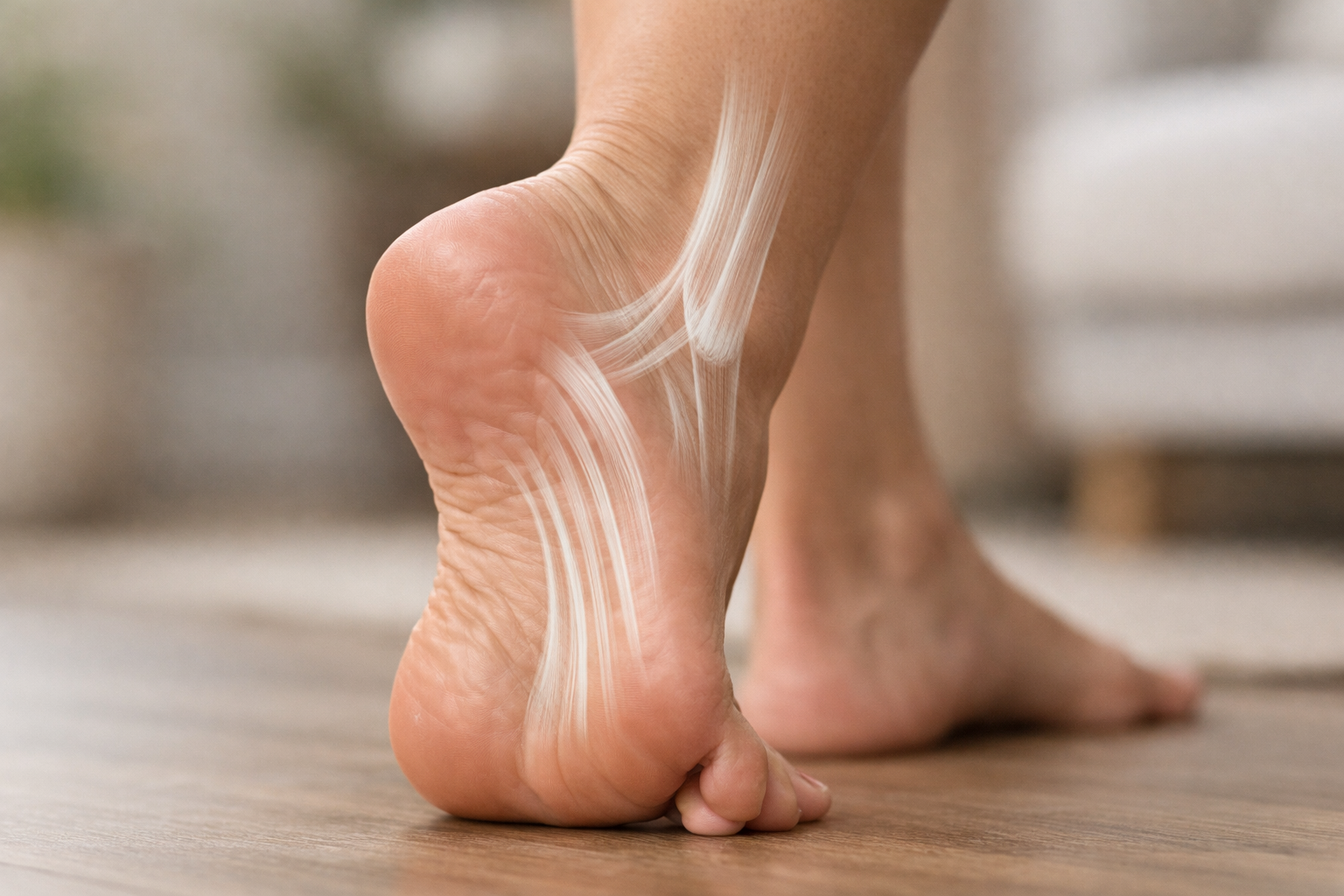
Most people don’t come in saying “I think I have tendonitis.” They say something like: “The first few minutes of my walk hurt, then it loosens up, then it’s sore again that night.” Or: “There’s one spot on the top of my foot that’s angry when I lace my shoes.” Or: “It started three weeks ago and I can’t think of anything I did.”
That pattern is the useful part. Tendon pain tends to behave in a recognizable way, and recognizing it early matters, because the earlier you understand what your foot is telling you, the smaller the adjustment needed to turn it around.
The pattern that usually points to tendon irritation
If you want one sentence to hold onto: tendon pain is usually specific, load-related, and worst at the transitions.
Here’s what that looks like day to day.
You can point to it with one finger. Tendon pain tends to be localized along a cord-like structure, not spread vaguely across the whole foot. You press along the line of the tendon and there’s a spot that lights up. Nerve pain is more likely to burn or radiate. Joint pain sits deeper and harder to pinpoint. Tendon pain has an address.
It hurts most when you start, eases as you warm up, then comes back later. This is the classic one. The first ten steps out of bed, the first block of a walk, the first few minutes of a run. Then it fades. You think it’s fine. Then two hours after you stop, or the next morning, it’s louder than it was. That warm-up-and-return pattern is very characteristic of tendon tissue.
It’s linked to load, not to random moments. Stairs, hills, pushing off, standing on a hard floor, walking in different shoes. There’s a connection between what you did and how it felt, even if the connection is delayed by a day.
It stiffens up after you sit still. Get up from your desk, from the car, from the couch, and the first few steps feel tight and sore. Then it loosens. Hours of no load make a sensitive tendon feel worse when load returns. That’s a sensitivity pattern, not the tendon getting worse while you sat there.
People often ask about “the four symptoms of tendonitis.” The classic teaching list is pain, swelling, stiffness, and reduced strength or movement in the affected area, sometimes with warmth or a creaky, grating sensation when you move. That list isn’t wrong. But in the foot specifically, it’s often incomplete, because plenty of genuine tendon problems show up with almost no visible swelling and no redness at all. The timing pattern is a better clue than the visual one.
Where it shows up, and what each location tends to feel like
The foot and ankle have a lot of tendons crossing a small space. The location shapes the experience.
Behind the heel (Achilles)

Pain at the back of the heel or a few inches up the tendon. Stiff and painful for the first steps in the morning. Often tender to pinch from side to side. Worse with hills, stairs, and pushing off. Sometimes there’s a thickened, slightly swollen zone you can feel through the skin.
Along the inside of the ankle and arch (posterior tibial)
Aching behind and below the inner ankle bone, sometimes tracking into the arch. Often worse with standing all day or walking on uneven ground. Some people notice the arch feeling like it’s flattening or that they’re rolling inward more than they used to, especially late in the day. This one deserves attention early rather than late, because the posterior tibial tendon supports the arch, and persistent problems here can gradually change how the foot sits.
Outside of the ankle, behind the bony bump (peroneal)
Pain along the outer ankle and sometimes into the outer border of the foot. Common after ankle sprains, on uneven trails, or when someone ramps up lateral activity. Can feel unstable or clicky.
Top of the foot (extensor tendons)

A linear ache across the top of the foot, often made worse by laces or the tongue of the shoe pressing down. Frequently shows up after tighter shoes, more hill walking, or a big increase in mileage. Sometimes mildly swollen and tender in a stripe rather than a circle.
Under the big toe or into the arch (flexor tendons)
Deep ache with push-off, sometimes felt when you rise onto the toes. Dancers, runners, and people who spend a lot of time on their forefoot see this more.
A note on the word itself. “Tendonitis” implies inflammation, and in the first days or weeks of an irritated tendon, that’s often part of it. But when tendon pain has been hanging around for months, what’s usually going on inside the tissue isn’t a raging inflammatory process. It’s a tendon that has been asked to do more than it could tolerate, and has partially adapted in disorganized ways. Clinicians often call that tendinopathy. The distinction matters, because it changes what actually helps: not chasing inflammation for months, but rebuilding the tendon’s ability to handle load.
Why it started when “nothing happened”
This is the part that confuses people most. There’s no rolled ankle, no misstep, no moment. It just started.
Tendons don’t usually fail from one event. They get overwhelmed by accumulation. Think of it as a simple balance: on one side, everything you ask the tendon to do. On the other, what the tendon can currently handle. Trouble shows up when the first side outgrows the second.
And the demand side includes everything, not just exercise:
- Walking the dog, the airport, the grocery store
- A job where you’re standing on concrete for eight hours
- New shoes, worn-out shoes, or switching to a flatter shoe
- A vacation with three times your normal walking
- Going from four thousand steps a day to twelve thousand because the weather improved
- A return to running after time off, at the pace you used to run
- Carrying more weight, whether that’s body weight, a backpack, or a toddler
None of those is a personal failing. They’re just load, and load adds up. The tendon doesn’t know the difference between a workout and a long day at work. It only knows the total.
This also explains the lag. Symptoms often show up a day or two behind the thing that caused them. You had a great Saturday. Monday your foot is angry. It’s easy to blame Monday’s stretching routine when the actual culprit was Saturday’s mileage.
What can be mistaken for tendonitis in the foot
Quite a lot, honestly. A few of the common impostors:
- Plantar fasciopathy, especially when heel pain gets labeled “Achilles” or vice versa. The plantar fascia and the Achilles both cause first-step-in-the-morning pain, but the location differs: bottom of the heel versus back of the heel.
- Bone stress injuries, particularly in the metatarsals. These tend to hurt in a more focused, bony spot, hurt with impact rather than easing with warm-up, and often keep aching at rest or at night.
- Nerve irritation, which more often burns, tingles, or shoots rather than aching along a cord.
- Joint arthritis, especially at the big toe or midfoot, which tends to feel deeper and stiffer with a different pattern of provocation.
- Bursitis, where a fluid-filled cushion near a tendon gets irritated and mimics the tendon itself.
- Inflammatory conditions, which can cause tendon pain in more than one place at once, often with prolonged morning stiffness across multiple joints.
The practical version of this: if your pain doesn’t follow the load-related, warms-up-then-returns pattern, or if it’s waking you at night, or if it’s in several places at once, it’s worth having someone sort it out in person. The label changes the plan.
Should you walk on a foot with tendonitis?
Almost always, yes. Some amount.
The question isn’t whether to walk. It’s how much, how fast, and on what surface.
Complete rest does something seductive: it makes the pain go away. But it doesn’t build anything. Unloaded tendon gets less tolerant of load, not more. So you feel great on day five of rest, go back to your normal walk on day six, and the pain comes right back. That’s not bad luck. That’s a tendon that had its sensitivity calmed without having its capacity rebuilt.
A more useful approach is finding the amount your foot can currently handle, and working there.
For many people, a reasonable working rule looks something like this:
- Discomfort during the activity stays at or below roughly 4 out of 10.
- Whatever it feels like afterward settles back toward your baseline within about 24 hours.
- Morning stiffness the next day isn’t noticeably worse than the day before.
If all three hold, that amount of walking is probably useful. If your foot is still louder two days later, that was more than it was ready for, and you drop back a step. Not forever. Just until it’s ready for the next one.
This isn’t a precise formula, and individual situations vary. But it gives you a way to make decisions instead of guessing.
How do I get rid of tendonitis in my foot?
The honest answer is that you rebuild the tendon’s tolerance, and that takes time and consistency rather than a single intervention.
Here’s the reasoning behind that, because the reasoning is what lets you make good decisions on your own.
Calming things down is the first step, not the whole plan. In the early, angry phase, reducing the aggravating load helps. Shorter walks. Fewer hills. Temporarily backing off the activity that spiked it. Maybe a shoe with a bit more cushion or a small heel lift if the Achilles is involved. This is legitimate and helpful. It’s just not the destination.
Then you load it, deliberately and gradually. Tendons respond to mechanical stress. That’s the signal that tells the tissue to remodel and get stronger. Stretching and massage can reduce sensitivity, and sometimes that feels dramatic, but they don’t change the structure of the tendon much. Progressive loading does.
In practice that usually means some version of:
- Starting with slow, controlled strengthening at a level that’s clearly tolerable, often isometric holds early on when things are irritable
- Progressing to slow, heavy, controlled work over weeks
- Adding speed, then bounce and impact, only once the slower work is comfortable
- Staying at each level long enough to adapt before moving up
Give it more time than feels necessary. Early improvement often comes fast, within a couple of weeks, and it’s mostly your nervous system getting more comfortable with the movement. The actual tissue change is slower. For many people, meaningful adaptation shows up over something like 8 to 12 weeks of consistent loading, sometimes longer for a problem that’s been around a while. The most common reason tendon pain comes back is stopping when the pain stops, which is usually before the tendon has caught up.
Recovery is built. Consistency beats intensity here, and it isn’t close.
What’s the fastest way to get rid of tendonitis?
People ask this hoping for a shortcut, and I understand why. The genuinely fastest route is less exciting than it sounds: catch it early, stop feeding the specific overload, and start loading intelligently right away instead of waiting for the pain to be gone first.
What tends to slow people down:
- Resting completely for weeks, then returning at full volume
- Cycling between “it feels fine” and “I overdid it” every ten days
- Chasing passive treatments exclusively without ever rebuilding capacity
- Changing the program every week because progress isn’t instant
What tends to speed people up: doing a manageable amount, most days, for long enough that the tissue has a reason to change.
What should you not do with tendonitis?
A few things reliably make it harder:
Don’t push through sharp pain that keeps climbing. There’s a difference between a familiar ache at a 3 and a rising, sharp pain that’s getting worse as you go. The first is usually fine. The second means stop.
Don’t shut everything down indefinitely. Rest in small doses calms an irritable tendon. Rest in large doses makes the whole system less capable. Rest equals rust.
Don’t aggressively stretch an irritated tendon into pain. Particularly with the Achilles and insertional heel pain, hard stretching that compresses the tendon against bone often makes things angrier. Gentle movement is usually fine. Forcing range is often not.
Don’t change five variables at once. New shoes, new orthotics, new exercise program, new walking route, all in the same week. When things change, you won’t know what helped or what hurt.
Don’t judge the whole plan by one bad day. A flare-up doesn’t erase what you’ve built. It’s information. Look at what changed, adjust the amount, and keep the longer trend in view. Recovery is not a straight line, and expecting it to be one is how people quit something that was working.
Does massage help tendonitis?
It can help, within limits, and it’s worth understanding what it’s actually doing.
Massage and soft tissue work often reduce sensitivity. Things feel looser, movement feels easier, pain drops for a while. For some people that window makes it easier to do the loading work, which is genuinely valuable.
What massage doesn’t do is build tolerance. It doesn’t make the tendon capable of more. So if massage is the entire plan, the relief tends to fade between sessions and the problem returns as soon as you go back to the activity that provoked it. Used as a companion to progressive loading, it’s useful. Used as a replacement, it usually disappoints.
Same general logic applies to ice, taping, night splints, and most passive approaches. Helpful for symptoms, not a substitute for capacity.
Does foot tendonitis ever go away?
Yes, for many people it does, and even long-standing tendon problems usually improve with the right approach.
But the word “chronic” scares people more than it should. Having had foot tendon pain for eight months doesn’t mean the tendon is permanently damaged. It usually means two things: you’re starting from a lower level of tolerance, and the progression needs to be more patient than it would have been at week two. Lower starting point, longer runway. Not a dead end.
What often derails long-standing cases isn’t the tissue. It’s the stop-start cycle. Feel better, do too much, flare, rest, feel better, repeat. That loop can run for years without the tendon ever getting a stretch of consistent, appropriately dosed load long enough to adapt. Sometimes the missing piece isn’t another treatment. It’s knowing how to progress.
What’s the average age to get tendonitis?
There isn’t one clean answer, and anyone who gives you a single number is oversimplifying. Tendon problems show up across the lifespan, but the reasons cluster differently.
Younger and more active people tend to get tendon pain from rapid increases in training: mileage jumps, a new sport, a return to running after a break.
From roughly the forties onward, tendons become somewhat less tolerant of sudden change. Not fragile, just slower to adapt. So the same two-mile increase that was fine at 25 is more likely to cause trouble at 50. Add in the reality that many people in that age range have desk jobs punctuated by weekend activity, and you get a common setup: low load Monday through Friday, high load Saturday.
The practical takeaway isn’t about age. It’s about the rate of change. A tendon in a 60-year-old that’s been consistently loaded for years often handles more than a tendon in a 30-year-old who sat all winter and started running in March.
What to watch for, and when to get it looked at
Most foot tendon pain is manageable and responds well to sensible load management. A few things deserve a prompt in-person evaluation rather than a wait-and-see approach:
- Pain that woke you at night or is significant at complete rest
- A sudden pop or snap followed by weakness, especially at the back of the heel, or trouble rising onto your toes
- Significant swelling, redness, and warmth, particularly with fever or if it came on quickly
- Numbness, tingling, or spreading burning pain
- Pain in multiple joints at once, or prolonged morning stiffness lasting well over an hour
- Pain after a specific injury that isn’t settling over a couple of weeks
- Anything that’s steadily getting worse despite reducing your activity
And more broadly: if you’ve been managing this on your own for six to eight weeks without a clear trend in the right direction, an evaluation is worth it. Not because you’re doing something wrong, but because the plan depends on which tissue is actually irritated and what your particular foot can currently handle. That’s hard to sort out from the outside.
Starting from where you actually are
If you take one thing from this: pay attention to the pattern, not just the pain number. How does your foot feel in the first few steps? How does it feel after twenty minutes? How does it feel the next morning? That sequence tells you more about what’s going on and what to do next than any single moment of discomfort does.
And when you start adding load back, add it in amounts small enough that you’d feel slightly silly. Then hold there. Then add a little more. The tendon will tell you what it thought of the last step, usually within a day, and that response is what decides the next one.