Foot Tendons Explained: The Structures That Hold Your Arch Up
A plain-language tour of the major tendons in your foot and ankle, what each one actually does when you walk, and how tendon problems develop, get diagnosed, and rebuild. Includes what tearing really means, why walking is usually still part of recovery, and what a realistic healing timeline looks like.

Most people don’t think about their foot tendons until one of them starts complaining. Then suddenly you’re interested. Something aches on the inside of your ankle after a long day. The outside of your foot gets sore on uneven ground. There’s a ropey line on top of your foot that hurts when you lace your shoes tight.
So you go looking for a map. What’s actually in there, and which one is the one that hurts?
Here’s the tour, along with the part most anatomy pages leave out: what each tendon is doing while you walk, why they get irritated, and what actually rebuilds one that’s gone sour.
What a tendon is, in practical terms
Muscles pull. Bones move. Tendons are the cables in between.
Your foot has bones and joints, but almost none of the muscle power that controls it lives in the foot itself. Most of it lives in your lower leg. The calf, the muscles along the shin, the ones tucked deep behind the shin bone. Those muscles send long tendons down past the ankle and out into the foot, sometimes all the way to the toes. It’s a bit like operating a puppet from above. The engine is up in the leg; the strings run down to the foot.
There are also small muscles that live entirely inside the foot, and they matter a great deal for arch support. But the big movers are up in the calf and shin.
One thing worth understanding early: tendons don’t just transmit force. They store and return it. Every step you take loads a tendon, stretches it slightly, and gets some of that energy back as you push off. They’re springs as much as they are cables. That’s why tendon problems tend to show up in people who walk a lot, stand a lot, or run, and why the fix is rarely “stop using it.”
The major tendons in your foot and ankle
The Achilles tendon
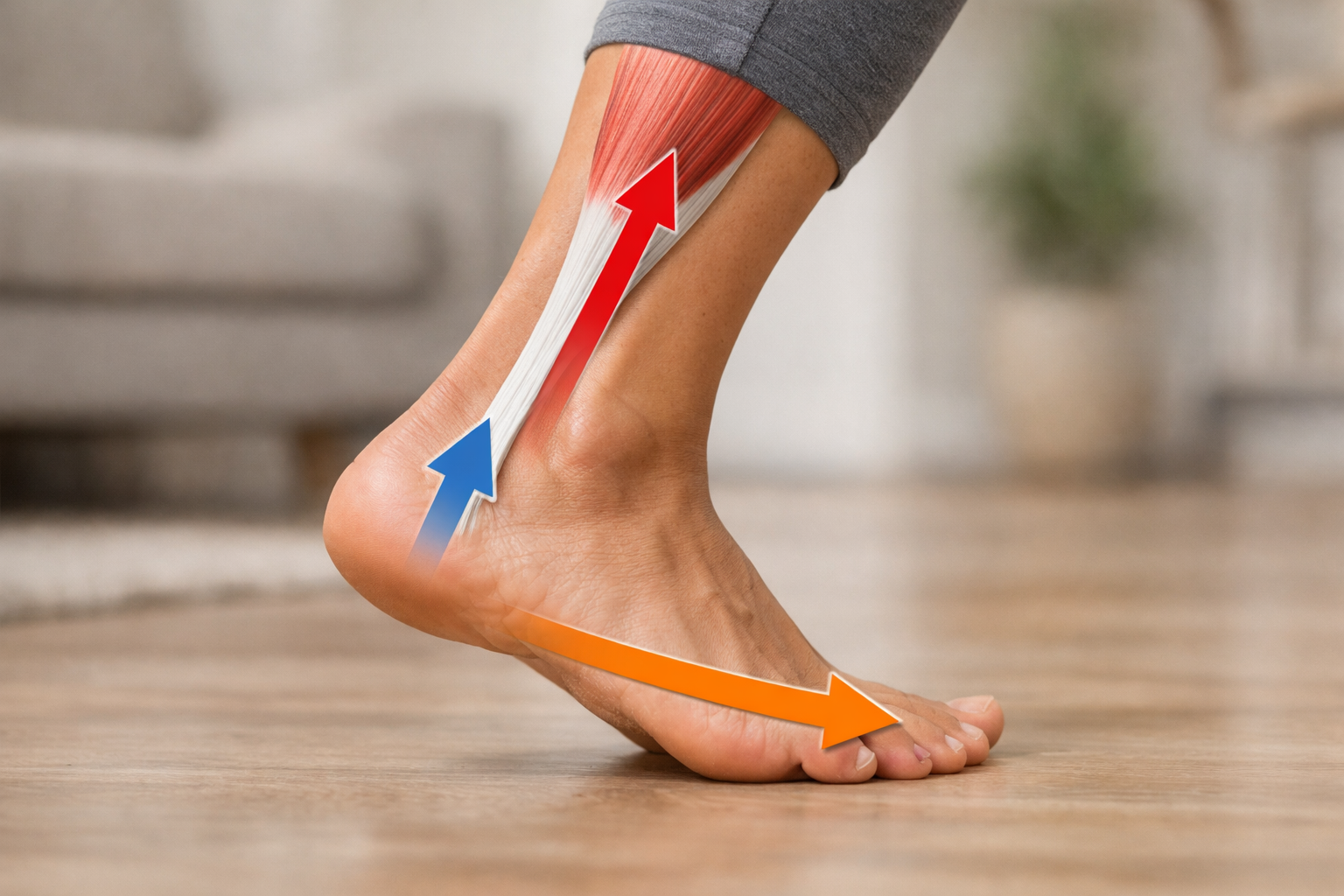
The big one. It connects your calf muscles to the back of your heel bone, and it’s the thickest, strongest tendon in the body. Every time you push off, the Achilles is doing the heavy lifting.
It handles enormous loads. Walking puts several times your body weight through it. Running puts through considerably more. That’s normal, and a healthy Achilles is built for it. Problems tend to show up when the amount of work jumps faster than the tendon has had time to adapt to: a new job on your feet, a return to running after a layoff, a hilly vacation, a sudden switch to flatter shoes.
Achilles pain often shows up either at the very back of the heel where the tendon attaches, or a couple of inches above that, in the middle portion of the tendon. Those two locations tend to behave a little differently in rehab, which is one reason a hands-on exam is useful rather than guessing from a diagram.
The posterior tibial tendon

If your arch has a bodyguard, this is it.
The posterior tibial tendon starts from a muscle deep in your calf, runs down behind the bony bump on the inside of your ankle, curls around it like a rope around a pulley, and fans out underneath your foot to attach to several bones in the middle of the arch.
What it does: it lifts and supports the arch, turns the sole of your foot slightly inward, and, importantly, helps lock your midfoot into a rigid lever right before you push off. Without that locking action, your foot stays floppy through push-off and everything else has to work harder.
When this tendon gets irritated or starts losing capacity, people usually describe pain and sometimes swelling along the inside of the ankle, just below and behind that bony bump. It often hurts more with prolonged standing or walking, and less with sitting. Over time, if the tendon keeps losing its ability to do the job, the arch can gradually flatten and the heel can drift outward.
That’s the tendon most anatomy articles name when they talk about arch support, and the reason is simple. It’s the one whose failure changes the shape of your foot.
The peroneal tendons (fibularis tendons)
Two of them, running down the outside of your lower leg and hooking around the bony bump on the outside of your ankle.
The longer one dives underneath the foot and attaches near the base of your big toe on the underside. The shorter one attaches to the outer edge of your midfoot. Together they turn the sole of your foot outward and, just as importantly, they’re your side-to-side stabilizers. When you step on a curb edge or a tree root and your ankle starts to roll, the peroneals are the ones trying to catch you.
People with a history of ankle sprains often end up with peroneal tendon irritation, sometimes years later. If you’re getting pain along the outside of the ankle or the outer edge of the foot, especially on uneven ground, these are frequent suspects.
The anterior tibial tendon
This one runs down the front of your shin, crosses the front of your ankle, and attaches near the inside of the arch. You can usually see it as a prominent cord on the top of your foot when you lift your toes toward your face.
Its job is to lift the front of your foot as your leg swings through, so your toes clear the ground, and then to lower your forefoot smoothly to the floor after your heel lands. That controlled lowering is a bigger deal than it sounds. If it stops working well, you get a slap-footed landing that other people can hear.
Anterior tibial irritation often shows up as pain across the front of the ankle or the top of the foot, and shoe laces pressing on it can make it worse.
The extensor tendons
A fan of tendons running across the top of your foot to your toes, lifting them upward. These are the ones you see standing out under the skin.
They sit right beneath the surface with very little padding, so they’re vulnerable to simple pressure. Tight laces, a shoe with a stiff tongue, a hiking boot cranked down for a steep descent. Pain on the top of the foot after a long hike is frequently just an irritated extensor tendon, not something sinister.
The flexor tendons
The counterparts to the extensors, running along the bottom of the foot to curl your toes downward. Two of them come down from the calf: one to the big toe, one to the other four. The big-toe flexor is a genuine workhorse. It contributes real force at push-off and helps stabilize the arch from below.
Dancers, runners, and people who spend a lot of time on their toes sometimes get irritation where the big-toe flexor passes behind the inside of the ankle. It can be mistaken for posterior tibial pain because the two run near each other.
And the plantar fascia, which is not a tendon
Worth mentioning because people lump it in. The thick band running along the bottom of your foot from heel to toes is fascia, not tendon. It doesn’t connect a muscle to a bone; it connects bone to bone and works as a tension band that keeps your arch from splaying under load.
It behaves a lot like a tendon, though. It responds to gradual loading the same way, gets irritated for the same reasons, and rebuilds on a similar timeline. So if you’re dealing with heel pain rather than tendon pain, most of the reasoning below still applies.
How your arch is actually held up
The tendons don’t do it alone, and it’s worth understanding the layers because it explains why arch problems are rarely solved by one thing.
Bone shape. The bones of the midfoot are wedged together into an arch. That geometry gives you passive support before any muscle fires.
Ligaments and fascia. Ligaments hold the bones in that arrangement. The plantar fascia acts as the bowstring across the bottom. This layer is passive too. It doesn’t get tired, but it also doesn’t adjust.
Small muscles inside the foot. Layers of little muscles between the heel and the toes. They’re the fine-tuners, adjusting from step to step.
The long tendons from the leg. Posterior tibial from the inside, the peroneals from the outside, the flexors from below. These are the dynamic support, the ones that can pull harder when a step demands more.
A foot with a fairly flat shape but strong, capable tendons and muscles often does just fine. A foot with a beautiful arch on paper but poor capacity can hurt constantly. Shape and capability are different things, and capability is the one you can change.
What is the most common tendon injury in the foot?
Achilles problems are the most common tendon complaint in the foot and ankle by a wide margin. Posterior tibial and peroneal issues follow, and they get more common with age and with jobs that keep you upright all day.
But the word “injury” is worth pushing back on, because it implies an event. Most of these don’t start with an event.
The far more common story: the tendon was handling its usual workload fine, then the workload went up, or the recovery time went down, and the tendon started falling behind. No moment. No pop. Just a slow accumulation of soreness that took a few weeks to become a real problem.
That’s the load-versus-capacity picture. Demand exceeded what the tissue could currently tolerate. Not because anything is wrong with you, and not because the tendon is fragile, but because the two got out of balance.
Which also tells you what recovery involves. If the problem is a gap between demand and capacity, you can lower the demand for a while, and that helps. But at some point you have to raise the capacity, because you still want to walk three miles, stand through a twelve-hour shift, and take a trip that involves airports.
One more piece of vocabulary. Longstanding tendon problems are often called “tendonitis,” which implies active inflammation. In a tendon that’s been bothering you for months, the tissue picture is usually less about inflammation and more about disorganized, poorly adapted tendon fiber. Clinicians often call that tendinopathy. It matters because it shapes the treatment. Anti-inflammatory approaches alone tend to disappoint when the real issue is a tendon that needs to be rebuilt through loading.
Does walking help tendonitis in the foot?
Usually yes, at the right amount. Which is the whole game.
Tendons are load-responsive tissue. They get stronger, better organized, and more tolerant in response to being used, and they get weaker and less tolerant when they aren’t. Sitting still for three weeks will often reduce your pain, because an unloaded tendon is a quiet tendon. Then you walk to the mailbox and it hurts again, and it feels like you’re back at square one.
You weren’t back at square one. The pain got quieter because the demand dropped, not because the tendon got better at anything. Rest lowers sensitivity. It doesn’t build capacity. Rest equals rust, if you leave it there too long.
So walking helps when the amount matches what your foot can currently handle. Here’s roughly how I think about finding that amount:
- During activity, discomfort that stays at or below about a 4 out of 10 is generally acceptable. For many people that’s a reasonable working ceiling.
- Afterward, what matters most is the next morning. If symptoms settle back to your usual baseline within about 24 hours, that dose was fine. If you’re still noticeably worse two days later, that was too much for now.
- Watch the trend across weeks, not the reading from any single day. Days bounce around. Weeks tell the truth.
And remember that total load is cumulative. Your foot doesn’t distinguish between your rehab exercises and your workday. Ten thousand steps at a warehouse, three hours standing at a stove, a walk with the dog, plus your calf raises, all go into one bucket. When people flare, it’s frequently not the exercise that did it. It’s the exercise plus a day that was busier than usual. Symptoms can also lag a day or two behind the load that caused them, which is why the culprit often isn’t what you did today.
How long do damaged tendons in the foot take to heal?
Honest answer: longer than most people are told, and it depends heavily on what “damaged” means.
Tendons have a modest blood supply and they remodel slowly. When you start loading a cranky tendon properly, the first improvements tend to come within a few weeks, and much of that early gain is your nervous system getting more comfortable and your muscles coordinating better. Real change in the tendon tissue itself takes longer. For many people, meaningful structural adaptation happens over something like 8 to 12 weeks of consistent, progressive loading, and a longstanding problem can take longer still.
This is the single most common reason tendon problems come back. Pain resolves at week five. The person stops, understandably, because it stopped hurting. But the tendon hadn’t finished adapting yet. Then the first busy week undoes it.
Think of pain as an early indicator, not a finish line. The finish line is capacity: can your foot do the thing you want it to do, repeatedly, and recover normally afterward?
A few things that shift the timeline:
- How long it’s been going on. Something you’ve dealt with for two years usually means starting from a lower point and progressing more patiently. It does not mean it can’t improve. Persistent isn’t the same as permanent.
- Which tendon. Achilles and posterior tibial problems typically take longer than an irritated extensor tendon on top of the foot.
- What’s happening the other 23 hours. If your job has you on concrete all day, your rehab is competing with a large daily load. That’s not a barrier, it just changes how the progression gets built.
- Whether there’s an actual tear, which is a different situation.
If there’s a full rupture and surgery is involved, you’re looking at a considerably longer road, usually many months, with a structured progression from protection to weight bearing to strengthening to return to activity.
How to tell if a tendon in the foot is torn
You often can’t be certain on your own, and I’d rather you get it checked than talk yourself into or out of something. But there are patterns worth knowing.
Features that raise concern for a significant tear:
- A sudden pop, snap, or the sensation of being kicked or struck in the back of the ankle, particularly with the Achilles
- A clear, immediate loss of a specific function: can’t push off, can’t rise onto your toes on that leg, can’t lift your foot when you walk and your toes catch or your foot slaps down
- A visible gap or dent you can feel along the line of the tendon
- Rapid, significant swelling and bruising after a distinct moment
- A noticeable change in the shape of your foot, like an arch that’s flattened over months alongside inside-ankle pain
Features that point more toward an irritated, overloaded tendon rather than a tear:
- Pain that built up gradually over weeks with no single moment
- Stiffness and soreness first thing in the morning that eases as you move
- Pain that’s worse at the start of activity, warms up somewhat, then returns afterward
- Strength that’s still basically there, even if it hurts to use
A couple of self-checks clinicians use as starting points. For the Achilles, being unable to do a single-leg heel raise is a meaningful finding. For the posterior tibial tendon, standing and rising onto your toes on one leg should make your heel swing inward; if it doesn’t, or you can’t do it at all, that’s worth evaluating.
Neither test proves anything by itself. They’re clues.
Can you still walk with a torn tendon in your foot?
Often, yes. Which surprises people, and it’s exactly why some tears get missed for weeks.
Your foot has redundancy built in. If one tendon can’t do its job, others partially cover for it. People walk on completely ruptured Achilles tendons, with a limp and no push-off, but they walk. People walk for years on a posterior tibial tendon that’s failing, gradually flattening their arch as they go.
So “I can still walk on it” is not reassurance. What’s more telling is whether you can do the specific job that tendon owns. Rise onto your toes on that leg alone. Lift the front of your foot clearly. Hold your balance on one foot without your ankle wobbling all over.
And the fact that you can limp along on it isn’t a reason to keep limping along on it. Walking with a tendon that isn’t functioning shifts the work elsewhere: the other foot, the knee, the hip, the low back. Those areas often start speaking up next.
What will a doctor do for a torn tendon?
The first step is figuring out what’s actually there. That usually means a hands-on exam that tests each tendon’s specific job, plus your history: how it started, what makes it worse, what changed in the weeks before.
Imaging comes in when the exam raises a question the exam can’t answer. Ultrasound is useful for tendons because it shows them moving in real time. MRI gives more detail on the surrounding structures. X-rays don’t show tendons at all, but they’re used to rule out bone problems.
A note about what scans show. A tendon that looks thickened on imaging is not automatically the source of your pain. Thickening is often the tissue’s adaptation to years of stress. Plenty of people have tendon changes on imaging and no symptoms whatsoever. A scan can show structural changes, but it doesn’t always tell us why you hurt, and it certainly doesn’t determine what you’ll be capable of a year from now. The scan is one input. The exam and your actual function are the others.
From there, treatment sorts roughly into three paths:
Partial tears and overloaded tendons. Almost always managed without surgery. Calm the irritation, protect it briefly if it’s very reactive, then load it progressively over months. This is where the majority of foot tendon problems live, and where the outcomes are generally good when the loading is actually progressed rather than repeated at the same level for eight weeks.
Full ruptures. Depends on which tendon, your age, your activity demands, and how long ago it happened. Achilles ruptures are treated both surgically and non-surgically, and the decision is genuinely individual. Either way, there’s an extended rehab period, and the rehab is what determines the result more than the choice itself.
Tendons that have failed structurally over time, like an advanced posterior tibial problem with a collapsed arch. These sometimes need reconstruction, which can involve transferring a nearby tendon to take over the job, and sometimes bone work to realign the foot.
How do they repair a tendon in your foot?
When surgery is on the table, the approach depends on what’s left of the tissue.
Direct repair. If the tendon tore cleanly and the ends can be brought together, they’re sewn back to each other with strong suture. Most common with acute Achilles ruptures.
Debridement. For a tendon full of degenerated, disorganized tissue, the damaged portion is removed and the healthy remainder is repaired. Sometimes combined with removing a bone spur that’s been rubbing against it.
Tendon transfer. When a tendon is beyond repair, a neighboring tendon whose job is less essential gets rerouted to take over. The classic example is using the flexor tendon to the smaller toes to substitute for a failed posterior tibial tendon.
Reattachment to bone. If the tendon pulled off its bony attachment, it’s anchored back down with small implants.
Reconstruction with a graft. For a large gap, tissue from elsewhere or donor tissue bridges the distance.
Surgery restores the anatomy. It does not restore capacity. The tendon that gets repaired in the operating room is weak, stiff, and untrained afterward, and the months of graded loading that follow are what turn it back into something that handles a workday. That part is the same principle as non-surgical rehab, just starting from further back and with a surgeon’s timeline on when each stage can begin.
What is the hardest tendon to heal?
Among foot and ankle tendons, the posterior tibial tendon has the toughest reputation, and there are reasons for it.
It has a stretch with a relatively poor blood supply, right around where it curves behind the inside ankle bone, which is also exactly where it’s under the most mechanical stress. Every step loads it. You can’t easily unload it and still live your life. And its failure changes foot shape, which then increases the strain on it further. The problem tends to feed itself.
The Achilles is a close contender, not because it heals poorly, but because the loads it handles are so large that returning to full activity takes real time and real patience.
But “hardest to heal” isn’t the same as “won’t heal.” What it usually means in practice: start from a lower level, progress in smaller steps, and stay with it longer. Consistency beats intensity here, and it’s not close.
When is it too late to fix a torn tendon?
A question that carries a lot of anxiety, so let me separate two things.
For fresh, complete ruptures, timing genuinely matters. An Achilles rupture repaired within the first few weeks is a more straightforward operation than one addressed months later, once the tendon ends have retracted and scarred. This is one of the situations where getting evaluated promptly changes your options. If you had a pop and a sudden loss of push-off, don’t wait it out.
For everything else, the window is much wider than people assume. Longstanding tendon problems, partial tears, tendons that have been gradually degenerating for years: these still respond to loading. Not always back to exactly how things were, and sometimes the foot’s shape doesn’t change much. But the tendon’s ability to tolerate work usually does improve, and that’s what determines whether you can walk the distance you want to walk.
Where “too late” has more real meaning is with long-neglected posterior tibial failure. If the foot has been collapsing for years and the joints have gone stiff in a poor position, the options narrow, and surgery becomes more involved. That’s an argument for getting inside-ankle pain looked at reasonably early, not an argument for despair if you’re already down that road.
Working from where you actually are
When someone comes in with a tendon that’s been irritable for months, the useful question isn’t “how bad is the tendon.” It’s “what can this tendon currently tolerate, and how do we build from there.”
Sometimes the honest starting point is small. Isometric holds, where you contract the muscle without moving the joint, are often well tolerated even by a very reactive tendon. Sometimes it’s a modified version of a movement, or the same movement with less range, or fewer repetitions than feels satisfying. That’s not a consolation prize. That’s finding the level where adaptation can actually happen.
Then it goes up. That’s the part that gets skipped most often. People get given exercises, do them faithfully at the same difficulty for two months, feel some relief, and then get flattened by a long day. The exercises weren’t wrong. The progression was missing. Maybe the piece that’s been missing isn’t another treatment, but a plan for how the work increases as your foot becomes capable of more.
And expect the trend to wobble. A flare-up doesn’t erase your progress; it tells you something about what your foot was ready for that particular day. You look at what changed, you adjust, you keep going. Recovery is not a straight line, and treating every bad day as a verdict is exhausting and inaccurate.
What I watch as much as the pain number: How far can you walk before it complains? How long does it take to settle down afterward? How rough is the first ten minutes in the morning compared to a month ago? Those often move before the pain does, and they’re the things that make a difference in your actual life.
When to get it looked at
Some things warrant a proper evaluation rather than a self-directed plan:
- A sudden pop or snap with immediate loss of function
- Inability to rise onto your toes on one leg, or a foot that slaps or drags when you walk
- Numbness, tingling, or a foot that feels weak in a way you can’t explain
- Pain that’s steadily worsening over weeks despite sensible adjustments
- An arch that’s visibly changing shape, especially with pain on the inside of the ankle
- Significant swelling, warmth, or redness, or foot pain alongside feeling unwell
It’s also worth saying that not everything that feels like a tendon problem is one. Nerve irritation, stress reactions in bone, joint problems, and referred pain from higher up the chain can all produce foot pain that mimics tendon pain closely. A proper exam sorts that out reasonably quickly, and getting the right target matters more than starting fast on the wrong one.
The short version of all of this: your foot tendons are strong, adaptable tissue that got into trouble because of an imbalance between what was asked of them and what they were ready for. That imbalance can be shifted from both ends. Recovery is built, and knowing which tendon does what is a genuinely useful place to start.