What Is the Root Cause of Heel Pain? A Clearer Explanation
Heel pain has a lot of possible sources, but most of them share one underlying story: the demand on the tissue outgrew what that tissue could currently handle. Here's how to think about the cause of your heel pain and what actually changes it.

Most people who ask about the root cause of heel pain are really asking two things at once. What is it? And why now?
That second question is the one that usually goes unanswered. You get a name for the problem, maybe plantar fasciitis, maybe a spur on an X-ray, and you leave with stretches and an insert. But nobody explains why your heel was fine in March and miserable by June, when you didn’t fall, twist it, or do anything dramatic.
So let’s start there.
The Underlying Story Behind Most Heel Pain
Strip away the specific diagnoses for a second. Almost all gradual-onset heel pain comes down to one thing: the demand placed on the tissue went past what that tissue could currently handle.
That’s it. That’s the mechanism.
Your plantar fascia, your Achilles, the fat pad under your heel, the small muscles in your arch, all of these have a certain amount of work they can absorb and recover from. Not just today. Day after day, for weeks. When the work stays inside that range, the tissue adapts and gets sturdier. When the work outruns that range, it gets irritated, then sensitive, then painful.
The important part is that both sides of the equation can change.
Demand can go up. You started walking more. You took a new job that keeps you on concrete for nine hours. You trained for a race. You spent five days at Disney in flat sandals. You moved into a house with stairs.
Or capacity can go down. You had a few sedentary months. You were sick. You stopped running for a winter and then picked up where you left off. You switched from a stiff, cushioned work shoe to something flat and flexible, and now the same walking asks more of your foot than it used to.
Either direction produces the same result. Load exceeded capacity. Heel hurts.
This is why “how did I suddenly get plantar fasciitis?” has an answer even when nothing obvious happened. It usually wasn’t sudden. It was accumulating quietly, and the pain was just the last thing to arrive.
The Specific Causes, and Why the Label Matters Less Than You’d Think
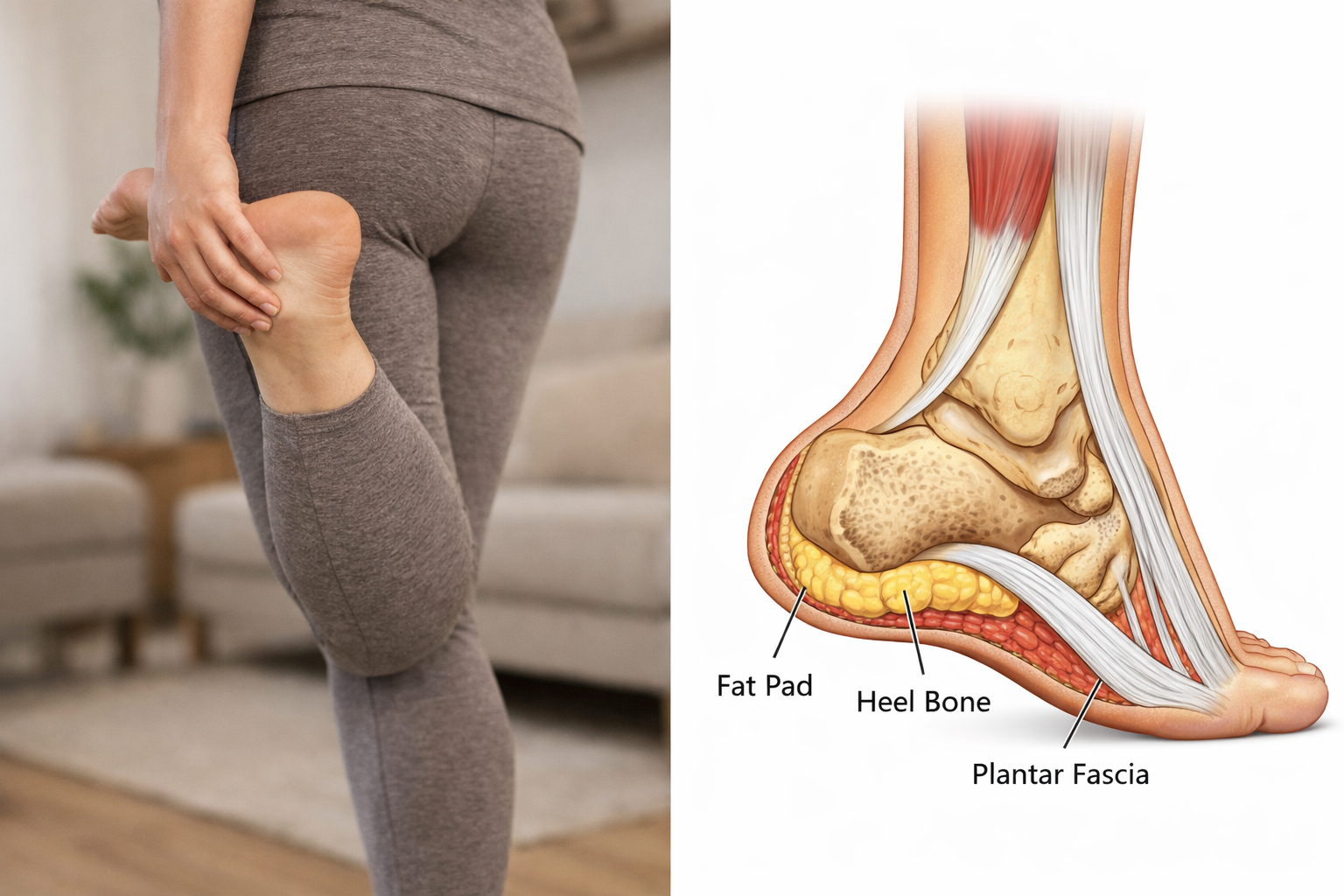
Heel pain isn’t one condition. Here are the common ones, roughly grouped by where it hurts.
Pain under the heel, worst with the first steps
This pattern can be consistent with plantar fasciitis, which is the most common source of heel pain. The plantar fascia is the thick band of tissue running from your heel bone to the ball of your foot. It works like a spring and a tension cable while you walk.
When the problem has been going on a while, the more accurate word is plantar fasciopathy. The difference matters: “itis” implies active inflammation, and in a heel that’s been sore for six months, what we usually find is tissue that has been remodeling under stress rather than a fire that needs putting out. That changes what helps. You can’t anti-inflammatory your way out of a capacity problem.
Pain right at the bottom center of the heel, more like a bruise
The heel fat pad is a specialized shock absorber. It thins with age and can get overloaded by long hours on hard surfaces or by thin, flat footwear. Fat pad irritation tends to feel deeper and more diffuse than plantar fascia pain, and it often hurts most while standing rather than in that sharp first-step way.
Pain at the back of the heel
This is Achilles territory. It can be the tendon itself a few centimeters above the heel, or the spot where the tendon inserts into the bone. Insertional problems tend to be crankier and more sensitive to stretching, which is one reason aggressive calf stretching sometimes makes back-of-heel pain worse while helping bottom-of-heel pain.
Nerve-related heel pain
A branch of a nerve running near the inner heel can get irritated and produce burning, tingling, or a pain that radiates rather than staying put. This behaves differently from fascia pain and responds to different things.
Bone-related heel pain
A stress reaction in the heel bone is less common but real, particularly in runners who ramped up quickly, and in kids and adolescents where the growth plate at the back of the heel gets irritated (that one has its own name and its own timeline, and it typically settles as growth finishes).
Here’s the thing about all of these. The label tells us where the tissue is and how sensitive it currently is. It doesn’t change the underlying question, which is still: what is this tissue being asked to do, and what can it currently handle? A nerve gets treated differently from a tendon in the details. But the logic of finding a workable starting point and building up from there holds across nearly all of it.
What Gets Mistaken for Plantar Fasciitis
Plantar fasciitis is common enough that it becomes the default guess for anything that hurts near the heel. Sometimes that guess is wrong, and that’s often why months of plantar fasciitis treatment went nowhere.
Things that can look similar:
- Fat pad irritation or thinning. Hurts under the heel, but the pattern and the fix differ.
- Nerve irritation near the inner heel. Burning or electrical quality, sometimes worse at night, less of a classic morning spike.
- A stress reaction in the heel bone. Tends to hurt with impact and progressively worsen rather than warm up as you move.
- Insertional Achilles problems. Pain at the back, not the bottom, though people describe both as “my heel.”
- Referred pain from the low back or from nerve irritation higher up the chain.
- Inflammatory arthritis. Certain inflammatory conditions have a real tendency to show up at tendon and fascia attachment points, and the heel is a favorite spot. These often come with a different flavor: prolonged morning stiffness that lasts well beyond a few minutes, pain in other joints, symptoms in both heels, sometimes eye or skin or gut symptoms. That combination deserves an evaluation rather than another round of stretches.
On the question of what diseases start with heel pain: a handful of systemic conditions can announce themselves at the heel, including inflammatory arthritis and, indirectly, conditions that affect nerves or circulation. That’s not a reason to worry about every sore heel. It is a reason to take seriously any heel pain that comes with fever, swelling, redness, night pain that won’t settle, numbness, or symptoms spreading elsewhere in your body. We wrote separately about heel pain red flags and when the pattern suggests something beyond a load problem, and that’s worth reading if any of this sounds like you.
Why Only One Foot?
This is one of the most common questions, and it trips people up because it feels like it should mean something is structurally wrong with that one foot.
Usually it’s simpler. You don’t load your two legs identically. Almost nobody does.
One side takes more weight when you stand. One side pushes off harder. One hip is a little less willing to do its share, so the foot below compensates. You had an ankle sprain eleven years ago and that side never quite returned to full duty. You favor one leg on the ladder at work.
Small asymmetries in demand, repeated thousands of times a day, add up. The side asked to do slightly more crosses its threshold first.
So one-sided heel pain is the norm, not a warning sign by itself. When heel pain shows up in both feet at once, especially with significant morning stiffness elsewhere, that’s actually the pattern more likely to prompt a broader look.
Why It Hurts Most in the Morning
Those first steps out of bed are the most reliable symptom in all of foot care, and they’re also the most misunderstood.
People assume it means the tissue got worse overnight. Something tore while you slept. It’s degenerating.
Not what’s happening. You spent seven or eight hours with no load going through that tissue at all. Sensitive tissue that’s been completely unloaded responds sharply when load returns suddenly. Then, after a few dozen steps, it settles. The sensitivity has a threshold, and gentle repeated loading raises it for the day.
This is why morning pain that eases within five or ten minutes of walking is reassuring rather than alarming. The pattern of easing is information. It tells us we’re dealing with a sensitivity issue in tissue that responds to movement.
And it tells you something practical: the first few minutes of your morning don’t have to be a cold start. A little gentle ankle movement and some calf and foot work before your feet hit the floor often takes the edge off. That’s not treatment. It’s just making the transition less abrupt.
Will Plantar Fasciitis Go Away by Itself?
Sometimes, yes. If the cause was a temporary spike in demand, a vacation, a training block, a month of extra hours on your feet, and life returns to its normal level, the tissue can catch up on its own. Plenty of people have a sore heel for six weeks and then don’t.
But here’s the pattern I see over and over in the clinic, and it’s worth understanding.
Rest reduces sensitivity. It does not build capacity.
So you back off. It feels better. That feels like healing. Then you return to what you were doing before, and within a week or two you’re back where you started, sometimes worse, and now you’re confused because you did the rest and it didn’t hold.
It didn’t hold because nothing changed about what your foot could tolerate. You just removed the demand temporarily. The moment the demand came back, so did the problem. Rest calms things down. It doesn’t make the tissue stronger. Those are two separate jobs.
That’s also the honest answer to why some heel pain drags on for a year or two. Not because it’s untreatable. Because the cycle of rest, feel better, resume, flare, rest again never gets around to the part where the tissue actually gets more capable. Recovery is built.
How Do You Get Heel Pain to Go Away?
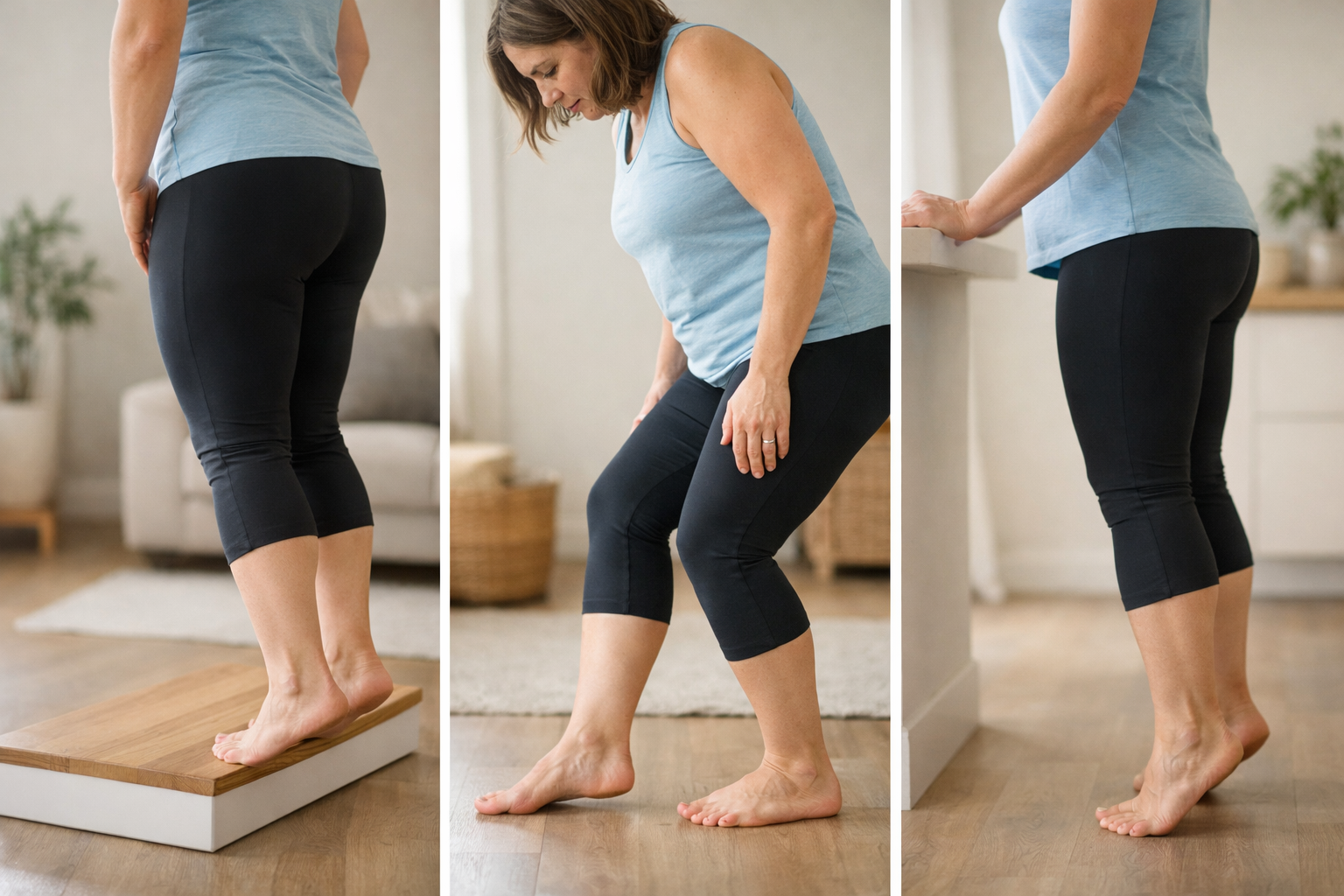
I can’t prescribe for you through a screen, and I won’t pretend to. But the logic isn’t complicated, and understanding it changes how you approach the next few months.
Step one: find the starting point your foot can handle.
Not the level that’s completely painless, and not the level that wrecks you. Somewhere in between. For many people, a useful rule of thumb is keeping discomfort at or below roughly a 4 out of 10 during and after activity, and expecting it to settle back toward your normal baseline within about a day.
That 24-hour window is the real test. Some soreness after loading a sensitive tissue is expected. Soreness that’s still elevated two days later usually means the dose was too much. Adjust and go again.
Step two: load it, and keep loading it.
For plantar fascia and Achilles problems, this generally means slow, deliberate, progressively heavier work through the foot and calf. Not just stretching. Stretching can feel good and can reduce sensitivity, and there’s a place for it. But stretching doesn’t change tissue structure the way loading does. Tendon and fascia adapt to mechanical demand over weeks and months.
Step three: give each level enough time.
Early improvements come fast and they come mostly from your nervous system: better coordination, less protective guarding, less sensitivity. That’s genuine progress but it isn’t structural yet. Real tissue change tends to show up over something like 8 to 12 weeks of consistent loading, often longer for stubborn cases.
This is the single most common place people go wrong. Pain resolves at week four, they stop, and the tissue never finished adapting. Then it comes back in the spring. Consistency beats intensity, and consistency has to outlast the pain by a decent margin.
Step four: account for everything, not just the exercises.
Your foot doesn’t distinguish between “exercise load” and “life load.” A workday on your feet, a long errand run, a flight, the shoes you chose, all of it goes in the same bucket. This is why flares so often trace back to the day, not the workout. It’s also why symptoms can lag a day or two behind whatever caused them, which makes the pattern hard to spot unless you’re paying attention.
Is Walking Good for Plantar Fasciitis?
Usually, yes, with an honest asterisk about amount.
Walking loads the plantar fascia in exactly the way it’s built to be loaded. It’s rhythmic, it’s moderate, and it’s the function most people are actually trying to get back. Avoiding it entirely tends to backfire, because the tissue becomes less tolerant of the very thing you need it to tolerate.
What matters is dose. Three ten-minute walks often land differently than one thirty-minute walk, even though the total is the same. Surface matters. Shoes matter. Whether you were already on your feet for eight hours matters.
So walk. Watch the response. If your heel is grumpier the next morning than it was the day before and stays that way, you found the ceiling. Work just under it, and the ceiling rises.
The Worst Things You Can Do
People ask for the single worst mistake. There isn’t one, but there are a few reliable ways to stay stuck.
Complete rest as a strategy. Short-term unloading to settle an angry foot is fine and sometimes necessary. Weeks of avoiding walking is a different thing, and it leaves you with a foot that tolerates even less than before. Rest equals rust.
Pushing through pain that keeps climbing. The other ditch. If pain rises steadily through an activity rather than warming up, or if it takes days to settle, that’s not toughness, it’s just more irritation.
Changing everything at once. New shoes, new inserts, new stretches, new exercises, all in the same week. When something changes, you have no idea which variable did it. Change one thing at a time and watch.
Stopping the moment it feels better. Already covered, but it’s the big one. This is the difference between a heel that’s quiet for a month and a heel that’s quiet for years.
Waiting for zero pain before you start building. If you wait until the foot is perfectly comfortable to begin loading it, you may wait a very long time. Function matters as much as pain. Walking farther, standing through a shift, recovering faster afterward, those are all progress even if the number hasn’t hit zero yet.
“What Finally Worked?”
Search this and you’ll find a hundred answers, each delivered with total conviction. Night splints. A specific insert. A particular stretch. Shockwave. An injection. New shoes. Losing weight. Taping.
The frustrating truth is that most of those things help some people, and it’s rarely because the thing itself was magic. It’s because that intervention shifted the load-and-capacity balance enough, at the right moment, for the tissue to catch up.
An insert can reduce demand on the fascia while you rebuild. An injection can drop sensitivity enough that you can finally start loading. Better shoes can take enough off the top that your daily total lands inside your tolerance. A stretch can make the mornings livable so you stay active instead of hiding from your own feet.
These are all legitimate. What they aren’t is the whole plan on their own. The pattern I see in people who get durably better, whatever combination of treatments they used along the way, is that at some point they went through a stretch of weeks where the foot was asked to do progressively more, and it adapted.
And for people who’ve been dealing with this for a year or two: a longer history usually means a lower starting point and a slower, more patient progression. It does not mean the door is closed. Persistent does not mean permanent.
One more thing on body weight and standing jobs, since they come up constantly and usually get delivered with a side of guilt. Both increase total load on the system. That’s just physics, not a character assessment. The useful response isn’t shame; it’s recognizing that your foot has to build capacity for the life you actually live, which might mean a more gradual build and closer attention to how much is landing on that tissue each day.
What About the Spur on My X-Ray?
Briefly, since we’ve covered this in depth elsewhere on the site: a heel spur is usually a consequence of long-term stress at the fascia’s attachment, not the thing generating your pain. Plenty of people have spurs and no symptoms at all. Recovery looks about the same with or without one.
Same goes for a report that says your plantar fascia is thickened. Thickening is the tissue responding to stress. It’s a finding, not a verdict, and it doesn’t tell you how your next three months will go. A scan can show structural changes, but it doesn’t always tell us why you hurt.
When to Get It Looked At
Most heel pain is a load problem and improves with a sensible, progressive plan. Some of it isn’t. Worth getting evaluated if you have heel pain with fever, redness or significant swelling, numbness or weakness in the foot, pain that woke you and wouldn’t settle, an inability to bear weight, pain in both heels alongside morning stiffness elsewhere in your body, or symptoms that keep getting worse despite reasonable changes. Same if you’ve been at this for months and can’t figure out why nothing is holding. Sometimes the missing piece isn’t another treatment. It’s the right diagnosis, or a clear way to progress.
When you understand that your heel hurts because the demand outgrew what the tissue could handle, the path forward stops being mysterious. You’re not waiting for it to heal. You’re figuring out what your foot can do today, and then patiently asking it for a little more.