Is It Okay to Walk With Heel Bursitis? A Practical Guide
Heel bursitis rarely requires you to stop walking, but it does ask you to change a few specifics: what touches the back of your heel, how much ankle bend your day demands, and how you spread activity out. Here is how to keep moving while the irritation settles, and how to rebuild what your heel can handle.
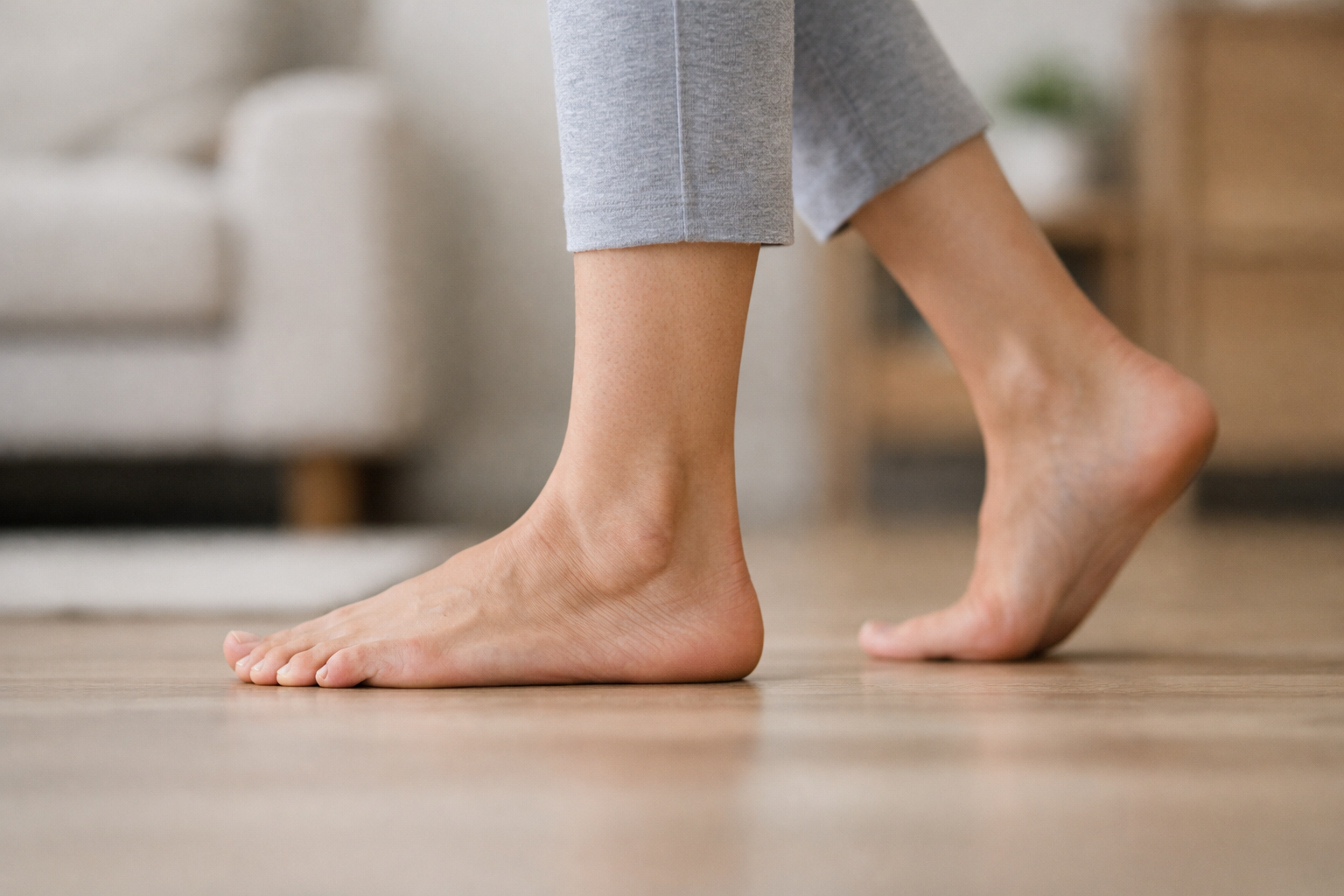
Most people arrive at this question already limping a little. The back of the heel is sore, shoes have started to feel like the enemy, and somewhere along the way you read that you should stop walking until the bursa calms down. So you’re asking a reasonable question: is it okay to walk with heel bursitis, or am I making it worse every time I stand up?
For most people, the answer is yes, walking is okay. Usually it’s necessary. But the details matter more with a bursa than with almost any other heel problem, because what irritates a bursa isn’t only how far you walked. It’s what pressed on it, and how much your ankle had to bend while doing it.
That’s the part most advice skips.
Why a bursa reacts differently than a tendon
A bursa is a small fluid-filled cushion that sits where things rub. At the heel there are a couple that matter. One sits between your Achilles tendon and the back of the heel bone, tucked deep. Another sits between the tendon (or the skin over it) and whatever is on the outside, usually the back of your shoe.
That location tells you almost everything about what will bother it.
The deep one gets squeezed when your ankle bends far, because that motion pulls the tendon down against the bone and pinches the space in between. Think uphill walking, stairs, a deep lunge, or holding your heel off the edge of a step to stretch your calf.
The shallow one gets irritated by pressure and friction from the outside. A firm heel counter, a stiff new boot, a shoe laced tightly at the top, the seam of a sock, the back of a dress shoe rubbing for eight hours.
So when people ask whether bursitis gets worse when walking, the honest answer is: some kinds of walking, yes. Flat ground in a forgiving shoe often feels fine. Twenty minutes on a hill in a stiff-backed boot can set you back a few days. Same distance, very different demand on that one small structure.
Once you see it that way, the plan stops being “walk or don’t walk” and becomes “which parts of walking do I need to change this week.”
Should I stop walking if I have heel pain?
Complete rest is genuinely useful for a bursa in small doses, over a few days, when things are hot and angry. It’s much less useful as a strategy for a few weeks.
Here’s why. Unloading tissue lowers how sensitive it is. It doesn’t make it more capable. So you rest, the heel feels better, you go back to your normal life, and the irritation returns within days because nothing about your heel’s tolerance actually changed. That cycle is one of the more common reasons heel bursitis ends up feeling like it’s dragging on for months.
Rest can calm irritation. It can’t build capacity. Recovery is built.
The practical middle ground: stay as active as you can tolerate, reduce the specific things that compress or rub the bursa, and rebuild from there. If you want a fuller discussion of how much walking pain is acceptable and when backing off is actually the right call, we’ve covered that separately in “Should I Keep Walking With Heel Pain, or Rest It?” Here I want to get more specific about the mechanics.
How to make walking tolerable this week
A few adjustments do most of the work. None of them are permanent.
Get pressure off the back of the heel. This is the single highest-yield change for shallow bursa irritation. That may mean switching to a shoe with a soft, low, flexible heel counter. It may mean skipping the top eyelet when you lace, so nothing cinches over the tender spot. Some people do well temporarily in a backless shoe or a clog around the house. Small heel pads or a gel sleeve can help too, as long as they cushion rather than add pressure.
Add a little heel height, temporarily. A modest heel lift, or simply a shoe with some drop from heel to toe, reduces how far your ankle has to bend with each step. That takes some of the pinch off the deep bursa. This is a short-term tool to keep you walking comfortably, not something you should plan to live in forever, because eventually we want your ankle to tolerate its full range again.
Flatten your terrain for a while. Hills, stairs, sand, and uneven trails all ask for more ankle bend and more push-off. If you have a choice of routes, take the boring flat one for now.
Break the day up. Three ten-minute walks are often much better tolerated than one thirty-minute walk, especially early on. Total time can stay the same while the peak demand on the heel drops.
Be careful with barefoot on hard floors. Not because barefoot is bad in principle. Because a bare heel on tile gives you zero cushioning and often more ankle bend than a shoe does. Slippers with a bit of a heel are usually a kinder choice while things are sensitive.
Ease off aggressive calf stretching. This is counterintuitive, since stretching is standard advice for most heel pain. But hanging your heel off a step is exactly the position that compresses the deep bursa against the bone. If stretching consistently makes the back of your heel worse a few hours later, that’s information worth respecting.
Reading your heel’s response
A reasonable general guide, and one I use with a lot of patients: keep discomfort during and after walking at a level you’d call mild, roughly a 4 out of 10 or less, and check where things sit about 24 hours later. If your heel has settled back to its usual baseline by the next morning, the amount you did was likely fine. If it’s clearly angrier a day later, the dose was too much, or something pressed on it that shouldn’t have.
With bursitis specifically, I’d also pay attention to two things beyond the pain number:
- Tenderness to touch. Pinch the back of the heel gently from both sides. As things improve, that squeeze usually becomes less sharp. It’s often a more honest signal than walking pain, which can be masked by a comfortable shoe.
- Whether swelling is building. A little puffiness at the back of the heel that comes and goes with activity is common. Swelling that keeps growing across a week suggests the total load is still too high.
And notice function, not only symptoms. Walking farther before the heel speaks up, standing through a shift with less trouble, getting through a morning without hobbling to the bathroom: those count as progress even if the pain number hasn’t moved much yet. Function matters as much as pain.
Don’t let the limp become the habit
One thing I watch for. When the back of the heel hurts, people naturally shift weight to the outside of the foot, shorten the stride, and stop pushing off. That’s a smart short-term strategy. It’s a poor medium-term one.
Offload one structure and you load another. A few weeks of limping tends to show up as calf weakness, a cranky forefoot, or a sore hip and low back. Then you have two problems instead of one, and it’s harder to tell which is driving what.
So if you find yourself needing to limp noticeably to get through a walk, that’s usually a sign to walk shorter distances at a normal-looking gait rather than long distances with a compensation pattern. Quality of the steps, not just the count.
What exercise can I do with heel bursitis?
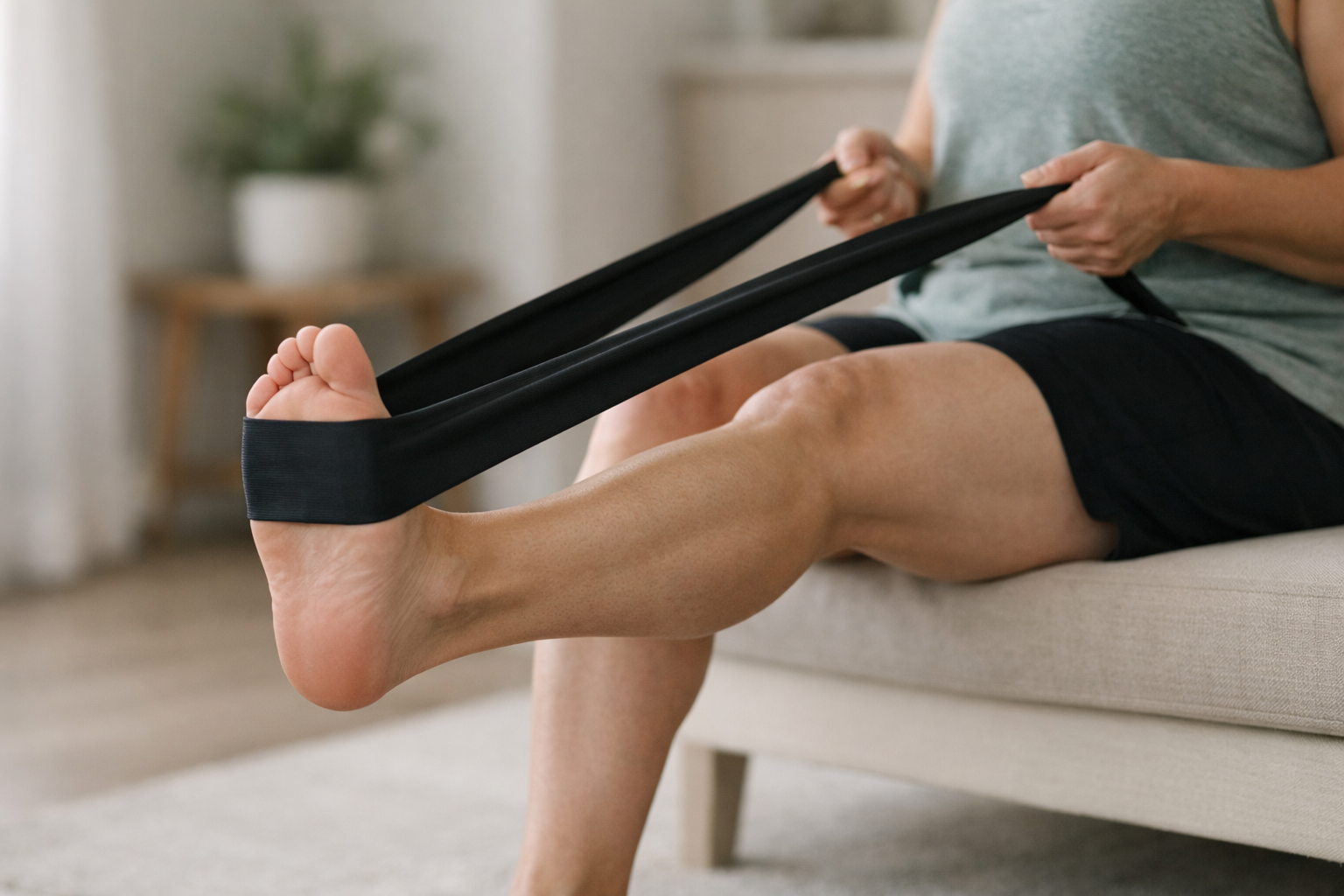
More than you’d think. The goal is to keep your legs and your general conditioning intact while giving the irritated tissue a lower-compression environment.
Usually well tolerated:
- Cycling (stationary or road), keeping the ankle relatively quiet and the seat height reasonable
- Swimming and deep-water jogging
- Pool walking, where body weight is partly supported
- Hip, glute, quad, and core strengthening, which almost never involves the heel at all
- Isometric calf work: pressing the ball of the foot down against resistance without letting the ankle bend far, held for a slow count. Many people find this calms the heel for an hour or two afterward
Usually worth delaying until things settle:
- Heel drops off a step edge (that’s the pinch position)
- Hill running or hill sprints
- Jump rope and plyometrics
- Deep squats where the heel stays down and the shin travels far forward
Then you build. Heel raises on flat ground, both legs, small range. Add reps. Add load. Progress to one leg. Eventually, when the back of the heel tolerates it, restore the full range including the lowered heel, because you’ll want that range back for stairs and hills and running. The order matters more than the calendar. Stay at a level long enough that it becomes easy before you add to it, because early improvements come mostly from your nervous system getting more comfortable, while the actual tissue change takes longer. For many people that adaptation plays out over something like eight to twelve weeks, sometimes more if this has been going on a long while.
That’s also why so many cases come back. People stop when the pain stops, which is usually well before the heel is genuinely ready for the thing that irritated it in the first place.
What shoes are best for heel bursitis?
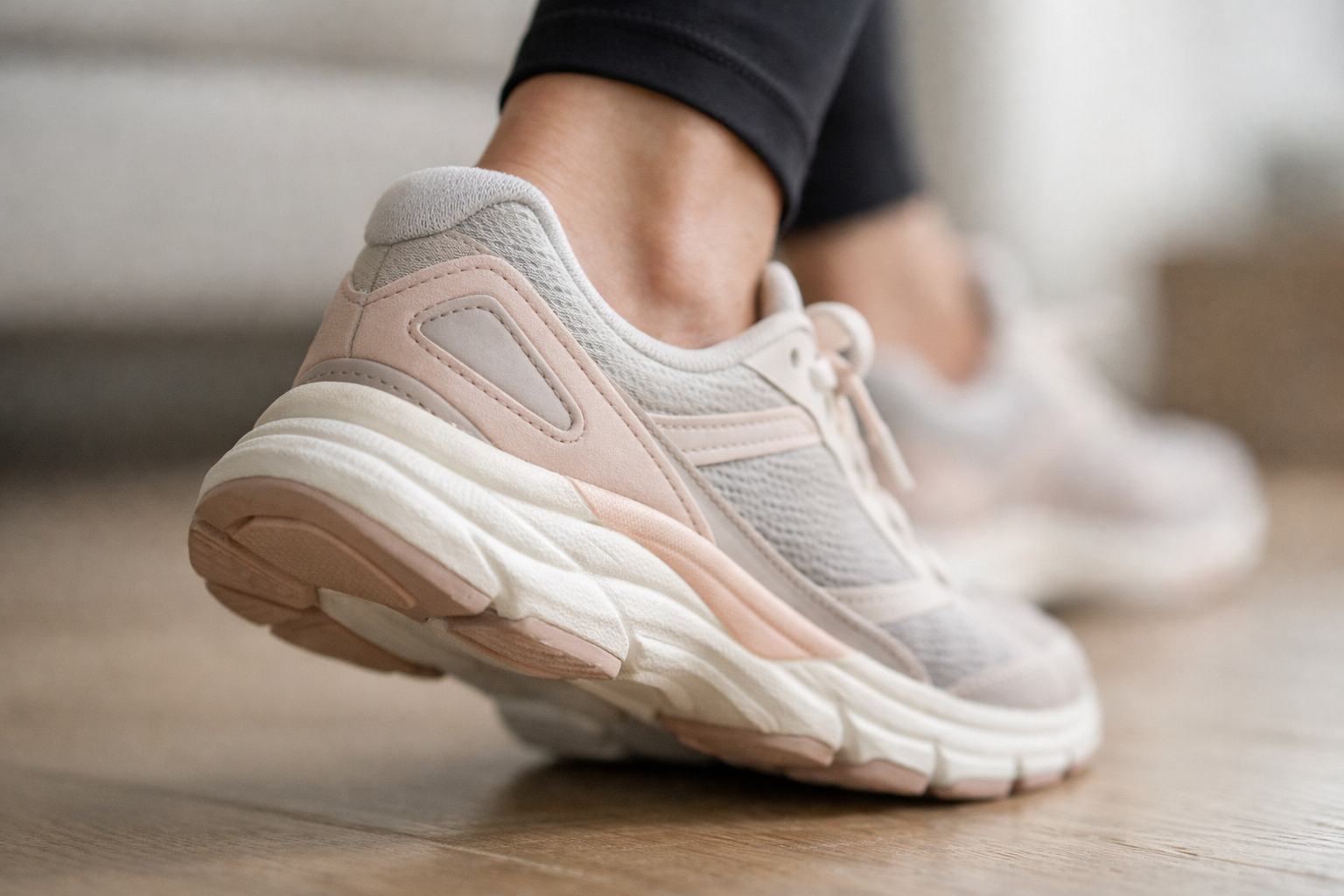
There’s no single best shoe, but there are features that reliably help while the back of the heel is sensitive:
- A soft, low heel counter, or a counter you can press in with your thumb without effort
- Some heel-to-toe drop rather than a completely flat shoe
- Enough length and width that your heel isn’t jammed backward with every step
- A cushioned midsole, which reduces impact even if it does nothing for the bursa directly
- Smooth, seamless socks at the back of the heel
What tends to cause trouble: brand-new stiff boots, rigid running shoes with a tall molded heel collar, dress shoes with a hard back seam, ski and skate boots, and thin flat sandals or flip-flops that offer no cushioning and no heel height. Sudden changes are the real risk. A shoe that has been fine for two years is less likely to be your problem than the one you bought three weeks ago.
If you have a standing job, look at the surface too. An anti-fatigue mat, or shifting positions more often, or a footrest to change your ankle angle periodically, can matter as much as the shoe.
What calms bursitis down?
The things that actually help are unglamorous:
- Taking the pressure off, which usually means footwear changes, not activity elimination
- Reducing total load for a short window, then rebuilding it deliberately. Your total load is everything added up: walking, standing, work, errands, exercise. A flare-up often traces back to a long day on your feet rather than to your exercises
- Ice or a cold pack on the back of the heel after a demanding day, if it feels good
- Isometric holds at a comfortable ankle angle
- Time at each level of activity, long enough for the tissue to adjust
Some people also use over-the-counter anti-inflammatories for short stretches, which is a conversation to have with your physician or pharmacist given your own health history. Injections have a place in stubborn cases, though around the Achilles they warrant careful discussion with your clinician. Either way, medication and injections lower sensitivity. They don’t build tolerance. Whatever calms things down, the rebuilding step still has to happen.
Will heel bursitis ever go away? Does bursitis ever fully heal?
Most of the time, yes. An irritated bursa is not permanent structural damage, and it isn’t arthritis of the heel. It’s a small structure that has been asked to absorb more pressure and friction than it currently tolerates, and it becomes inflamed in response. Remove the aggravating pressure, rebuild what the area can handle, and many people get all the way back to hiking, running, and normal shoes.
A few honest caveats. If there’s a bony prominence at the back of your heel, that shape isn’t going to change, so managing shoe pressure may stay a lifelong habit rather than a temporary one. If this has been going on for a year, expect a lower starting point and a more patient build, not an impossible one. Something you’ve dealt with for a long time is not the same as something permanent.
Recurrence, when it happens, is usually about how someone returned to activity rather than about the bursa being unfixable. New boots, a jump in mileage, a hilly vacation. Those are load problems, and load problems have solutions.
We’ve gone deeper into the treatment side and what tends to speed things along in “Heel Bursitis: Symptoms, Causes, and How to Get Rid of It,” if that’s what you’re after next.
Real life: work, travel, and the days you can’t modify
Some days you don’t get to control your step count. A wedding, an airport, a long shift, a move. A few things help:
- Pack a second pair of shoes and switch mid-day. Different pressure points beat the same pressure point for twelve hours
- Sit when you can, and when you sit, change your ankle position now and then
- On travel days, expect the next morning to be worse and plan a light day after, rather than treating the soreness as a setback
- After a big day, get the shoe off and let the heel decompress instead of pushing through the evening in it
And when a flare does happen, look at what changed before you conclude you’ve gone backward. A temporary increase in symptoms after an unusual day doesn’t erase the previous six weeks of progress. Adjust, drop back a level, rebuild. The trend over a month tells you far more than any single day.
When to get it looked at
See a clinician rather than managing this on your own if you notice heel pain that keeps worsening despite reasonable changes, marked redness with warmth spreading up the back of the heel, fever, a sudden pop followed by weakness pushing off, numbness or tingling into the foot, or heel pain alongside a known inflammatory arthritis condition. Also worth an evaluation if you’ve been at this for more than a few weeks without a clear direction, because not all pain at the back of the heel is bursitis. Achilles tendon problems, an irritated fat pad, a stress reaction in the heel bone, and nerve irritation can all produce something that feels close enough to fool anyone, and they don’t all get managed the same way.
A hands-on exam sorts that out quickly, and it gives you something more useful than a list of things to avoid: an actual plan for what to do next, and how to know when you’re ready for more.