How to Tell If You Have Heel Bursitis: Signs Worth Noticing
A practical guide to recognizing heel bursitis, including where it hurts, how it behaves through the day, and what else can produce nearly identical symptoms. Learn the self-checks that help sort it out and the signs that mean you should be evaluated.
Most people don’t arrive wondering whether they have bursitis. They arrive with a heel that hurts when their shoe touches it, or a deep ache at the back of the ankle that shows up after a long day, and they’ve read enough at midnight to be genuinely confused. Plantar fasciitis. Achilles tendinopathy. Bursitis. Heel spur. Everything sounds like it could fit.
So let’s do the part that actually helps: sort out what heel bursitis tends to feel like, where it tends to sit, how it behaves, and what else looks almost exactly like it. You won’t be able to diagnose yourself from an article, and I won’t pretend otherwise. But you can get much closer to the right question, and you can walk into an evaluation with better information than “my heel hurts.”
First, what a bursa is and why it gets cranky
A bursa is a small fluid-filled sac that sits between two things that slide against each other. Tendon over bone. Skin over bone. It’s a cushion and a lubricant. Your heel has a couple of them that matter.
One sits between the Achilles tendon and the back of the heel bone. That’s the retrocalcaneal bursa, and it’s deep, tucked in front of the tendon.
Another sits between the Achilles tendon and your skin, right where a shoe counter presses. That one is superficial, sometimes called the retro-Achilles bursa, and it’s the one that can look like a visible puffy bump.
There’s also a bursa under the heel bone in some people, beneath the fat pad, though pain there gets attributed to other structures far more often.
A bursa becomes painful when it’s compressed or rubbed more than it can currently tolerate. That’s the whole mechanism. Not mysterious. The demand on that little sac went past what it was ready for, and it responded by getting thicker, more fluid-filled, and more sensitive.
What does bursitis in the heel feel like?
People describe it in fairly consistent ways.
A specific, findable sore spot. This is one of the more useful features. With retrocalcaneal bursitis, pressing in on both sides of the Achilles tendon just above where it attaches to the heel bone often reproduces the pain. Not the tendon itself, but the space on either side of it. That squeeze test is something you can try on yourself.
Pain that shoes make worse. If a superficial bursa is involved, the back of your heel may hate anything with a firm heel counter. Dress shoes. Stiff running shoes. Ski or skate boots. Patients often tell me they’re fine barefoot at home and miserable twenty minutes into a workday.
A soft, warm, sometimes visibly swollen area. A bursa holds fluid, so when it’s irritated it can look puffy and feel boggy rather than hard. Compare one heel to the other in a mirror. Asymmetry that you can see is meaningful information.
Deep aching after activity more than sharp pain during it. Especially with the deeper bursa. Walking uphill, climbing stairs, or pushing off hard tends to compress that space, and the ache often builds through the day or shows up that evening.
Stiffness at the ankle. Some people notice they can’t pull the foot up toward the shin as far on the painful side, or that doing so pinches at the back.
What it usually does not feel like: a sharp stab in the bottom of the heel with your first steps out of bed. That pattern points elsewhere, and we’ll get to it.
A few self-checks that narrow things down
None of these prove anything on their own. Together they build a picture.
Point to it with one finger
Where exactly? Bottom of the heel, toward the inside, where the arch meets the heel? That’s more consistent with plantar fascia irritation. Back of the heel, right where the shoe rubs? Superficial bursa or the tendon’s insertion. Deep at the back, on both sides of the tendon just above the bone? That’s the retrocalcaneal space.
Squeeze from side to side
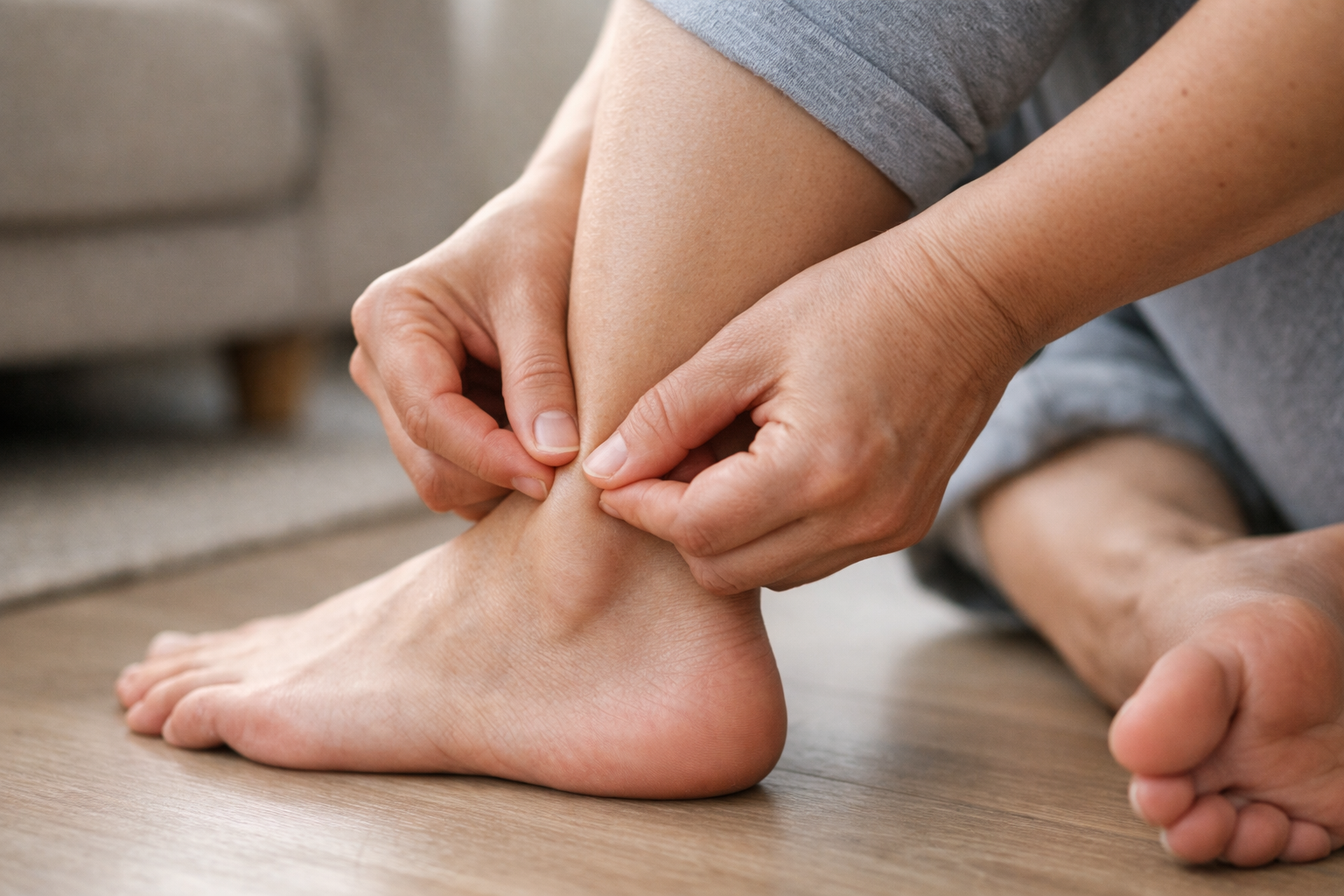
Pinch the soft area just in front of the Achilles tendon, above the heel bone, between your thumb and index finger. If that specific squeeze lights up and the same squeeze on the other heel doesn’t, it’s worth noting.
Pinch the tendon itself
Now move your fingers back to the cord of the Achilles and squeeze the tendon directly, an inch or two above the heel. If that’s the tender spot instead, you may be dealing with the tendon rather than the bursa. The two often travel together, which is exactly why this gets confusing.
Check the morning pattern
How are your first ten steps out of bed? Plantar fascia problems are famous for a rough start that eases within a few minutes of walking. Bursitis pain more often ramps up with accumulated activity and pressure rather than peaking first thing.
Compare barefoot to shod
Walk around the house barefoot for a bit. Then put on the shoes you wear most. If the shoe reliably makes it worse within minutes, external pressure on the back of the heel is part of your problem, and that’s a strong clue.
Look and touch
Is there visible swelling? Warmth compared to the other side? A soft bump at the back of the heel that catches on your shoe? Those favor a bursa over a tendon or fascia issue.
What gets mistaken for bursitis (and what bursitis gets mistaken for)
This is where most of the online confusion lives, and it’s worth being honest: heel pain is a neighborhood, not a single address. Several structures sit within a couple of centimeters of each other.
Insertional Achilles tendinopathy. The tendon where it attaches to the heel bone. Pain is right at the back, worse with uphill walking and with stretching the calf. This overlaps so heavily with retrocalcaneal bursitis that the two frequently coexist. The good news is that the loading approach for both is more similar than different.
Plantar fasciopathy. The persistent version of what most people call plantar fasciitis. Bottom of the heel, sharp with first steps, worse after long sitting. Different location, different behavior.
Haglund’s deformity. A bony prominence at the back of the heel that can rub against a shoe and irritate the bursa sitting on top of it. Here the bump is hard, not soft. Some people have had it their whole life and only notice when a new pair of shoes changes the pressure.
Fat pad irritation. The cushion under the heel bone can get bruised and inflamed, particularly after a hard landing, a lot of barefoot walking on tile, or with age-related thinning. Pain is central under the heel, sore to direct pressure, worse on hard surfaces.
Calcaneal stress reaction or stress fracture. This matters. Bone stress injury in the heel can produce pain that worsens steadily with weight-bearing, doesn’t calm down with rest days the way soft tissue does, and often hurts when you squeeze the heel bone from both sides. A recent sharp jump in running volume, new impact activity, or persistent night pain should raise the question.
Nerve irritation. Branches of the tibial nerve run near the inside of the heel. When a nerve is involved, people often describe burning, tingling, or pain that radiates rather than staying in one spot.
Systemic inflammatory conditions. Certain inflammatory arthritis conditions have a real tendency to cause pain where tendons attach to bone, and the heel is a classic site. If you have heel pain in both feet, morning stiffness lasting well over half an hour throughout your body, other joints involved, or a personal or family history of psoriasis or inflammatory bowel disease, that’s worth mentioning to your physician. Gout can also affect the heel.
Infection. Uncommon, but a superficial bursa that is hot, red, rapidly swelling, and painful out of proportion, especially with fever or after a break in the skin, needs same-day medical attention rather than a stretching routine.
So when people ask what gets mistaken for bursitis, the honest answer runs in both directions. Bursitis gets labeled plantar fasciitis. Tendon problems get labeled bursitis. And an evaluation exists precisely because poking around, watching you walk, testing what makes it better and worse, and taking a careful history sorts this out far better than any single test.
Why did I suddenly get bursitis?
The word “suddenly” is usually about when you noticed it, not when it started. Something changed a week or two before the pain arrived. Almost always. The trick is finding it.
Common culprits I ask about:
- New shoes. A different heel counter height or stiffness is one of the most reliable triggers for back-of-heel pain. So is a shoe that fits slightly differently than the one it replaced.
- A change in training. More miles, more hills, faster work, or a return to running after time off. Hills and speed both increase compression at the back of the heel.
- A change in standing or walking volume. A trip with a lot of walking. A new job on your feet. A home renovation. A conference on concrete floors.
- New activity type. Starting hiking, ice skating, ski season, a boot-heavy work environment.
- Aggressive calf stretching. This surprises people. Pulling the toes hard toward the shin can compress the retrocalcaneal space against the heel bone. If your heel has gotten worse since you started stretching more, that’s a real possibility, not a coincidence.
- A period of unusual rest followed by a sudden return. Tissue capacity drops with disuse. Coming back at the level you left off is a common setup.
Nothing on that list is a mistake. They’re just increases in demand that outpaced what that tissue could handle at the time. The load went up faster than the capacity did. That’s the entire story of most overuse problems in the foot and ankle, and it’s a much more useful way to think about it than “my heel is damaged.”
Body weight, a standing job, and footwear all belong in the same category: they add to the total demand the system is managing. Not personal failings. Inputs to the equation, some of which we can adjust and some of which we build capacity around.
Does heel bursitis go away? Does bursitis ever fully go away?
Yes, most people get substantially better. The bursa is not a fragile structure that stays broken.
What trips people up is the difference between calming something down and building it back up. Take pressure off an irritated bursa (change the shoe, back off the hills, stop the aggressive stretching) and it often quiets within a couple of weeks. That’s real, and it’s worth doing. But if nothing else changes, the pain tends to come back when the load comes back, because the underlying capacity never moved.
That’s the part that determines whether it “fully” goes away or becomes the thing that flares every spring when you start running again. Sensitivity settles quickly. Tissue adaptation takes longer, often something in the range of eight to twelve weeks of consistent, gradually increasing work for many people, sometimes more. Stopping the moment the pain stops is the most common reason these problems recur.
If you’ve had it for months, that doesn’t mean it’s permanent. It usually means we start at a lower level and progress more patiently. Persistent is not the same as untreatable.
For the specifics of treatment and rebuilding, there’s a companion article on this site, “Heel Bursitis: Symptoms, Causes, and How to Get Rid of It,” that goes deeper into that side of it.
What is the fastest way to heal bursitis?
I understand why this is the question. Here’s the honest version.
The fastest route is usually a combination of removing the specific thing that’s compressing the bursa and then progressively rebuilding what the area can tolerate. Not one or the other. Both.
Removing compression is the quick win: change the shoe, add a small heel lift temporarily to reduce the stretch at the back of the heel, stop the deep calf stretching for now, adjust the hills. Many people feel a difference within days from those changes alone.
The rebuilding part is slower and it’s the part that keeps you from repeating this. Calf and foot strength work, done at a level that keeps discomfort in a tolerable range (often at or below about a 4 out of 10 during and afterward, as a general guide), with attention to how the heel feels the next day. A 24-hour check-in tells you more than how it felt mid-exercise.
What won’t speed it up: waiting. Rest is a good short-term tool and a poor long-term plan. Rest equals rust. The heel eventually has to become capable of the walking, standing, and running you actually want to do, and capacity is built through gradually asking it to do more.
What not to do when you have bursitis
A short list of things that tend to backfire:
- Don’t keep wearing the shoe that presses on it out of habit. This is the easiest variable in the whole equation.
- Don’t stretch aggressively into pain at the back of the heel. For retrocalcaneal irritation, hard end-range dorsiflexion stretching can be the thing feeding it.
- Don’t massage or dig into a swollen superficial bursa. Mechanical irritation is the problem; more mechanical irritation doesn’t solve it.
- Don’t go to complete rest for weeks. You’ll feel better and be less capable, and the pain will return with the first real day on your feet.
- Don’t chase the pain number as your only measure. Walking farther, standing longer at work, and recovering faster the next day all count. Function matters as much as pain.
- Don’t treat a flare as failure. A rough day after a long walk means the load was above what the heel was ready for that day. Adjust, keep the trend in view, continue.
- Don’t assume an image settles it. Ultrasound or MRI can show a thickened, fluid-filled bursa. That finding is common, and it shows up in people without pain too. A scan can show structural changes, but it doesn’t always tell us why you hurt.
What happens if I ignore bursitis?
Usually not a catastrophe, and I’d rather be accurate than scary. A lot of mild heel bursitis resolves when whatever was pressing on it stops pressing on it, even without anyone paying much attention.
What happens more often with prolonged ignoring is subtler. You start limping a little, and the limp changes how you load the other leg, the hip, the low back. You stop doing the walk you enjoy. The calf gets weaker because you’ve been unconsciously offloading it for months. Now you have a heel problem plus a deconditioning problem, and the starting point for recovery is lower than it would have been.
With the deeper retrocalcaneal bursa, prolonged irritation can go along with changes at the Achilles insertion, and sometimes calcification develops there over time. That’s a slower, more stubborn situation to work with, though still workable.
The cases where ignoring genuinely matters are the ones that aren’t bursitis: a bone stress injury that keeps getting loaded, an infected superficial bursa, or an inflammatory condition that needs medical management. Which is a big part of why getting it looked at is worth the appointment.
When to get it evaluated
Reasonable to have someone look at it if:
- Heel pain has lasted more than two or three weeks despite changing your shoes and backing off the aggravating activity
- You’re limping, or altering how you walk to avoid the pain
- It’s getting worse week over week rather than better
- Both heels hurt, or other joints are involved, or you have significant all-over morning stiffness
- Pain wakes you at night or persists when you’re completely off your feet
- You’re not sure what you’re dealing with and want a clear plan rather than another round of guessing
Get seen urgently if the area is hot, red, and rapidly swelling, if you have a fever, if there’s a break in the skin over the swelling, if you felt a sudden pop with immediate weakness pushing off, or if you can’t bear weight at all.
An evaluation isn’t just about attaching a label. It’s about figuring out where your heel is right now, what it can currently handle, and how to build from there in a way that holds up when you go back to the hills, the long shifts, or the shoes you actually like wearing.
This article is general education, not individual medical advice. Heel pain has several possible causes, and sorting out which one applies to you requires an in-person evaluation.