Sprained Ankle Recovery Time: What to Realistically Expect
A clear, honest look at how long ankle sprains actually take to heal, what changes that timeline, and how to know you're progressing rather than stalling.

Almost everyone who sprains an ankle asks the same question within the first hour: how long is this going to keep me sidelined? The honest answer is that it depends, but not in a vague way. There’s a real range, and the factors that move you toward the short end or the long end of that range are mostly things you can influence.
The General Timeline
Most mild ankle sprains improve substantially within one to three weeks. Moderate sprains often take three to six weeks before you’re back to normal walking and light activity without a limp. More severe sprains, especially those involving a complete ligament tear or significant instability, can take two to three months or longer to feel fully solid again, particularly for cutting, jumping, or uneven terrain.
Those numbers are patterns, not promises. Two people with what looks like the same sprain on exam can heal at different rates because the ligament itself is only part of the story. What matters just as much is how much load the ankle is asked to tolerate each day, and how well that load is matched to what the tissue can currently handle.
Why the Timeline Varies So Much
A ligament sprain heals in overlapping phases. There’s an initial inflammatory phase lasting several days, then a longer proliferative phase where new tissue is laid down, and finally a remodeling phase that can stretch on for months as that tissue organizes and strengthens under gradual use. The visible swelling and pain calm down well before this last phase is finished, which is exactly why so many ankle sprains get reinjured. The ankle feels ready weeks before it actually is.
Several things push the timeline one way or the other:
- Severity of the initial injury. A ligament that’s stretched (Grade 1) has less structural work to do than one that’s partially torn (Grade 2) or fully torn (Grade 3).
- How the first week or two is managed. Too much rest delays the loading the tissue needs to remodel. Too much activity too soon reinjures tissue that hasn’t caught up yet.
- Total daily load, not just exercise. Standing all day at work, walking on uneven ground, or being on your feet for a physically demanding job all add to the ankle’s workload, even if you’re not doing any specific rehab that day.
- Age, prior ankle injuries, and general conditioning. An ankle with a history of previous sprains often starts with lower baseline capacity and needs a more patient progression.
- Whether swelling and range of motion are addressed early, since a stiff, swollen ankle tolerates load poorly no matter how much time has passed.
This is the same load-versus-capacity relationship that shows up in tendon and fascia injuries elsewhere in the foot and ankle. The ligament needs a demand it can just barely handle, repeated consistently, so it adapts. Too little load and it stays fragile. Too much and it gets irritated or reinjured. Recovery time is really a reflection of how well that balance is managed, not just a countdown clock.
How Long Are You Supposed to Stay Off a Sprained Ankle?
Complete rest is rarely the right answer, and it’s usually not necessary even for significant sprains. The first 24 to 72 hours typically call for protecting the ankle and limiting weight-bearing to what’s comfortable, but after that, most people do better staying as active as symptoms allow rather than staying off it entirely. Prolonged non-weight-bearing tends to slow healing, not speed it, because ligaments and the muscles around them respond to graded load.
A reasonable general pattern many people can use is keeping pain at or below about a 4 out of 10 during and after activity, and expecting any soreness to settle within roughly 24 hours. If pain runs higher than that or lingers longer, that’s usually a sign the current activity level is outpacing what the ankle can tolerate yet, not a sign that something is going wrong long-term.
Is It OK to Walk on a Sprained Ankle?
For most mild to moderate sprains, gentle walking within a tolerable pain range is fine and often helpful once the acute swelling has started to settle, typically within the first few days. Walking that stays within that roughly 4-out-of-10 window helps maintain circulation, range of motion, and early tissue adaptation. What matters is the amount and the surface, not whether walking happens at all. Short, even-terrain walking is very different from trying to walk briskly on uneven ground the day after a bad roll.
What Happens If You Walk on It Too Soon?
Walking too aggressively, too early, particularly on an unstable or more severely sprained ankle, can aggravate the healing ligament and increase swelling and pain that then sets you back a few days. It generally doesn’t undo structural healing that’s already happened, but it can delay progress and make the next attempt at loading feel more sensitive than it needs to be. This is more of a setback than a catastrophe for most sprains, but with a suspected complete tear or significant instability, overloading it early carries more real risk and is worth having evaluated before pushing activity.
Grade 1 or Grade 2: Does It Change the Timeline?
Grading matters mostly because it sets expectations. A Grade 1 sprain (mild stretching of the ligament, no real tearing) usually settles within one to three weeks and rarely needs more than basic support. A Grade 2 sprain (partial tearing, more swelling, more instability) generally takes three to six weeks and often benefits from more structured support in the early going. Distinguishing the two isn’t always obvious from how it feels in the first day or two, since a bad Grade 1 can feel worse initially than a mild Grade 2. If instability, ongoing giving-way, or an inability to bear weight after a few days is present, it’s worth having someone examine it rather than guessing at the grade yourself.
Do You Need a Boot for a Grade 1 Sprain?
Most Grade 1 sprains don’t require a walking boot. A brace, ankle tape, or simply supportive shoes are usually enough while the ligament settles, and many people do fine with no external support at all once acute swelling has passed. A boot is more commonly used for Grade 2 or 3 sprains, or when weight-bearing is too painful to tolerate without support in the first several days. Bracing and boots are tools for managing load while the tissue is more sensitive than usual, not a requirement for healing, and staying in one longer than needed can slow the ankle’s return to normal function.
What Speeds Up Recovery
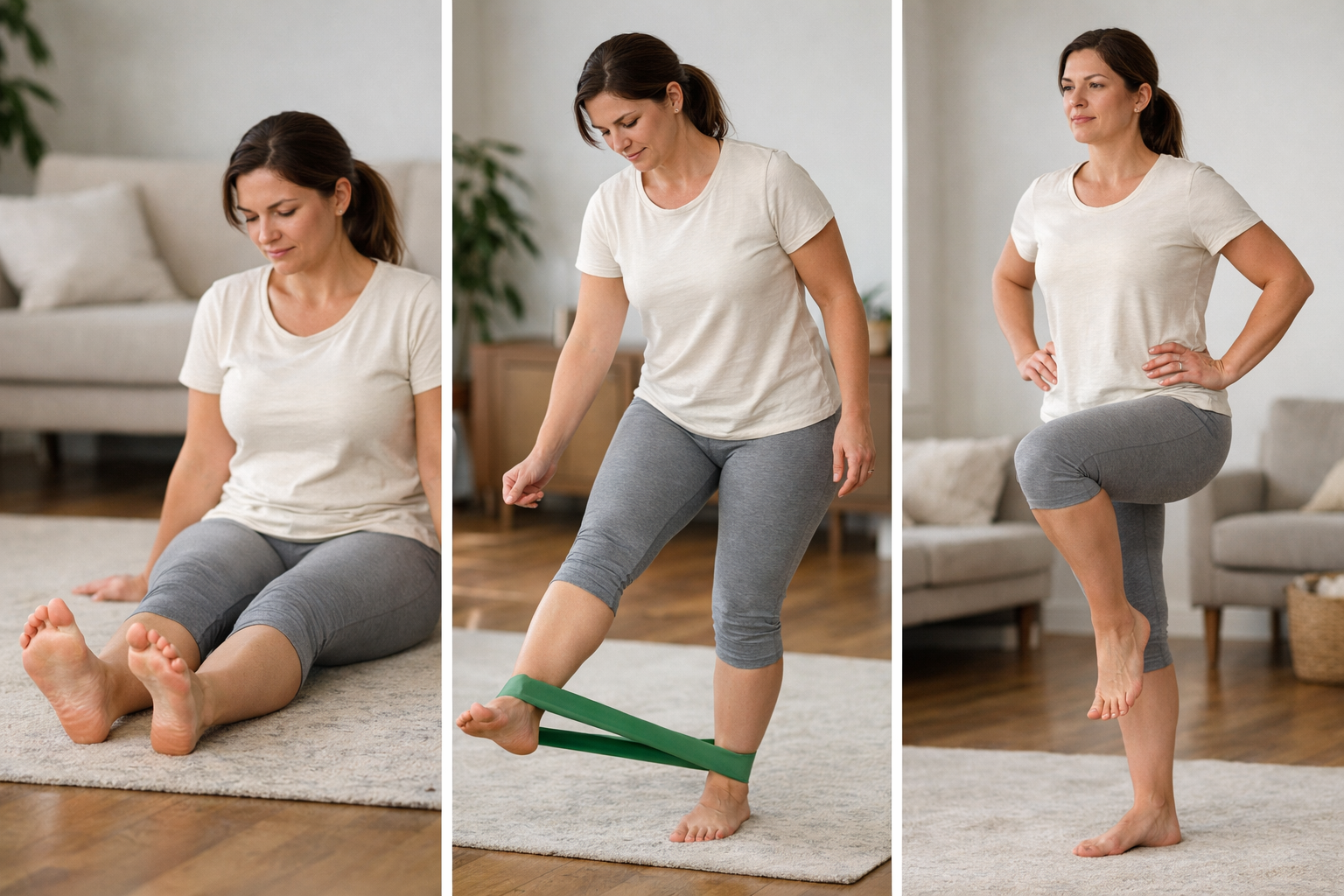
A few things consistently help ankle sprains move through the expected timeline rather than stall:
- Early, gentle range-of-motion work rather than prolonged immobilization
- Managing swelling in the first several days with elevation and, when appropriate, compression
- Progressive weight-bearing as symptoms allow, rather than an all-or-nothing return
- Balance and proprioception work once basic walking is comfortable, since ankle sprains disrupt the joint’s positional awareness even after pain resolves
- Strengthening the muscles around the ankle as tolerance improves, to rebuild the support structure around the healing ligament
None of this needs to be complicated or high-intensity. The principle is the same one that applies to plantar fasciopathy and Achilles overload: progressive, tolerable loading, held for long enough at each step to let the tissue adapt before asking for more.
How Should You Sleep With a Sprained Ankle?
In the first few nights, elevating the ankle slightly above heart level with a pillow under the calf (not directly under the ankle joint, which can restrict blood flow at the back of the knee) can help manage overnight swelling. Beyond the acute phase, sleeping position matters less than making sure the ankle isn’t twisted awkwardly under blankets or bumped repeatedly through the night. If a brace was recommended for daytime wear, most people don’t need to sleep in it unless a clinician specifically advised it for stability.
Four Signs an Ankle Sprain Might Be More Serious
Most sprains follow the pattern above, but a few signs suggest it’s worth getting evaluated rather than assuming it will follow the usual timeline:
- Inability to bear any weight at all, even briefly, more than a few days after the injury
- Significant bruising that spreads well beyond the ankle itself
- A feeling of real instability or the ankle giving way, rather than just soreness with movement
- Pain that isn’t improving at all after the first one to two weeks, or is getting worse
Any of these can be consistent with a more significant ligament tear, a fracture, or another issue that mimics a typical sprain, and an evaluation sorts out which one you’re dealing with.
How Long Can a Sprained Ankle Go Untreated?
Mild sprains often improve on their own to some degree even without formal treatment, simply because walking and daily movement provide some natural loading. But going untreated for weeks with a moderate or severe sprain tends to leave the ankle with lingering instability, reduced range of motion, and a higher chance of re-spraining down the road, because the ligament and surrounding tissue never went through a deliberate loading progression. There isn’t a firm cutoff where an untreated sprain becomes unfixable, but the longer it sits unaddressed, particularly with ongoing instability or swelling, the more work it usually takes to rebuild full capacity later.
When to See Someone
Most ankle sprains, even fairly significant ones, improve with time and appropriate loading. If you’re not seeing steady improvement after a couple of weeks, if the ankle keeps giving way, or if you weren’t able to bear weight well from the start, it’s worth having it evaluated. A clinician can also rule out a fracture or a high ankle sprain, which follows a different and often longer recovery course than a standard rolled ankle. Getting a clear read on what you’re actually dealing with early on tends to save time in the long run, not cost it.