Will Shoe Inserts Help Plantar Fasciitis? An Honest Answer
Shoe inserts can meaningfully reduce heel pain for many people, but they change the load on your foot rather than the capacity of your foot. Here's what inserts actually do, when they're worth using, how to tell if yours is helping, and what else has to happen alongside them.
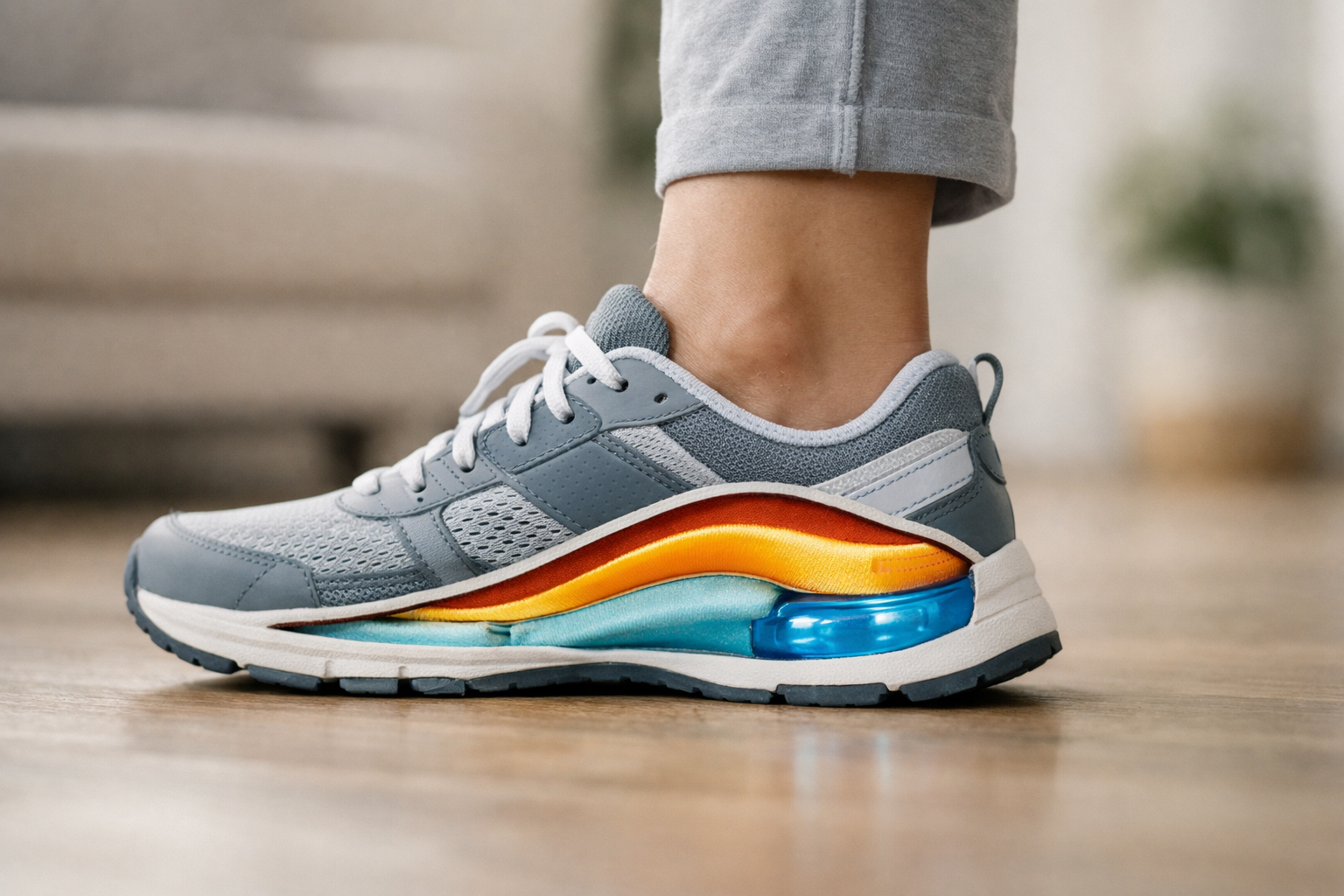
Most people arrive at this question after a specific moment. You’ve been limping through the first few minutes of every morning for a few weeks, someone at work told you to grab a pair of inserts, and now you’re standing in a pharmacy aisle looking at eight boxes that all promise the same thing. Or you already bought a pair, they helped for a while, and now you’re wondering whether you need the expensive custom version.
So: will shoe inserts help plantar fasciitis? For a lot of people, yes, at least partly. They’re one of the more reliable ways to take some of the daily strain off a sore heel. But they work in a narrower way than the marketing suggests, and understanding that narrow way is what separates people who use inserts well from people who end up dependent on them and no better off a year later.
Here’s the frame I’d want you to carry out of this article. An insert changes the demand placed on your foot. It does not change what your foot is capable of tolerating. Those are two different problems, and long-term you need both handled.
What an insert is actually doing under your foot
Stand up. Every step you take sends force through the arch of your foot, and the thick band of tissue along the bottom (the plantar fascia) takes a share of it. That’s normal. That’s the job.
Heel pain that fits the plantar fasciitis pattern usually shows up when the amount of load going through that tissue has outpaced what the tissue can currently handle. Not one bad step. An accumulation.
An insert intervenes on the load side of that equation. A supportive contour under the arch means slightly less of the total force passes through the fascia itself and slightly more is shared with the shoe. Cushioning under the heel softens the impact of each step. Some inserts also subtly change how your foot rolls through the step, which shifts where the strain lands.
That’s real, and for an irritated heel it can be the difference between finishing a shift and not finishing a shift. But notice what it doesn’t do. It doesn’t make the fascia more durable. Take the insert out, and your foot is exactly as capable as it was before you put it in.
This is why the experience so many people describe is so common: inserts help, and then the moment they go barefoot on a tile floor or wear flat shoes to a wedding, the heel pain shows up immediately. The tissue’s tolerance never changed. Only the demand did.
Should I wear insoles if I have plantar fasciitis?
If your heel hurts right now and inserts make walking more comfortable, wear them. There’s no prize for suffering through your workday with a sore foot.
I’d think of an insert as doing one of two jobs.
Job one: buying you room to work. When a heel is very irritated, almost everything hurts, and you can’t load the tissue enough to build anything. An insert lowers the background load of ordinary life (walking to the car, standing at the sink, doing your job) enough that you have some capacity left over for the loading that actually rebuilds the tissue. That’s a genuinely useful role.
Job two: permanent load management for a high-demand situation. Some people stand on concrete for ten hours. Some people are runners putting real mileage through their feet. For them, an insert may stay in the shoe indefinitely, not because their foot is fragile, but because the daily demand is high and they’d rather share some of it. That’s a reasonable choice, not a failure.
Where inserts get people into trouble is when they become the entire plan. Six months in, the heel still hurts without them, and the only change is that the collection of insoles in the closet has grown. The insert was never going to solve that. It was doing exactly what it’s designed to do.
If you want the practical side of picking a pair, there’s a separate article on this site called “How to Choose Insoles and Arch Support for Heel Pain” that goes through the selection process in detail. I’m not going to repeat it here.
Custom versus over the counter
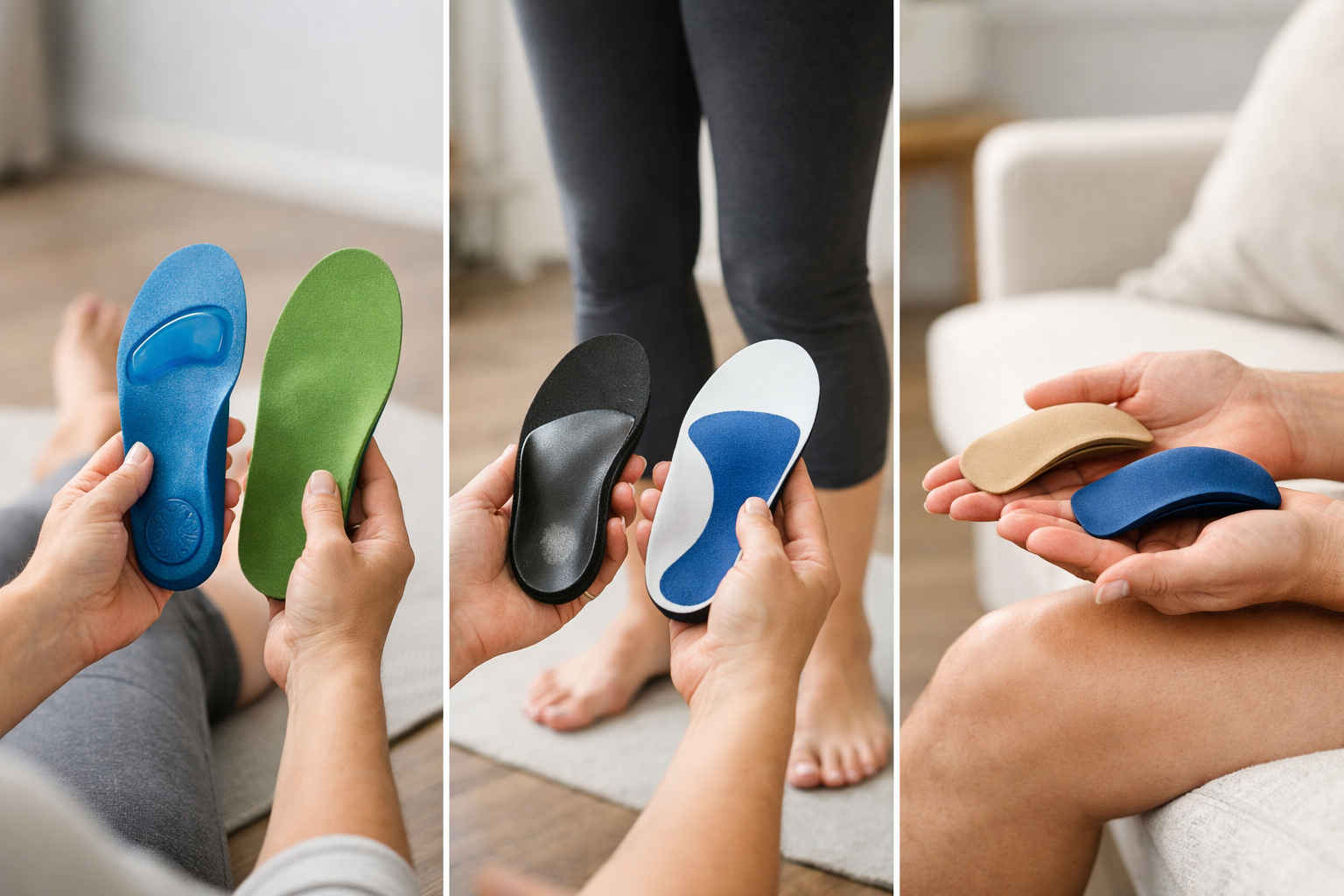
The honest version: for most people with a fairly typical heel pain presentation, a reasonable over-the-counter insert is a sensible first try. Many people do fine with one. Cost is low, you can test it in a week, and if it doesn’t change anything you’ve learned something cheaply.
Custom orthotics earn their place in more specific situations. A significant structural difference between your feet. A leg length difference. A foot with limited motion that needs accommodation rather than generic support. A history of trying several off-the-shelf options with no response. A rigid high arch or a very mobile flat foot that shelf inserts genuinely don’t match.
What I’d push back on is the idea that custom is automatically better because it’s custom. A precisely molded insert that supports a foot which is still unable to tolerate what you’re asking of it is a precisely molded insert that you’ll be wearing for a long time.
One more thing about the dependence worry people raise online. Wearing an insert does not weaken your foot in some inevitable way. What weakens your foot is doing nothing else. If the insert is sitting in your shoe while you’re also, over the weeks, gradually asking your foot to do more, you’re not building a dependence. You’re building a bridge.
How to tell whether the insert is actually helping
Give it a real trial, a couple of weeks, in the shoes you actually live in. Then look at more than the pain number.
Signs it’s doing something useful:
- Your first steps in the morning are less sharp, or the stiffness clears faster.
- You can stand or walk longer before the ache starts.
- The evening ache after a normal day is smaller.
- You recover faster. A day that used to leave you sore into the next morning now settles by bedtime.
Signs to reconsider:
- No change at all after two to three weeks of consistent wear.
- New pain somewhere else: the ball of the foot, the outside of the foot, the arch in a different spot, the knee.
- It only feels good in one pair of shoes and nowhere else.
A short adjustment period is normal. Your foot is being asked to move slightly differently and a few days of mild unfamiliar soreness doesn’t mean the insert is wrong. Pain that keeps climbing past that does mean something.
And broaden the measure. Function counts as much as the pain number. Walking farther, standing longer, recovering faster after a busy day, these are all evidence that something is moving in the right direction even if the number on a 0 to 10 scale hasn’t dropped much yet.
What should you not wear with plantar fasciitis?
Less a list of banned shoes and more a question of how much your foot is being asked to absorb that day.
The footwear that tends to aggravate an irritated heel:
- Completely flat, unsupportive shoes worn for long periods. Thin flats, old canvas sneakers with a compressed sole, flip-flops on a day of walking. Not because flat is evil, but because flat asks the fascia to do more of the work, and right now that’s the tissue that’s complaining.
- Worn-out running shoes. The foam in a shoe you’ve had for two years and several hundred miles is not doing what it did when you bought it. This is a common, quiet reason heel pain shows up seemingly out of nowhere.
- Barefoot on hard floors at home. For a lot of people this is the single biggest hidden load in the day. You wear good shoes to work and then spend four hours on kitchen tile with nothing on your feet.
- An abrupt change in heel height. Going from heels every day to completely flat, or the reverse, changes how much stretch the fascia and calf take with each step. The change itself is often the problem, not either shoe on its own.
Notice what I’m not saying. I’m not saying you can never wear sandals again. I’m saying that on a day you’ve already been on your feet for six hours, the sandals are additional load on a system that’s near its limit. Pick your spots.
When things have calmed down and you’ve genuinely built up what your foot can handle, most of this becomes flexible again. The restrictions are temporary and proportional to how irritable the foot currently is.
What’s the worst thing you can do for plantar fasciitis?
Two things, and they’re opposites, which is part of why this condition confuses people.
The first is pushing straight through sharp, escalating pain and changing nothing. Same shoes, same mileage, same twelve-hour shifts, hoping it sorts itself out. It usually doesn’t, and the foot gets more sensitive over time.
The second, and the one I see more often, is shutting down completely. Stop walking, stop training, sit as much as possible, wait for it to feel better. Rest absolutely calms an irritated heel. But an unloaded tissue doesn’t get stronger, it gets less tolerant, and the pain comes roaring back the moment you return to normal life. People then conclude they re-injured themselves, when what actually happened is that their foot’s tolerance quietly dropped during the weeks off. Rest equals rust.
The workable middle is staying as active as you reasonably can while adjusting the parts of the day that are clearly too much. Keep walking, walk less far. Keep training, change the surface or the volume. Use the insert so the baseline is manageable. Then build from there, patiently.
Does anything really help plantar fasciitis?
Yes. It’s just slower and less exciting than any single product suggests.
The things that reduce sensitivity in the short term: inserts, supportive shoes, a period of reduced loading, calf and foot stretching, ice, sometimes taping, sometimes an injection in a stubborn case. These are genuinely useful. They make you more comfortable. They also, on their own, tend not to hold, because they haven’t changed what the tissue can tolerate.
The thing that changes what the tissue can tolerate is loading it progressively over time. Calf and foot strengthening with meaningful resistance, done consistently, progressed as your foot responds. Not aggressive. Not painful in a way that lingers. Just steadily more demanding across weeks.
A general rule of thumb I use: discomfort during and after loading is often acceptable up to around a 4 out of 10 for many people, provided it settles back to your usual baseline within about 24 hours. If it’s still elevated the next day, that dose was too much, and we back off a step rather than abandon the whole thing. That’s a pattern, not a law, and a clinician who can see your foot may adjust it for you.
The timeline that matters: early improvements in the first couple of weeks are mostly your nervous system getting more comfortable with the movement. Actual structural change in fascia and tendon typically takes something more like eight to twelve weeks of consistent loading, sometimes longer. This is the single most important reason heel pain comes back. People feel better at week four, stop, and the tissue never finished adapting.
What finally cured my plantar fasciitis?
People ask this hoping for the one item. Reading forums, you’ll see fifty different answers: a specific insole, a night splint, a shockwave session, new shoes, a cortisone shot, dry needling, calf raises.
Most of those answers are partly true and missing the context. The person who says the custom orthotic did it was usually also walking more, gradually, over those same months. The person who credits the injection usually got a window of relief and used it to get back to activity, which loaded the tissue.
What consistently seems to be present when someone genuinely gets past it and stays past it: their foot ended up able to do more than it could before. However they got there, capacity went up. The interventions that helped were the ones that made building that capacity possible.
So if you want the honest answer, it’s rarely a single thing. It’s usually a sensible reduction in aggravating load, something that makes daily life tolerable (often an insert), and then weeks of gradually asking the foot to do more. Consistency beats intensity, here more than almost anywhere.
How did I suddenly get plantar fasciitis?
It usually isn’t sudden, even though it feels that way. The pain arrives suddenly. The load that produced it built up over weeks.
Common triggers worth looking back for:
- A jump in walking or running volume. A vacation with long days on your feet. Training for something.
- A change of job or a change of station at the same job, especially onto concrete.
- New shoes, or old shoes that finally gave out.
- A change in surface. Treadmill to pavement, carpet to tile, gym floor to trail.
- A period of reduced activity followed by a return to full activity at the old level. The foot’s tolerance drifted down and the demand came back up.
- A gradual increase in the load the whole system carries, including body weight changes. That’s not a character issue, it’s arithmetic: more mass through the same tissue over the same number of steps.
Symptoms also lag. The heel that hurts on Wednesday often reflects what you did Monday. That delay is a big part of why people can’t identify a cause and conclude it came out of nowhere.
When you find the trigger, you’ve also found part of the plan. Not to avoid that thing forever, but to rebuild toward it deliberately instead of stepping back into it at full volume.
What gets mistaken for plantar fasciitis?
This matters for the insert question, because if the insert isn’t touching your pain, one possible reason is that the problem isn’t primarily the fascia.
Other things that can produce heel or arch pain:
- A bone stress injury in the heel. Pain that’s more constant, worse with impact and weight bearing generally, often not following the classic pattern of terrible first steps then improvement.
- Nerve irritation. Compression of a small nerve near the inside of the heel can create burning, tingling, or numbness alongside the ache. Arch support alone tends not to help much.
- Fat pad irritation. The cushion under the heel bone itself can get sore, often described as a deep bruise right under the center of the heel rather than at the front edge where the fascia attaches.
- Achilles or insertional tendon problems. The pain sits at the back of the heel, not underneath.
- Referred pain from the low back or nerve irritation higher up the leg.
- Systemic inflammatory conditions, which can cause heel pain at tendon attachments, sometimes in both feet, sometimes with other joint symptoms.
Only an in-person examination can sort this out properly. If your heel pain doesn’t behave like the typical pattern (sharp first steps in the morning, eases with a few minutes of movement, worse again after long standing), it’s worth having someone actually look at it rather than buying a third pair of inserts.
What is the heel squeeze test?
It’s a simple clinical check, mostly used to screen for a possible stress injury in the heel bone rather than to confirm plantar fasciitis.
The examiner squeezes the sides of the heel bone between their palms, compressing it from the inside and outside. Plantar fascia pain is usually reproduced by pressing directly on the underside of the heel, toward the front edge where the fascia attaches, and by loading the tissue with toe extension. Squeezing the sides of the bone shouldn’t do much. If side-to-side compression produces significant pain, that raises the question of a bone stress injury, which is managed quite differently and sometimes needs imaging.
It’s one piece of information among several, not a verdict. Nobody should diagnose you from a single test, and you shouldn’t diagnose yourself from one either. But if squeezing your heel from the sides is sharply painful, that’s a reasonable prompt to get it evaluated.
What is stage 3 plantar fasciitis?
You’ll see staging systems online, usually along the lines of: stage 1 is occasional pain after activity, stage 2 is regular pain with daily activity, stage 3 is persistent pain that’s present most of the time and limits what you do, stage 4 involves long-standing changes to the tissue.
These descriptions can be useful as a rough sense of how irritable your foot is. They are not a formal, universally agreed medical classification, and I’d be careful about attaching too much meaning to a stage number.
Here’s what actually changes with duration. When heel pain has been around for many months, the tissue state is better described as plantar fasciopathy than plantar fasciitis, because it’s less about active inflammation and more about a tissue that’s been under stress long enough to change its structure. Practically, that means your starting point is lower and your progression needs to be more patient. It does not mean the situation is fixed in place. Persistent does not mean permanent. The same principles apply, on a longer runway.
What a longer duration does change is how much an insert alone is likely to accomplish. Early on, reducing load can sometimes be enough to let things settle. When it’s been a year, the tissue has deconditioned alongside everything else, and the load-reduction side of the equation has less left to give. The capacity side has to do more of the work.
About imaging, spurs, and thickened fascia
If you’ve had an ultrasound or X-ray, a few things worth knowing.
A heel spur is a common finding, including in people with no pain at all. It’s generally a consequence of long-term stress on the area rather than the thing causing your symptoms, and recovery follows the same path whether you have one or not. You don’t need it removed to get better.
Fascia thickening on ultrasound tells you the tissue has responded to load. It’s a description of a state, not a prediction about your future. Thickness measurements often don’t track neatly with how much someone hurts, and plenty of people improve substantially with the same measurement on a repeat scan. A scan can show structural changes, but it doesn’t always tell us why you hurt.
Where the insert fits in the bigger picture
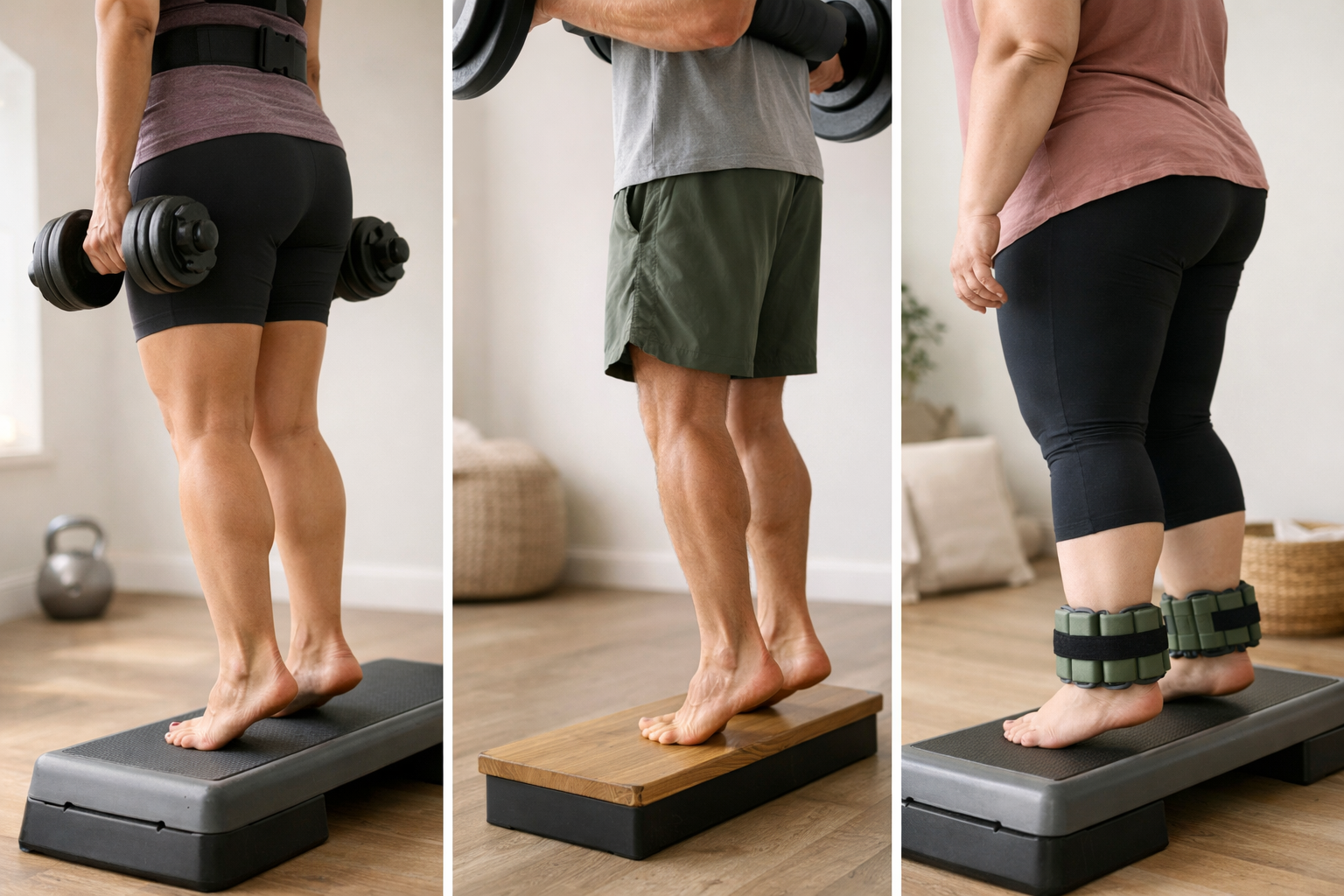
Put the insert in your shoe. Wear good shoes at home, not just at work, especially if your floors are hard. Then, alongside that, start doing the thing an insert can’t do: gradually building what your foot can handle.
That means loading the calf and the foot with real resistance, progressed over weeks, staying at each level long enough for the tissue to adapt before moving up. It means watching how your foot responds over the following day and adjusting from there rather than following a fixed schedule. Some weeks you’ll advance. Some weeks you’ll hold. The response tells you which.
And when you have a flare, and most people do somewhere along the way, it doesn’t erase what you built. Look at what changed in the previous day or two. Usually you’ll find it: the long walk, the shoes you wore to the event, the extra shift. Adjust, and carry on. Recovery is not a straight line, and a bad week inside a good month is still a good month.
Eventually, if the plan is working, you’ll find you can wear the flat shoes for an evening without paying for it. That’s the real marker. Not that the insert feels good, but that your foot is fine without it.
When to get it looked at
Most heel pain responds well to sensible load management and progressive loading. Some doesn’t, and some isn’t what it appears to be.
Worth an in-person evaluation:
- Pain that’s been there for more than six to eight weeks without meaningful improvement despite reasonable changes.
- Numbness, tingling, or burning in the foot.
- Significant swelling, redness, or warmth.
- Pain that’s constant, including at rest or at night.
- Heel pain that started after a specific injury or fall.
- Sharp pain when the sides of the heel bone are compressed.
- Pain in both heels at once, particularly alongside joint pain elsewhere.
None of that is cause for alarm. It’s just information that’s better gathered by someone who can examine your foot, watch you walk, and test how the tissue responds under load, which is the part no insert and no article can do for you.