Foot Exercises for Plantar Fascia: Mobility and Strength That Last
A practical guide to the exercises that actually change plantar fascia pain, why loading matters more than stretching alone, and how to progress them without setting off a flare-up.
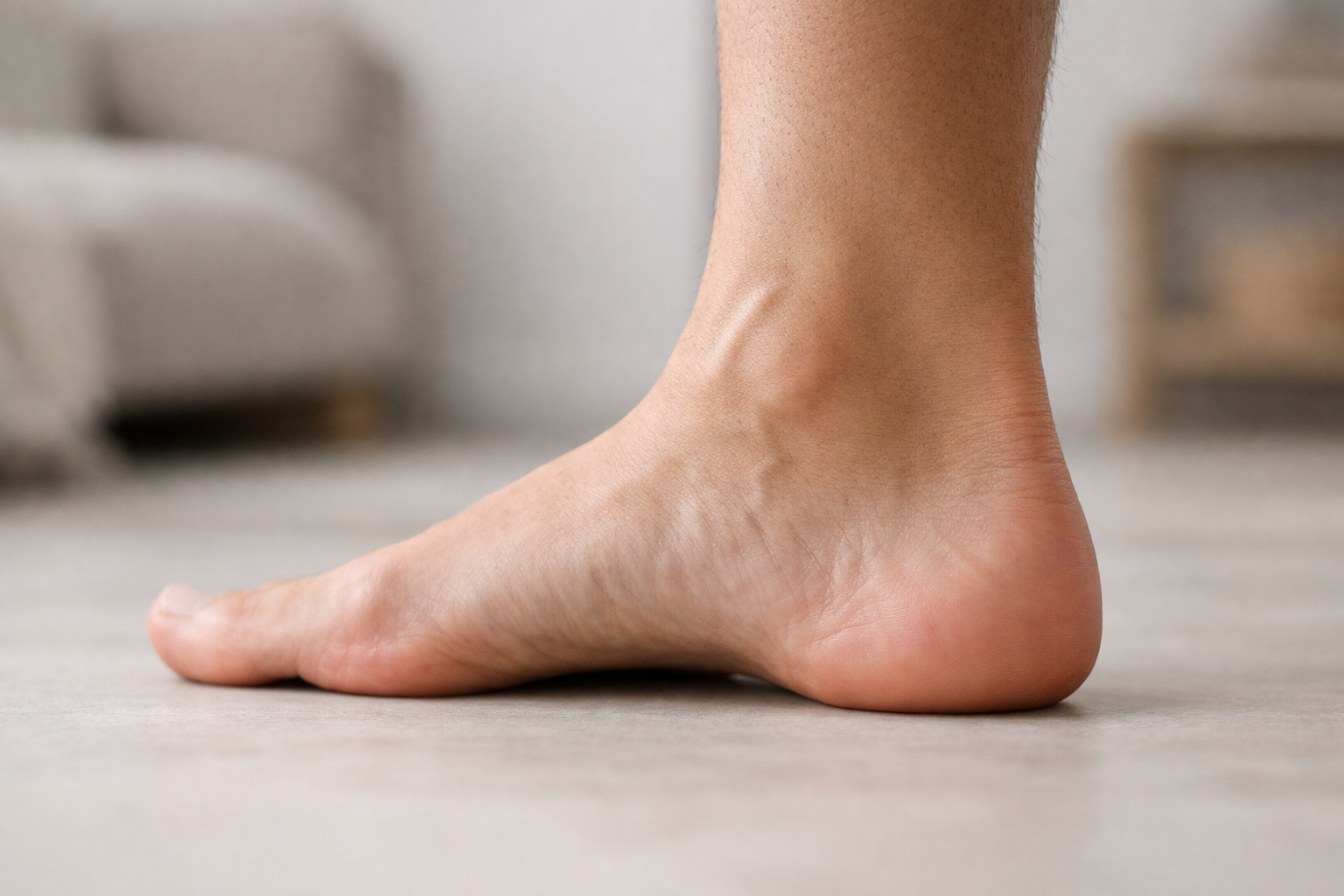
Most people arrive at this topic after already trying a few things. You rolled your foot on a frozen water bottle. You stretched your calves. You bought new shoes. Some of it helped for an hour or a morning, and then the pain came back the moment you were on your feet again.
That pattern is not a sign you did something wrong. It’s a clue about what’s actually going on.
When you stretch or roll or rest, you’re turning down how sensitive the tissue is right now. That’s real, and it feels good. But it doesn’t change what your foot can handle when you go stand at work for eight hours. Changing that takes something different: asking the tissue to do progressively more work, over weeks, until it’s genuinely more capable.
So yes, foot exercises for plantar fascia problems are worth doing. The question is which ones, in what order, and how hard.
Why the Bottom of Your Foot Hurts in the First Place
The plantar fascia is a thick band of connective tissue running from your heel to the base of your toes. It’s not a passive strap. It works with the small muscles inside your foot and with your calf and Achilles to store and return energy every time you take a step.
When the demand on that system stays higher than what it can currently tolerate, it gets irritated. Sometimes the demand changed: a new job on concrete, a jump in running mileage, a vacation with 18,000 steps a day in flat sandals. Sometimes the capacity dropped: a few months off, an injury elsewhere, a long stretch of sitting. Usually it’s both at once, quietly, and then one specific day gets blamed.
If it’s been going on for months, the tissue itself has often changed. That state gets called plantar fasciopathy rather than fasciitis, because it’s less about active inflammation and more about a tendon-like tissue that’s been under stress and hasn’t adapted well. Practically speaking, that matters for one reason: tissue that has changed needs loading to change back. Stretching alone won’t get you there.
About that morning pain
The first steps out of bed being the worst is one of the most recognizable patterns there is. People often read it as “my foot got worse overnight.” It didn’t. After hours of no load at all, the tissue is at its most sensitive, and your foot goes from zero demand to full body weight in a single step. Within a few minutes of walking, it usually settles.
Watching how quickly that morning pain fades is actually one of the better ways to track progress. Twenty minutes shrinking to five, over several weeks, tells you something real even if the pain number at its peak hasn’t moved much yet.
Can You Fix Plantar Fasciitis With Exercise?
Many people improve substantially with a well-built loading program, and for a lot of them that’s the main thing that moved the needle. The principles are sound: connective tissue responds to mechanical load by getting stronger and more tolerant, the same way muscle and bone do.
But “exercise” done casually and “exercise” done as a progression are two different things. Doing ten towel scrunches a day for six months isn’t a plan. It’s a habit with no ceiling and no build. The foot adapted to that in week two and has had nothing new to respond to since.
What tends to work is a program that starts at a level your foot can currently handle, stays there long enough to adapt, then asks for a bit more. Repeat. That’s less exciting than a list of six exercises, and it’s the part that actually matters.
The Exercises
Here’s a set worth knowing. Not all of these are for everyone, and not all at once. I’ve grouped them by what they’re for, because the purpose tells you when to use them.
Mobility and sensitivity work (useful early, not the main event)
1. Plantar fascia massage. Roll the arch over a ball or a chilled bottle, moderate pressure, a minute or two. This makes the tissue temporarily less sensitive and can make everything after it more comfortable. It’s a doorway, not a destination.
2. Toes-up fascia stretch. Sit, cross the painful foot over the opposite knee, and pull the toes back toward the shin with your hand until you feel a stretch through the arch. Hold about 20 to 30 seconds, a few rounds. Often most useful before you get out of bed or before standing up after a long sit.
3. Calf stretch, both versions. Straight back knee for the big calf muscle, slightly bent back knee for the deeper one closer to the Achilles. Ankles that don’t bend well push more work onto the fascia with every step.
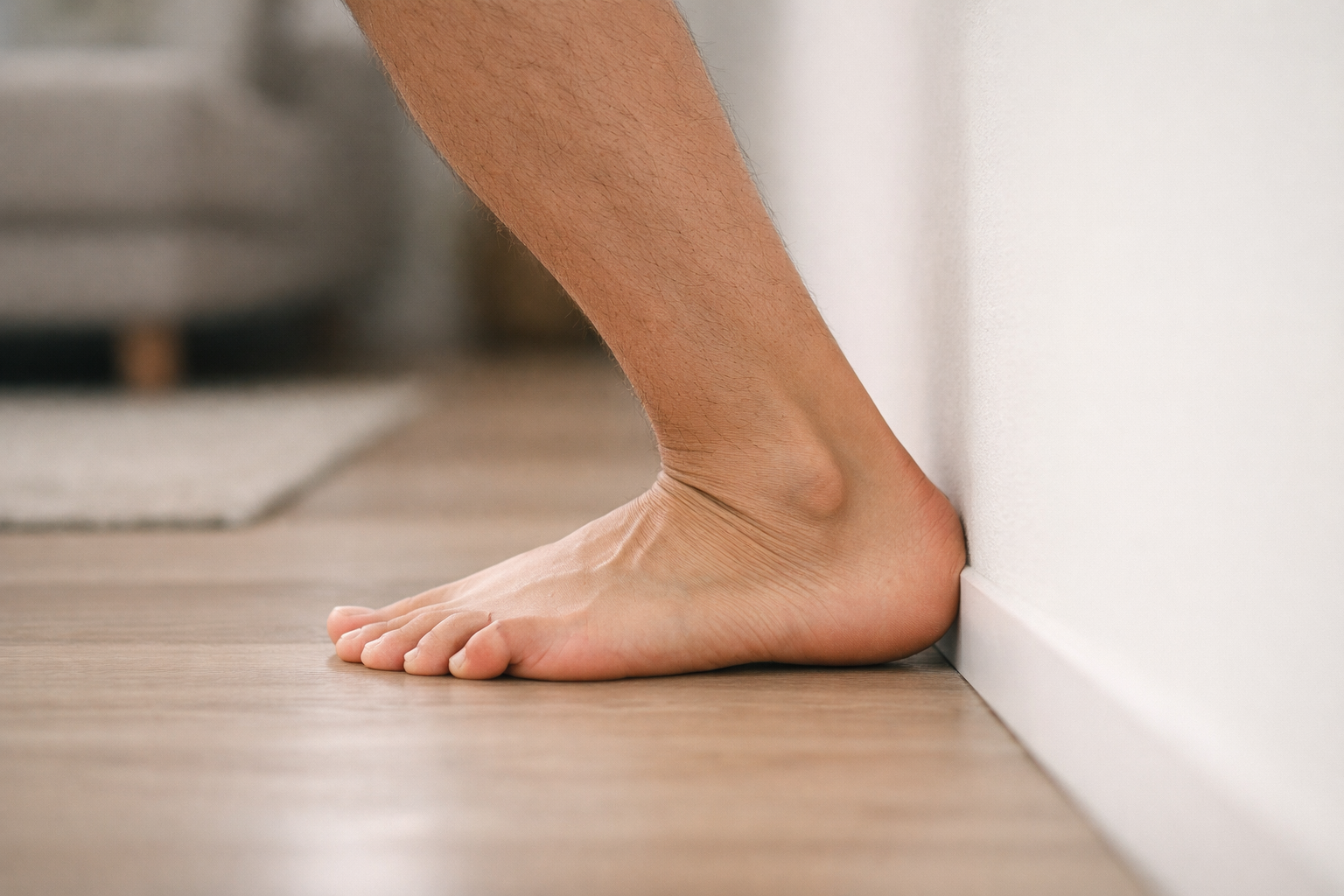
4. Ankle mobility at the wall. Foot flat, knee tracking forward over the toes without the heel lifting. This is a movement drill, not a hold. It changes how you walk more than a static stretch does.
Strength and capacity work (this is where change happens)
5. Heel raises with the toes propped up. This one deserves its own paragraph below, but in short: a towel or book under the toes so they’re extended, then slow heel raises. Slow up, slow down. This loads the fascia and calf together, which is the point.
6. Single-leg heel raises. Once both feet together feels easy, move to one. Control on the way down matters more than height on the way up.
7. Toe curls and towel scrunches. Fine as a starting point for the small muscles inside the foot, and genuinely useful when you’re very sensitive and can’t load much. Low ceiling, though. Progress them or graduate past them.
8. Short foot / arch lift. Without curling the toes, draw the ball of the foot slightly toward the heel so the arch domes. Hold a few seconds. Awkward at first for almost everyone. It builds control of the muscles that share work with the fascia.
9. Toe splay and big toe press. Press just the big toe down while keeping the others relaxed, then reverse it. Your big toe does a large share of push-off. When it’s weak or stiff, the rest of the foot compensates.
10. Loaded balance and step work. Single-leg stance, then single-leg reaches, then step-downs. This bridges the gap between exercises on a mat and what your foot does at 4pm on a hard floor.
That’s ten, since that’s what people search for. But the number is not the point. Two or three exercises done with real progression beat ten done as a checklist.
Why the toes-elevated heel raise is the one I keep coming back to
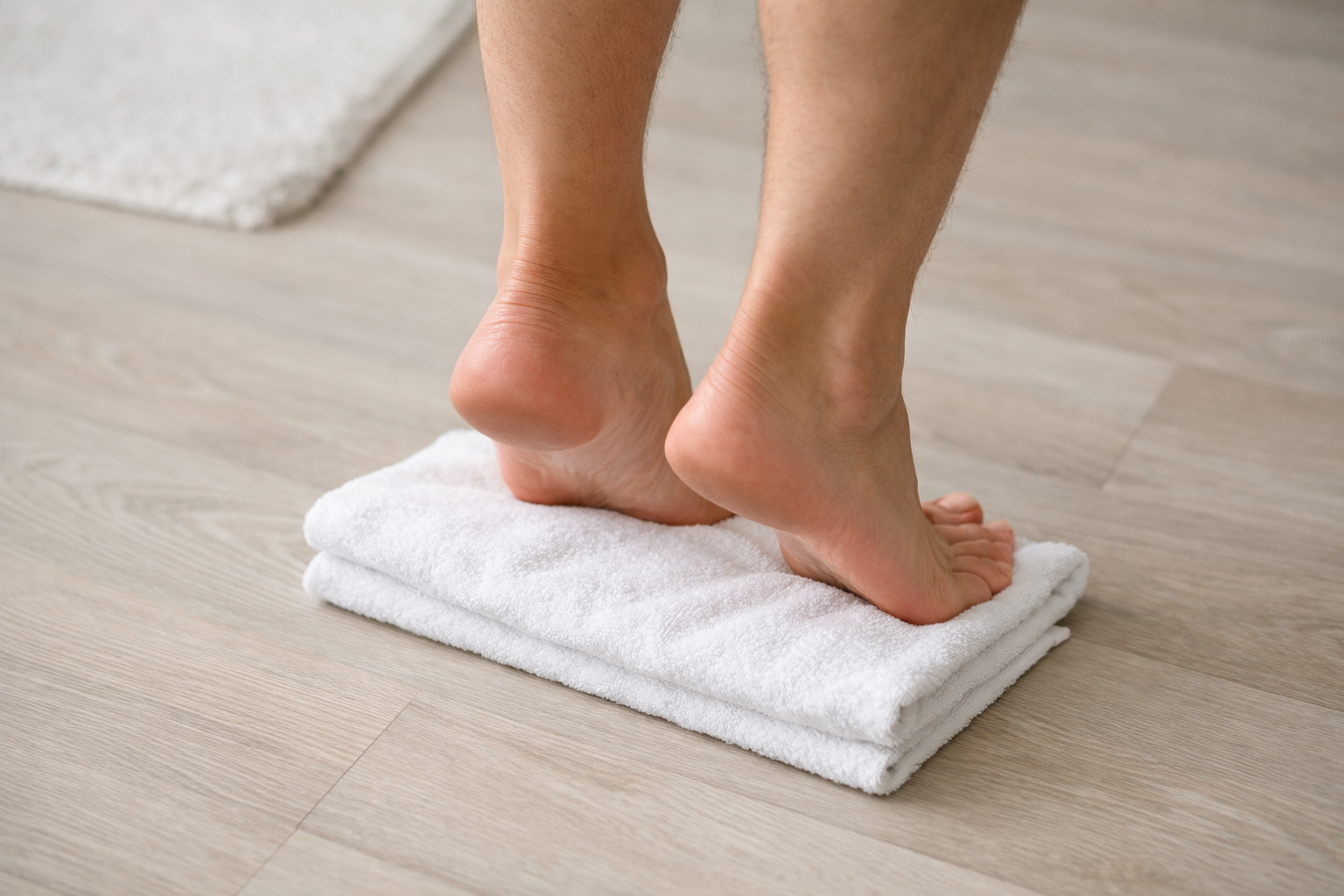
When your toes are pulled up and your heel lifts, the fascia gets pulled taut across the arch and has to accept load. Add slow, controlled tempo and enough resistance that it’s genuinely hard by the last few reps, and you’ve got a way to load the plantar fascia directly in a controlled dose.
Start with both feet, a modest number of reps, slow on the way up and slower on the way down. When that stops being challenging, go to one leg. When one leg gets easy, add weight (a backpack works). The progression is the medicine here. The exercise itself is just the vehicle.
For many people this kind of loading needs something in the range of 8 to 12 weeks before the tissue itself has meaningfully changed, and the first improvements you feel in the early weeks are mostly your nervous system getting better at the task. That gap is why people who stop the week their pain disappears so often find it back a month later. The symptom resolved before the structure caught up.
How Much Should It Hurt?
This is the question that stops most people from progressing, so let’s make it concrete.
Some discomfort during loading work is usually acceptable. A common rule of thumb I use: keep it at or below roughly a 4 out of 10 during the exercise, and check where you are about 24 hours later. If your foot is back to its usual baseline by the next morning, the dose was reasonable. If it’s noticeably worse and stays worse, the dose was too much for that day.
Notice what that does. It turns pain from a stop sign into information. You’re not guessing whether you hurt yourself. You’re running a small test and reading the result.
One more thing worth knowing: symptoms often lag a day or two behind the load that caused them. So when your foot flares on Wednesday, the honest question is what happened Monday and Tuesday, not just what you did this morning.
What’s the Worst Thing You Can Do?
There are two opposite mistakes, and people usually pick one and commit to it.
The first is pushing straight through, unchanged. Same mileage, same shoes, same twelve-hour shifts, adding painful stretching on top, waiting for it to sort itself out. That keeps the demand above capacity indefinitely.
The second, and honestly the more common one, is shutting down completely. Total rest, a boot, months of avoiding anything that hurts. Symptoms do calm down, because unloaded tissue gets less sensitive. But capacity keeps falling the entire time. Then you return to normal life with a foot that can handle less than it could before, and the pain comes back faster and at a lower threshold. Rest is a useful tool in small doses and a liability in large ones.
A few other things that reliably make this harder:
- Changing everything at once (new shoes, new orthotic, new exercises, new mileage) so that when something changes you can’t tell what did it.
- Aggressive stretching or deep massage on a foot that’s already very irritated, on the theory that more must be better.
- Judging the whole week by the worst five minutes of it.
- Quitting the loading work the moment the pain leaves.
“What Finally Cured My Plantar Fasciitis?”
People ask this everywhere, and the honest answer is less satisfying than the forum posts suggest. I’d avoid the word cure altogether. What tends to happen when this resolves durably is unglamorous: someone finds a level of loading their foot can tolerate, does it consistently for a couple of months, manages their total daily load reasonably well while they do it, and gradually gets back to the things they want to do.
The person who swears it was the night splint, the person who swears it was the injection, the person who swears it was a specific shoe: each of them may be telling the truth about their own case, and each of those tools can genuinely help in the right context. The injection calms things enough to start moving. The splint keeps the fascia from spending eight hours shortened. The shoe changes how much the foot has to do. What makes any of it stick is what you build during the window it buys you.
Same goes for “how do you permanently fix plantar fasciitis.” Feet don’t get permanently sealed. What you can do is raise capacity high enough that normal life, and then the harder things you want to do, sit comfortably underneath what your foot can tolerate. That’s a durable place to be, and it’s maintained through staying active rather than through a finished course of treatment.
And the fastest way?
There isn’t a shortcut worth selling you. The fastest realistic route is usually: identify what pushed demand past capacity and adjust it temporarily, start loading at a level you tolerate right away instead of waiting for the pain to leave, keep daily walking and standing within what your foot can recover from overnight, and stay consistent rather than doing a heroic session every ten days. Consistency beats intensity here more than in almost any other rehab I do.
Longer-standing cases usually take longer. That’s about the starting point being lower and the progression needing more patience, not about the situation being hopeless. Persistent does not mean permanent.
Can Plantar Fasciitis Be Massaged Out?
Massage, whether from your own hands, a ball, a tool, or a therapist, changes sensitivity. That’s a real effect and often a pleasant one. It can make it easier to move, easier to stretch, easier to start exercising.
What it doesn’t do is build tissue that tolerates more load. You can’t rub a foot into being able to stand for ten hours. Use massage as a way to make the loading work more comfortable, and judge it by whether it helps you do more, not by how it feels in the twenty minutes afterward.
What About Traditional Chinese Approaches?
People ask about acupuncture, dry needling, cupping, herbal soaks, and foot reflexology paths in Chinese parks. The general picture: several of these approaches, particularly needling, are used for heel pain and some people report meaningful short-term relief. They work mainly on the pain and sensitivity side.
That’s not a knock. Reducing pain is valuable, especially when pain is what’s keeping you from walking normally. But treat them the same way you’d treat massage or an injection: helpful for creating room to move, not a substitute for the loading that changes what your foot can handle. If something makes you more comfortable and you use that comfort to build capacity, you’re ahead.
Is There an Emotional Component?
This one comes up a lot, sometimes framed as “what emotion is connected to plantar fasciitis,” and there’s a version of it that deserves a straight answer.
No particular emotion causes heel pain. But persistent pain and how you feel are genuinely linked, in both directions. Stress, poor sleep, and worry all turn up how loudly your nervous system reports pain. So does the belief that your foot is damaged and that every sharp step is making it worse. I see a lot of people who have become afraid of their own foot, and that fear shapes how they walk, how much they do, and how they interpret every twinge.
Which is why I spend time explaining what pain actually means here. An increase in symptoms after a longer walk is usually a tissue that got asked for more than it was ready for that day. It’s not a tear. It’s not the fascia unraveling. Once that stops being mysterious, most people move more freely, and moving more freely is itself part of the treatment.
Building a Week That Works
The exercises are the small part. The rest of your day is the big part.
Total load is cumulative. Your loading session, plus your commute, plus the grocery store, plus the concrete floor at work, plus the run. Your foot doesn’t file them separately. When someone tells me their program is flaring them up, the culprit is often the 11,000 steps they took that afternoon rather than the twelve heel raises.
So a few practical anchors:
- Pick two or three exercises, not ten. Do them most days, in a dose you can recover from by the next morning.
- Change one thing at a time. If you add mileage this week, hold your loading steady. If you push loading, keep the walking stable.
- Track function, not just pain. How far you can walk before it complains. How long the morning stiffness lasts. How you feel the day after a long shift. Pain is noisy week to week; these move more honestly.
- Use footwear as a load dial, not a cure. More cushion and support temporarily reduce what the foot has to do, which can be exactly right during a rough stretch. As capacity improves, most people can widen the range of shoes they tolerate. If you’re curious about the muscular side of this, the arch itself trains like anything else, which is worth understanding alongside the fascia work.
- Expect flare-ups. A bad week is not erased progress. Look at what changed, back the dose off a notch, and keep going. Recovery is not a straight line, and a flare-up is information about the dose, not a verdict on the plan.
When to Get It Looked At
Not all heel and arch pain is plantar fascia related. Nerve irritation near the inner ankle, a stress reaction in the heel bone, fat pad problems, and referred pain from the low back can all produce something that feels similar. What’s described here can be consistent with plantar fasciopathy, but it takes an actual evaluation to sort out which one you’re dealing with, and the treatment differs.
Worth getting checked sooner rather than later if: the pain came on suddenly after a specific injury, you have numbness, tingling, or burning, the heel is tender to the point you can’t tolerate any weight on it, there’s swelling, redness, or warmth, symptoms are steadily worsening despite sensible management, or things haven’t budged after a couple of months of honest effort.
One note on imaging, since it worries people. A heel spur showing up on an X-ray is usually a consequence of long-term stress on the area, not the source of your pain, and plenty of people have one and no symptoms at all. Thickening of the fascia on ultrasound reflects tissue that has adapted to stress. A scan can show structural changes, but it doesn’t always explain why you hurt, and it doesn’t set a ceiling on what you can get back to.
Where to Start Tomorrow
If you want a place to begin: the toes-up fascia stretch before your first steps in the morning, calf stretching through the day, and toes-elevated heel raises at a dose that stays around a 4 out of 10 and settles by the next morning. Hold that for a couple of weeks. When it gets easy, make it harder, not longer.
The foot in front of you is the one that tells you what comes next. The calendar gives you structure. The response tells you when to move.