Plantar Fasciitis Stretches: How to Use Them Well
A practical guide to plantar fasciitis stretches, including how to do them, how often, what they actually change, and where stretching alone stops being enough. Written for anyone whose heel pain keeps coming back the moment they get moving again.
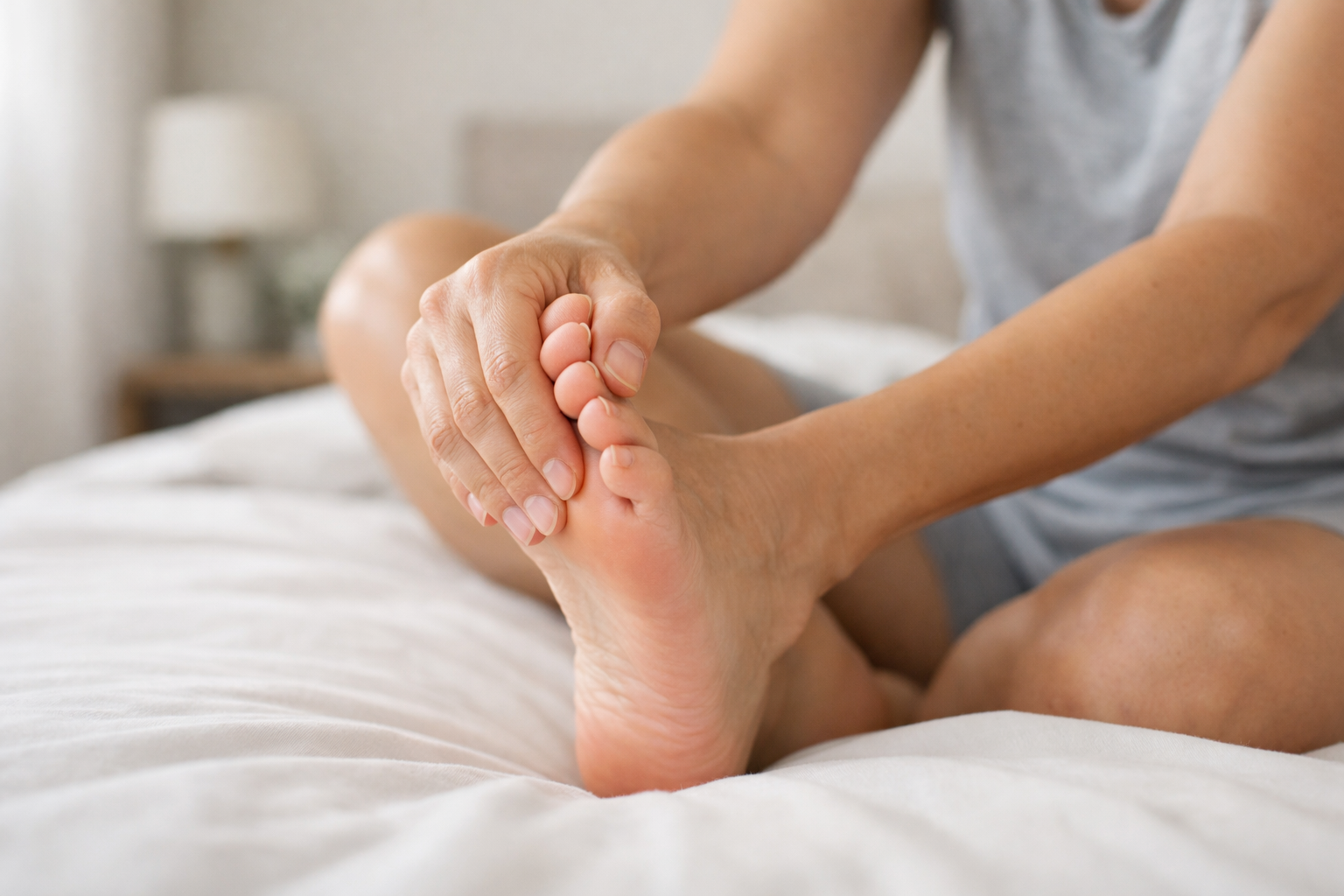
Most people arrive at stretching the same way. Your heel hurts, you look it up, and you find a dozen stretches. You do them. It feels better for twenty minutes. Then you stand up from your desk two hours later and the first few steps hurt again.
So the honest question isn’t “which stretch is best.” It’s “why does the relief keep wearing off?”
That’s worth answering before we get into the how-to, because it changes how you use these stretches. Done well, plantar fasciitis stretches are genuinely useful. Done as the whole plan, they tend to plateau. Let’s separate those two things.
What stretching actually does for your heel
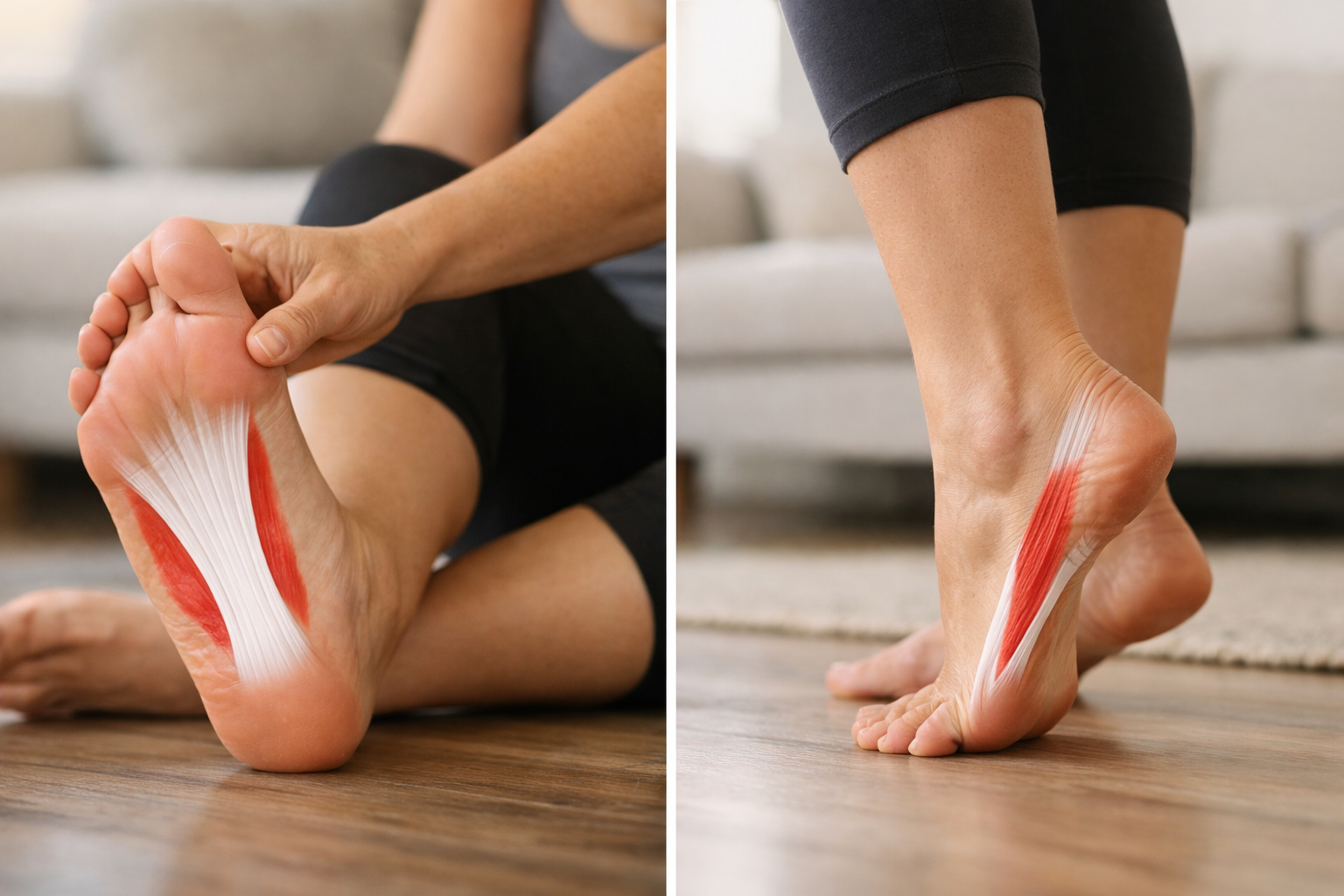
Stretching changes how sensitive the tissue is right now. It buys you a window where the foot tolerates load better, moves more freely, and complains less.
What it doesn’t do, on its own, is make the tissue stronger or more durable. The plantar fascia is a thick band of connective tissue that runs from your heel to the base of your toes, and it responds to being loaded, not to being lengthened. That’s why the relief is real and also temporary. You reduced sensitivity. You haven’t yet changed what the foot can handle.
So here’s the frame I’d want you to keep: stretching opens the door, loading walks through it. Stretch to make movement more comfortable, then use that comfort to do a little more than you did yesterday.
Can you fix plantar fasciitis with stretching?
Some people do get better with stretching alone, usually the ones who caught it early, whose foot was only mildly irritated, and whose daily walking was already enough of a load to keep the tissue adapting in the background.
If you’ve had heel pain for months, stretching alone rarely finishes the job. It’ll help. It probably won’t get you back to standing a twelve-hour shift or running four miles. For that, the tissue has to become more capable, and capacity gets built by asking the foot to do progressively more over weeks, not by holding a stretch longer.
Worth saying plainly: that’s not a knock on stretching or on anyone who taught it to you. It’s just a different job. Recovery is built.
Why mornings are the worst, and how stretching fits
The first-steps-out-of-bed pain is the most recognizable feature of this problem, and it’s also the most misunderstood.
While you sleep, your foot sits in a relaxed, toes-pointed position for hours with essentially no load through it. The tissue settles in short. Then you stand up and load it hard and fast, from zero to full body weight in one step. That mismatch is what you feel.
It is not your foot getting worse overnight. It’s a sensitivity pattern from a long stretch of no load followed by a sudden one.
Which is exactly where a stretch is useful. Doing something gentle before your feet hit the floor takes the edge off that first-step spike. Not because you loosened anything permanently, but because you eased the transition.
Before you get out of bed:
- Sitting up in bed, pull your toes back toward your shin with your hand, gently, and hold about 20 to 30 seconds. Two or three rounds.
- Point and flex your ankle slowly, ten or fifteen times.
- Roll the bottom of your foot over a ball or even the edge of your mattress for thirty seconds.
Then stand. Most people find those first steps noticeably less sharp. If morning pain is your main complaint, this small routine is probably the highest-value two minutes in your day.
A night splint, which holds the foot at a neutral angle instead of toes-pointed, works on the same logic. It helps some people a lot and annoys others enough that they stop wearing it. Both outcomes are fine.
The stretches worth your time
You don’t need seven. You need two or three done consistently, in positions that actually target the tissue involved.
1. The seated plantar fascia stretch (toes pulled back)
This is the one with the most direct effect on the fascia itself, and it’s the one people most often do too casually.
- Sit down. Cross the sore foot over your opposite knee so you can reach the sole.
- With one hand, grasp your toes (all of them, including the big toe) and pull them back toward your shin until you feel a firm pull along the arch.
- Use your other hand to feel the arch. You should feel the band of tissue go taut and cord-like under your fingers. That’s your confirmation you’re in the right position.
- Hold about 20 to 30 seconds. Repeat two or three times.
Do this after periods of sitting or before standing up to walk. Many people do well with a few rounds spread through the day rather than one long session.
The detail that matters: pulling the toes back is what tensions the fascia. Just flexing your ankle isn’t the same stretch.
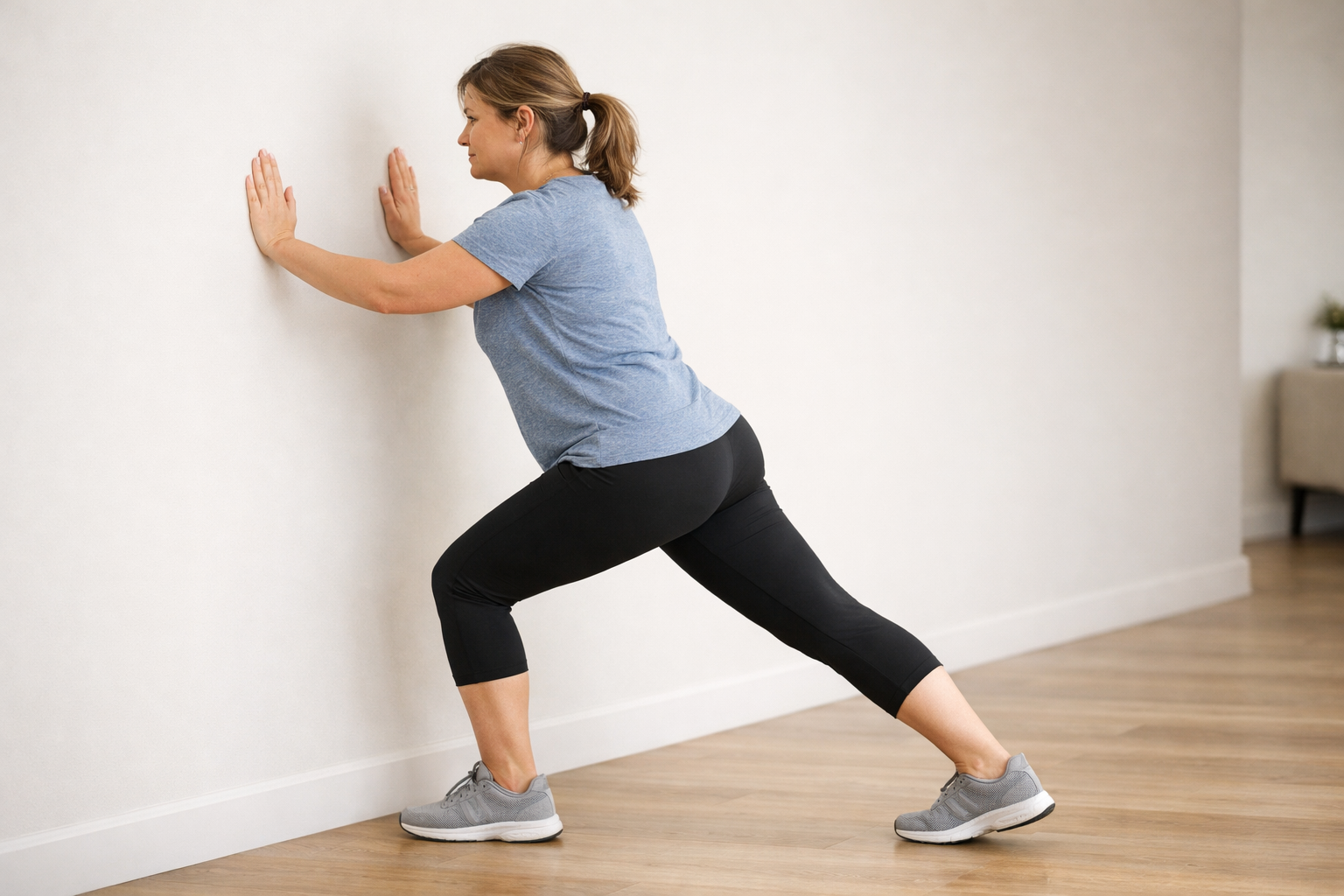
2. Calf stretch against a wall (straight knee, then bent)
Your calf and your plantar fascia are functionally connected through the heel. Tight, stiff calves mean your foot has to do more work to get you through each step, and that raises the demand on the fascia every time you walk.
- Hands on a wall, sore leg back, heel down, knee straight.
- Shift your hips forward until you feel a stretch in the upper calf. Hold about 30 seconds.
- Then do a second version with the back knee slightly bent, which shifts the stretch lower toward the Achilles and the deeper calf muscle.
Both versions matter. People skip the bent-knee one and it’s often the stiffer of the two.
3. The towel stretch (for early mornings and stiff ankles)
If reaching your foot is hard, or if you want something you can do before getting up:
- Sit with the leg straight out.
- Loop a towel or belt around the ball of your foot.
- Pull the towel toward you, keeping the knee straight, until you feel the stretch through your calf and arch. Hold about 30 seconds.
Less targeted than grabbing your toes, but easier to do at 6 a.m. and easier on stiff hamstrings and backs.
4. Step stretch, with a caution
Standing on a step and letting your heels drop below the edge gives a strong calf and Achilles stretch. It works well for a lot of people.
It can also be too much if your heel is very irritated, because you’re stretching under full body weight. If you try it and the heel is angrier for the rest of the day, go back to the wall version for a few weeks. Nothing wrong with taking the smaller dose.
How long and how often
General pattern, not a prescription: holds of about 20 to 30 seconds, two to three repetitions, two or three times a day. Consistency beats intensity here. Short sessions spread through the day tend to do more for the morning pain than one heroic ten-minute stretch.
And during a stretch, aim for a firm pull, not a bracing, breath-holding pain. If you’re gritting your teeth, ease off. As a rough guide, keeping discomfort at or below about a 4 out of 10 during and after works well for most people.
How do you self-release the plantar fascia?
“Release” is a loose word. You are not breaking anything up or dissolving anything. What you’re doing is applying pressure and movement that temporarily reduces sensitivity and makes the area feel less guarded.
That’s still useful. The simplest version:
- Sit down, put a lacrosse ball, golf ball, or frozen water bottle under your arch.
- Roll slowly, front to back, for 60 to 90 seconds. Pause on tender spots for a few breaths rather than grinding through them.
- Moderate pressure. If you’re wincing, you’re pressing too hard.
A frozen water bottle does double duty if your heel feels hot and irritated after a long day. Rolling before your stretches often makes the stretches more comfortable, so that’s a reasonable order.
If you want to go deeper on hands-on techniques, pressure, and what massage does and doesn’t accomplish, there’s a separate article on this site about massage for plantar fasciitis that covers it properly. I’ll leave it there.
Where stretching stops being enough
Here’s the pattern I see constantly. Someone stretches faithfully for six weeks. Morning pain improves. They feel encouraged. Then they try to get back to their walks, or their shift schedule picks up, and the heel flares again.
Nothing went wrong with the stretching. The foot just never got asked to become stronger.
Rest and stretching reduce sensitivity while the tissue is relatively unloaded. That’s why symptoms so often return the moment real load returns. Changing what the tissue itself can tolerate takes progressive loading over weeks to months, and it tends to happen in a specific order: the first few weeks of improvement come mostly from your nervous system tolerating the movement better, and the actual structural adaptation comes later. Often somewhere in the 8 to 12 week range for meaningful change, sometimes longer if you’ve had this a while.
Which explains one of the most common ways people end up back at square one. Pain resolves at week five, they stop everything at week five, and the tissue never got the rest of the adaptation. Symptoms come back and it feels like the whole thing failed. It didn’t. It just stopped early.
The practical takeaway: use the stretches, and add loading. Calf raises. Loaded work with the toes extended over a rolled towel, which puts tension through the fascia while the calf works. Heavier, slower, controlled movements as tolerance improves. This site has a full article on plantar fasciitis exercises if you want the specifics of what that progression looks like.
Is walking good for plantar fasciitis?
Usually, yes, in the right amount.
Walking is load, and load is what makes tissue more capable. It also keeps your calves and ankles from stiffening up and keeps you from getting deconditioned while you wait for a heel to settle down. Complete rest calms things temporarily and costs you capacity. Rest equals rust.
But amount matters more than yes-or-no. Some useful adjustments:
- Break it up. Three fifteen-minute walks are often easier on the foot than one forty-five minute walk.
- Watch surfaces. Concrete and barefoot on hard floors at home are harder on an irritated heel than a track or a smooth, level path. Aim for even ground early on. Uneven trails, sand, and hills ask more of the fascia, so save those for when the heel has settled and your tolerance has built back up.
- Wear something supportive at home. Many people load their feet hardest in the least supportive footwear, padding around the kitchen barefoot.
- Use the 24-hour rule. If your foot is back to roughly its usual baseline within about a day, that walk was a reasonable dose. If it’s still noticeably worse two days later, that was more than the foot was ready for. Scale back, then build again.
That 24-hour window is the single most practical tool I can give you. It turns guessing into information.
What causes plantar fasciitis to flare up?
Almost always a change in total load, and total load includes everything, not just exercise.
Common triggers:
- A jump in walking or standing. A trip with lots of airports and museums. A busy stretch at work. A new job on your feet.
- New shoes, or old shoes that finally gave out. Also going from cushioned everyday shoes to flat, minimal ones too quickly.
- Ramping up running mileage, adding hills, or adding speed work.
- Barefoot time on hard floors, especially in summer or on vacation.
- Long periods of sitting followed by sudden activity, which is really the same mismatch as the morning problem.
- Anything that increases how much load goes through the foot per step, including changes in body weight. Not a character issue, just arithmetic on a system that has a current limit.
And one thing that trips people up: symptoms often lag a day or two behind the load that caused them. You feel fine during the hike and rough on Tuesday. So when you’re trying to figure out a flare, look back two or three days, not just at what you did this morning.
A flare-up is not failure. It’s a data point. Something exceeded what the foot could handle that week. Find it, adjust it, and keep the larger trend in view, because the trend over a month tells you far more than any single bad day.
What not to do
More useful than a list of don’ts is a short list of the things that reliably slow people down.
Stretching aggressively into sharp pain. More pull is not more progress. Hard, painful stretching of an already irritated fascia tends to keep it irritated.
Complete rest as the plan. Backing off for a few days to calm a bad flare is reasonable. Backing off for six weeks leaves you with a quieter foot that’s even less capable than before, and the pain returns the moment life resumes.
Doing nothing but stretching and passive treatment, for months. Ice, rolling, massage, taping, and stretching all reduce sensitivity. They’re worth using. They don’t build capacity, and if all you’re doing is managing sensitivity, you’ll keep landing back in the same place.
Changing everything at once. New shoes, new orthotics, new stretching routine, new mileage goal, all in the same week. When it flares, you have no idea which variable did it.
Chasing the pain number and ignoring function. Function matters as much as pain. If you can stand longer at work, walk farther before it complains, and bounce back faster the next morning, you’re improving, even if the number on a bad day looks similar. Track what you can do, not only how much it hurts.
If you want one candidate for the worst move: staying completely off it and waiting for the pain to disappear on its own before doing anything at all. That’s the approach most likely to leave you in the same place six months from now.
What actually gets people better
When people describe what finally turned things around, the answer is rarely one exercise or one gadget. It’s usually some version of: they stopped waiting, got consistent, and gradually asked the foot to do more.
The pieces that tend to be present:
- Something to reduce sensitivity in the short term, especially in the morning (stretching, rolling, supportive shoes, sometimes a night splint).
- Progressive loading, done consistently, continued past the point where pain resolved.
- Managing total daily load intelligently instead of oscillating between total rest and overdoing it.
- Patience with the timeline. Months, not days, especially if this has been going on a while.
And if you’ve had heel pain for a year, that doesn’t mean you’re stuck. Persistent doesn’t mean permanent. It usually means a lower starting point and a more patient build, not a different destination.
Things like orthotics, injections, and shockwave can each have a place, particularly when pain is high enough that you can’t load the foot at all. They work best as a way to make loading possible, not as a substitute for it.
What gets mistaken for plantar fasciitis?
Not all heel and foot pain is plantar fascia pain, and stretching the fascia won’t help much if that isn’t the problem. Things that can look similar:
- Fat pad irritation or thinning, where the pain sits more centrally under the heel and feels like a bruise rather than a pull through the arch.
- Nerve irritation, including the nerve branches near the inner heel or symptoms referred from the low back. Burning, tingling, or numbness points this direction.
- A heel stress fracture, which tends to hurt with any weight bearing rather than easing up after you get moving. This one matters, especially if you’ve recently increased running volume.
- Achilles or insertional tendon problems, where the tenderness is at the back of the heel rather than underneath.
- Tarsal tunnel syndrome, arthritis in the foot, or occasionally an inflammatory condition, particularly if both heels hurt or other joints are involved.
A couple of clues worth noticing. Classic plantar fascia pain is worst with the first steps in the morning, eases as you warm up, and is tender when you press on the inside front edge of the heel bone. Pain that’s constant, worse the longer you’re on it, or accompanied by numbness deserves a proper look.
And about heel spurs, since imaging brings them up so often: a spur is usually a consequence of long-term stress on the area rather than the thing generating your pain. Plenty of people have spurs and no symptoms at all. Recovery looks about the same whether you have one or not. Same story with a thickened fascia on ultrasound. It reflects tissue adapting to stress. It’s a description, not a verdict on what your foot can become.
When to get it looked at
Stretches and sensible load management are reasonable to try on your own. See a clinician if:
- Pain has stuck around for several weeks without any trend toward improvement.
- You have numbness, tingling, or burning.
- The pain is severe with every step, or came on suddenly after a specific injury.
- You have swelling, redness, warmth, fever, or heel pain on both sides.
- You’re not sure the fascia is even the problem.
An in-person evaluation sorts out what’s actually driving the pain and, more importantly, gives you a starting load and a way to progress it. For a lot of people, the missing piece was never another stretch. It was knowing how much to do and when to do more.
Start with the two minutes before you get out of bed tomorrow. Then see what your foot tells you.