Peroneal Tendonitis: Symptoms, Causes, and What Actually Helps
Peroneal tendonitis causes pain along the outside of the ankle that flares with activity and quiets with rest. Here's what it feels like, what else it can be mistaken for, and how loading the tendon the right way rebuilds what your ankle can handle.
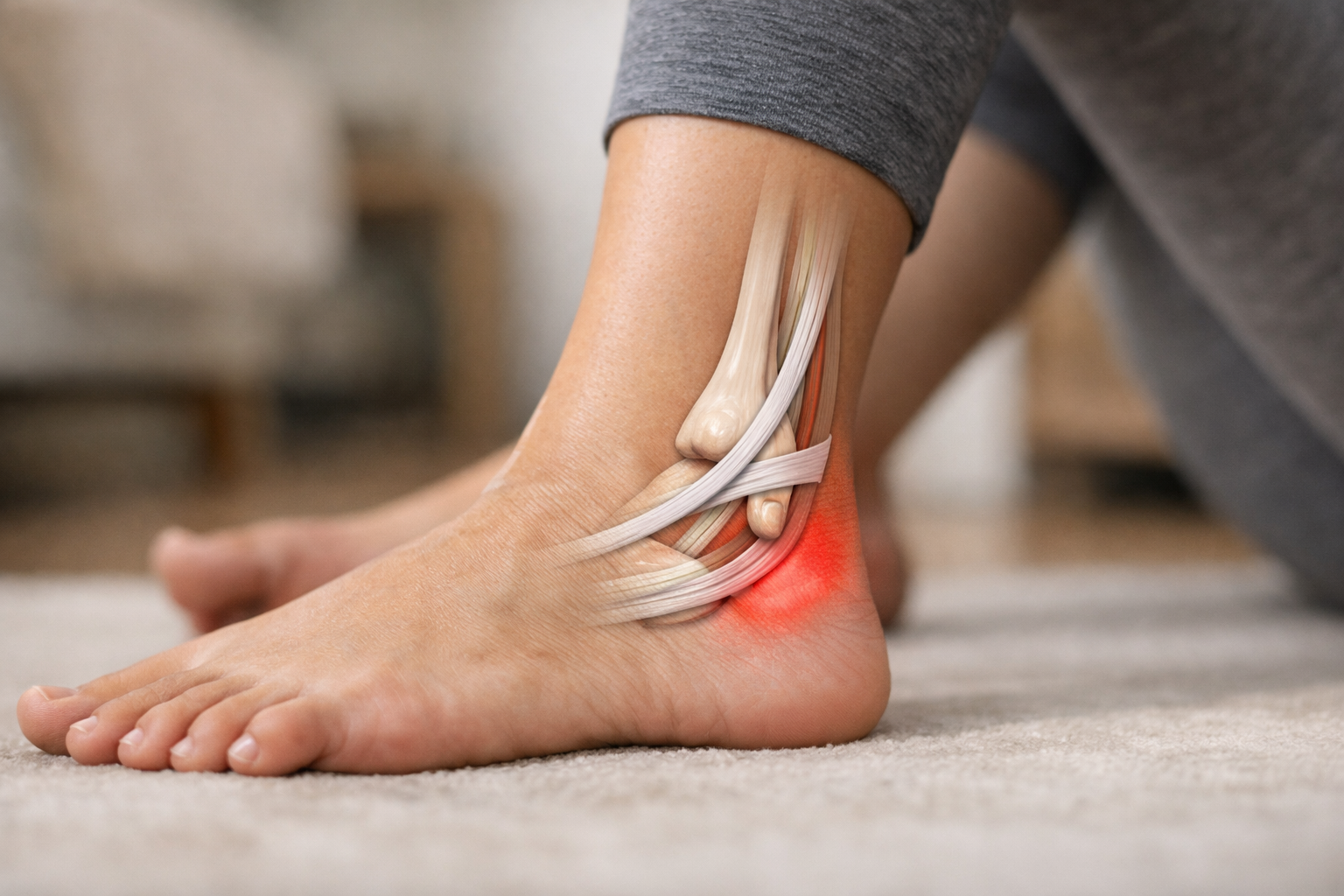
Most people who come in with this describe the same thing. Pain on the outside of the ankle, sometimes just behind that bony bump on the outer side, sometimes tracking forward along the outside of the foot. It’s fine at rest. It shows up during or after walking, running, hiking, or a long day on uneven ground. Ice and a few days off help. Then you go back to what you were doing and it returns almost on schedule.
That pattern is the useful part. It tells us the tissue isn’t broken. It tells us the tissue is being asked to do more than it can currently handle, and it quiets down when you stop asking.
What the peroneal tendons do (and why the outside of the ankle gets loaded so much)
Two muscles run down the outside of your lower leg. Their tendons wrap around the back of the outer ankle bone, sit in a shallow groove there, and then head into the foot. One attaches to the base of the fifth toe on the outer edge of the foot. The other dives under the arch and attaches on the inner side.
Their job list is bigger than most people expect:
- Turning the foot outward
- Helping push off at the end of each step
- Keeping you from rolling the ankle outward when you land on something uneven
- Quietly bracing the ankle sideways, thousands of times a day, on stairs, curbs, gravel, sand, and slopes
That last one matters. These tendons are your ankle’s side-to-side stabilizers. Every time you walk on a cambered road, cut sideways in a sport, or step on a tree root, they take a hit of load. If your ankle is a little unstable from an old sprain, they work overtime for the rest of your life without being asked.
So a lot of outer ankle pain isn’t a mystery. It’s a tissue with a demanding job that got a sudden increase in work.
What does peroneal tendonitis feel like?
What people typically describe, and what can be consistent with irritation of these tendons:
- Pain along the outside of the ankle, often behind or just below the outer ankle bone, sometimes extending along the outside edge of the foot
- An ache or burning that builds during activity rather than a sharp single moment of injury
- Stiffness or soreness in the first few steps in the morning that eases as you move
- Worse on uneven ground, hills, sand, or trails than on flat sidewalk
- Pain when you turn the foot outward against resistance, or when you push off
- Mild swelling or a puffy feeling along the tendon line, occasionally some warmth
- A feeling that the ankle is unreliable on uneven surfaces, like it might give sideways
- Sometimes a snapping or popping sensation behind the outer ankle bone
That morning stiffness confuses people. It isn’t the tendon getting worse overnight. Tendons that have been sitting still for hours are simply more sensitive on the first load of the day. Give it twenty or thirty steps and it usually settles. That’s a sensitivity pattern, not damage.
One note on terminology. “Tendonitis” implies pure inflammation, and in the first days after a sudden spike in activity there is often an inflammatory component. But when this has been going on for weeks or months, what’s happening inside the tendon is more about a change in the tissue’s structure and its ability to handle load. Clinicians often call that tendinopathy or peroneal tendinosis. The label matters less than what it implies for treatment: you can’t calm your way out of a capacity problem.
What actually causes it
Almost always, something changed. Not always dramatically. Common triggers:
- A jump in mileage or intensity. New running program, longer hikes, a return to sport after time off, a walking vacation with cobblestones.
- A change in surface. Trails, beach, treadmill to road, a track with a consistent curve.
- New footwear. A shoe with a very different heel height, a worn-out shoe collapsing to one side, a stiff hiking boot, or a switch to something minimal too quickly.
- A previous ankle sprain that never fully rebuilt. This is the one most people miss. After a lateral ankle sprain the ankle is often left with less confidence sideways and less strength in exactly these muscles. The tendons pick up the slack.
- Foot shape and mechanics. A higher arch or a foot that sits slightly turned in can put more day-to-day demand on the outer ankle. Not a defect. Just more work landing in one place.
- A standing or walking job. Nurses, teachers, warehouse and construction work, hospitality. The tendon never gets a quiet day.
And here’s the piece worth sitting with: total load is cumulative. It isn’t just your workout. It’s your workout plus your commute plus eight hours on concrete plus the dog walk plus whatever your weekend looked like. Body weight is part of that math too, not as a moral issue, just as one input into how much force passes through a tendon with every step. When we look for the cause of a flare, we look at the whole week, not just the exercise.
Symptoms also lag. Something you did Saturday can show up Monday morning. If you only look at what you did in the last hour, you’ll blame the wrong thing.
What can be mistaken for peroneal tendonitis?
Quite a lot, which is why an in-person exam is worth it if this isn’t resolving. Outer ankle and foot pain has several possible sources:
- An unhealed lateral ankle sprain. Ligament pain sits slightly more forward and lower than tendon pain, but the two overlap and often coexist.
- A stress fracture of the fibula or the fifth metatarsal. Pain that’s sharp, focal, tender right on the bone, and that gets worse with continued running rather than warming up, deserves prompt evaluation.
- Peroneal tendon subluxation or a tear. If the tendon snaps or shifts behind the outer ankle bone, or you feel real weakness turning the foot out, that changes the plan.
- Sinus tarsi syndrome. Pain in the small hollow just in front of the outer ankle bone, common after sprains.
- Nerve-related pain. Referred symptoms from the low back or an irritated nerve in the leg can produce burning along the outer lower leg and foot without the tendon being the problem at all.
- Arthritis or a bone bruise in the ankle joint. Deeper, more diffuse, often stiffer.
- A short peroneal muscle irritation higher up the leg, which can feel like the ankle even though the sore tissue is well above it.
Most of these get sorted out with a good history and a hands-on exam. Imaging can help in specific situations, but a scan showing thickening of the tendon isn’t a verdict. Tendons thicken because they’ve been adapting to stress. Plenty of people have thickened tendons and no pain at all. What the tendon looks like matters less than what it can do and how it responds to load.
How do you heal peroneal tendonitis?
Here’s the honest version. You calm it down enough to work with, and then you rebuild what it can handle. Both halves are required. Skipping the second half is the single most common reason outer ankle pain comes back.
Rest is genuinely useful in small doses. It drops sensitivity. It gets you out of a flare. What it does not do is make the tendon stronger. In fact, a tendon that hasn’t been loaded for three weeks is a tendon with less capacity than it started with, which is why symptoms often return the moment normal life returns. Rest equals rust.
So the sequence, in plain terms:
1. Take the spike out, not the activity
If running lit this up, you don’t necessarily stop running. You reduce it to a level the ankle tolerates. Flatter route, shorter distance, no hills, no trails for a while. Same for hiking, same for a standing job where you might change shoes, add sit-down breaks, or shift how much of the day is spent on uneven ground.
A rough working guide many people find useful: keep symptoms at or below about a 4 out of 10 during activity, and see where the ankle sits about 24 hours later. If it’s back to baseline by the next morning, that dose was reasonable. If it’s still angry two days later, that dose was too much for now. Not a failure. Just information.
2. Start loading the tendon deliberately

This is where recovery is actually built. Early on that often looks unimpressive: gentle, controlled work that turns the foot outward against light resistance, calf raises done slowly with attention to keeping the ankle from rolling, weight shifts and balance work. Slow and controlled beats fast and springy at the beginning.
As the ankle tolerates more, the work gets heavier and eventually faster: single-leg calf raises, loaded raises, then hopping, cutting, and direction changes if your life or sport requires them. The tendon only becomes good at side-to-side stability if you eventually train side-to-side stability.
The progression rule is boring and it works. Start at a level you tolerate. Stay there long enough for the tissue to adapt, usually a couple of weeks, not a couple of days. Then increase. Your response determines when you move up, not the calendar.
3. Don’t stop when the pain stops
The first improvements come fast, and they’re mostly your nervous system getting more comfortable and more coordinated. Real structural change in tendon tissue takes longer, typically in the range of 8 to 12 weeks of consistent loading, sometimes more if this has been going on a long time. That gap between feeling better and being more capable is exactly where recurrences live.
4. Look above the ankle
Hip and calf strength change how your foot lands. So does single-leg control. Someone whose hip fatigues by mile three lands differently at mile four, and the outer ankle absorbs the difference. This isn’t about finding a flaw. It’s about spreading the work around.
Is walking good for peroneal tendonitis?
Usually, yes, in an amount your ankle tolerates.
Walking is load, and load is the stimulus tendons need. It’s also unavoidable for most people, so the more useful question isn’t whether to walk but how much, how fast, and on what.
Practical adjustments that often help early on:
- Choose flat, even surfaces. Save trails, beaches, and cambered roads for later.
- Break long walks into shorter ones. Three fifteen-minute walks are often better tolerated than one forty-five-minute walk.
- Wear a supportive shoe you already trust. This is not the week to break in something new.
- Notice how the ankle feels the next morning, not just during the walk.
If walking a mile leaves you sore for two days, walk less for now and build from there. If walking a mile is uncomfortable during but settled by the next day, that’s a workable starting point. The goal is finding the amount your ankle can handle and building up from there.
Should you massage peroneal tendonitis?
Massage along the outer calf and the muscles above the ankle can feel good and can reduce sensitivity for a while. Nothing wrong with that. Use it if it helps you move more comfortably.
What I’d steer you away from is aggressive digging directly on the tendon where it wraps behind the outer ankle bone, especially if that area is already swollen and tender. There’s very little tissue between skin and tendon there, and hard pressure tends to increase irritation without adding anything. Same logic for very deep foam rolling right over the sore spot.
Treat massage as something that makes the loading easier, not as the treatment. A tendon doesn’t get stronger from being rubbed.
What not to do with peroneal tendonitis
- Don’t shut down completely for weeks. Complete rest calms symptoms and shrinks capacity at the same time. Boots and immobilization have a place in specific situations, such as a suspected tear or a stress fracture, but they aren’t the default answer for an irritated tendon.
- Don’t push through pain that keeps climbing. Discomfort that stays moderate and settles within a day is workable. Pain that escalates during activity, makes you limp, or lingers for days is telling you the dose was wrong.
- Don’t chase a new fix every ten days. Tendons adapt to consistency. Two weeks of one thing followed by two weeks of something else gives you a month of starting over. Consistency beats intensity here.
- Don’t rely only on stretching. Stretching the outer calf can feel good and can reduce sensitivity temporarily. It doesn’t build capacity, and pain that returns the second you load the ankle again is a clue about which one you were missing.
- Don’t rush back to uneven ground. Trails and sport-specific cutting are usually the last thing to return, not the first.
- Don’t ignore new instability. If the ankle is genuinely giving way sideways, that needs an exam.
Orthotics, taping, a brace, anti-inflammatories, and injections all have legitimate roles in the right situation, usually as tools to get you loading comfortably. They tend to disappoint when they’re used instead of a progression rather than alongside one. Sometimes the missing piece isn’t another treatment. It’s a plan for how to get from where you are to what you want to do.
How long does it take for peroneal tendonitis to heal?
It depends on how long it’s been going on and how much your daily life keeps loading the tendon.
Something that started three weeks ago after a mileage jump, in someone with an otherwise strong ankle, often turns around within several weeks. Something that’s been simmering for eight months, in someone who works twelve-hour shifts on concrete, takes a more patient progression, and often lands in the range of a few months before it feels solid under real demand.
What I’d rather you track than a countdown:
- How far you can walk before symptoms start
- How long they last afterward
- Whether the first steps in the morning are getting easier
- Whether you trust the ankle on uneven ground
- Whether the overall trend across three or four weeks is going the right way
Progress rarely runs in a straight line. You’ll have a good week, then a stiff morning after a long day. That’s normal. A flare-up doesn’t erase what you built. It’s a signal to look at what changed, adjust, and keep going.
A longer history doesn’t mean you can’t recover. It usually means starting lower and moving up more gradually.
Does tendonitis ever fully go away?
Many people get back to full activity with no ongoing symptoms and stay there. That’s a common outcome, and it’s a reasonable thing to aim for.
What I’d be careful about is thinking of the tendon as either broken or perfect. Tendons keep responding to how you use them for the rest of your life. If you build the outer ankle up to handle running, hiking, and pickleball, and then keep doing some version of that work, the tendon stays capable. If you rebuild it, stop everything for eight months, and then jump straight back into a hilly hike, you’ve recreated the original setup.
That’s not a warning. It’s just how tissue works, and it applies to everyone with or without a history of tendon pain. The people who do best long term tend to keep a small amount of strength and balance work in their routine, the way you’d keep brushing your teeth after a cavity gets filled.
How should I sleep with peroneal tendonitis?
Sleep position rarely drives this, but a few things help if nights are uncomfortable:
- Side sleepers who feel it on the outer ankle can put a pillow between the ankles, so the top foot isn’t pressing down and the bottom ankle isn’t rolling into the mattress.
- Keep the covers loose. Heavy blankets that pin the foot into a pointed position for hours can make the first steps in the morning stiffer.
- If there’s noticeable swelling, elevating the leg slightly in the evening (not necessarily all night) can help it settle.
- Don’t sleep in a compression sleeve so tight it wakes you up.
And for the morning stiffness itself: a minute of gentle ankle circles and slow up-and-down movement before you stand up often takes the edge off the first several steps. It doesn’t change the tendon. It just wakes it up before you ask it to carry you.
When to get it looked at
See a clinician in person if any of this fits:
- You can’t bear weight, or there’s significant swelling and bruising after a specific injury
- There’s sharp, pinpoint tenderness directly on bone, especially with pain that worsens the longer you run
- The ankle is genuinely giving way sideways, or you feel real weakness turning the foot outward
- The tendon snaps or shifts audibly behind the outer ankle bone
- Numbness, tingling, or pain that travels up the leg
- Symptoms are getting worse over several weeks despite backing off
- You’ve been managing it for months and it hasn’t budged
There’s also plenty of value in an exam even when nothing alarming is happening, because the most useful thing about outer ankle pain is knowing what’s actually irritated and where your ankle currently sits in terms of capacity. That’s what determines the starting dose, and the starting dose is what makes the rest of it work.
If the pain is on the inside of the ankle or under the arch rather than the outside, the reasoning is similar but the tendon involved is different. Our article on posterior tibial tendon dysfunction covers that side of the ankle in more detail.
The outside of your ankle isn’t fragile. It’s under-prepared for something you’ve been asking it to do. Those are very different problems, and only one of them requires waiting.
This article is for general education and isn’t a substitute for an individual evaluation. If your symptoms are severe, worsening, or not improving, see a physical therapist or physician who can examine you in person.