Posterior Tibial Tendon Dysfunction: Treatment and Recovery
A plain-language guide to posterior tibial tendon dysfunction, covering the early warning signs people usually miss, what actually rebuilds the tendon's capacity, and how to tell progress from a setback.
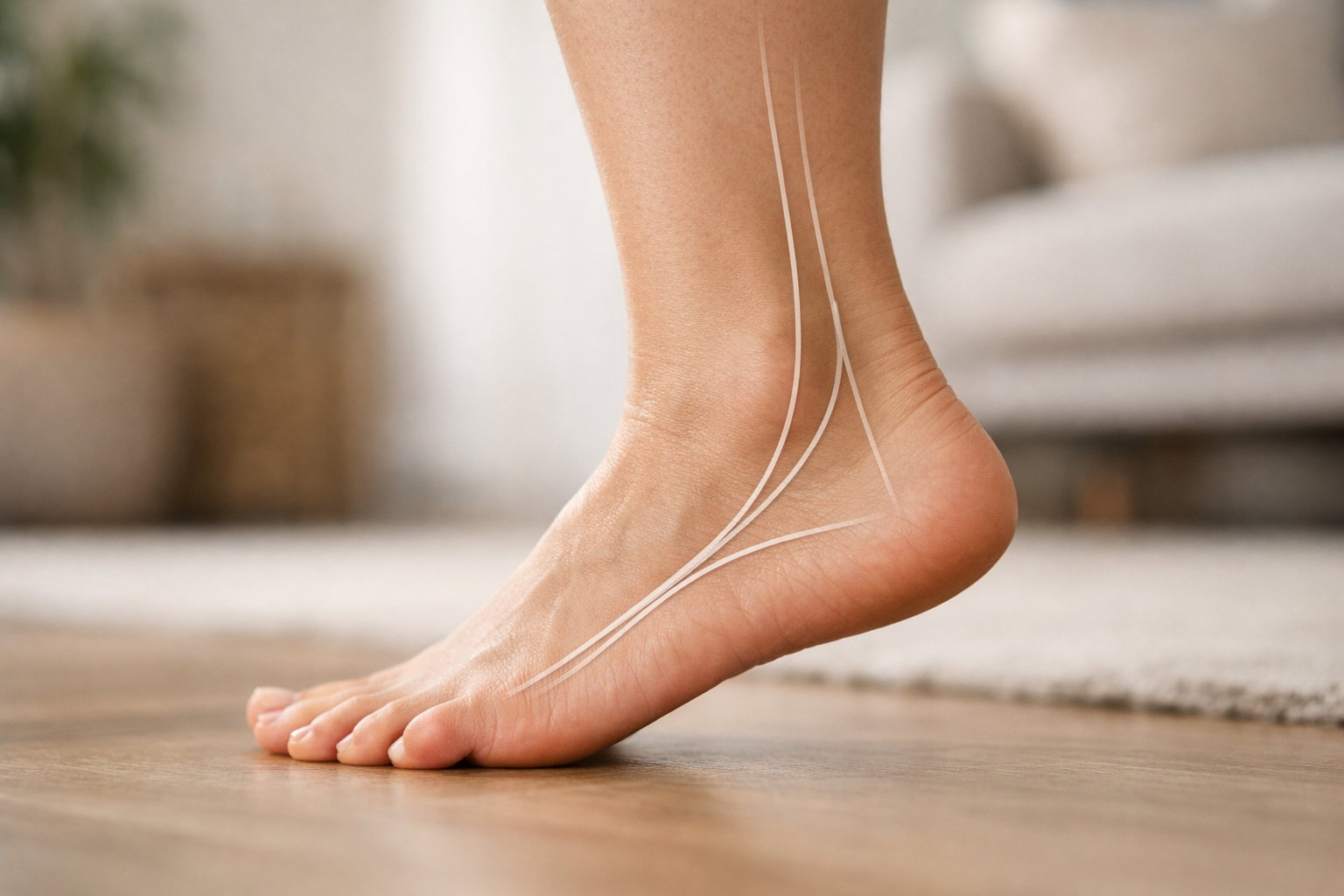
Most people don’t come in saying “I think my posterior tibial tendon is failing.” They come in saying their ankle aches on the inside, near the bump, and it’s been going on for a few months. It hurts more at the end of a long day. It hurts on stairs. They’ve noticed the arch on that side looks a little flatter than the other one, or their shoes are wearing unevenly, or a walk that used to be easy now leaves them limping the next morning.
That’s usually the real starting point. Not a diagnosis, but a nagging suspicion that something on the inside of the ankle isn’t holding up the way it used to.
Let’s talk about what’s actually happening, and more importantly, what to do about it.
What the posterior tibial tendon actually does
Run your finger along the inside of your ankle, just behind and below that bony bump. The tendon underneath is the posterior tibial tendon. It starts from a muscle deep in your calf, wraps around the inside of the ankle, and attaches into the bones under your arch.
Its job is bigger than it sounds. Every single step you take, that tendon helps control how much your arch collapses when your foot hits the ground, and then helps stiffen the foot so you can push off. Do that five, eight, ten thousand times a day. Add your body weight. Add a hill, a hard floor, a heavy bag.
So when this tendon gets overworked, you feel it in the most ordinary things. Walking. Standing. Getting up in the morning.
What posterior tibial tendon dysfunction is, in plain terms
Posterior tibial tendon dysfunction, or PTTD, is what happens when the demand placed on that tendon has outpaced what it can currently handle. The tendon gets irritated, then over time it can get less efficient at doing its job. Because it’s one of the main supports of the arch, a tendon that isn’t pulling its weight can let the arch settle lower, which then puts even more strain on the tendon. That loop is why it tends to be a slow, creeping problem rather than a sudden one.
You’ll hear a few different names for this. Posterior tibial tendonitis suggests inflammation, which is often part of the early picture. Posterior tibial tendinopathy or tendinosis describes the longer-standing state, where the tendon’s structure itself has changed. Some clinicians now use “adult acquired flatfoot deformity” or “progressive collapsing foot deformity” for the later stages. The labels matter less than where you are on that spectrum.
What matters clinically is this: is the tendon irritated but still structurally sound, or has it been overloaded long enough that the foot’s shape is changing? Those two situations get treated differently, and only an in-person evaluation can really sort that out.
Early signs that are easy to dismiss
The early stage is where this is most treatable, and it’s also the stage people most often ignore because the symptoms are mild and intermittent. Some patterns that can be consistent with early PTTD:
- Aching or burning along the inside of the ankle and arch, sometimes tracking up toward the inside of the calf.
- Symptoms that build with activity. Some people do notice stiffness or soreness in the first few steps that eases once they get moving, which is a common tendon behavior. With this particular tendon, though, the pattern I hear most often is cumulative: you walk a mile fine, and mile two hurts, because the arch has to be controlled on every step.
- Swelling or a warm, puffy feeling behind the inner ankle bone.
- Fatigue in the arch after standing a long time, even without sharp pain.
- Trouble with a single-leg heel raise. Standing on the involved leg and rising onto your toes feels weak, wobbly, or just harder than the other side. This is one of the more telling early signs.
- A subtle change in foot shape. The arch sits lower, or when someone looks at you from behind, more toes are visible on the outside of the affected foot than on the other side.
- Shoes wearing unevenly, or an old orthotic that suddenly feels wrong.
One caution worth stating plainly: inside-ankle pain isn’t automatically this tendon. Tarsal tunnel irritation, a stress reaction in the navicular or the tibia, ankle joint arthritis, a nerve problem referring from the low back, and even a spring ligament issue can all produce pain in the same neighborhood. An evaluation sorts that out, and it changes what you should be doing. Guessing costs you time.
Why rest alone tends to disappoint
Here’s the pattern I see constantly. Someone’s inner ankle starts hurting. They back off. Over two or three weeks it settles down nicely. They feel encouraged, return to their walking routine or their job or their sport, and within a week or two they’re right back where they started, sometimes worse.
That’s not bad luck, and it’s not a sign the problem is untreatable. It’s what happens when you reduce the tendon’s sensitivity without changing what the tendon can handle.
Those are two different things. Sensitivity is how easily the tissue gets irritated right now. Capacity is how much work the tendon can actually absorb before it complains. Rest lowers sensitivity, which feels like healing. But capacity, the structural side, only changes when you load the tendon in a graded, repeated way over weeks and months. Take the load away entirely and capacity actually drops. So you return to normal life with a calmer tendon that’s weaker than it was before.
Rest has a role. In a genuinely angry, swollen tendon, a period of relative rest, sometimes a boot, sometimes an immobilization period recommended by your physician, can be exactly the right call to break the cycle. That’s a tool for a specific moment. It isn’t the plan. Rest equals rust if it’s all you’ve got.
The useful version is intelligent load management: reduce the things that are flaring you, keep as much movement as you reasonably tolerate, and start deliberately building the tendon’s ability to do work.
Is walking good or bad for posterior tibial tendonitis?
Both, depending on the dose. That’s not a dodge, it’s the actual answer.
Walking is the exact task this tendon exists to support, so it’s also the task most likely to irritate it. But avoiding walking altogether deconditions the tendon and every muscle around it, which makes eventual walking harder, not easier.
The practical approach is to find the amount your foot can currently handle and work from there. A few guideposts I use with patients:
- During and after walking, aim to keep discomfort at roughly 4 out of 10 or lower. Mild ache is usually acceptable. Sharp, escalating, or limp-inducing pain is not.
- Judge the next 24 hours, not the walk itself. If you’re back to your normal baseline within about a day, that walk was within your current capacity. If you’re worse for two or three days, it was too much.
- Break it up. Three ten-minute walks are usually far better tolerated than one thirty-minute walk, because this tendon fatigues cumulatively.
- Terrain and surface count. Hills, sand, uneven ground, and long stretches of hard concrete all demand more from the arch than a flat, even path.
If walking is genuinely painful and you’re limping, that limp itself is worth respecting. Change your route, shorten the distance, add support, or temporarily shift some of your activity to a bike or pool while you rebuild. Not because motion is dangerous, but because thousands of painful, compensating steps a day is a lot of load to keep pouring onto an irritated tendon.
How do you strengthen the posterior tibial tendon?

This is the part that gets skipped most often, and it’s the part that actually changes the trajectory.
The posterior tibialis muscle’s main action is turning the sole of the foot inward and downward, and controlling the arch under load. So strengthening progresses roughly along this path: start with the muscle working against light resistance in an easy position, then progress toward the tendon absorbing your body weight in positions that look like walking and stair climbing.
A general progression, not a prescription for you specifically:
Early stage, low load
- Seated or lying resisted inversion with a band. Foot pointed slightly down, then turned inward against the band’s pull. Slow. Controlled. Both directions, meaning you resist on the way back out too.
- Double-leg heel raises, sometimes with a small ball squeezed between the heels to bias the inside of the foot.
- Basic balance work on a stable surface.
Middle stage, building capacity
- Heel raises shifting more weight to the involved side, then eventually single-leg.
- Step-downs and controlled descents, where the tendon has to manage the arch as the foot loads.
- Standing balance progressed to less stable surfaces or with eyes closed.
- Calf work in both a straight-knee and bent-knee position, because the whole posterior chain shares the workload.
Later stage, task-specific
- Single-leg heel raises with added weight or on a step for more range.
- Hopping, bounding, or return-to-run work if running is your goal.
- Longer-duration standing and walking tolerance built deliberately, not accidentally.
A few principles matter more than the exact exercise list. Go slow, especially on the lowering phase. Tendons respond well to controlled, heavier, slower work, and rushing the eccentric portion wastes the stimulus. Stay at each level long enough to actually adapt before you climb. Two workouts at a level isn’t adaptation, it’s a sample. And when you can’t yet do a single-leg heel raise, don’t just skip to trying one every day and failing; find the version you can control (two legs, or hands on a counter for support) and own it first.
The first few weeks of feeling stronger are largely your nervous system learning to recruit the muscle better. Real structural change in the tendon comes later, often over a couple of months of consistent loading. That gap is exactly why people who stop as soon as the pain quiets down end up back in the same place three months later. The pain resolved. The tendon hadn’t finished adapting.
How long does posterior tibial tendon dysfunction take to heal?
Honest answer: it depends on how long it’s been going on, how far the tendon and foot shape have changed, and how consistent the loading program is.
Some general patterns. Tendons typically need something in the range of eight to twelve weeks of progressive loading before you see meaningful structural change, and longer-standing cases often need more. For someone who caught it early, four to six weeks can bring noticeable relief while the strengthening continues underneath. For someone who’s been dealing with it for a year or two with visible arch change, planning in months rather than weeks is more realistic.
What I’d rather you track than a calendar:
- Can you walk farther before symptoms show up?
- Do you recover faster after activity than you did a month ago?
- Are you standing longer at work with less end-of-day ache?
- Is your single-leg heel raise better, higher, steadier, more reps?
Those measures often improve before the pain number does, and they’re better indicators that the tendon’s capacity is genuinely rising. Function matters as much as pain. If your ability is climbing while your discomfort is holding steady, that’s progress, not a stall.
How do you speed up tendon healing?
Everybody wants the shortcut. There are some real levers, and there are a lot of things sold as levers that aren’t.
What actually seems to help:
- Consistent, progressive mechanical loading. This is the main driver. Nothing else on this list matters as much. Tendons remodel in response to being asked to work, in doses they can absorb.
- Adequate frequency without overcooking it. Tendons often respond well to loading most days at a moderate level, with harder sessions spaced out. Consistency beats intensity here.
- Managing total load. Your exercises are a small fraction of what that tendon does in a day. Twelve hours on your feet at work matters more than three sets of heel raises. If you’re not progressing, look at the whole day, not just the program.
- Sleep and general nutrition. Not glamorous, and not a supplement pitch. Tissue repair happens in a body that’s reasonably rested and reasonably fueled.
- Patience with the middle. The fastest recoveries I see are the ones that don’t rush and then crash.
What generally isn’t a shortcut: complete rest, passive treatments used alone, or jumping load quickly because you felt good for three days. And be cautious with steroid injections around this particular tendon. Some physicians use them selectively, but injecting into or around a weight-bearing tendon carries risk of weakening it, so it’s a conversation to have carefully with a physician who has examined you, not a default move.
What not to do with posterior tibial tendonitis
The short list of things that tend to work against people:
- Pushing through a limp. If your gait is visibly altered, you’re not training the tendon, you’re teaching your body to avoid it and loading everything else oddly.
- Big jumps in activity. A new job on concrete, a vacation with ten-mile walking days, a sudden increase in running mileage. Load spikes are what created this in the first place.
- Total shutdown for weeks on end. Capacity falls, and the return is harder.
- Aggressive stretching of an angry tendon. Calf flexibility is often part of the picture and worth addressing, but pulling hard into a compressive, painful range early tends to backfire.
- Barefoot on hard floors all day, especially early on. Home is where a lot of unnoticed load accumulates.
- Stopping the program the week the pain stops. This is the single most common reason people have this problem twice.
- Ignoring it for a year. The early stages respond well to loading and support. The later stages, where the arch has structurally collapsed and the hindfoot is stiffening, get harder to manage without surgical input.
What shoes are best for posterior tibial tendonitis?

The general principle is to reduce how hard the tendon has to work to control the arch, without making the foot dependent on that support forever.
What that usually looks like:
- A supportive shoe with a firm heel counter. Squeeze the back of the shoe. If it collapses easily, it isn’t giving your heel much guidance.
- A torsionally stiff midsole. Try to wring the shoe like a towel. Lots of twist means lots of work left for your foot.
- Some arch support, and often a stability or motion-control category rather than a soft, neutral, maximally cushioned shoe. Squishy is not the same as supportive.
- A slight heel-to-toe drop is often more comfortable than a zero-drop shoe during the irritable phase.
Over-the-counter arch supports help plenty of people. Custom orthotics can be worth it when the foot’s shape needs more specific accommodation, and a well-made one can meaningfully reduce daily strain on the tendon. In more advanced cases, a physician may recommend a custom brace or an ankle-foot orthosis that controls the hindfoot.
Here’s how I’d frame all of it: support changes the load on the tendon today. Strengthening changes what the tendon can handle six months from now. You want both. Support alone is a very reasonable way to stay comfortable, and for some people with advanced arch collapse, it’s the long-term plan. But if you’re in the early or middle stages and you want the tendon to become genuinely more capable, the orthotic buys you room to do the rebuilding work, not a replacement for it.
One underrated detail: what you wear at home. People wear great shoes for eight hours and then spend the evening barefoot on tile. Slippers or sandals with real arch support can quietly remove a lot of daily strain.
Do compression socks help?
They can help with symptoms, mildly, for some people. Compression may reduce swelling around the tendon sheath and many people report the ankle just feels more supported and less “loose” through a long day of standing.
What compression won’t do is change the tendon’s capacity or hold up the arch in any meaningful mechanical way. A sock isn’t going to resist body weight. Think of it as a comfort measure that’s low-cost and low-risk, not a treatment. If it makes your workday more tolerable and helps you stay active, that’s a real benefit. Just don’t let it stand in for the loading work.
Is massage good for posterior tibial tendonitis?
Soft tissue work has a place. Massage to the calf, the deep posterior compartment, and the surrounding foot muscles can reduce tightness and make movement more comfortable, especially when the whole lower leg has been guarding for months. Plenty of patients find that a session leaves them moving better, and moving better means they can do more of the loading work that matters.
What I’d steer away from is aggressive, deep, painful digging directly on an acutely irritated tendon behind the inner ankle bone. That area doesn’t have much padding, the tendon is already sensitized, and hard cross-friction over an angry tendon often stirs things up for days.
So: helpful as a comfort and mobility tool, especially applied to the calf and surrounding tissue. Not a driver of tendon healing on its own. Same category as ice, topical anti-inflammatories, or a short course of over-the-counter medication if your physician says it’s appropriate for you. These make you more comfortable so you can do the work. They aren’t the work.
Can posterior tibial tendon dysfunction be cured?
I don’t use that word, and here’s why it isn’t just semantics.
A large number of people with early and middle-stage PTTD get back to full walking, standing, working, hiking, and often running, with little or no ongoing pain. That’s a genuinely good outcome and it’s common. What I won’t tell you is that the tendon becomes permanently immune to being overloaded again. If you rebuild capacity and then spend two years doing nothing while adding a job on concrete, that tendon can get overwhelmed again. That isn’t failure, it’s just how tissue works.
So the realistic goal is a foot that can handle the life you want to live, plus enough understanding of the load-and-capacity relationship that you know how to respond when symptoms show up again.
The later stages are a different conversation. Once the arch has collapsed significantly and the hindfoot has become stiff or arthritic, conservative care may control symptoms well but won’t reverse the structural change. Surgical options exist for that situation, including tendon transfers, calcaneal osteotomies, and joint fusions, and for the right person they can work well. Even then, rehab afterward runs on exactly the same principles: progressive loading, patience, watching the response.
The fact that this has gone on a long time doesn’t mean recovery is off the table. Persistent usually means a lower starting point and a slower, more patient climb, not a closed door.
When your symptoms flare
They will at some point. A long travel day, a wedding in bad shoes, an ambitious hike, a week where you added too much too fast.
A flare doesn’t erase the work you’ve done. It’s information about what your foot was ready for on that particular day, layered on top of everything else that day asked of it. Symptoms often lag a day or two behind the thing that caused them, which is why the exercise session frequently gets blamed when the real culprit was six hours at a street fair the afternoon before.
When it happens: pull back a level or two on your loading, not to zero. Look honestly at what changed in the previous few days. Give it a handful of days to settle. Then climb back, usually faster than the first time. The trend over months is what matters, and recovery is not a straight line for anybody.
The response is what should guide the next step. Not a rigid calendar, not what someone else’s program said, not what your foot could do two months ago. What it does today, and how it feels tomorrow.
When to get it looked at
See a clinician if pain along the inside of your ankle has been going on more than a few weeks, if you notice your arch flattening or your foot shape changing, if you can’t perform a single-leg heel raise on that side, or if you’re limping regularly. Sudden severe pain, marked swelling, an inability to bear weight, numbness, or a foot that’s changing shape quickly warrants prompt medical attention.
Early-stage PTTD generally responds well to conservative care. Late-stage PTTD is a much harder problem. That difference is the strongest argument for getting inside-ankle pain evaluated sooner rather than waiting to see if it sorts itself out.
A good evaluation should tell you which stage you’re in, what else could be producing the same pain, and what your first few weeks of loading should actually look like. Sometimes the missing piece isn’t another treatment. It’s a clear plan for how to progress.