Night Splints for Plantar Fasciitis: What They Actually Do
A physical therapist's take on how night splints work, who tends to benefit, how long to wear one, and why a splint calms morning pain without building the capacity your foot needs.
Most people ask about a night splint for one reason: the first few steps in the morning. You know the feeling. You swing your legs out of bed, put weight on that heel, and it feels like you’re standing on a stone bruise or a stretched cable. Twenty steps later it eases. By mid-morning you’ve almost forgotten about it. Then you sit through a meeting, stand back up, and it’s there again.
So when someone tells you there’s a brace you can wear while you sleep that makes that first step hurt less, of course you want to know if it works.
Short answer: it can help, for some people, with that specific problem. It’s also one of the most misunderstood tools in this whole category, because what a splint does and what actually gets your foot back to walking, standing, and working comfortably are two different things.
Let’s take it apart.
Why the Morning Is the Worst Part
Here’s the thing that surprises people. Morning pain is not a sign your foot got worse overnight.
When you sleep, your foot sits in a relaxed position with your toes pointed away from you. Nothing is pulling on the tissue on the bottom of your foot for six or eight hours. No load at all. Tissue that’s been irritated tends to get more sensitive when it sits still, not less. So when you stand up, you’re asking a sensitized structure to take your full body weight and stretch out, cold, all at once.
That’s why it fades as you walk. You’re not damaging anything and then repairing it in ten minutes. You’re waking up a sensitive system, and once it has some blood flow and some gentle repeated load, the sensitivity settles down.
Understanding that changes how you read your own mornings. A bad first step is information about sensitivity. It isn’t a report card on last night.
What a Plantar Fasciitis Splint Actually Does
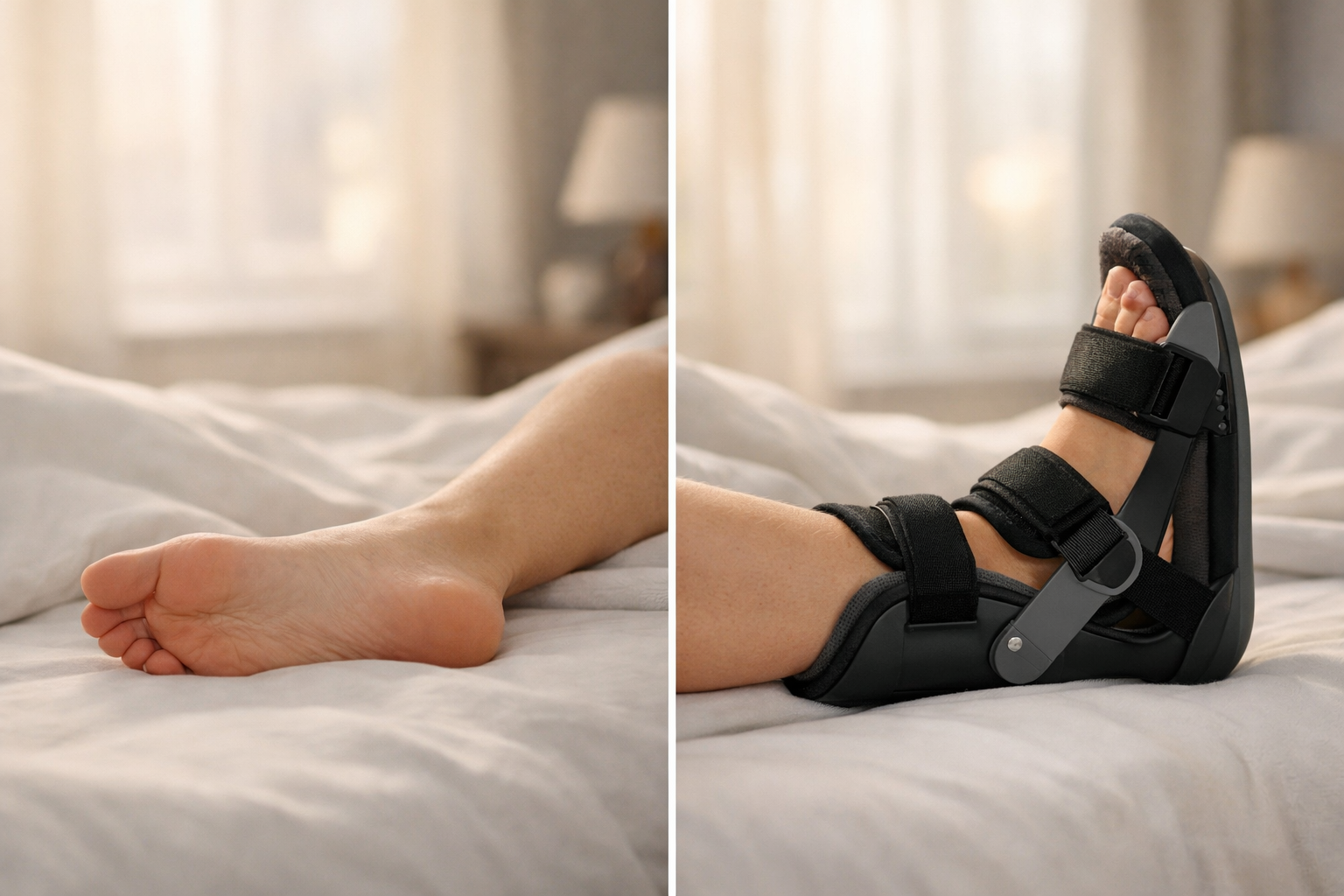
A plantar fasciitis splint (usually called a night splint) holds your ankle at roughly a right angle while you sleep, sometimes with a slight upward pull on the toes. Instead of your foot resting in a pointed position, it stays in a position where the tissue along the bottom of your foot and the calf above it are held at a gentle length.
Two things follow from that.
First, the tissue isn’t spending the whole night fully slackened and then getting yanked to length at 6 a.m. The transition into standing is less abrupt.
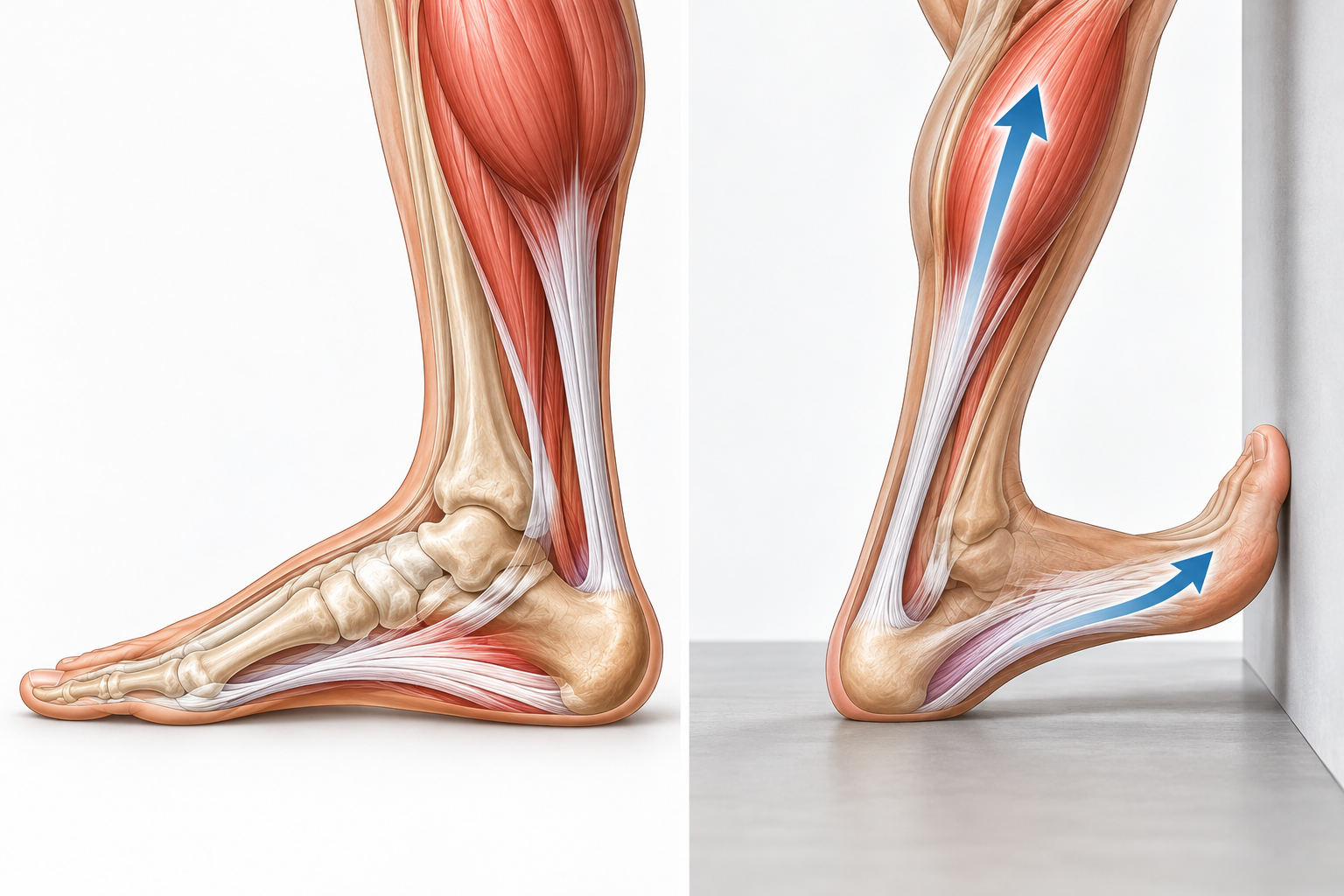
Second, and this matters more than most descriptions let on, your calf gets a long, low-grade stretch. Calf tightness and plantar heel pain travel together constantly. The plantar fascia and the Achilles are functionally connected through the back of the heel. If your calf is short and stiff, your heel takes more of the strain with every step you walk.
So a splint is not doing anything magical to the fascia overnight. It’s managing position, and through position, sensitivity.
Dorsal versus plantar (boot-style) splints

You’ll see two designs.
Boot-style splints wrap the back of the calf and the bottom of the foot, sometimes with a strap that lifts the toes. They tend to hold position more firmly and are adjustable in the amount of stretch.
Dorsal splints sit along the front of the shin and the top of the foot, leaving the bottom of the foot open. They’re lighter and less bulky, and many people find them easier to actually keep on all night.
The better splint is the one you’ll wear. A perfectly engineered boot that ends up on the floor at 2 a.m. does nothing. If you’re choosing between them, weigh comfort heavily.
What about heel splints, cups, and sleeves?
People use “heel splint” loosely, and it can mean a few different products. Compression sleeves and heel cups aren’t really splints at all. They don’t hold your ankle in a position. They provide cushioning, mild compression, or a bit of arch support, and some people genuinely find them comfortable during the day.
Are they good for plantar heel pain? They can take the edge off. They’re comfort tools. They change how the load feels in the moment. They don’t change what your foot can tolerate over weeks and months, so if that’s all you’re doing, symptoms tend to come right back when you push your activity up again. Same category as a supportive shoe or a temporary insert: useful, not curative.
Does a Plantar Fasciitis Splint Work?
This depends entirely on what you’re asking it to do.
For reducing that first-step morning pain, many people do notice a difference, often within the first week or two of consistent use. That’s the outcome night splints are most reasonable to expect.
For making your foot capable of an eight-hour shift on concrete, a 5K, or a day of walking through an airport, a splint on its own won’t get you there. Nothing that happens while you’re asleep and unloaded builds tolerance for load. Tissue adapts to demand. Fascia, tendon, and muscle get stronger and more tolerant because something asked them to be, gradually, over time.
This is the key distinction I’d want you to walk away with. Sensitivity and capacity are not the same thing. Rest, stretching, ice, and a night splint all reduce sensitivity while the tissue isn’t being asked to do much. That’s real relief and it isn’t fake. But it explains a frustrating pattern people describe all the time: things feel better for a couple of weeks, they get back to normal walking or running, and the pain shows up again. The sensitivity went down. What the foot could handle never went up.
So a splint works best as one piece of something larger. It buys you calmer mornings while you do the slower work of building tolerance.
How Long Should You Wear a Plantar Fasciitis Splint?
Two versions of this question: how long each night, and for how many weeks.
Each night. Ideally all night, but most people don’t get there immediately. A reasonable approach is starting with an hour or two in the evening while you’re reading or watching TV, then adding time as it becomes tolerable. If you wake up at 3 a.m. and take it off, that’s still four or five hours of position change. Don’t treat that as failure.
If the splint is set to an aggressive stretch and you wake up with a sore heel, numb toes, or a cramping calf, back the angle off. More stretch is not better. You’re aiming for a mild, sustained lengthening, not a deep stretch you’d wince through for eight hours.
How many weeks. For many people, a few weeks to a couple of months is enough to change the morning pattern noticeably. Some use one intermittently after that, pulling it back out during a busy stretch at work or after a long travel day.
Here’s the more useful way to think about it. Don’t judge the splint by whether your foot still hurts. Judge it by whether your mornings are improving and whether you’re able to keep up with the strengthening and walking that actually rebuild tolerance. If it’s helping you do the work, keep it. If you’ve stopped noticing any difference and you’re sleeping worse because of it, you’ve probably gotten what it had to offer.
A splint that wrecks your sleep is a bad trade. Sleep matters for recovery in ways no brace compensates for.
Is It Better to Walk or Rest With Plantar Fasciitis?
This is the question underneath almost every other one.
Complete rest is not the answer. Two weeks off your feet will usually feel better while you’re off your feet, and then that first day back on them tells you nothing changed. Meanwhile your calf got stiffer, your foot muscles got a little weaker, and the amount of walking your foot can tolerate quietly dropped. Rest equals rust.
Walking isn’t automatically the answer either, at least not the amount you were doing before this started. If you’ve been walking four miles a day and your heel has been screaming for two months, four miles a day is more than your foot can currently handle.
The honest answer is that you want to find the amount your foot tolerates and work from there. That might be a ten-minute walk instead of forty. It might mean breaking a long walk into three short ones. It might mean staying off hard surfaces for a while and keeping supportive shoes on at home instead of going barefoot on tile.
How do you know you found the right amount? Two rough guidelines I use with people, and treat these as general patterns rather than precise rules:
- Discomfort during and shortly after activity stays at a manageable level, somewhere around a 4 out of 10 or below, not something that makes you change how you walk.
- By about 24 hours later, your foot is back to its usual baseline. Not perfect. Just no worse than before.
If both of those hold, that amount of walking is probably fine to repeat, and in a week or two you can add a bit. If your foot is noticeably angrier the next day or the day after, you went past what it was ready for. That’s not damage. It’s feedback. You adjust and go again.
Symptoms often lag a day or two behind the thing that caused them, which is why people blame the wrong activity. It’s rarely the exercises. It’s usually the total of the day: the exercises plus the grocery store plus standing at the stove plus the shoes you wore to the wedding.
What’s the Worst Thing You Can Do?
The two mistakes I see most are opposites.
One is pushing straight through sharp pain because you’ve decided the foot needs toughening up. Running on a heel that’s clearly flaring, day after day, at a pain level that changes your gait, keeps the tissue too irritated to make any progress.
The other, and this is the more common trap, is waiting. Waiting for the pain to be gone before you start strengthening. Waiting for the right insert, the right shoe, the right injection. Waiting is comfortable because it feels responsible. But time alone doesn’t build capacity. Recovery is built.
There’s a version of this specific to splints: wearing one for months as the entire plan. It’ll manage your mornings. It won’t make your foot capable. I’ve talked with plenty of people who’d been diligent with a splint, diligent with stretching, diligent with inserts, and had never once been given a way to progressively ask more of the foot. Maybe the missing piece wasn’t another treatment. It was knowing how to progress.
What Finally Helps Most People
People search for what finally “cured” it, and I understand the impulse, but the honest framing is different. What tends to work is a loading program that’s built up patiently over a couple of months, usually including calf and foot strengthening done slowly and with real resistance, alongside sensible management of how much walking and standing you’re doing day to day.
Early improvements show up faster than you’d expect, often in the first couple of weeks, and those are mostly your nervous system getting better at recruiting muscle and getting less protective. The structural changes in tissue come later. For many people, meaningful tissue-level adaptation takes something in the range of 8 to 12 weeks of consistent work, sometimes longer if this has been going on a long time.
That gap explains the single most common reason plantar heel pain comes back. Pain fades at week three, the exercises stop, and the tissue never got the chance to actually change. Consistency beats intensity here, and it beats it by a wide margin.
If you want the specifics on which exercises are worth your time, we’ve covered that separately in our article on plantar fasciitis exercises for heel pain. This article is about where a splint fits around that work.
What Are the Signs It’s Improving?
Pain going away is the last thing to happen, not the first. Watch for these instead:
- Shorter morning stiffness. Fifteen painful minutes becomes five. Then two. The intensity of that first step may not change much at first, but the duration shrinks.
- Faster recovery after activity. You walk the same distance and your foot settles back down in an hour instead of the rest of the evening.
- Higher ceiling before symptoms start. You used to feel it at ten minutes of standing. Now it’s thirty.
- Fewer flare-ups from ordinary things. Going barefoot to the bathroom, or standing in a line, stops setting you off.
- Smaller flares when they happen. A long day still bothers you, but it’s a 3 instead of a 7, and it’s gone by morning.
Function matters as much as pain. Someone walking twice as far with the same pain score is genuinely better, and if you only track the number, you’ll miss that and conclude nothing is working.
And when a flare does come, which it will, it isn’t a reset to zero. Look at what changed in the last two days. New shoes, a longer walk, a day on your feet at an event, a jump in your exercises. Adjust, let it settle, keep going. The trend over a month tells you far more than any single bad day.
“Stage 4 Plantar Fasciitis”: A Note on Staging
You’ll find articles describing plantar fasciitis in four stages, with stage 4 as the severe, persistent, degenerated end of things. There’s no single universally used staging system for this condition, so take those numbers as descriptive rather than diagnostic. What people generally mean by late-stage is heel pain that’s been around a long time, hurts through most of the day rather than only in the morning, and shows tissue changes on imaging.
Which brings up two things worth clearing up.
Once this has been going on a while, the tissue isn’t really inflamed in the way “itis” implies. The more accurate term is plantar fasciopathy, meaning the tissue itself has changed in structure and quality. That’s why anti-inflammatory approaches often disappoint after the early weeks, and why loading matters so much.
And being long-standing does not mean being permanent. It usually means starting lower and progressing more patiently, not that improvement is off the table. I’ve worked with people who’d had heel pain for two years and got meaningfully better. The timeline was longer. The principles were the same.
On imaging: a thickened plantar fascia on ultrasound reflects tissue that’s been under stress and adapted to it. A heel spur is generally a consequence of long-term stress rather than the source of your pain, and plenty of people have spurs with no symptoms at all. Recovery looks about the same whether you have one or not. A scan can show structural changes, but it doesn’t always tell us why you hurt.
When to Get It Looked At
Most plantar heel pain responds to a sensible loading plan, and a night splint can be a reasonable part of that. But not all heel pain is plantar fasciitis. Nerve irritation, a stress fracture in the heel bone, fat pad problems, Achilles issues, and some inflammatory conditions can all produce pain in the same neighborhood, and they don’t all respond to the same approach.
Worth getting evaluated if:
- The pain came on suddenly with a pop or snap, or you can’t put weight on the foot.
- You have numbness, tingling, or burning that travels into the arch or toes.
- Pain is significant at night or at rest, not just with weight-bearing.
- There’s noticeable swelling, redness, or warmth, or you’re feeling systemically unwell.
- Both heels started hurting around the same time without an obvious reason.
- You’ve been at this for months with no change in the signs above.
An in-person evaluation sorts out what’s actually going on and, more importantly, gives you a starting point for load that matches what your foot can handle today. That’s the part a brace can’t do for you.
If you take one thing from all this: use the splint for what it’s good at. Calmer mornings, a looser calf, a less jarring first step. Then spend your real effort on gradually asking your foot to do more, because that’s the part that changes what tomorrow looks like.