Orthotics for Metatarsalgia: What They Can and Can't Do
A practical look at how orthotics, metatarsal pads, and shoe choices change pressure under the ball of the foot, why offloading alone rarely settles forefoot pain for good, and how to use supports as one part of rebuilding what your foot can handle.
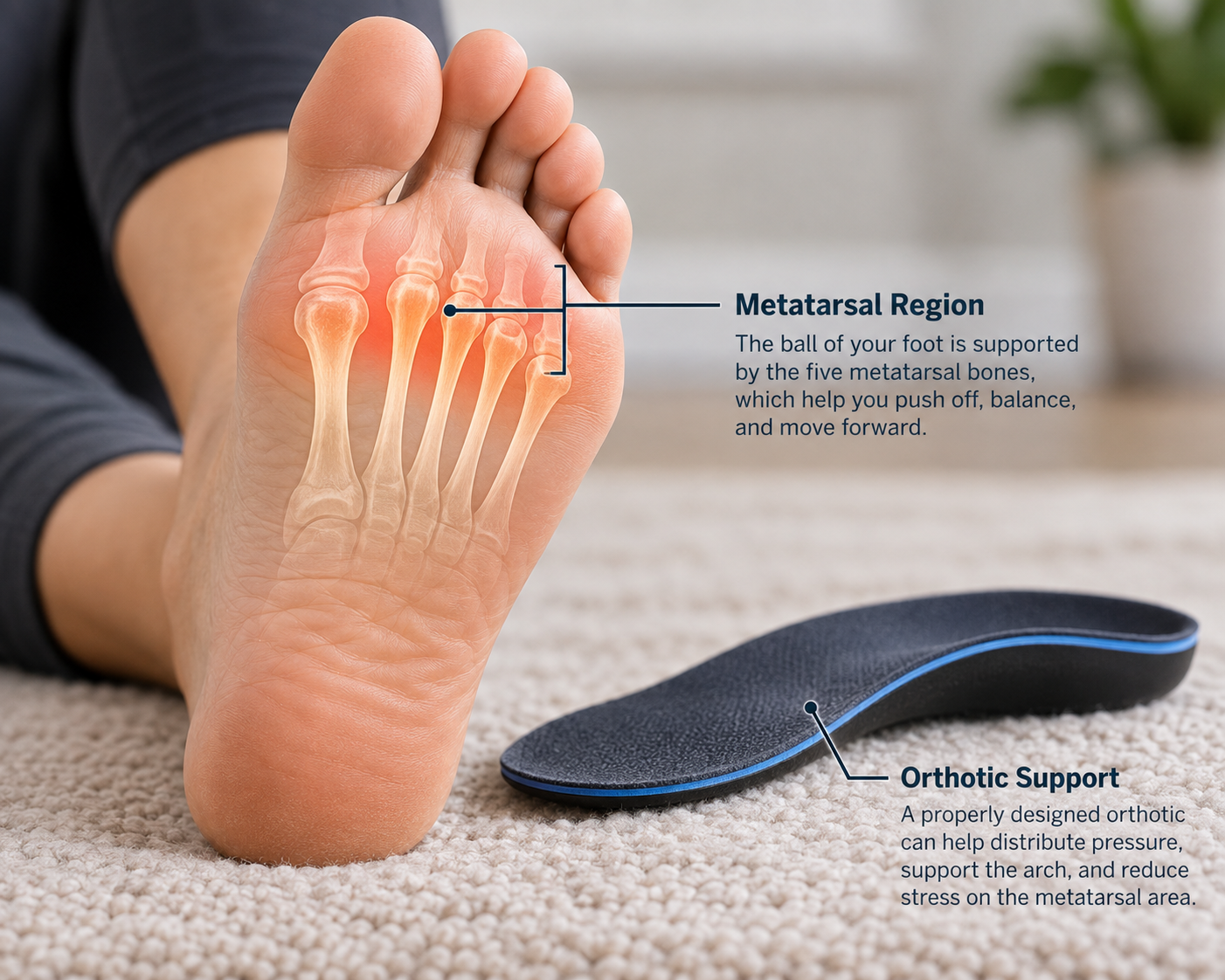
Most people arrive at this question the same way. The ball of your foot burns or aches after you’ve been on it a while. Someone told you to get orthotics. So you did, maybe over the counter, maybe custom, and now you’re standing in your kitchen wondering why you still feel that hot spot under your toes at hour six of the day.
That’s a fair place to be confused. Orthotics for metatarsalgia genuinely help a lot of people. They also get sold as the whole answer, when they’re really one tool that changes one variable. Understanding which variable they change, and which ones they don’t, is the difference between a support that becomes a stepping stone and one that becomes a crutch you never get off of.
So let’s go through what’s actually happening under the ball of your foot, and where a piece of material inside your shoe fits into it.
What an orthotic is actually doing under your forefoot
Strip away the marketing and an orthotic does three practical things.
It redistributes pressure. The ball of your foot isn’t a single surface. It’s five metatarsal heads, and the pressure across them is rarely even. Most forefoot pain lives under the second and third. A well-positioned insert takes some of the load off the spot that hurts and spreads it somewhere that doesn’t.
It changes how your foot moves through a step. Arch support, heel cup depth, and material stiffness all subtly alter timing and how much your forefoot has to do at push-off.
It adds cushioning between a bony foot and a hard floor. Simple, and not nothing, especially on concrete.
Notice what’s missing from that list. None of it makes the tissue under the ball of your foot more capable. An orthotic reduces demand. It doesn’t build capacity. That distinction is the whole article, so hold onto it.
When the load on a structure exceeds what that structure can currently tolerate, you get irritation. You can solve that from two directions: lower the load, or raise the capacity. Orthotics work the first lever, and working it is often exactly right in the beginning, when the area is angry and everything hurts. But if lowering the load is the only thing you ever do, then your foot’s tolerance stays where it is. And the moment life asks for more (a vacation with a lot of walking, a new job on your feet, a return to running), you’re back where you started, looking for a better insole.
Will orthotics help with metatarsalgia?
Often, yes, and sometimes noticeably fast. People with forefoot pain frequently report meaningful relief within days of getting pressure redistributed properly. That’s real, and worth having.
What orthotics help with most:
- Pain during long standing or walking days. If your symptoms are mostly about accumulated time on your feet, taking pressure off the sore metatarsal head buys you hours.
- Symptoms that are clearly pressure-driven. A distinct hot spot, a callus under one metatarsal head, pain that’s worse barefoot on tile and better in a cushioned shoe.
- The irritable early phase. When the area is sensitive enough that normal walking hurts, offloading can bring you down to a level where you can actually start doing productive work.
- Buying time while you rebuild. This is the underrated one. An orthotic that keeps your daily pain lower means you have more room in your budget for the loading that actually changes tissue.
Where orthotics tend to disappoint:
- When the real problem is that your foot’s tolerance dropped (after an injury, a long period of inactivity, an illness) and demand never dropped with it.
- When forefoot pain is coming from something an insole can’t reach: a stress reaction in a metatarsal, nerve irritation, a joint problem at the base of the big toe, inflammatory arthritis.
- When the orthotic is well made but the metatarsal pad is in the wrong place, which is common and fixable.
- When they’re worn in one pair of shoes for eight hours and nothing else about the day changes.
So the honest answer to “will orthotics help” is that they change your symptoms by changing the load, and whether that’s enough depends entirely on whether the load was the only problem.
The metatarsal pad is the part most people get wrong
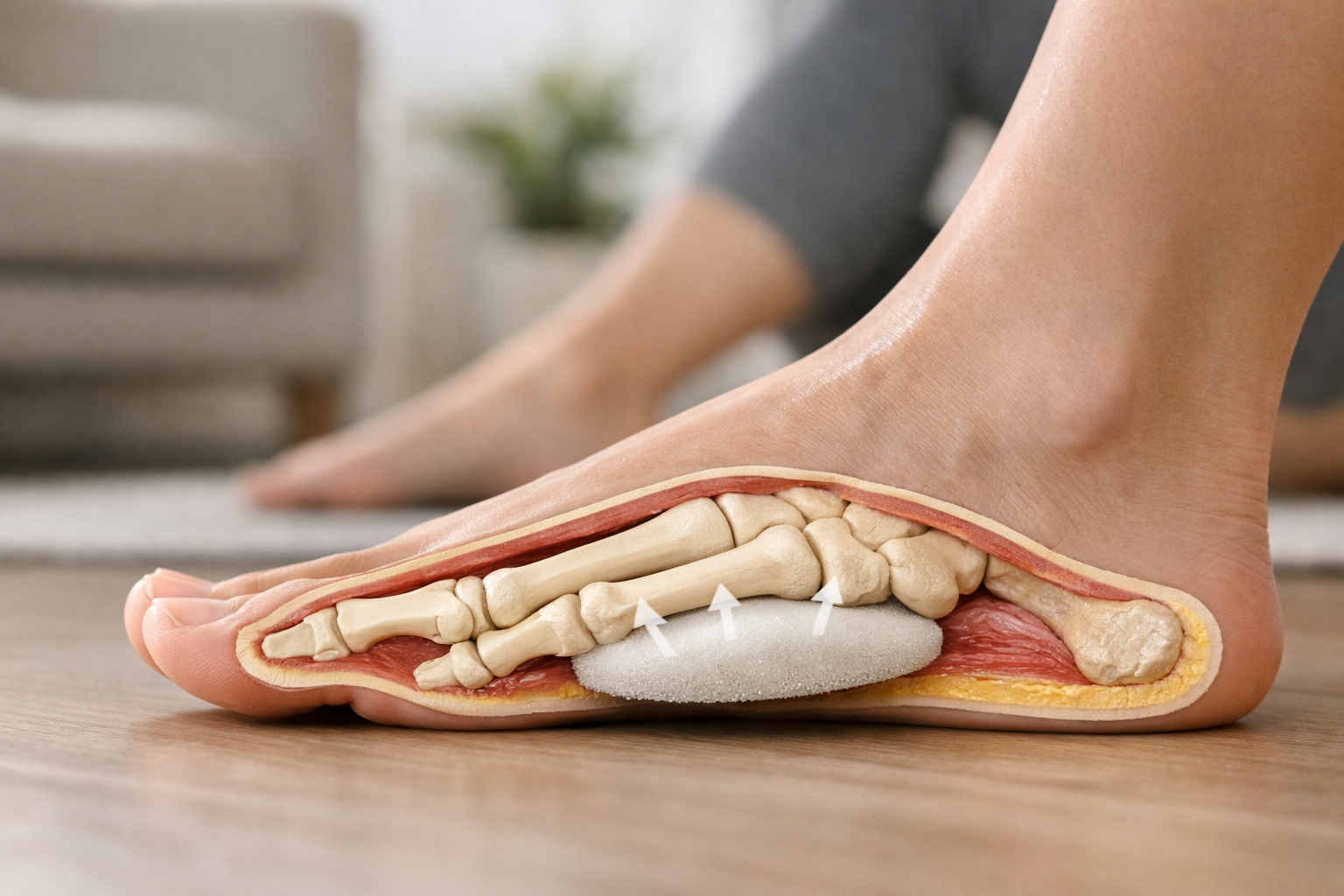
If there’s one specific thing worth knowing about orthotics for metatarsalgia, it’s this: the placement of the metatarsal pad matters more than almost any other feature, and it is frequently off.
A met pad is a small dome of firm material. Its job is to sit just behind the metatarsal heads, on the shafts of the bones, so it lifts and spreads them and takes pressure off the heads themselves. That’s it. That’s the whole mechanism.
Put it directly under the painful spot and you’ve built a bump under the exact place that already hurts. People do this constantly, because intuition says put the cushion where the pain is. Then they conclude met pads don’t work for them.
A few practical notes:
- Correct position is usually a bit further back than feels natural, roughly a finger’s width behind the sore area. You should feel it against the arch side of the ball of your foot, not underneath the tender point.
- Stick-on pads are useful precisely because you can peel and reposition. Move it a few millimeters at a time across several days and pay attention.
- Right placement often feels slightly odd for a day or two and then noticeably better. Wrong placement feels worse immediately or creates a new sore spot.
- Firm works better than squishy. A pad that compresses flat under your body weight isn’t redistributing anything.
If you have a custom orthotic that didn’t help, this is worth revisiting with whoever made it before concluding the whole approach failed. A device built well but positioned a centimeter off is a solvable problem, not a dead end.
Custom or over the counter?
The expensive answer isn’t automatically the better one.
Over-the-counter inserts with a decent arch and a repositionable met pad handle a lot of straightforward forefoot pain well. They’re cheap enough to experiment with, which matters, because finding out what your foot responds to involves some trial and error. If the first pair feels wrong, you’ve learned something without much cost.
Custom devices earn their keep when the foot itself is unusual or the situation is complicated: a significant deformity, a very high or very rigid arch, a foot after surgery or fracture, diabetes with any loss of sensation, an old midfoot injury that changed the shape of the arch, or a stubborn case where off-the-shelf options have genuinely been tried and adjusted. In those situations you want something shaped to your foot with specific offloading built in.
A few features that matter more than the custom-versus-not question:
- Full length versus three-quarter. For forefoot pain you generally want the insert to extend under the ball of your foot, so the met pad can sit where it needs to and the transition doesn’t create an edge right at the sore area.
- Arch height that fits your arch. A support that’s too high pushes your foot laterally and can load the outer metatarsals harder. Too low and it isn’t doing much.
- Stiffness. Soft feels good in the store. Firm tends to control pressure better over a long day. Many people do best with a firm shell and a thin cushioned top layer.
- Thickness and shoe fit. A thick insert in a shoe with a snug toe box crowds the forefoot and can undo the benefit. This trips people up more than they realize.
What type of shoe is best for metatarsalgia?
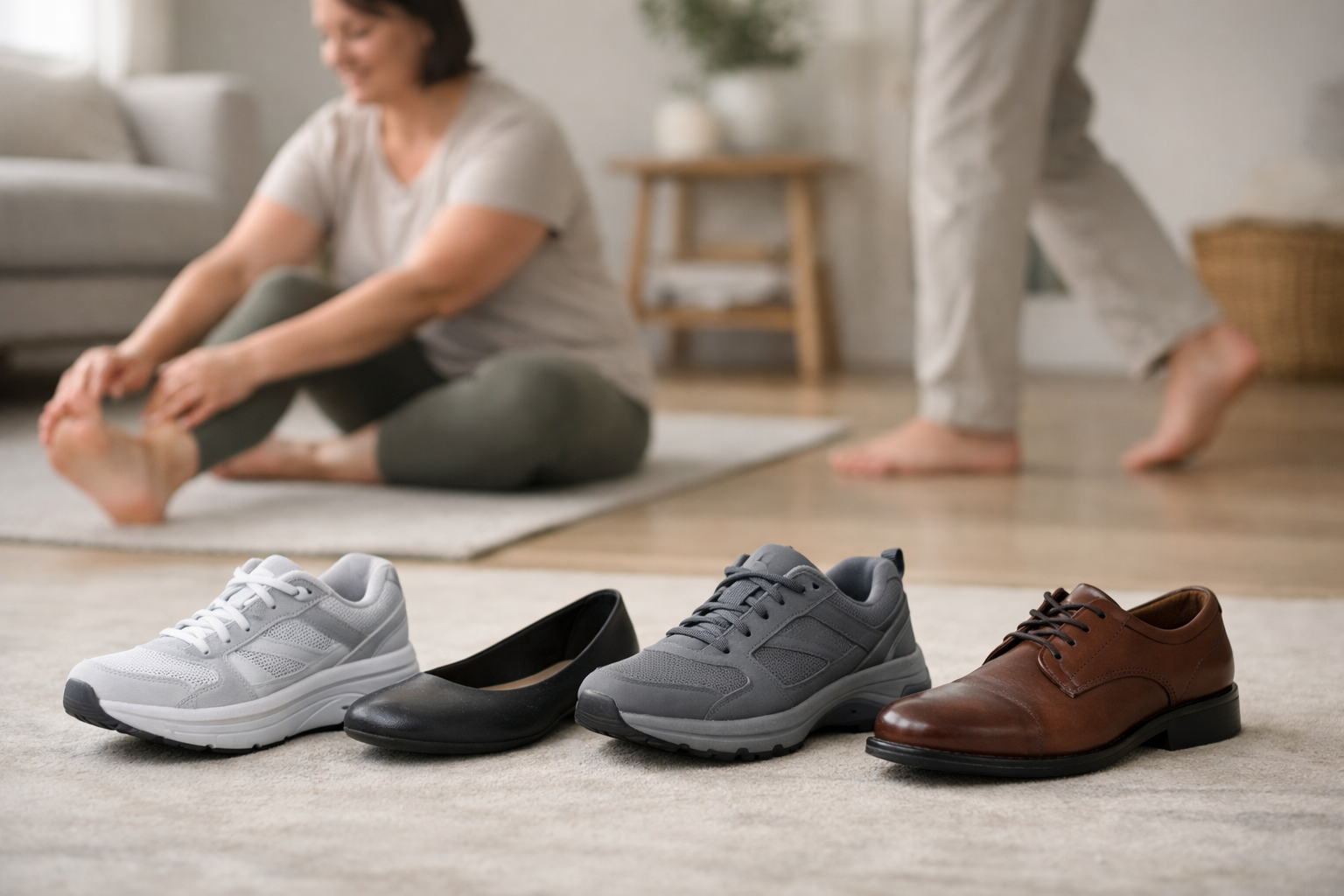
The shoe often matters as much as what you put inside it. Three features do most of the work.
A wide enough toe box. If the front of the shoe squeezes your foot from the sides, the metatarsal heads get compressed together and pressure goes up. Take your insole out and stand on it. If your foot spills over the edges, the shoe is too narrow for your foot, regardless of the size label.
A stiffer forefoot. Shoes that bend easily in the middle of the ball of your foot ask your metatarsals to flex and load at exactly the sore point. A stiffer sole through the forefoot shares that work with the shoe. This is one of the most reliably helpful changes for ball-of-foot pain, and it costs nothing to test by trying to bend a shoe with your hands before buying it.
Some rocker shape. A sole that curves up at the front lets you roll through the step instead of pushing off hard through the forefoot. Combined with a stiff sole, a rocker meaningfully reduces what the ball of your foot has to tolerate at toe-off.
A modest heel, not zero and not high. High heels transfer a large share of body weight straight onto the forefoot. Completely flat, thin, flexible shoes give the forefoot no help at all. Something in between usually feels best while things are sensitive.
Are Hokas good for metatarsalgia? And what are the downsides?
Hoka gets asked about constantly, and the reason is straightforward. Many of their models combine thick cushioning with a stiff sole and a pronounced rocker, which is close to the exact recipe that reduces forefoot pressure. Plenty of people with ball-of-foot pain find them comfortable right away. That’s a legitimate mechanical reason, not a marketing story.
The downsides are worth knowing too, and they’re mostly about change rather than defect:
- A rocker changes your gait. Your ankle, calf, and Achilles work differently in a rocker shoe. Switch suddenly, wear them all day, and you can trade forefoot pain for calf tightness or Achilles irritation. Ease into them.
- A tall, soft midsole reduces stability for some people. If you have a history of ankle sprains or you feel wobbly in them, that matters.
- Sizing and toe box vary a lot by model. Some run narrow through the forefoot, which works against you.
- You feel the ground less. Some people walk and run less precisely when they can’t sense the surface.
- The cushioning compresses over time. A pair that felt great at month one may not be doing the same job at month ten.
And the broader caution: a shoe that makes your foot’s job easier is useful when things are irritated, and can quietly become the only reason you’re comfortable. If you can’t walk across your bedroom in the morning without them, that’s information about your foot’s current tolerance, not proof that you need better shoes.
Are Skechers good for metatarsalgia?
Depends heavily on which ones. Skechers makes a lot of very different shoes.
The models with a firmer midsole, a roomy toe box, and a removable insole can work well, particularly because being able to pull the stock insole out means you can fit a proper support with a met pad. The plush memory-foam slip-ons are a different story. They feel wonderful for the first ten steps. The foam then compresses under the ball of your foot, the sole is often quite flexible, and the heel counter is soft, so your foot slides forward and the forefoot takes more than it should over a long day.
The test isn’t the brand. Bend the shoe. Look at the toe box. Check whether the insole comes out. Then wear it for a real day and see what your foot says.
What shoes do foot clinicians wish people would wear less of?
Not a moral judgment, just a load conversation. The usual suspects concentrate force on the forefoot or leave it unsupported:
- Thin, flexible flats and ballet shoes. Essentially a sock with a sole. No forefoot support, no cushioning, and they fold in half.
- Narrow, pointed dress shoes. They squeeze the metatarsals together and often pitch you forward.
- High heels for full days. Fine in small doses for most people. A problem when they’re the standing-all-day shoe.
- Flip-flops as primary footwear. Your toes have to grip to keep them on, which loads the forefoot with every step.
- Worn-out trainers. Once the sole has compressed and the upper has stretched, the shoe isn’t doing what you bought it for.
- Completely unstructured minimal shoes adopted overnight. Minimal footwear isn’t inherently bad. Going from cushioned shoes to zero-drop with no transition is a big jump in forefoot demand, and the forefoot is usually where that shows up.
None of these need to be thrown away. It’s about proportion. An hour in dress shoes at an event is different from eight hours on a trade show floor.
Should you walk if you have metatarsalgia?
Yes, in an amount your foot can handle right now. That last part is the whole instruction.
Complete rest is tempting because it works, briefly. Take load off an irritated area and it calms down. The problem is that unloaded tissue doesn’t get stronger, it gets less tolerant. So you rest for three weeks, feel better, go back to your normal walking, and the pain returns within a day or two. It wasn’t that the walking was wrong. It’s that your foot’s tolerance quietly dropped while you waited, and the demand you returned to hadn’t changed. Rest equals rust.
A more useful way to think about walking:
- Find the amount that leaves you at or below roughly a 4 out of 10, during and after. Not zero. Uncomfortable but manageable, and not escalating as you go.
- Check in about a day later. For many people, whether a given amount of walking was reasonable shows up around the 24-hour mark, not in the moment. If you’re back to your usual baseline by the next day, that amount was fine. If you’re noticeably worse for two or three days, it was too much for now.
- Change one thing at a time. More distance or faster pace or different shoes, not all three in the same week.
- Break it up. Three 15-minute walks are usually better tolerated than one 45-minute walk while the forefoot is sensitive.
- Count the whole day. Grocery shopping, the office, cooking dinner, the airport. Your foot doesn’t distinguish between exercise steps and life steps. A flare after a walk was often really about the walk plus everything else that day.
If you find you genuinely cannot walk on it, or the pain is sharp and localized to one bone and worse with each passing day, that’s a different conversation. Get it looked at.
What’s the fastest way to resolve metatarsalgia?
I understand why people ask this, and I’d rather answer it honestly than tell you what you want to hear. There’s no shortcut that makes irritated tissue tolerant of load faster than it can adapt. But some approaches get there considerably faster than others, and a few reliably slow you down.
What tends to move fastest:
- Take pressure off the sore spot immediately. Met pad placed correctly, shoe with a stiff forefoot and a roomy toe box, insert that fits. This is the day-one change, and it’s where orthotics earn their place.
- Reduce the spike, don’t eliminate activity. Cut back to the amount that keeps you around or below that 4 out of 10 and keeps you recovered by the next day. Stay active at that level.
- Start loading the foot on purpose, early. Calf and foot strengthening, work through the toes and the arch, then gradually more demanding positions. This is the part that changes tissue rather than sensitivity, and it’s the part most commonly skipped.
- Increase gradually and stay at each step long enough to adapt. Meaningful tissue change typically takes something in the range of 8 to 12 weeks, sometimes longer if the problem has been around a while. Early improvement in the first couple of weeks is mostly your nervous system adjusting, which feels great but isn’t the same as a stronger foot.
- Keep going past the point where it stops hurting. This is where recurrences come from. Pain resolves before capacity catches up. If you stop the week the pain goes away, you’ve stopped roughly halfway.
What slows people down: waiting for pain to hit zero before loading anything, resting completely for weeks, changing five variables at once and losing track of what helped, and treating every flare as proof that the plan failed.
On that last point. You will probably have a bad week somewhere in this. A long travel day, a concrete floor, a shoe that didn’t work out. Symptoms go up. That doesn’t erase what you built. Look at what changed, pull back a notch, and keep the overall trend in view. Recovery isn’t a straight line, and function matters as much as the pain number: standing longer, walking farther, recovering faster afterward all count as progress even when some discomfort is still present.
Getting off the orthotic, or not
A question people are sometimes embarrassed to ask: do I have to wear these forever?
Sometimes the honest answer is yes, and that’s fine. If your foot has a structural feature that concentrates pressure under one metatarsal head, or you work twelve-hour shifts on concrete, a support may just be part of your equipment, the same way glasses are. No shame in that.
But for many people, the orthotic was a way to lower demand while they rebuilt tolerance. As the foot becomes more capable, it needs less help. That transition should be gradual and guided by how your foot responds: shorter days without it first, then longer, then more demanding activity. If you come out of the insert and symptoms return immediately, that’s not failure. It tells you the capacity isn’t there yet, and that the strengthening work still has somewhere to go.
What I’d want you to avoid is the version where the support becomes the entire plan. Offloading is a good beginning. It’s a poor destination.
One more thing worth ruling out
Not all pain in the ball of the foot is metatarsalgia, and the distinction changes what helps. Nerve irritation between the metatarsals produces a different quality of symptom, often burning, electrical, or a sense of a pebble under the foot. A stress reaction in a metatarsal bone tends to be sharply localized, sore to press directly on, and progressively worse rather than steady. Joint problems at the base of the big toe, inflammatory conditions, and fat pad thinning all show up in the same neighborhood and respond to different things.
These patterns can look alike from the outside, which is why persistent forefoot pain is worth having examined in person rather than solved by buying a fourth pair of insoles. If your pain is severe, getting worse week over week, involves numbness or significant swelling, or followed a specific injury, see a clinician sooner rather than later. If you have diabetes or reduced sensation in your feet, any new pressure point or callus deserves prompt attention.
And if you want to understand the forefoot problem itself more deeply, including what else can cause it and why it sometimes shows up on only one side, our article on pain in the ball of the foot covers that ground.
The insert under your foot changes what today asks of you. What you do over the next couple of months changes what your foot can handle a year from now. Both are worth doing. They’re just doing different jobs.