Ball of Foot Pain: Causes, Symptoms, and Treatment Options
A practical breakdown of what causes pain in the ball of the foot, how metatarsalgia differs from other forefoot problems, and how to rebuild the area's tolerance for standing, walking, and activity.
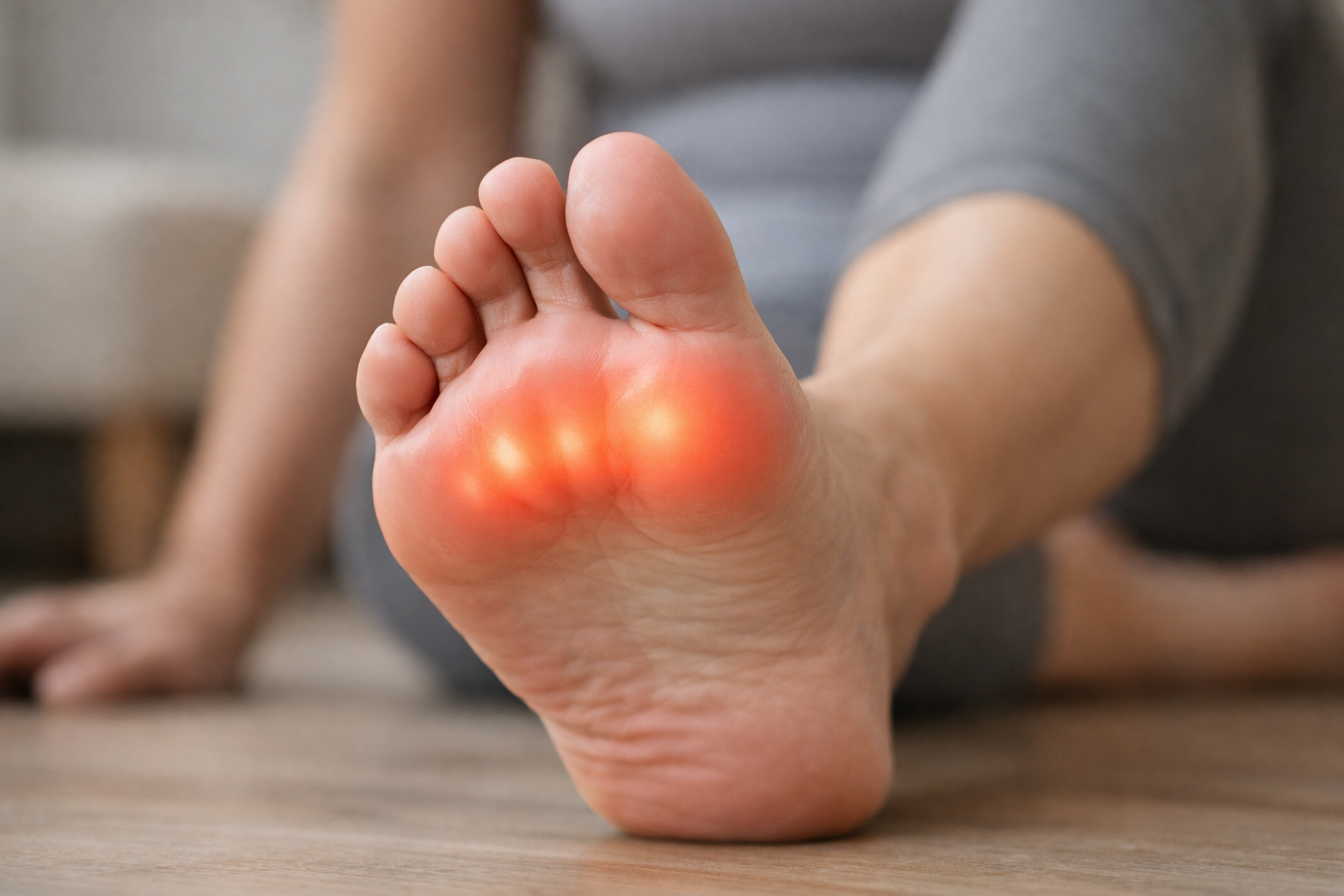
Pain under the ball of the foot, the padded area just behind your toes, is one of the more common forefoot complaints we see. It’s often lumped under one label, metatarsalgia, but that word describes a location and a symptom pattern more than a single diagnosis. Several different problems can produce pain in that spot, and figuring out which one you’re dealing with matters for how you treat it.
What Pain in the Ball of the Foot Usually Indicates
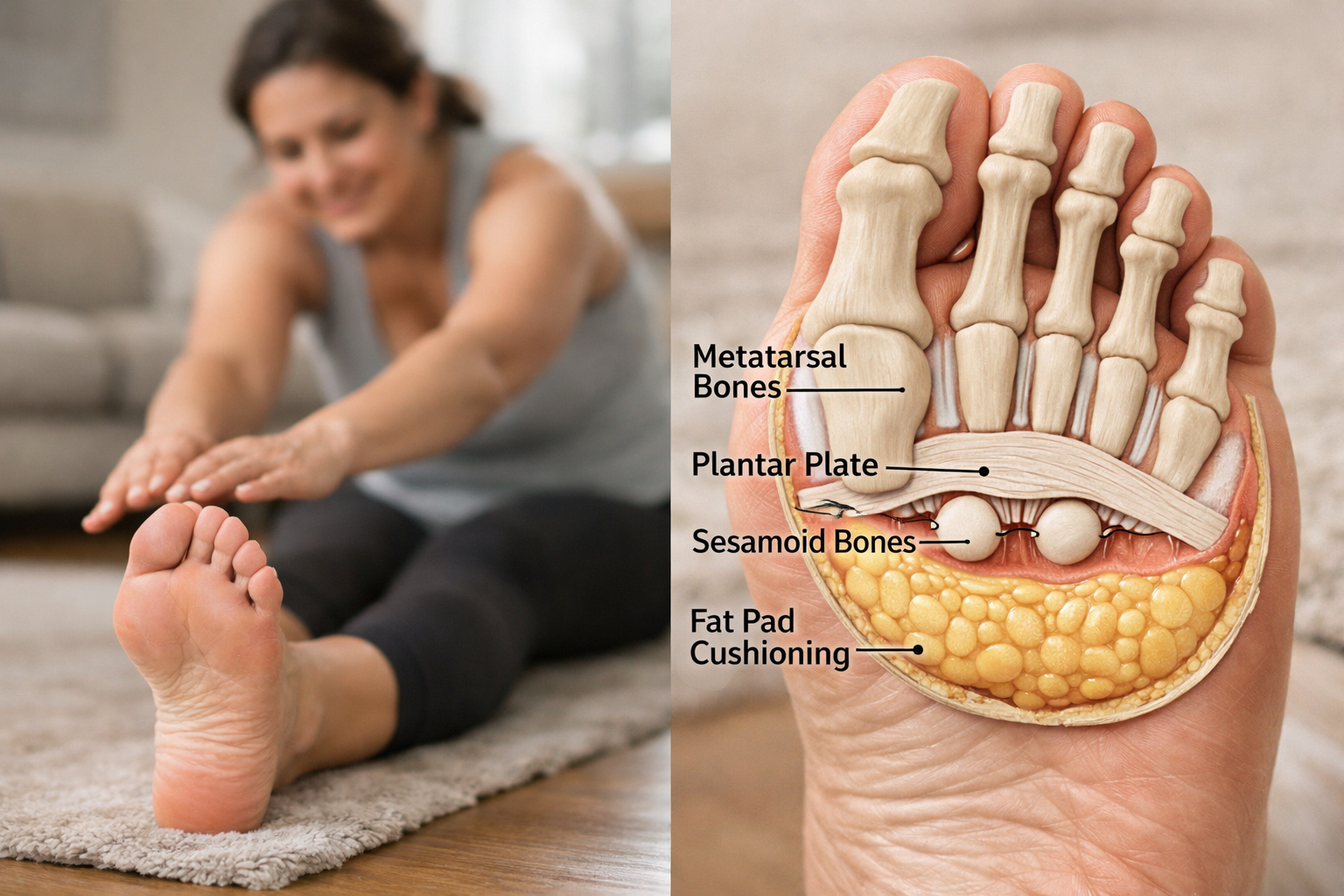
The ball of the foot bears a large share of your body weight every time you push off during walking or running. That area includes the heads of the metatarsal bones, the joints where your toes meet the rest of the foot, small stabilizing structures called the plantar plates, and the fat pad that cushions all of it.
When pain shows up here, it generally means the tissue in that region is being asked to tolerate more load than it currently can handle. That’s not a diagnosis by itself, it’s a mechanism. The actual source could be a joint, a nerve, a ligament, or the bone itself, and each has a somewhat different treatment path.
Common contributors include:
- Metatarsalgia in the general sense: inflammation and irritation around one or more metatarsal heads, often from repetitive impact or uneven weight distribution across the forefoot.
- Plantar plate strain or tear: the small ligament under the second (sometimes third) toe joint gets overloaded, which can feel like you’re walking on a marble or a bunched-up sock.
- Morton’s neuroma: irritation of a nerve between the metatarsal heads, often the third and fourth, producing burning, tingling, or numbness in addition to pain.
- Sesamoiditis: irritation of the two small sesamoid bones under the big toe joint, more common in runners and dancers.
- Fat pad atrophy: the natural cushioning under the metatarsal heads thins with age or with certain foot shapes, leaving bone closer to the surface.
- Stress reaction or stress fracture: a gradual overload injury in one of the metatarsal bones, usually tied to a fairly sharp increase in impact activity.
- Structural factors: a high arch, a long second metatarsal, bunions, or hammertoes can all shift more pressure onto the forefoot than it’s built to absorb long term.
The Load Versus Capacity Problem in the Forefoot
The same principle that governs most overuse foot problems applies here. Pain develops when the demand you’re placing on a tissue exceeds its current capacity to tolerate that demand. Capacity isn’t the same as strength. It’s a specific tissue’s ability to absorb a specific kind of repeated stress, whether that’s the impact of running, hours of standing on hard floors, or a new pair of shoes with a stiffer sole.
Most people don’t develop ball-of-foot pain from one bad step. It builds gradually: a change in footwear, a jump in mileage, a new job that has you on your feet all day, or simply months of walking on a foot shape that concentrates pressure over one or two metatarsal heads. The tissue in that region didn’t have the chance to adapt to the new demand, so it got irritated instead.
This reframes the question from “what’s wrong with my foot” to “what changed, and what does this area need in order to tolerate that again.” Sometimes the answer is a shoe change. Sometimes it’s rebuilding tolerance gradually after a period of reduced activity. Rarely is it a single fix.
Why Does the Ball of Only One Foot Hurt?
Unilateral pain, meaning it’s only in one foot, is actually the more typical pattern, and it usually points toward a mechanical or structural cause rather than a systemic one. A few reasons one foot takes more of the load:
- Leg length differences or asymmetric gait, even minor ones, shift more weight to one side over the course of a day.
- A specific structural quirk in that foot, like a slightly longer second metatarsal or a more prominent bunion, concentrates pressure differently than the other foot.
- Uneven footwear wear or an old injury on one side that changed how you walk without you fully noticing.
- Occupational habits, like standing with more weight on one leg, using a clutch pedal, or favoring a stance during work tasks.
If both feet hurt, or if the pain came on suddenly and severely without a clear trigger, that’s worth mentioning to a clinician, since it can occasionally point toward an inflammatory or systemic issue rather than a local mechanical one. That’s the exception, not the rule.
What Can Be Mistaken for Metatarsalgia
A handful of conditions overlap enough in location that people (and sometimes early self-diagnosis) confuse them with metatarsalgia:
- Plantar fasciitis, or more precisely plantar fasciopathy, usually causes pain closer to the heel and arch, though some referred discomfort can extend forward. If your pain is centered more toward the heel and worse with the first steps in the morning, that’s a different pattern.
- Morton’s neuroma produces more burning, tingling, or a sense of a foreign object under the foot, rather than the dull ache or bruised feeling typical of straightforward metatarsal head irritation.
- Gout, particularly at the big toe joint, can flare suddenly with intense redness, heat, and swelling, quite different from the gradual buildup typical of overuse metatarsalgia.
- Stress fractures tend to produce pain that’s more localized to one specific bone, often worse with impact and sometimes present even at rest once it progresses.
- Freiberg’s disease, a less common condition affecting blood supply to a metatarsal head (usually the second), shows up more often in younger, active people and needs imaging to sort out.
- Tarsal tunnel syndrome can refer pain and tingling into the forefoot from a compressed nerve higher up near the ankle.
This is exactly the kind of overlapping symptom picture where a hands-on evaluation earns its keep. A clinician can check which joints reproduce your pain, test for nerve involvement, and screen for the structural factors that predispose one foot to overload.
Will Ball of Foot Pain Go Away on Its Own?
Sometimes, especially if the trigger was temporary. A rougher week of standing, a single long hike in worn-out shoes, or a brief increase in running volume can cause a self-limited flare that settles once the trigger is removed and the tissue calms down.
But for many people, especially when there’s an underlying structural contributor like a bunion, a long second metatarsal, or a job that keeps them on hard floors all day, the pain becomes a recurring pattern. It quiets down for a while, then flares again with the next demanding stretch. That pattern usually means the tissue’s capacity hasn’t actually improved, even though the symptoms went quiet for a bit. Reducing sensitivity and rebuilding capacity are two different jobs, and only one of them prevents the pain from coming back.
Ignoring persistent forefoot pain also carries a practical risk: you tend to compensate by walking differently, which can load other structures (the arch, the ankle, even the opposite foot) in ways they weren’t built to handle either.
How Do I Get Rid of Ball Pain in My Foot?
There’s no single fix that works for everyone, because the underlying cause varies. But the general approach follows a consistent logic: reduce the load enough to calm the acute irritation, then rebuild the tissue’s tolerance so the same activities don’t keep re-triggering it.
In the short term:
- Cut back on, rather than eliminate, the aggravating activity. Complete rest calms symptoms temporarily but doesn’t build capacity, and pain often returns as soon as you resume normal activity.
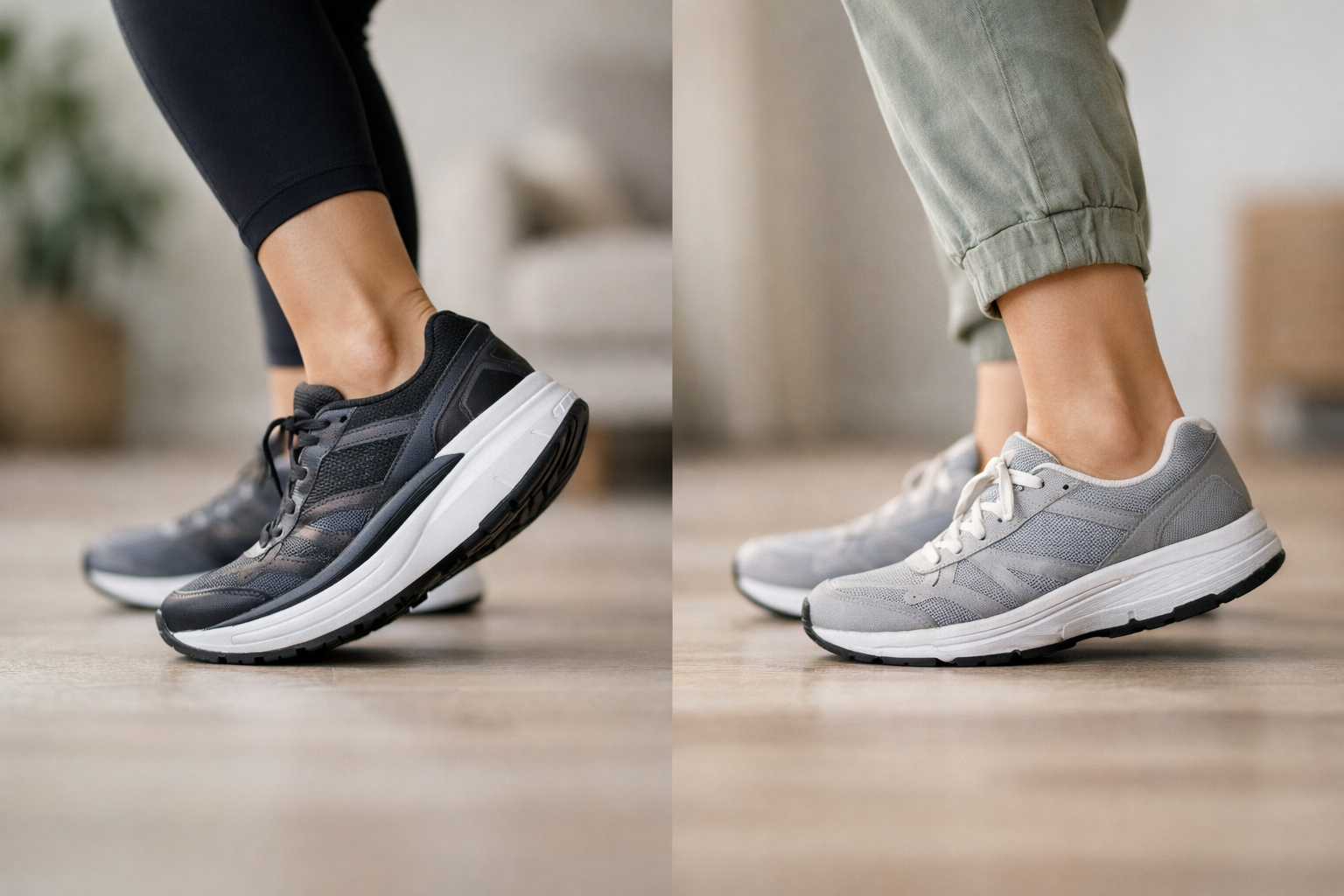
- Try a shoe with a slightly firmer, more supportive sole and adequate toe box room. Stiff-soled shoes or a rocker-bottom design can reduce the bending forces through the metatarsal heads during push-off.
- A metatarsal pad, placed just behind the painful area rather than directly under it, can redistribute pressure away from the irritated joint or bone.
- Ice and over-the-counter anti-inflammatories can help take the edge off during a flare, used as a short-term tool rather than a long-term plan.
Over the medium term:
- Gradually reintroduce the activities that were aggravating things, in smaller doses, and let the tissue adapt. A common working guideline is to keep discomfort at or below roughly a 4 out of 10 during and after activity, and to expect any next-day soreness to settle within about 24 hours before advancing further. These are general patterns we watch for clinically, not guarantees, and they’ll vary somewhat by individual.
- Work on the intrinsic muscles of the foot and toe strength, which help share the load across the forefoot rather than concentrating it on one or two metatarsal heads.
- Address footwear as an ongoing load-management tool, not a one-time purchase. Rotating shoes, replacing worn-out cushioning, and matching shoe stiffness to your activity all matter over time.
- Give it real time. Meaningful tissue adaptation in overuse forefoot problems often takes somewhere in the range of 8 to 12 weeks of consistent, progressive loading, not days.
Custom or over-the-counter orthotics with a metatarsal support built in can help some people redistribute pressure while the area heals, and they’re a reasonable tool, not a crutch you’ll need forever. The goal over time is usually to build enough capacity in the foot that you rely on the orthotic less, not to become permanently dependent on it.
If a structural issue like a significant bunion, hammertoe, or long second metatarsal is driving repeated overload, footwear and load management may only get you so far, and that’s a conversation worth having with a foot and ankle specialist about whether further intervention makes sense for your situation.
When to See a Clinician
Most ball-of-foot pain responds to sensible load management over a matter of weeks. But get it checked sooner if you notice sudden, severe pain after an injury, visible swelling or deformity, numbness that doesn’t resolve, pain at rest that wakes you at night, or symptoms that keep getting worse despite backing off activity. Those patterns deserve a hands-on evaluation to rule out a fracture, nerve entrapment, or another condition that needs a different approach than the usual gradual reloading plan.