Is Walking Good for Plantar Fasciitis? What You Need to Know
Walking isn't automatically helpful or harmful with plantar fasciitis, it depends on how much, how fast, on what surface, and how your foot responds afterward. Here's how to figure out your own walking dose and build it back up without repeatedly flaring things.

Most people asking whether walking is good for plantar fasciitis have already noticed something strange: it depends on the day. Some mornings the first few hundred steps hurt and then the foot loosens up and walking feels almost normal. Other days a trip through a grocery store leaves you limping by evening, or fine that evening and sore the next morning.
That inconsistency is the most useful clue you have. It tells you walking isn’t the problem on its own. The amount, the pace, the surface, and everything else your feet did that day all stack together. So the honest answer to “is walking good for plantar fasciitis” is that walking is one of the better things you can do, right up until it’s more than your foot can currently handle. The work is figuring out where that line sits for you, and then moving it.
Why walking often feels good at first, then catches up with you
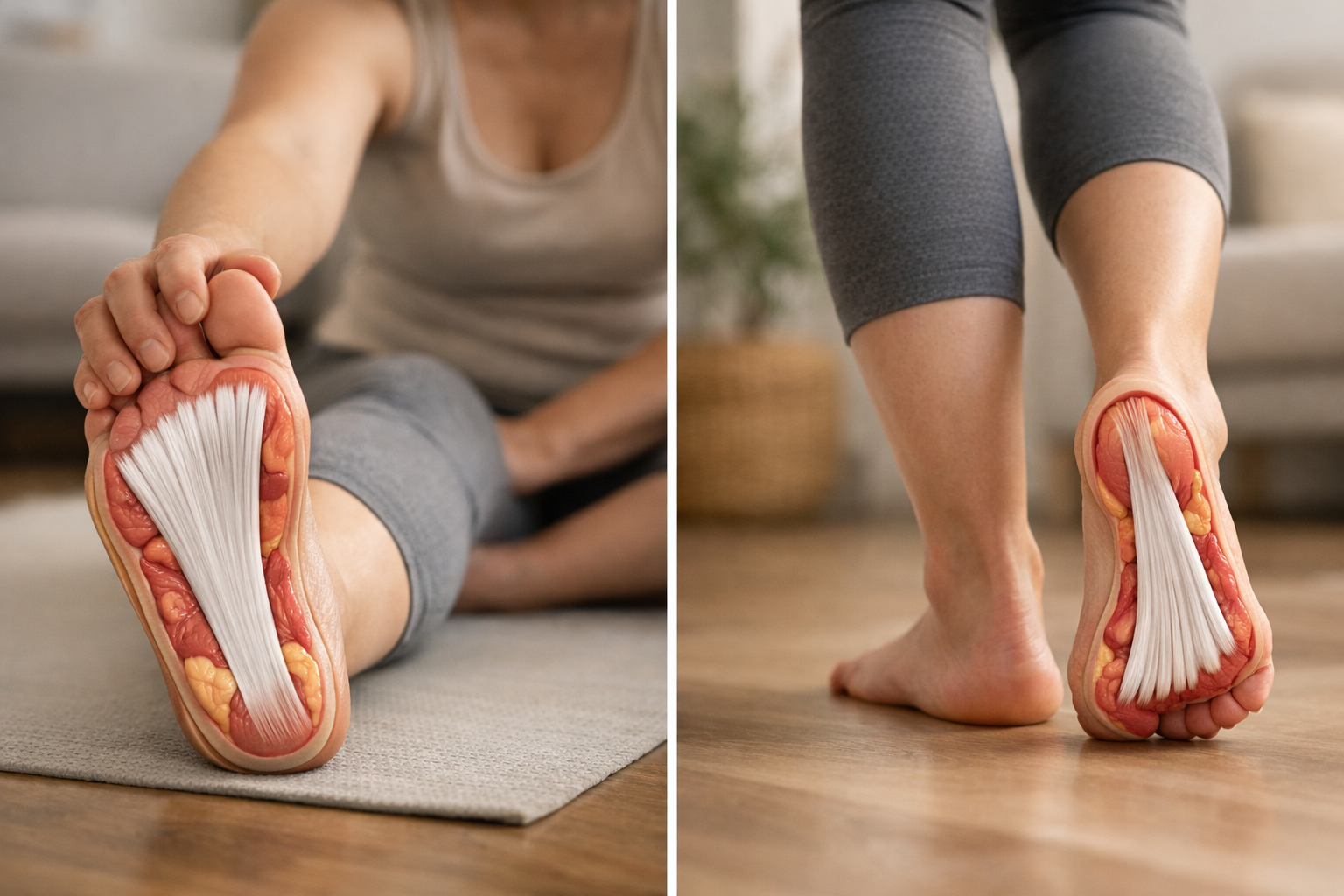
The plantar fascia is a thick band of connective tissue running along the bottom of your foot, from the heel to the base of the toes. Every step loads it. It stretches slightly, stores energy, and gives it back as you push off. It’s built for exactly this. That’s the point.
When you first stand up, the tissue has been sitting still for hours and it’s stiff and sensitive. Moving warms it up and the sensitivity drops. That’s why those first steps are the worst ones and things ease after a few minutes. It feels like walking is helping, and in a sense it is.
But ease is not the same as capacity. If the tissue can comfortably handle, say, twenty minutes of continuous walking right now, and you take advantage of the warmed-up feeling to do fifty, you’ve gone past the point where the foot could recover cleanly. You often won’t feel that at minute thirty. You’ll feel it that night, or the next morning, when the first-step pain is noticeably sharper than it was yesterday.
This lag is where most people get confused. They think the flare came from nowhere. It usually didn’t. It came from the day before.
How much walking should I do with plantar fasciitis?
There’s no universal number, and anyone who gives you one without examining your foot is guessing. But there is a way to find your own.
Start with what you already know. Think back over the last couple of weeks. Roughly how much walking left your foot about the same the next morning? That’s your current working amount. Not your goal, not what you used to do. What your foot has been tolerating.
From there, two guidelines I use with most people:
Keep pain during the walk at or below about a 4 out of 10. Some discomfort is acceptable and often unavoidable early on. Pain that makes you change how you walk, or that climbs steadily as you go, is past the useful range. A limp is a signal, not a strategy.
Judge by the next 24 hours, not by how you feel mid-walk. If your symptoms settle back to your normal baseline within about a day, the amount was reasonable. If you’re still noticeably worse two days later, it was too much, or too much on top of everything else you did.
That second window is the more important of the two. Plenty of walks feel fine in the moment and tell the truth later.
Once you’ve found an amount your foot handles reliably, hold it for several days before you add. Then add in small increments. Ten percent more, or an extra five minutes, is not dramatic, and that’s the idea. The foot adapts to repetition it can absorb, not to single heroic efforts.
Broken up beats all at once
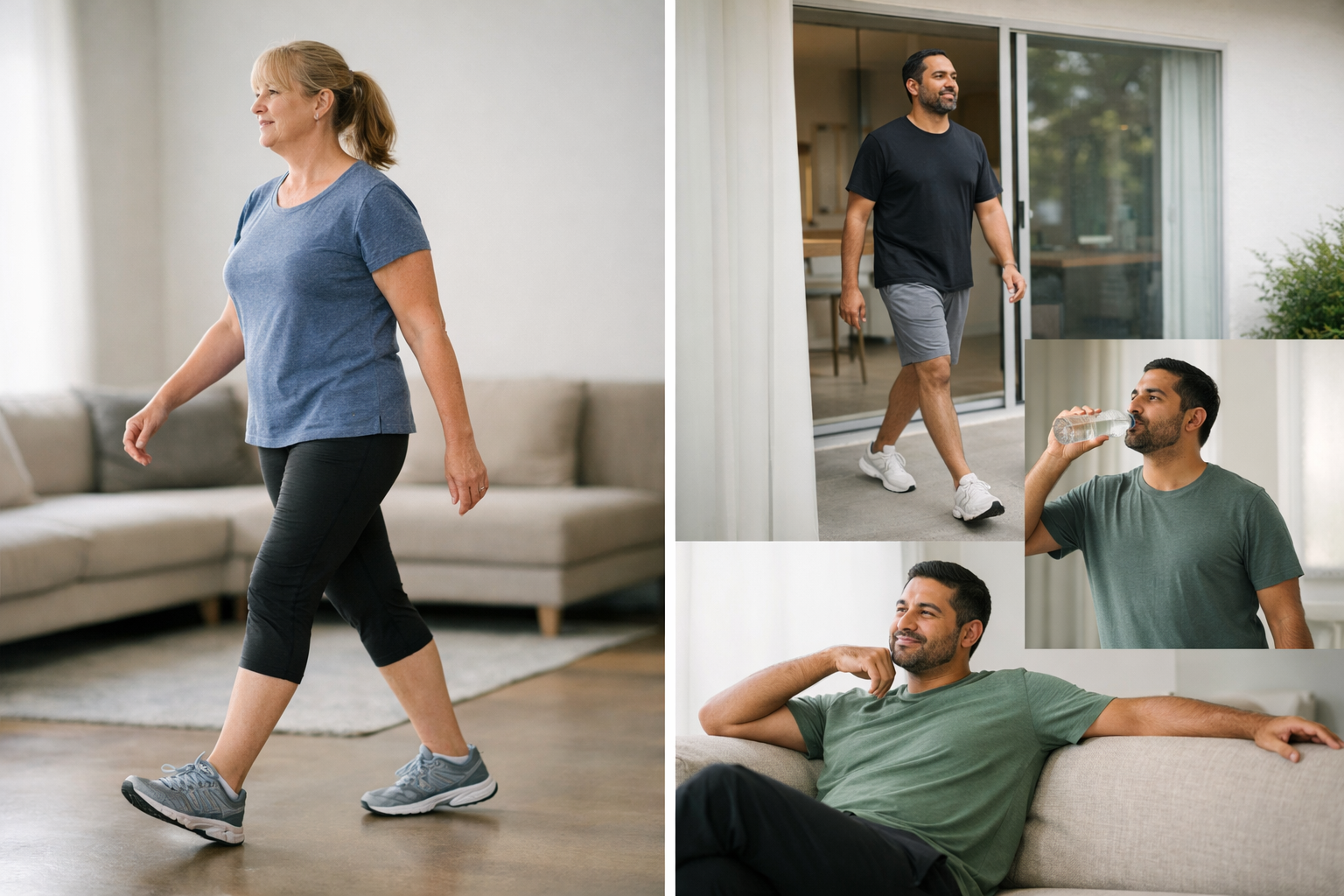
For many people early on, three ten-minute walks are far better tolerated than one thirty-minute walk. Same total, very different demand. Continuous loading without a break is harder on irritable tissue than the same volume spread out.
If you’re trying to get your daily movement up, splitting it is usually the easiest first adjustment to make.
The things that change the dose without changing the step count
Two people can both walk 6,000 steps and have completely different experiences. Here’s what makes the difference.
Surface. Concrete and tile are unforgiving. Grass, a track, a smooth packed dirt path, or a treadmill with some give will usually let you go longer for the same symptom cost. Softness isn’t the whole story, though. Uneven footing (rocky or root-covered trails, sand, sloped or cambered ground) asks more of the foot and the fascia even when the surface itself is soft, so those are worth saving until the heel has settled and your tolerance has built back up. Early on, aim for even ground. If your only option is pavement, that’s fine, just know it counts for more.
Pace. Faster walking loads the fascia more per step, and it also means more steps in the same amount of time. Slowing down is a legitimate way to get more volume in during an irritable phase.
Hills and stairs. Walking uphill and pushing off on stairs both increase the demand at the arch and heel. A route that’s flat one week and hilly the next isn’t the same route, even if the mileage matches.
Shoes. A supportive shoe with a reasonable amount of cushion and some stiffness through the sole usually reduces how hard the fascia has to work per step. This matters most when you’re sore. It matters less as you get stronger. Flat, flexible, worn-out shoes, or barefoot on hard floors, ask more of the tissue. That’s not inherently bad, but it’s a bigger ask, and it’s the wrong time to make it when you’re flared.
Standing. This one gets missed constantly. Standing still on a hard floor for two hours is real load on the foot, even though you took almost no steps. If you work retail, teach, cook, or stand at a bench, your walking budget is smaller than someone who sits at a desk, and it’s not because you’re doing anything wrong. It’s arithmetic.
Everything else that day. Exercise, errands, a long day at an airport, a house project. It all lands on the same foot. A flare-up often traces back to the total day, not to the one thing you’d think to blame.
Why complete rest usually backfires
Here’s the trap. You stop walking, the pain drops within a week or two, and it feels like you’ve found the answer. Then you go back to normal activity and the pain returns almost immediately, sometimes worse than before.
What happened is that rest lowered the tissue’s sensitivity, but it didn’t build anything. Meanwhile, the foot’s tolerance quietly went down, because unloaded tissue gets weaker, not stronger. So you returned to your old life with a foot that was less prepared for it than when you started. Rest equals rust.
That doesn’t make rest useless. Backing off for a few days can absolutely calm a bad flare, and there are times I’ll tell someone to do exactly that. It’s a tool for settling irritation, not a treatment for the underlying problem. The underlying problem is that the demands of your life currently exceed what your foot can tolerate, and the only way to change that side of the equation is to gradually ask the foot to do more.
What not to do with plantar fasciitis
The list is shorter than the internet suggests. Most of it comes down to avoiding sudden swings in either direction.
- Don’t shut down completely for weeks. Covered above. Stay as active as you reasonably can.
- Don’t push through a limp. If your gait is changing to protect the foot, you’re loading other things (your other leg, your knee, your hip, your low back) in ways that tend to create new problems.
- Don’t jump your walking volume by large amounts on good days. Feeling better is the moment people overshoot. The good day is real; it just isn’t a mandate to double your mileage.
- Don’t change everything at once. New shoes, new inserts, a new stretching routine, and a new walking program started the same Monday means you’ll have no idea what helped or what hurt.
- Don’t aggressively roll or stab at the heel when it’s angry. Gentle rolling can feel good and temporarily reduce sensitivity. Hammering a painful area with a lacrosse ball in the hope of breaking something up mostly just leaves it more irritated tomorrow.
- Don’t assume barefoot at home is neutral. For a lot of people, hard kitchen floors first thing in the morning are the single most aggravating part of the day. Keeping a supportive pair of shoes or sandals by the bed is a small change that often pays off.
Is there one best exercise for plantar fasciitis?
No, and I’d be suspicious of anyone who names one. What consistently matters is progressive loading of the foot and calf: heel raises and their variations, along with work that asks the arch and toes to do something under increasing resistance. Calf and fascia stretching can help with the stiffness and the morning sensitivity, but stretching alone tends to reduce symptoms without building tolerance, which is why the relief fades when you go back to your normal activity.
I’ve written more about specific exercises and how to progress them in Plantar Fasciitis Exercises That Actually Help Heel Pain, so I won’t repeat all of it here. The relevant point for this article: walking is not a substitute for strengthening, and strengthening is not a substitute for walking. Walking rebuilds your tolerance for the specific task of walking. Loading exercises build the underlying capacity that makes walking easier. You want both, and they progress at their own pace.
What’s the fastest way to get better?
The fastest route is almost always the one with the fewest setbacks. That sounds like a platitude until you look at how most plantar fasciitis stories actually go: six weeks of improvement, a big weekend, ten days of regression, repeat. Someone who progresses more conservatively and never gets knocked backward typically arrives sooner than someone who pushes hard and flares every three weeks.
A few things genuinely speed the process along:
- Loading the foot consistently, several times a week, rather than in bursts.
- Managing your total daily load, especially on work days, so the exercise has room to do its job.
- Using shoes, and sometimes an insert or taping, to reduce symptoms enough that you can stay active. These are support, not the treatment itself.
- Staying at each level long enough to actually adapt before advancing.
That last one is where most people shortcut. Early improvements come quickly, largely because your nervous system gets better at the task and sensitivity drops. The tissue itself changes more slowly. Meaningful adaptation in fascia and tendon typically unfolds over something like eight to twelve weeks of consistent loading, sometimes longer if you’ve had this a while. Stopping when the pain goes away but before the tissue has caught up is the single most common reason this comes back six weeks later. Consistency beats intensity.
“What is stage 4 plantar fasciitis?”
This question comes up a lot and it deserves a straight answer: there isn’t an accepted four-stage grading system for plantar fasciitis. You’ll see staging language on various websites, but it isn’t standardized and clinicians don’t diagnose from it.
What is real is the distinction between an acutely irritated fascia and a persistent one. When this has been going on for months, the tissue has usually undergone changes in its structure, which is why the accurate term is plantar fasciopathy rather than plantar fasciitis. It’s less about active inflammation and more about tissue that hasn’t repaired and remodeled well under ongoing stress.
Practically, that changes two things. Your starting point is lower, and your progression needs to be more patient. It does not mean the problem is permanent. Persistent is not the same as fixed in place. Tissue responds to loading at every stage; it just takes longer when it’s been unhappy for a long time.
Same goes for imaging findings. A thickened fascia on ultrasound reflects the tissue adapting to stress it’s been under. A heel spur, if you have one, is generally a consequence of long-term tension rather than the source of your pain, and plenty of people have spurs with no symptoms at all. A scan can show structural changes, but it doesn’t always explain why you hurt, and it doesn’t determine how well you’ll do.
“Why did I suddenly get plantar fasciitis?”
Usually because something about your load changed, even if it seemed minor at the time. A new job with more standing. A move to a house with hard floors. Ramping up walking or running faster than usual. A vacation with three days of sightseeing. New shoes, or old shoes that finally gave out. A period of being less active, followed by a return to normal, which is a real load increase relative to what the foot had recently been doing.
Sometimes it’s a combination of small things that individually wouldn’t matter. Body weight, calf flexibility, foot structure, and job demands all factor into the total demand on the tissue, but none of them are character flaws and none of them are the whole story. They’re inputs into one equation: how much this foot is being asked to do, versus how much it can currently do.
The useful question isn’t “what did I do wrong.” It’s “what changed, and how do I build the foot back up to handle it.”
“What finally worked for other people?”
If you read enough forum posts you’ll find people crediting orthotics, a specific stretch, a night splint, a cortisone injection, a shoe brand, shockwave, or simply time. Most of them are telling the truth about their own experience, and most of them were doing more than one thing.
What I see hold up is this: the people who stay better are the ones who ended up with a foot that could do more than it could before. Sometimes an insert or an injection created enough relief for that rebuilding to happen. Sometimes a shoe change removed enough daily irritation that walking became productive again. The intervention that gets the credit is often the one that made the loading possible, and the loading is what changed the outcome. Recovery is built.
That’s also why so many people describe treatment that helped for a while and then stopped helping. Nothing was done incorrectly. The missing piece usually wasn’t another treatment, it was a plan for progressing back to full activity after the pain came down.
When a flare happens, and it will
Recovery is not a straight line. You’ll have a week where walking feels genuinely easy, then a day that sets you back, and it’s easy to read that as proof that nothing is working.
It usually isn’t. A flare-up tells you the load exceeded what the foot could absorb that particular day. It does not mean you re-injured anything, and it does not erase the adaptation you’ve built over the previous weeks.
When it happens, do three things. Look back at the last two days and find what changed, because there’s almost always something (more steps, different shoes, a hard floor, a hill, a long day on your feet). Drop back to the level you were handling comfortably, usually for a few days, not a few weeks. Then rebuild from there, a little more slowly than before.
And keep the longer trend in view. The question isn’t whether today was worse than yesterday. It’s whether this month you can walk farther, stand longer, and recover faster than you could last month. Function matters as much as pain. Somebody can still have a sore heel in the morning and be meaningfully better than they were, because the morning pain fades in five minutes instead of twenty-five and a full workday no longer wrecks them.
What else could this be
Not all heel pain is plantar fasciitis. A few things mimic it closely enough that they get treated as it for months: irritation of a small nerve near the inner heel, a stress reaction in the heel bone, fat pad irritation (which tends to feel more like a deep bruise in the center of the heel), Achilles-related pain that refers forward, and sometimes symptoms coming from the low back or a nerve higher up the chain.
A couple of patterns are worth paying attention to. Pain that’s worst with the first steps in the morning and eases with movement is fairly typical of plantar fascia irritation. Pain that gets steadily worse the longer you’re on your feet, or that hurts at rest and at night, or that came on right after a sharp increase in running volume, deserves a closer look. Same with numbness, tingling, burning, or pain that spreads rather than staying in one spot.
The self-checks in Arch Pain in the Foot: Is It Plantar Fasciitis or Something Else? can help you narrow it down, but an in-person evaluation is what actually sorts it out.
A note on getting help
If your heel pain is severe, not improving after a few months of sensible self-management, getting worse despite backing off, or accompanied by numbness, significant swelling, or pain at night, see a physical therapist or physician. That’s not a reason for alarm, it’s just how you rule things out and get a starting point that fits your foot instead of a generic one.
And if you’ve been told to rest, stretch, and wait, and you’ve done all three without lasting change, the answer probably isn’t another passive treatment. It’s a walking plan you can actually progress, built around what your foot handles today and where you want it to be in three months.