Intrinsic Foot Exercises: Rebuilding Strength in Your Arch
A focused guide to the small stabilizer muscles inside your foot, with specific exercises to train them, how they relate to plantar fascia problems, and honest answers to common questions about foot neuropathy.
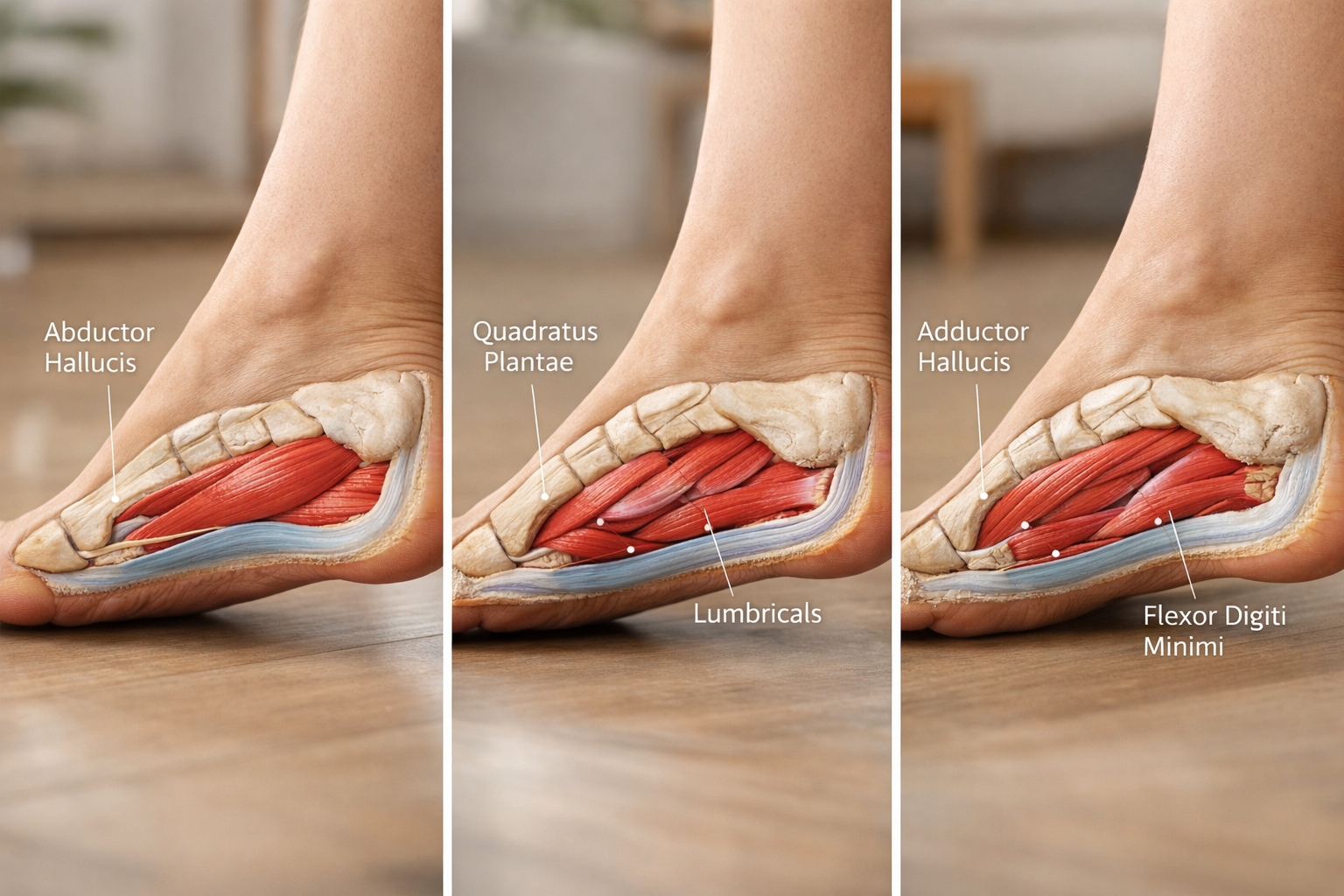
When people talk about foot strength, they usually mean the calf, the Achilles, or the big muscles that move the ankle. But underneath all of that sits a separate layer of small muscles that live entirely within the foot itself. These are the intrinsic muscles, and they do a job nothing else can do: they fine-tune the shape of your arch and stabilize your foot from the inside, step by step, as you walk, stand, and run.
This article focuses specifically on that layer: what the intrinsic muscles are, which exercises actually train them, and how they connect to common problems like plantar fasciopathy (the more accurate term for chronic plantar fasciitis). For a broader look at foot strength in general, including how to tell if your feet are weak and how to build capacity over time, see our article on foot strengthening exercises.
What Are the Intrinsic Muscles of the Foot?
The intrinsic muscles are the ones that originate and insert entirely within the foot, as opposed to the extrinsic muscles (like the calf muscles) that start higher up in the leg and cross into the foot by way of long tendons.
There are four layers of intrinsic muscles on the bottom of the foot alone, plus a few on top. The ones most relevant to arch function and stability include:
- Abductor hallucis, which runs along the inside of the arch and helps support it during standing and walking
- Flexor digitorum brevis, which curls the smaller toes and contributes to arch stiffness during push-off
- Quadratus plantae, lumbricals, and interossei, a group that fine-tunes toe position and helps distribute pressure across the sole
- Abductor digiti minimi, along the outer border of the foot
Together, these muscles act almost like the intrinsic muscles of the hand: not the prime movers, but the stabilizers that let the larger structures do their job efficiently. When they’re weak or under-trained, the foot tends to rely more heavily on passive structures, ligaments, fascia, and joint capsule, to hold its shape. Over time, that shifts load onto tissue that wasn’t built to carry it alone.
Why Train Them Specifically
Most of daily life doesn’t ask much of these muscles in isolation. Walking in supportive shoes, standing on flat floors, sitting for hours, none of it demands much fine control from the intrinsic layer. That’s part of why they can quietly lose capacity without you noticing, until a longer walk, a new pair of shoes, or a return to running exposes the gap between what the foot needs to do and what it’s currently able to tolerate.
This is the same load-versus-capacity idea that shows up across foot and ankle care generally. A tissue or muscle group becomes a problem not because it’s inherently weak, but because the demand placed on it has outpaced its current capacity to handle that demand. Intrinsic muscle training is one piece of closing that gap, alongside the calf, ankle, and hip work covered in our general foot strengthening guide.
The Core Intrinsic Foot Exercises
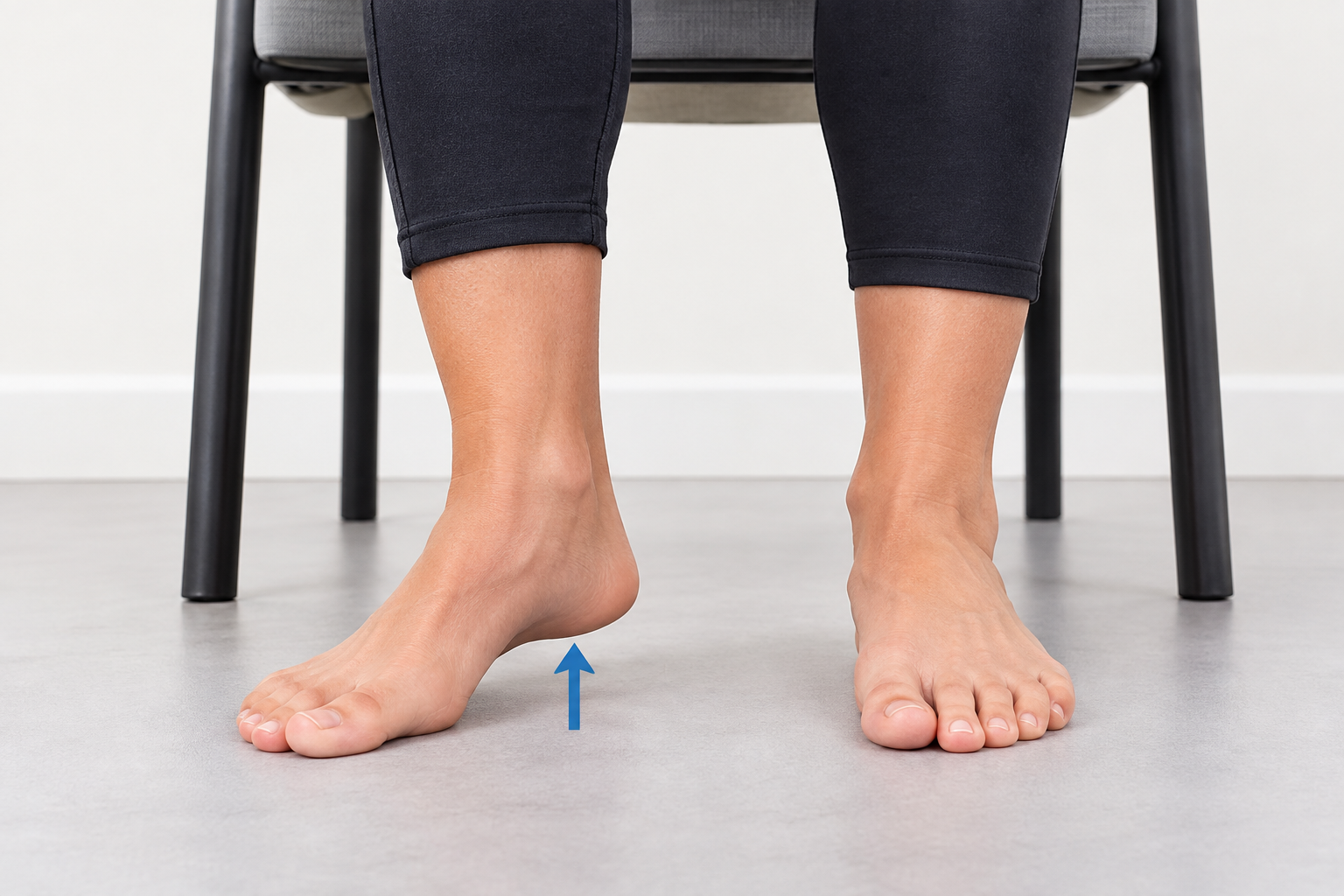
These are the exercises with the most support behind them for actually activating and training the intrinsic layer, rather than just working the toes or the visible arch muscles you can see move.
Short Foot Exercise (Foot Doming)
This is the foundation. Sit or stand with your foot flat on the floor. Without curling your toes, try to shorten the foot by drawing the ball of the foot toward the heel, as if you’re gently doming the arch upward. Your toes should stay long and relaxed on the floor.
Most people find this harder than it sounds at first. The instinct is to claw the toes, which recruits the wrong muscles. Aim for a small, controlled lift of the arch, hold for a few seconds, and release. Ten to fifteen reps, a few times a day, is a reasonable starting point.
Toes Spread Out
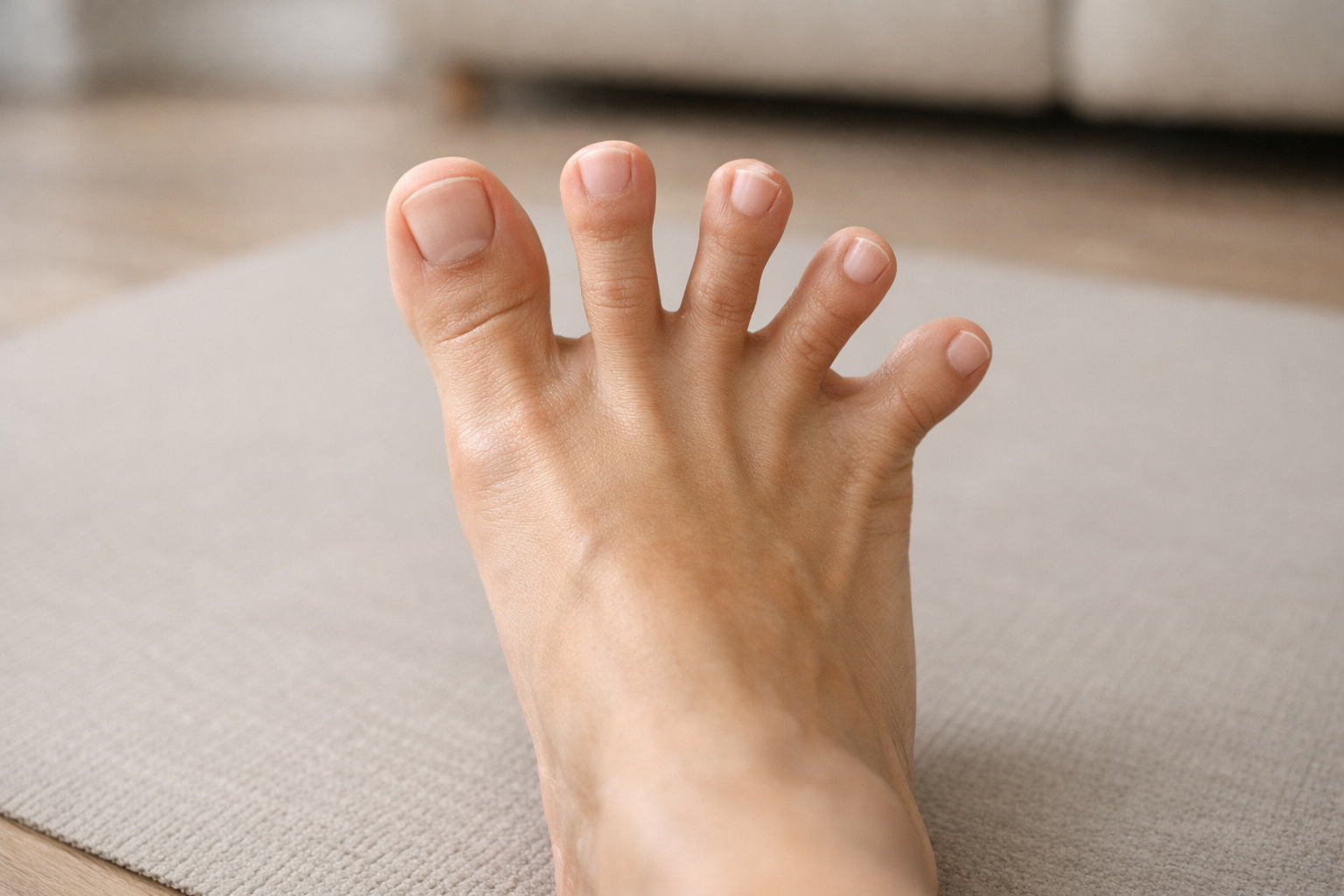
While keeping the toes straight, try to actively spread them apart from each other, similar to spreading your fingers. This targets the small muscles between the toes (the interossei) that are almost never trained through normal activity. It’s subtle work, and for many people the toes barely move at first. That’s normal. The neural connection improves with repetition before the visible motion catches up.
First Toe Extension With Stabilization
Keeping the second through fifth toes pressed flat on the floor, lift only the big toe upward. This isolates the muscles that stabilize the big toe joint, which matters a lot for push-off mechanics and for people dealing with bunions or big toe stiffness.
Second Through Fifth Toe Extension
The reverse: keep the big toe down and flat, and lift the other four toes together. This is often harder to isolate than it sounds, and that difficulty is itself useful information about how much the intrinsic muscles have been neglected.
Towel Curls and Marble Pickups
These classic exercises, curling a towel toward you with your toes, or picking up small objects, do train foot muscles, but they lean more heavily on the long toe flexors (extrinsic muscles) than on the deep intrinsic layer. They’re not wrong to include, and they add useful toe strength and dexterity, but they shouldn’t be your only tool if the goal is specifically intrinsic activation. Use them as a supplement to short foot and toe-spread work, not a replacement.
What Intrinsic Exercises Help With Plantar Fascia Issues?
If you’re dealing with heel or arch pain that’s consistent with plantar fasciopathy, intrinsic strengthening is often part of a broader plan, not a standalone fix. The short foot exercise and doming in particular help the foot generate some of its own arch support actively, rather than relying entirely on the passive tension of the plantar fascia to hold the arch shape under load.
That said, intrinsic work addresses one part of the picture. Calf and Achilles capacity, how quickly you’ve increased walking or running volume, footwear, and total daily load all matter too. Stretching and rest can calm sensitivity temporarily, but they don’t build the tissue capacity that prevents the problem from recurring. Progressive loading, including intrinsic strengthening, is what changes that over weeks and months.
A quick note: not all heel and arch pain is plantar fasciopathy. Nerve entrapment, stress reactions in the bone, and other causes can mimic it closely. If pain isn’t responding to a sensible loading program, or if it’s sharp, worsening, or came on suddenly, that’s worth having evaluated rather than assumed.
How Long Does It Take to Strengthen Intrinsic Foot Muscles?
Most people notice they can perform the movements more easily within a couple of weeks. That early improvement is mostly neural, your brain getting better at recruiting muscles it wasn’t using well before, rather than the muscle tissue itself changing size or strength.
Meaningful structural gains in muscle capacity typically take longer, often somewhere in the range of eight to twelve weeks of consistent work, similar to strength training timelines anywhere else in the body. This varies by person, by how much load the feet are under day to day, and by how consistent the practice is. If you stop once the exercises feel easy but before that window has passed, the gains tend to be shallow and fade quickly once you go back to normal activity.
Build the exercises into a stable routine, keep the dosage modest and consistent, and give it time. There’s no shortcut that skips the adaptation window, for intrinsic muscles or for any other tissue in the body.
A Note on Foot Neuropathy
Neuropathy is a different problem from muscle weakness or plantar fasciopathy, and it deserves its own honest treatment rather than being folded into a general strengthening plan. Peripheral neuropathy involves nerve damage, most commonly from diabetes, and it changes sensation, and sometimes muscle function, in the feet.
Exercises for foot neuropathy generally focus on maintaining circulation, joint mobility, and balance, rather than heavy strengthening. Gentle range-of-motion work for the toes and ankles, balance training (often done seated or with support if sensation is significantly reduced), and general walking as tolerated are commonly recommended. The specifics should be guided by a clinician who knows your history, especially your blood sugar control and the extent of sensation loss.
Is walking barefoot good for neuropathy? For most people with reduced sensation, this carries real risk. If you can’t reliably feel a small cut, a hot surface, or a sharp object underfoot, you may not notice an injury until it’s already become a problem. Supportive, well-fitted footwear with daily foot checks is generally the safer approach.
What’s the worst thing for neuropathy? Uncontrolled blood sugar is typically the biggest driver of nerve damage progression in diabetic neuropathy. Smoking, prolonged pressure from ill-fitting shoes, and skipping regular foot inspections also tend to make things worse by adding injury risk on top of reduced sensation.
How to reverse neuropathy in your feet depends heavily on the cause. Some early nerve damage, particularly when caught early and the underlying cause (like blood sugar) is well managed, can improve. More established nerve damage is often more about managing symptoms and preventing further loss than full reversal. This is a conversation to have with a physician managing the underlying condition, alongside a physical therapist addressing strength, balance, and safe activity.
On traditional practices: some cultures have long-standing approaches involving foot soaking, massage, or reflexology-style walking paths, sometimes referenced in questions about what’s done in Chinese or Japanese traditional medicine for neuropathy symptoms. These practices may feel good and support relaxation and circulation, but there isn’t strong clinical evidence that they reverse nerve damage, and they shouldn’t replace medical management of the underlying condition or a structured PT plan for strength and balance.
Getting Started
If you’re adding intrinsic foot exercises to your routine, start with short foot and toe-spread work, done in small, frequent doses rather than one long session. Keep any discomfort during and after the exercises mild, roughly a 4 out of 10 or under is a reasonable general guideline, and give the tissue about a day to tell you how it responded before increasing the dose. If pain is sharp, doesn’t settle within a day or two, or is paired with numbness, tingling, or swelling, that’s worth having looked at rather than pushed through.
The muscles inside your foot don’t ask for much, but they respond well to consistent, patient attention. Given time, most people can build meaningfully more capacity in this layer than they started with.