Improving Balance When Walking: Foot Stability Exercises for Safer Steps
Walking balance depends heavily on what your feet and ankles can sense and control with every step. Here's how to build that stability with specific exercises, practical adjustments, and a plan you can actually stick with.
You notice it most on uneven sidewalks, stepping off a curb, or turning too quickly in a grocery aisle. Your foot lands slightly wrong, your body corrects, and for a second you’re not sure you’ll catch yourself. Maybe you’ve started watching the ground more than the world around you. Maybe you’ve caught yourself grabbing a railing you never used to need.
That feeling isn’t in your head, and it isn’t really about your “balance” as some abstract trait. Walking balance is a moment-to-moment job your feet and ankles do, thousands of times a day, mostly without you noticing. When that job gets harder, the wobble is the first thing you feel.
Why Walking Balance Is Different From Standing Balance
Standing still and balancing is a relatively simple task. Your base of support doesn’t move, and your nervous system just has to make small adjustments to keep you centered over your feet.
Walking is a different problem entirely. Every step, you briefly stand on one foot while the other swings through the air. Your base of support shrinks to almost nothing for a fraction of a second, then shifts to a new spot you have to predict correctly. Your foot has to sense the surface the instant it lands, whether it’s flat concrete, a slight slope, grass, or a throw rug, and your ankle, knee, and hip have to adjust in real time.
This is why someone can balance fine standing at the kitchen counter but still feel unsteady walking across the same kitchen. Static balance and dynamic, walking balance draw on overlapping but distinct skills. Foot stability sits right at the center of the second one.
Why Am I So Unbalanced When I Walk?
There’s rarely a single cause, and a proper evaluation is the only way to sort out your specific picture. But a few common contributors show up again and again in people who ask this question.
- Reduced sensation in the feet. If nerve signals from the bottom of your foot are dulled (common with diabetes, certain medications, or just changes that come with age), your brain gets less accurate information about the ground with every step.
- Weaker ankle muscles. The small muscles around your ankle make constant micro-adjustments to keep your foot stable on uneven ground. When they weaken, those adjustments happen later and less precisely.
- A foot or ankle that hurts. Pain changes how you walk almost immediately. People shift weight off a sore spot, shorten their stride, or land differently, and all of that can throw off balance even if the actual balance system is fine.
- Vision and inner ear changes. Balance is a team effort between your eyes, inner ear, and the sensors in your feet and joints. A change in any of those inputs puts more pressure on the others.
- Footwear. Shoes with unstable soles, worn-down treads, or no real contact with the ground (think slick-bottomed slippers) remove information your foot needs and reduce your ability to correct quickly.
Some of these overlap with general causes of balance decline, which is a bigger topic on its own. What matters here is that several of the most fixable pieces sit in the foot and ankle, which is good news, because that’s an area you can actually train.
How Do I Stop Wobbling When I Walk?
A few practical adjustments help immediately, even before you start any exercise routine.
Widen your stance slightly. A slightly wider base of support (feet a bit farther apart than feels natural) gives you more margin for error without looking or feeling like a major change.
Slow your cadence on uncertain ground. Rushing across gravel, wet tile, or an unfamiliar surface is when most wobbles turn into real stumbles. Slowing down for those few seconds costs you almost nothing.
Let your arms move. Arm swing isn’t just cosmetic. It helps counter-rotate your trunk and contributes to overall stability. If you’re gripping a bag, phone, or railing with both hands, you’ve taken that stabilizer away.
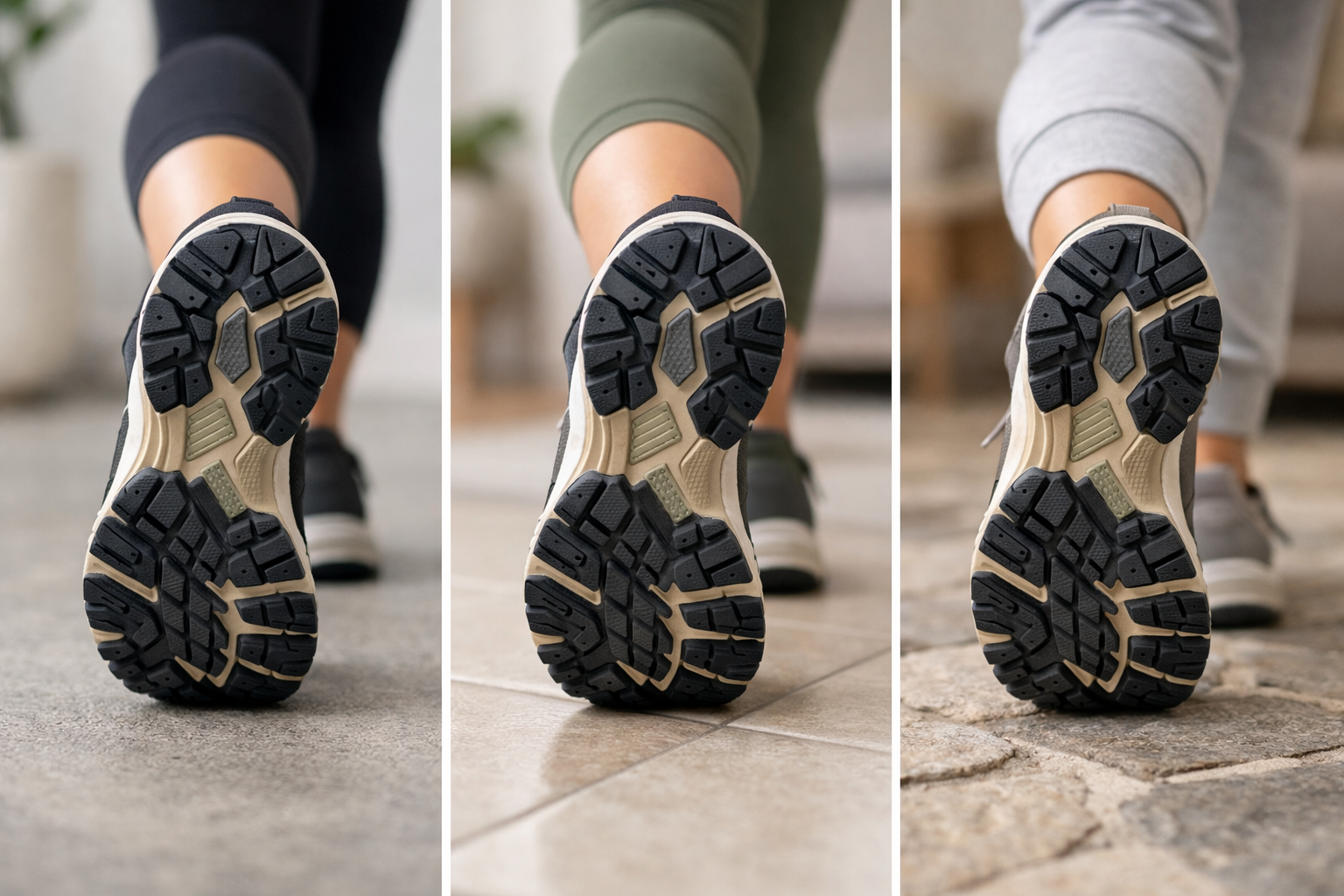
Check your shoes. A shoe with a reasonably firm, flat sole and good ground contact gives your foot more accurate feedback than a soft, unstable one. This doesn’t mean expensive or specialized footwear; it means something that lets your foot do its job.
Reduce visual distraction when you can. Looking down at your phone while walking removes one of your three balance inputs at the exact moment you need it. Save the screen for when you’ve stopped.
These adjustments manage risk in the moment. Actually improving your balance over time takes something more, which is building the foot and ankle’s capacity to handle the demands you’re placing on it.
The Foot’s Role in Balance: What You’re Actually Training
The bottom of your foot is dense with sensory receptors that tell your brain about pressure, texture, and the angle of the surface beneath you. Your ankle has small muscles whose entire job is fine-tuning your foot’s position dozens of times per step. Together, these systems are doing the real-time work of keeping you upright while you move.
When people do balance exercises, they aren’t training willpower or general coordination in some vague sense. They’re training this specific sensory and muscular system to respond faster and more accurately. That’s a trainable capacity, not a fixed trait, and it responds to consistent, graded practice the same way strength or endurance does.
Foot and Ankle Exercises for Better Walking Balance
These exercises focus on the muscles and sensory feedback your foot uses with every step. Start with support nearby (a counter, sturdy chair, or wall) and only progress to less support as it becomes genuinely easy, not just tolerable.
1. Single-Leg Stance
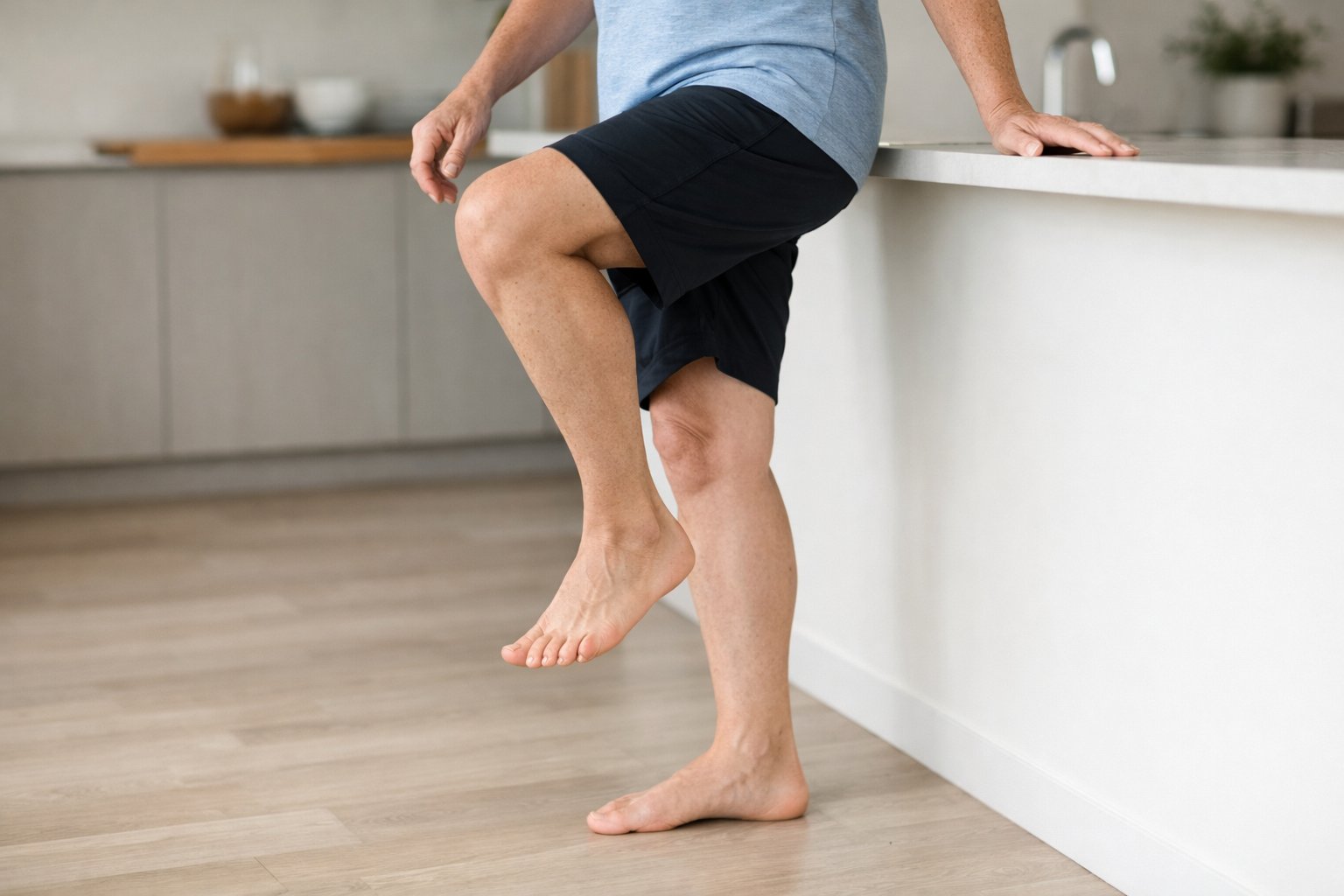
Stand near a counter for light fingertip support. Lift one foot slightly off the ground and hold. Aim to feel your standing foot make small adjustments rather than staying perfectly rigid, that’s the system working correctly. Build the time gradually rather than pushing for a personal record on day one.
2. Heel-to-Toe Walk
Walk in a straight line placing the heel of one foot directly in front of the toes of the other, as if walking a tightrope. This narrows your base of support and forces the foot to make quicker corrections, which is exactly the skill you’re after.
3. Ankle Circles and Alphabet
Seated or standing, move your ankle through its full range, or trace the letters of the alphabet in the air with your big toe. This keeps the joint mobile and warms up the small stabilizing muscles before more demanding work.
4. Calf Raises
Rise onto your toes slowly, hold briefly, then lower with control. This builds strength through the calf and ankle complex that supports you every time you push off during a step. Doing these slowly, especially on the way down, matters more than doing a lot of them fast.
5. Side-Stepping and Stepping Over Objects
Step sideways in a controlled line, or practice stepping over a low object like a pool noodle or rolled towel. Most falls don’t happen walking in a straight line on flat ground, they happen navigating a curb, a pet underfoot, or a change in terrain. Practicing controlled, varied steps prepares your feet for that reality.
These five cover a reasonable amount of ground for a home routine, and they apply regardless of age or gender. A 70-year-old woman working on balance and a 40-year-old recovering from an ankle sprain are training largely the same system, just starting from different points and progressing at different paces.
What Is the Number One Exercise for Balance?
If you had to pick just one, single-leg stance is usually the best return on investment, because it directly challenges the foot and ankle’s ability to make constant small corrections with minimal equipment or space required. That said, no single exercise replaces a well-rounded routine. Balance is built from a combination of strength, sensory input, and repeated practice under slightly varied conditions, not one movement done perfectly.
How Long Should a 70-Year-Old Be Able to Balance on One Leg?
There’s a wide healthy range here, and it depends on general fitness, prior injuries, and how much practice someone has had with the skill recently. As a rough pattern seen in clinical settings, many healthy older adults can hold an unsupported single-leg stance for somewhere in the range of ten to twenty seconds, though plenty of people below that range are perfectly capable of safe, confident walking. The number matters less than the trend. If your time is improving with practice, that’s the meaningful signal, not where you rank against a chart.
Which Activity Is Best for Improving Balance?
Walking itself, done regularly and on slightly varied terrain, is one of the most underrated balance activities available, because it practices the exact skill you’re trying to improve. Beyond that, activities like tai chi, yoga, and structured balance classes are well regarded because they combine slow, controlled movement with shifting weight and narrow bases of support, which is the same demand your foot faces on a sidewalk. The best activity is ultimately the one you’ll do consistently. Consistency beats intensity here, especially with a skill that depends on repeated, low-level practice rather than occasional hard effort.
What Does a Balanced Exercise Program for Seniors Actually Look Like?
A well-rounded routine usually includes a few categories working together, not one type of exercise done exclusively:
- Strength, particularly for the ankles, calves, and hips, since strong muscles execute the corrections your nervous system calls for.
- Balance-specific drills, like the ones above, done a few times a week.
- Mobility work for the ankles and feet, so joints can move through the ranges needed to adjust quickly.
- General activity, especially walking, which keeps the whole system practiced in a real-world context rather than only in a controlled exercise setting.
The exact mix depends on your starting point. Someone recovering from a fall or a long period of inactivity will start lower and progress more gradually than someone who’s simply noticed early wobbliness. Both approaches work on the same principle: find a level your foot and ankle can currently handle, do it consistently, and gradually ask for a little more as it adapts.
Building This Over Time, Not Overnight
Early improvement in balance work often comes from your nervous system getting better at using what you already have, sometimes within a couple of weeks. Real, durable change in strength and stability tends to take longer, often building over two to three months of consistent practice. That’s a normal pattern, not a sign that something isn’t working if week two doesn’t feel dramatically different from week one.
A little unsteadiness on a hard day doesn’t erase that progress either. Recovery and improvement in this area aren’t a straight line. If you have a rough day on uneven ground after a great week of practice, it tells you something about that specific situation, not that you’re back to square one.
When to See Someone
Occasional wobbliness that improves with practice is common and usually manageable on your own. But sudden onset of imbalance, balance problems paired with numbness, dizziness, or a recent fall, or a rapid decline in your walking confidence are worth having evaluated. These can have causes beyond what foot and ankle exercises address, and a clinician can sort out what’s actually driving the issue rather than guessing from a list online.
Movement is medicine here in a very literal sense. The feet and ankles that feel unreliable now are largely trainable, and small, consistent practice adds up in ways that are easy to underestimate from the outside.