How Older Adults Can Improve Their Balance Safely at Home
A clear, evidence-informed guide to understanding why balance declines with age and how to rebuild it gradually and safely, with practical exercises and honest answers to common questions.
Balance problems rarely show up overnight. They build slowly, often over years, as strength, sensation, vision, and reaction time each lose a little ground. The good news is that balance is trainable at almost any age. The nervous system and the muscles that support it respond to practice, even when that practice starts later in life and even when someone has already had a fall or two.
This article walks through what actually causes balance to decline, what helps, and how to build a safe home routine without guessing or overdoing it.
Why Balance Declines With Age
Balance depends on three systems working together: your vision, your inner ear (vestibular system), and the sensation coming from your feet, ankles, and joints (proprioception). With age, all three can weaken somewhat. Muscles that stabilize the ankle and hip get weaker if they aren’t used through their full range regularly. Reaction time slows. Vision changes. Nerve signals from the feet, which tell your brain exactly how your weight is distributed on the ground, can become less precise.
None of this is unusual, and none of it means decline is permanent or unmanageable. Think of it as a gap between the demand you’re placing on your balance system (walking on uneven ground, standing up quickly, turning a corner) and the capacity that system currently has to meet that demand. When demand exceeds capacity, you feel unsteady. The goal of a balance program is to close that gap by rebuilding capacity, not just by being more careful.
What Are the Possible Causes of a Person Losing Balance?
A number of things can contribute, often at the same time:
- Muscle weakness, especially in the hips, ankles, and feet
- Reduced sensation in the feet (from diabetes, neuropathy, or normal aging)
- Inner ear issues, including benign positional vertigo
- Vision changes or uncorrected prescriptions
- Certain medications, including some blood pressure drugs and sedatives
- Low blood pressure on standing (orthostatic hypotension)
- Joint stiffness or pain that changes how you walk
- Inactivity, which allows all of the above to compound
Because the causes overlap so much, and because some of them (vertigo, medication side effects, blood pressure drops) need a different approach than exercise alone, persistent or worsening balance problems are worth having evaluated rather than guessed at.
What Is the Best Treatment for Balance Problems?
There isn’t one single treatment that fits everyone, because the causes differ from person to person. That said, for balance problems related to strength, sensation, and general deconditioning, which is the most common picture in healthy older adults, progressive balance and strength training is consistently the most effective approach. Research on gait, coordination, and functional balance training in older adults backs this up: these programs are moderately to strongly effective at reducing fall risk when done consistently over weeks and months, not days.
Medical treatments matter for specific causes. Vertigo often responds to particular repositioning maneuvers a clinician performs. Medication-related dizziness may resolve with a prescriber adjusting a dose. Vision correction helps when vision is the limiting factor. But for the average older adult whose balance has quietly declined over time, exercise is the treatment, and it needs to be progressive to work.
How to Control Balance Problems
“Control” is a good word here, because balance training isn’t about eliminating all risk. It’s about narrowing the gap between what you can handle and what daily life asks of you. A few principles make this practical:
- Practice in a safe setup first (near a counter or sturdy chair), then gradually reduce your support as you improve.
- Progress slowly. Early improvements come largely from your nervous system getting better at coordinating what you already have. Real structural gains in strength and stability take longer, generally in the range of eight to twelve weeks of consistent practice, sometimes longer.
- Stay at each level long enough to feel steady before moving to something harder. Rushing progression is the most common reason people plateau or feel discouraged.
- Expect some off days. A harder day of standing or walking earlier in the week can make balance work feel worse a day or two later. That’s a sensitivity response, not a sign you’ve undone your progress.
The Number One Exercise for Balance
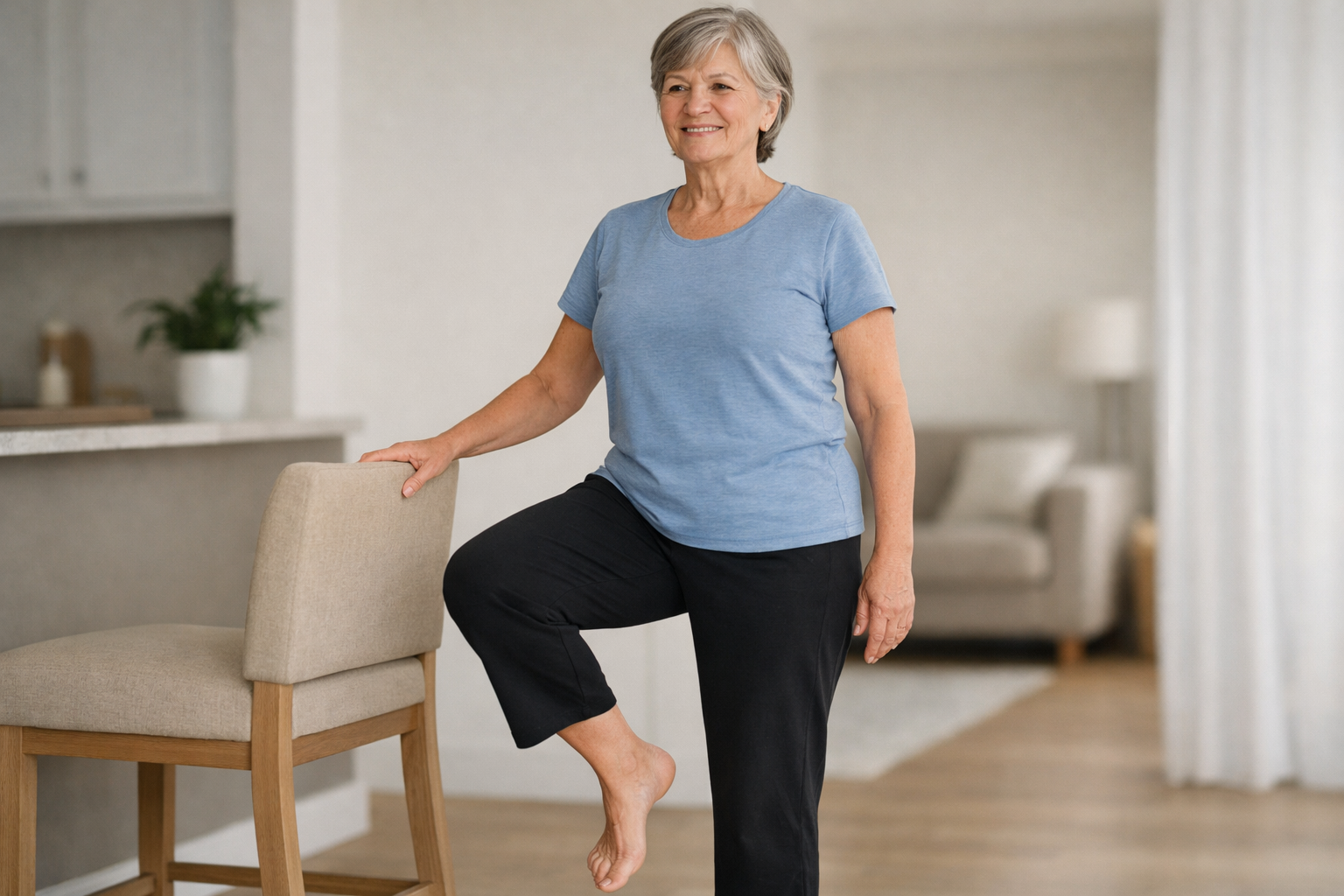
If we had to pick one, it would be the single-leg stance. It’s simple, requires no equipment, and directly trains the ankle, hip, and foot muscles that keep you upright on one leg, which is exactly what walking requires every single step.
How to do it:
- Stand near a counter or sturdy chair for safety.
- Lift one foot slightly off the ground and hold your balance on the standing leg.
- Start with a light touch on the counter if needed. Aim to work toward no hands, then eyes closed (only once no-hands is solid), then standing on an uneven or soft surface like a folded towel.
- Hold for 10 to 30 seconds per side, repeating a few times.
The progression matters more than any single rep. Moving from full support, to fingertip support, to no support, to an unstable surface is what actually builds capacity over time. Skipping steps just to prove you can usually backfires.
A Simple At-Home Balance Routine
Beyond single-leg stance, a well-rounded routine touches strength, dynamic movement, and reaction:
Sit-to-stands. Rising from a chair without using your hands trains the hip and thigh strength that underlies almost every balance task. Start with a higher, firmer chair and progress to lower or softer surfaces.
Standing marches. Holding onto a counter, lift your knees one at a time as if marching in place. This builds hip strength and practices the single-leg loading that walking demands.
Heel-to-toe walking. Walk in a straight line placing one foot directly in front of the other, like on a balance beam. This challenges your dynamic balance more than standing still does, and it mimics the narrow base of support you use in daily walking.
Weight shifts. Standing with feet shoulder-width apart, shift your weight slowly from side to side, then front to back, without lifting your feet. This trains your ability to control your center of gravity, which is often what fails right before a stumble.
Tai chi or similar slow, controlled movement practice. Multiple studies point to tai chi as one of the more effective broader movement approaches for fall prevention in older adults, likely because it combines weight shifting, single-leg loading, and attention training all at once.
Keep effort and discomfort modest. A general rule many people find useful is staying at or below about a 4 out of 10 for any strain or fatigue during and shortly after exercise. If a session leaves you sore or unsteady well beyond a day, that’s a sign to scale back slightly next time, not a reason to stop altogether.
How Do I Regain My Walking Balance?
Walking balance is really single-leg stance repeated dozens of times per minute, combined with forward momentum. If walking itself feels unsteady, work backward:
- Build single-leg stance tolerance first, since every step is briefly a one-legged task.
- Add heel-to-toe walking and marching to bridge the gap between standing balance and full walking speed.
- Practice walking with brief stops, turns, and direction changes, since real-world walking rarely stays in a straight line.
- Gradually walk on varied surfaces, grass, gravel, uneven sidewalks, once flat-ground walking feels solid.
If a cane or walker has been recommended, that’s a legitimate load-management tool, not a step backward. Using support appropriately while you rebuild capacity is often what allows someone to keep walking distances that matter to them, rather than avoiding walking altogether out of fear.
How to Restore Balance in Your Life
Beyond the exercises themselves, a few habits support the whole picture:
- Stay generally active through the day. Almost any movement, walking to the mailbox, gardening, climbing stairs, contributes something to balance, even outside a formal exercise session.
- Review medications periodically with a prescriber, especially if you take something that causes drowsiness or drops in blood pressure.
- Get vision checked yearly.
- Address foot pain or numbness rather than working around it, since altered walking patterns from foot problems often show up as balance problems downstream.
- Wear supportive, well-fitting shoes at home rather than going barefoot on hard floors or wearing loose slippers, both of which reduce the feedback your feet get from the ground.
What Vitamin Is Good for Balance? What Deficiency Causes Balance Problems?
Vitamin D and B12 are the two most commonly discussed in relation to balance. Vitamin D supports muscle function, and low levels have been associated with weakness and increased fall risk in older adults. B12 deficiency can affect the nerves that carry sensation from the feet and legs, and when that sensory feedback is impaired, balance suffers because the brain is getting less accurate information about where the feet are and how weight is distributed.
That said, taking a vitamin does not substitute for exercise, and supplementing without a documented deficiency generally doesn’t improve balance in someone whose levels are already adequate. A blood test through your physician is the right way to know if either is actually low before adding a supplement.
As for the best multivitamin for adults over 70, there isn’t a single product we’d endorse, and needs vary based on diet, kidney function, and other medications. A primary care physician or geriatrician can recommend an appropriate multivitamin or targeted supplement based on actual lab work, which is more useful than a general recommendation.
A Note on Feet Specifically
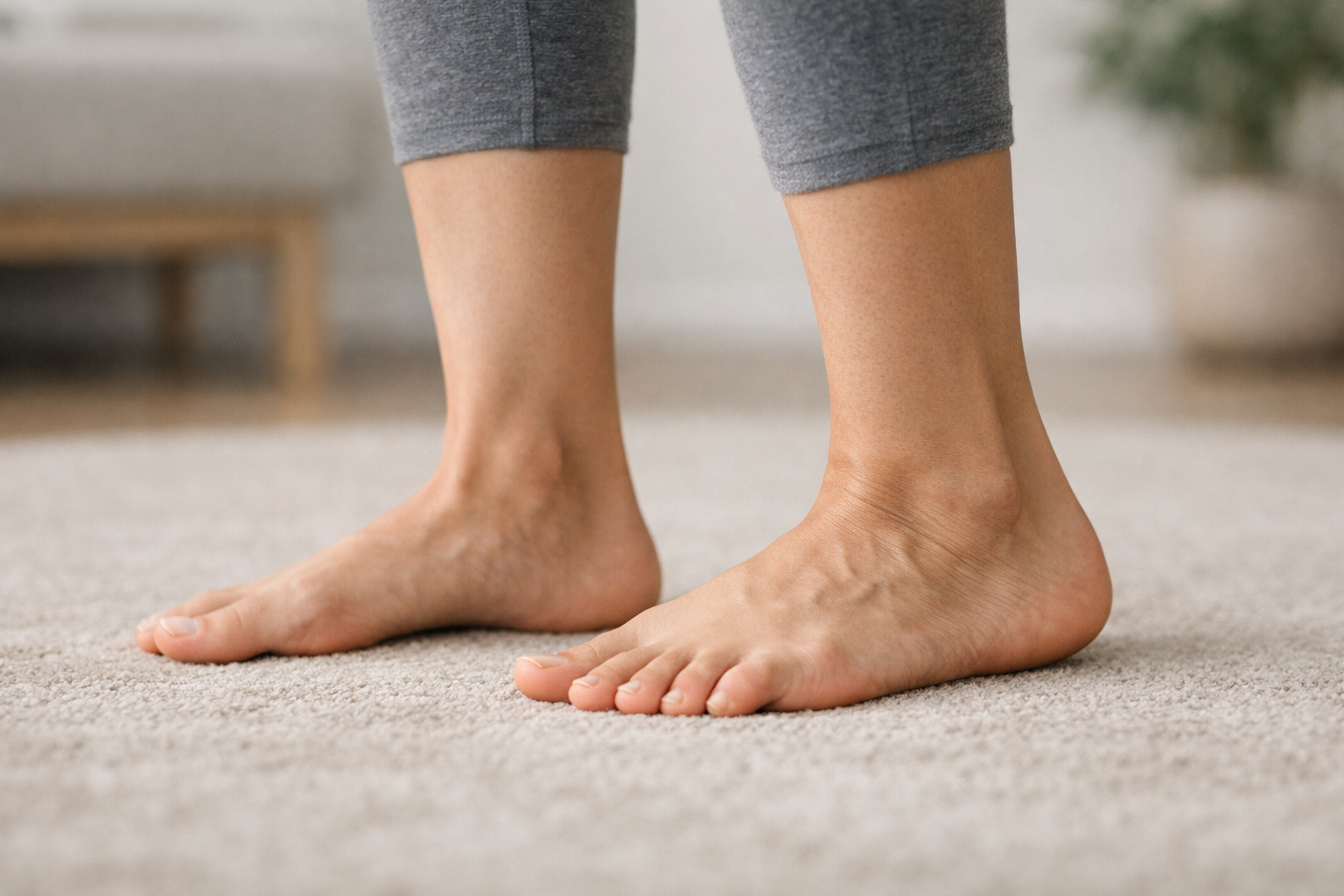
The feet are often the overlooked piece of the balance puzzle. They’re the only part of the body in contact with the ground, and the nerve endings there send a constant stream of information to the brain about pressure, tilt, and texture. When foot sensation or strength declines, whether from neuropathy, past injury, or simple disuse, balance often declines with it, even if hip and core strength are fine.
Going barefoot on safe, varied surfaces at home (carpet, then a firmer floor) for short periods can help maintain some of that sensory feedback, alongside the standing and walking exercises above. If foot pain, numbness, or noticeable weakness is part of the picture, that’s worth addressing specifically, since it can be the limiting factor no amount of hip strengthening will fully fix on its own.
When to See a Professional
Most age-related balance decline responds well to consistent exercise, and many people improve meaningfully with a patient, progressive approach. But some situations deserve a direct evaluation rather than a home program alone: a fall that caused injury, sudden or severe dizziness, balance that’s gotten noticeably worse over a short period, numbness or tingling in the feet, or any new weakness on one side of the body. A physical therapist can assess which systems, strength, sensation, vestibular function, are contributing most in your specific case and build a program around that, which is often faster and safer than trial and error at home.
Balance training is one of the more genuinely rewarding areas of physical therapy to work on, because the gains are practical and immediate: steadier stairs, more confident walks, fewer close calls. The principles are sound and well supported. What it asks for in return is patience and consistency, not intensity.