Hoffa's Fat Pad Impingement: Knee Pain, Not Heel Pain
Hoffa's fat pad impingement is a knee problem, not a heel one, and it often gets confused with the fat pad under the heel. Here's what the infrapatellar fat pad does, why it becomes painful, and how load management plus progressive strengthening help most people get back to walking, standing, and training.
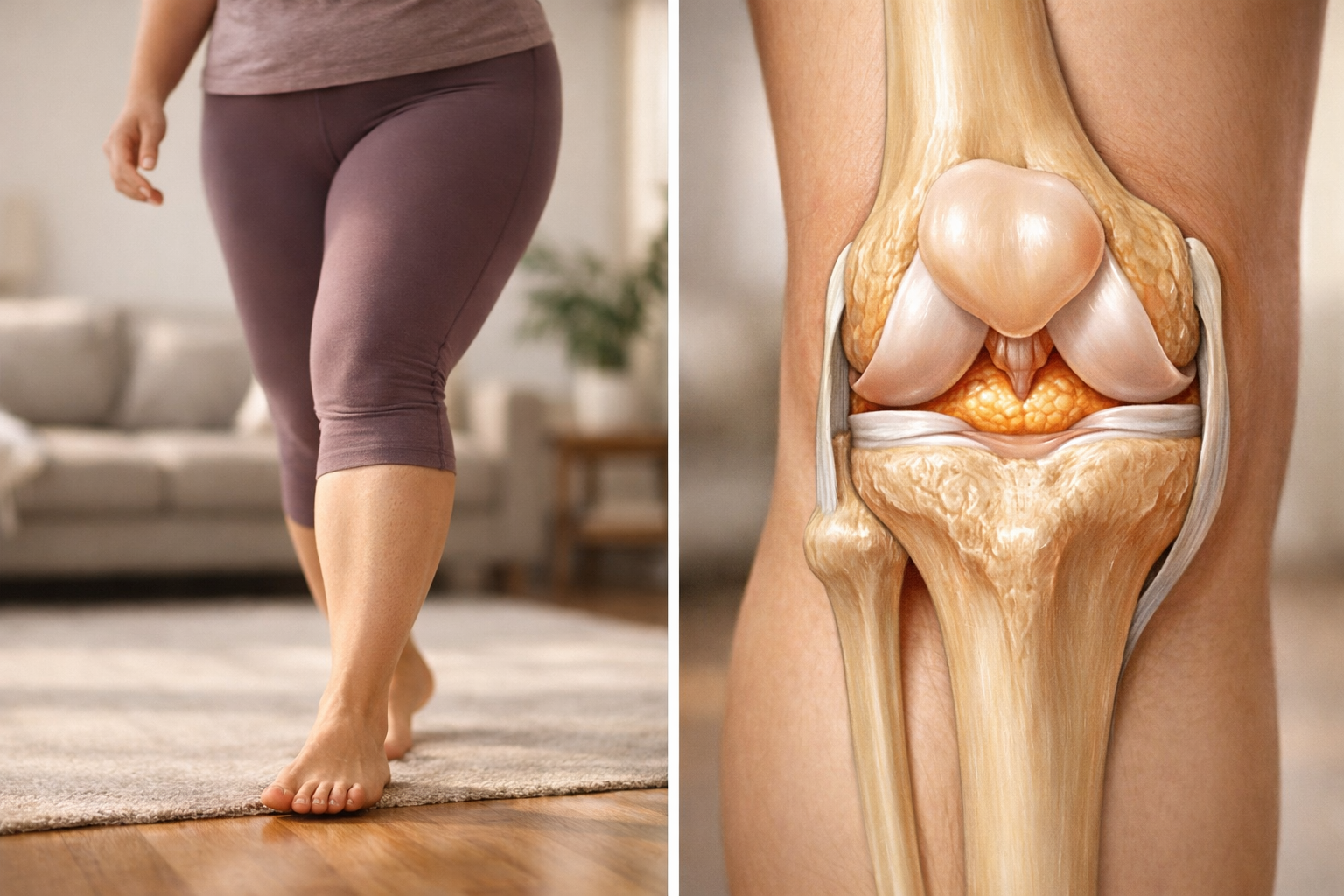
First, let’s clear up which fat pad we’re talking about
If you searched for “Hoffa’s fat pad impingement” and you’re here because your heel hurts, this is the article that saves you some time.
Hoffa’s fat pad is in the knee. It sits behind and just below your kneecap, and when it gets pinched or irritated, the pain shows up at the front of the knee, not under the foot. The fat pad under your heel is a completely separate structure with a separate set of problems. Both are cushions. Both can hurt. They are not related, and the names get tangled online constantly.
So, two paths from here. If your pain is under the heel, especially when you first stand up in the morning or after sitting, the article on heel fat pad syndrome on this site is the one you want. If your pain is at the front of the knee, low, right around the kneecap tendon, and it gets worse when your knee straightens all the way out, keep reading.
What the infrapatellar fat pad actually does
Slide your fingers just below your kneecap and you’ll find the patellar tendon, a firm band running down to your shinbone. Behind that tendon, filling the space between it and the front of the knee joint, sits a wedge of fatty tissue. Its formal name is the infrapatellar fat pad. Albert Hoffa described the painful version of it over a century ago, which is why you’ll see it called Hoffa’s fat pad, Hoffa’s syndrome, or Hoffa’s disease.
It is not spare padding. It fills space as the knee bends and straightens, helps distribute pressure at the front of the joint, and it’s richly supplied with nerves and blood vessels. That last part matters more than anything else in this article.
This tissue is one of the more nerve-dense structures around the knee. When it gets compressed or inflamed, it can generate pain that feels sharp, hot, and out of all proportion to how much is actually wrong. That’s a big part of why people with this problem get worried. The pain feels serious. The tissue involved usually is not.
What it feels like when the fat pad is the problem
The pattern that can be consistent with fat pad irritation looks something like this:
- Pain at the front of the knee, low down, often on both sides of the kneecap tendon rather than on it
- Worse when the knee straightens all the way, and especially when it snaps back past straight
- Standing around with your knees locked back becomes uncomfortable within minutes
- Sometimes a puffy, full feeling right below the kneecap
- Walking downhill, walking down stairs, or long periods on your feet can wind it up
- It can be tender to press right beside the tendon
The locked-knee thing is the most useful clue. When your knee goes fully straight, the space in front of the joint gets narrower and the fat pad gets squeezed. Some people naturally hyperextend a bit, and those knees tend to pinch the pad more. Others develop this after a direct blow to the front of the knee, a fall, or knee surgery, where the pad can become thickened and scarred and less willing to be compressed.
How it’s different from kneecap tendon pain
These two get mixed up all the time, and the distinction changes what you should do.
Patellar tendon pain usually sits directly on the tendon and gets angry with loaded bending: squatting deep, jumping, decelerating, running hills. It tends to feel better once you’re warm.
Fat pad pain usually sits beside the tendon and gets angry with the knee going straight and staying straight. Standing at a counter. Lying in bed with your leg out flat. Locking out at the top of a squat.
Other things can produce similar pain: kneecap joint pain, a irritated plica, meniscus issues, and in growing athletes, growth plate irritation at the front of the knee. This is genuinely hard to sort out from a description, and it’s worth an in-person exam rather than a guess. The exam is straightforward and takes minutes.
How serious is Hoffa’s fat pad impingement?
In terms of danger, low. This is a painful problem, not a threatening one. The fat pad is not a load-bearing structure holding your knee together, and irritating it does not put your joint on a path to ruin.
In terms of nuisance, it can be significant. Because it hurts with something as basic as standing up straight, it interferes with work, walking, and sleep in ways that people find genuinely frustrating. And because the pain can be sharp, many people assume they’ve torn something.
The honest framing: it’s usually a sensitivity problem in a tissue that is being repeatedly pinched, layered on top of a knee that isn’t currently strong enough or coordinated enough to keep that pinching from happening. Both parts are workable.
Why it flares: what the knee can handle versus what you’re asking of it
Here’s the frame I use for almost everything at the front of the knee.
Every tissue has some amount of demand it can currently tolerate. When what you’re asking of it stays under that line, things stay quiet. When demand climbs past it, whether from more volume, more speed, a new pair of shoes, a new job on your feet, or a knee that’s started resting into hyperextension because the muscles around it are tired, the tissue gets irritated.
For the fat pad, demand comes from compression. And compression comes from positions and postures more than from raw force. That’s why a person who can squat plenty of weight can still be miserable standing in line at the grocery store.
It’s also why total load matters. Your rehab exercises are one input. Your commute, the eight hours you spent on a warehouse floor, the walk you took because the weather was nice, and the way you sat with your leg propped straight out on the ottoman all night are also inputs. They add up. Symptoms often lag a day behind whatever caused them, which is exactly why people blame the last thing they did instead of the accumulation.
How do you fix Hoffa’s fat pad impingement?
There’s no single exercise or gadget that resolves this. What tends to work is a sequence, and the sequence matters more than any individual piece.
Take the pinch out of the day. Not rest. Just less compression. Stop locking your knees when you stand. Keep a soft bend. Put a small pillow or rolled towel under the knee when you lie down if lying flat aggravates it. Watch for the yoga and stretching positions that push the knee back past straight, and back off those for now. For some people, a shoe with a bit of heel height, or a small heel wedge, quietly keeps the knee from settling into that locked-back position while standing. Small change, sometimes noticeable difference.
Calm the tissue without unloading the leg. This is where taping earns its place. Lifting or offloading the tissue below the kneecap with tape helps a lot of people get through a work shift with less irritation. Ice can settle a hot, puffy pad. Both of these reduce sensitivity. Neither one builds anything, which is the part people miss. Rest and taping make the tissue less reactive while it isn’t being squeezed, so pain often walks right back in the door when normal demand returns. That’s not failure. It just means the sensitivity was addressed and the capacity wasn’t.
Then build. Recovery gets built here, over weeks. The quadriceps, particularly the part that controls the last stretch of knee straightening, needs to be strong enough to hold the kneecap in a position that doesn’t grind the pad. The hip and calf need to be capable enough that your knee isn’t the joint absorbing everything. Start with amounts your knee tolerates, hold at each level long enough for the tissue to actually adapt, then ask for slightly more.
A reasonable rule of thumb for most people: keep the discomfort at or below roughly a 4 out of 10 during the work, and expect it to settle back to your normal baseline within about a day. If it does, that dose was fine. If you’re still elevated two days later, it was too much, and you scale it back rather than abandon it.
What exercise can I do with fat pad impingement?
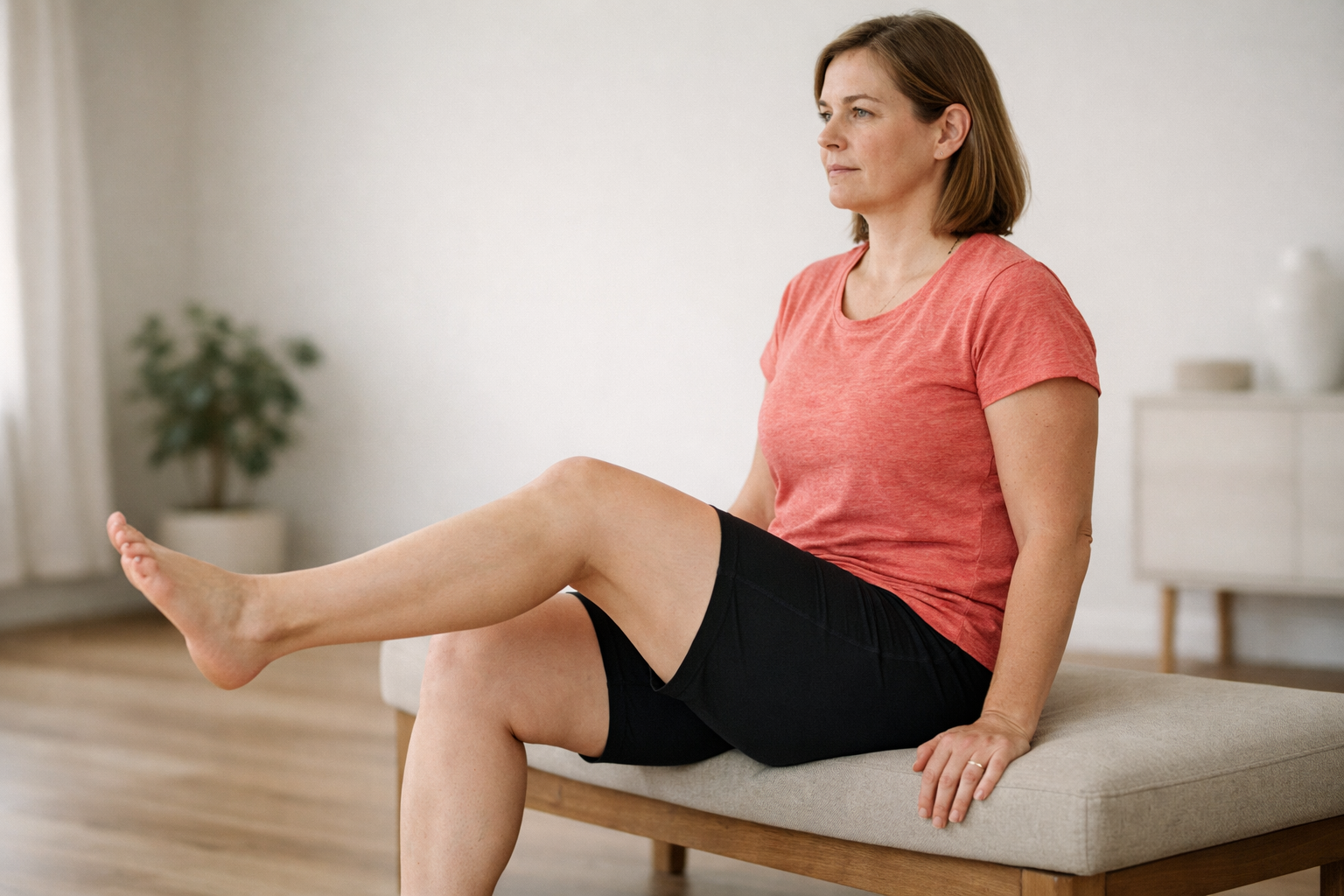
More than you’d think. The trick is choosing where in the range you work.
- Mid-range quad work. Holds and lifts that stop short of full lockout are often comfortable when full lockout is not. Isometric holds around 30 to 60 degrees of bend are a common starting point because they load the muscle without slamming the pad.
- Hip and glute strengthening. Bridges, hip hinges, step-ups, side-lying and standing hip work. Almost always well tolerated, and it takes pressure off the knee over time.
- Calf work. Heel raises, straight-knee and bent-knee variations. Your calf is a major shock absorber for the whole leg.
- Cycling. Often a good option because the pedal stroke never fully straightens the knee. Watch your seat height; too high pushes toward extension at the bottom.
- Squats and leg press within a tolerated range. Not necessarily deep, not necessarily locked out. Find the window that stays quiet and build inside it.
What to hold off on early: forced hyperextension stretches, hamstring stretches done with the knee jammed straight, locked-out leg extensions at the end of the machine’s range, and lots of downhill running while the pad is hot.
Movement is medicine here, but the dose and the range are the whole conversation.
Is walking good for fat pad impingement?
Generally yes, and staying as active as you reasonably can beats shutting down.
Walking loads the front of the knee at moderate levels and keeps circulation, strength, and confidence intact. What tends to aggravate it isn’t walking itself but specific versions of walking: long downhill stretches, hard flat surfaces for hours, a stride where the knee snaps back at heel contact, or standing still with locked knees, which is actually harder on the pad than walking.
So adjust rather than stop. Shorter, more frequent walks. Flatter routes for a few weeks. A slightly shorter stride so the knee isn’t whipping into full extension. Then use the 24-hour check. Walked 20 minutes, sore that evening, back to baseline the next morning? That’s a workable dose, and next week you can ask for a bit more.
What’s the best knee brace for fat pad impingement?
There isn’t a best one, and I’d be suspicious of anyone who names a specific model as the answer.
Here’s what different options actually do. A simple compression sleeve gives some support and feedback and helps a lot of people feel steadier, which is worth something. Taping below the kneecap is often more targeted than a brace for this particular problem, because the goal is offloading one small area. A strap that sits over the patellar tendon, the kind used for kneecap tendon pain, is a mixed bag here, since for some people it presses directly onto the tissue that’s already unhappy.
A brace can be genuinely useful for getting through a workday with less irritation. What it can’t do is build the capacity you need, so think of it as scaffolding rather than the repair.
How long does it take to recover from fat pad impingement?
It depends on how long it has been going on and how irritable the knee currently is, which is an unsatisfying answer, so let me give you the shape of it instead.
The early improvements come fast and are mostly about sensitivity and muscle activation. People often feel noticeably better in the first two or three weeks once the daily pinching stops and they start loading sensibly. Real tissue adaptation takes longer, often in the range of 8 to 12 weeks of consistent work for many people, sometimes more if this has been dragging on for a year.
That gap between feeling better and being more capable is where recurrence lives. Pain quiets down, the exercises stop, the knee goes back to a full standing shift or a full training week, and the pad gets pinched again by a leg that hasn’t finished getting strong. Persistent cases aren’t permanent cases. They usually mean starting lower and progressing more patiently.
And measure more than pain. Can you stand longer before it bothers you? Walk farther? Recover faster afterward? Function is a signal in its own right, and it frequently improves before the pain number does.
Does Hoffa’s fat pad impingement require surgery?
Usually not. Most people improve with load management and progressive strengthening, and that’s the right first course by a wide margin.
Surgery, generally an arthroscopic procedure to trim the thickened or scarred portion of the fat pad, is reserved for people whose symptoms persist despite a genuine, well-progressed rehab effort, often where there’s clear thickening or scarring on imaging, sometimes following prior knee surgery or trauma. Injections are sometimes used to settle a severely irritated pad and buy a window to start rehab. They can help in the right situation, but they’re a way in, not a destination.
On success rates, I’d rather be straight with you than quote a number. Reported outcomes for arthroscopic fat pad resection in carefully selected patients are generally described as favorable, but this is an uncommon condition and results depend heavily on who gets selected and whether the fat pad was really the pain source. There’s no reliable single percentage to hand you.
Recovery after surgery follows the usual arthroscopic pattern: basic walking and daily function within a few weeks for many people, and a longer runway, commonly a few months, before full return to running or sport. And it’s still a strengthening project afterward. Removing irritated tissue changes the anatomy. It doesn’t make the leg strong.
When a flare happens
It will, at some point, and it’s not a reset to zero.
Something increased. A longer shift, a hillier route, a day of yard work, a class where you held a locked-knee position for a while. Look for what changed, drop back to the level that was quiet, and rebuild from there. You usually don’t lose the ground you gained. Recovery on this stuff is not a straight line, and expecting it to be is what makes normal bumps feel like proof that nothing is working.
Worth getting looked at
See a clinician if the knee locks or catches, if it swells substantially, if it gave way or buckled, if the pain followed a significant injury, or if you’ve got fever, redness, and warmth over the joint. Also worth an in-person evaluation if this has been going on for weeks without changing, or if it’s getting worse. Front-of-knee pain has several possible sources, they respond to different approaches, and an exam sorts out which one you’re dealing with far better than a symptom checklist can.
What usually turns this around isn’t a new treatment. It’s knowing which positions to stop feeding, and then having a plan for making the leg capable of the life you want to put it through.