Causes of Plantar Fasciitis: Why Your Heel Pain Developed
Plantar fasciitis rarely comes from one thing. It develops when the demand on your foot outgrows what your foot can currently handle, and understanding which parts of that equation shifted is the first step in changing it.
Most people who come in with heel pain ask some version of the same question: what did I do?
They run through the list out loud. New shoes. A vacation with a lot of walking. A job change. A hill workout. Nothing at all, which is often the most frustrating answer of them all. They want a single moment to point to, because a single moment feels like something you can undo.
The honest answer is usually less satisfying and more useful. Plantar fasciitis almost never comes from one thing. It comes from a slow mismatch between how much your foot was being asked to do and how much it was currently prepared to do. Sometimes the demand went up. Sometimes the preparation quietly went down. Often both, at the same time, and neither one loudly enough for you to notice.
Once you see it that way, the cause stops being a mystery and starts being a set of things you can actually adjust.
The One Idea That Explains Most Plantar Fasciitis Causes
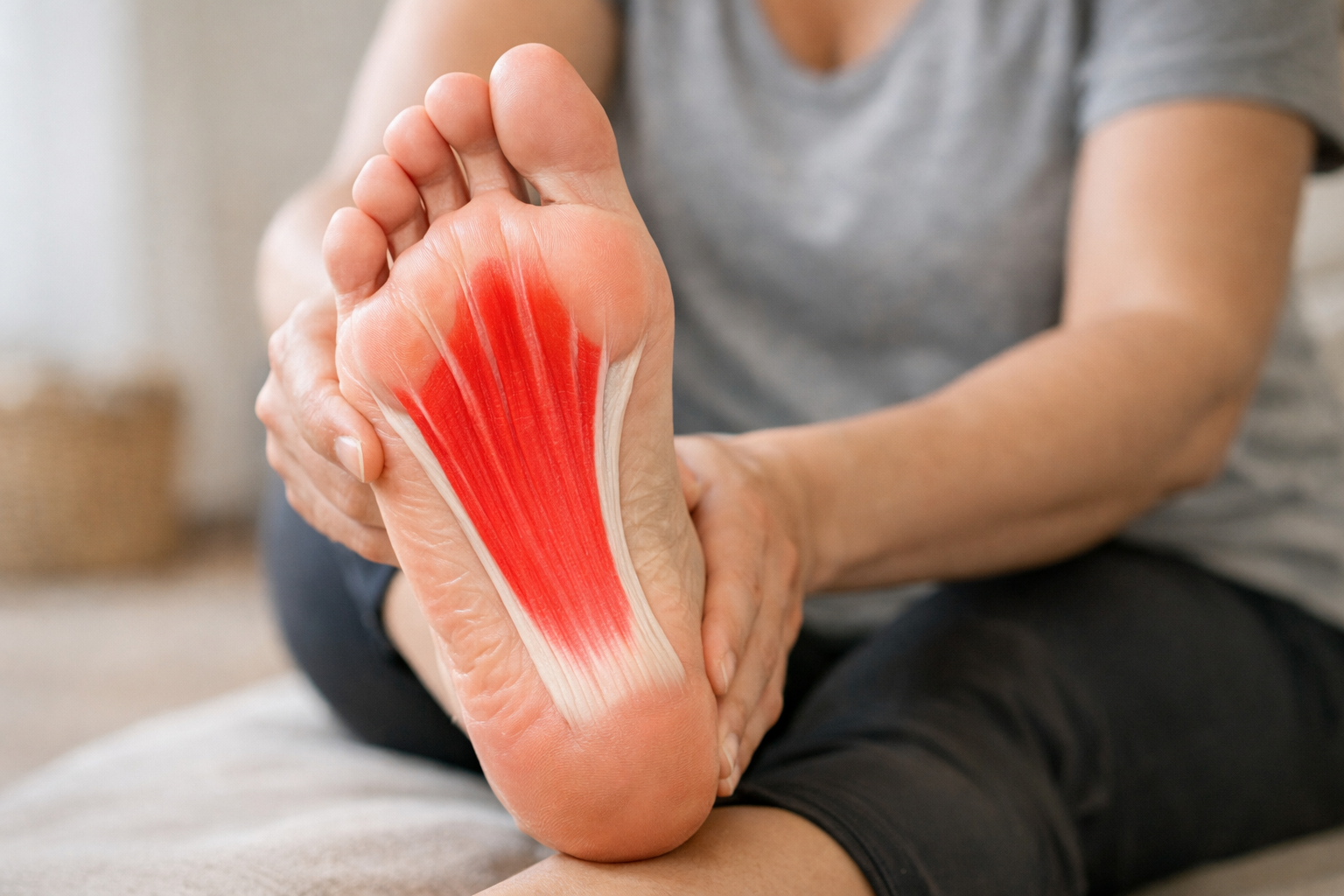
Your plantar fascia is a thick band of connective tissue running along the bottom of your foot, from the heel to the base of the toes. Every step you take, it takes tension. Walking, standing, pushing off, absorbing impact. It is built for that.
Like any tissue, it has a certain amount it can handle. Call that its capacity. Capacity is not the same thing as strength in the gym sense. It is the ability of that specific tissue to tolerate a specific task, repeated, over time. A foot that can handle a 30-minute walk is not automatically a foot that can handle eight hours on a concrete floor.
Problems start when the demand crosses over what the tissue can currently tolerate, and stays there. Not once. Repeatedly, without enough recovery in between.
So when we talk about the causes of plantar fasciitis, we’re really talking about two separate questions:
- What raised the demand on the bottom of your foot?
- What lowered, or failed to build, your foot’s ability to handle it?
Almost every recognized risk factor fits into one of those two columns.
Things That Raise the Demand
Doing more, faster than the tissue can adapt
This is the most common story I hear, and it usually doesn’t sound dramatic when it’s described.
A runner adds mileage. Or keeps the mileage the same but adds hills, or speed work, or switches from a treadmill to pavement. A person starts a walking routine after years of not walking much, and does well with it, so they extend it. Someone takes a trip and covers 15,000 steps a day for five days straight when their normal is 4,000.
None of those are mistakes. They’re all reasonable things to do. The issue is rate of change. Tissue adapts, but it adapts on its own schedule, generally over weeks, not days. When the jump in demand outpaces the adaptation, the fascia spends a stretch of time working above what it’s built for.
A change in what’s on your feet
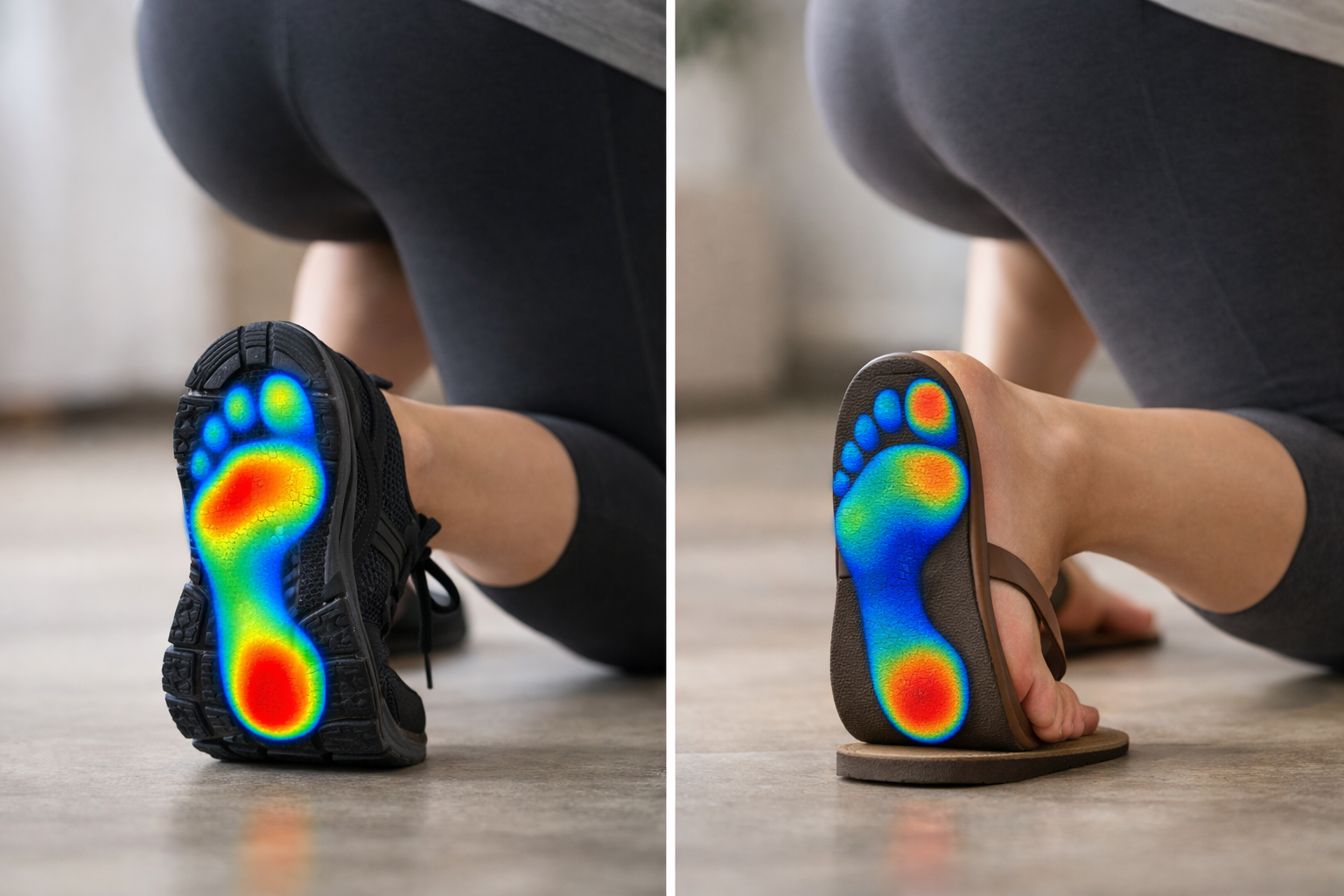
Footwear changes the distribution of load, not the total amount. But redistribution matters.
Switching from a supportive work shoe to flat sandals for the summer changes how much work the bottom of your foot does per step. Going from a cushioned trainer to a minimal shoe does the same, faster. So does the opposite, sometimes. Barefoot on hardwood at home after a lifetime in slippers counts too.
The shoe itself is rarely the villain. The abruptness is the problem. A foot that has been doing a job one way for years needs time to learn a new way.
Standing and walking surfaces
A standing job is a plantar fascia load, all day, in small doses. So is a warehouse floor, a hospital shift, a teaching day, a kitchen. Concrete returns more force to you than grass does.
This is not a reason to quit your job. It is a reason to recognize that your foot’s daily baseline load is already high before you add anything else, which changes how much room you have left for a workout or a long errand day.
Total load, not just exercise load
Here’s the part that catches people. Your foot doesn’t keep separate accounts for exercise and life. It adds everything together.
The exercise session. The grocery store. The dog walk. The two hours cooking. The airport. It’s all one number. Which is why a person can be doing exactly the same rehab exercises on Monday and Thursday and feel fine on one day and sore on the other. The exercise didn’t change. The rest of the day did.
Symptoms can also lag. Something you did on Saturday can show up Monday morning. If you only look at what you did right before the pain, you’ll blame the wrong thing constantly.
Body weight as a load variable, not a judgment
More body mass means more force through the fascia per step. That’s mechanics, and it’s worth saying plainly rather than dancing around.
But it belongs in the same column as standing hours and mileage: it’s an input to total load, not a personal failing, and it’s not the whole story. Plenty of lean runners develop heel pain. Plenty of heavier people never do. What matters is the relationship between what’s being asked of the tissue and what the tissue is currently prepared for, and you have more levers on that relationship than one.
Things That Lower the Capacity
Time off, injury, or illness
Capacity is not permanent. Tissue responds to what you ask of it, in both directions. An offseason, a long illness, a few months where life got busy, a knee surgery that kept you sedentary: any of these lower what your foot can comfortably handle, quietly, without symptoms.
Then you go back to your old activity level. The activity didn’t increase. Your tolerance for it decreased. Same mismatch, arrived at from the other side.
Rest equals rust is a blunt way to put it, but the mechanism is real.
Calf and ankle stiffness
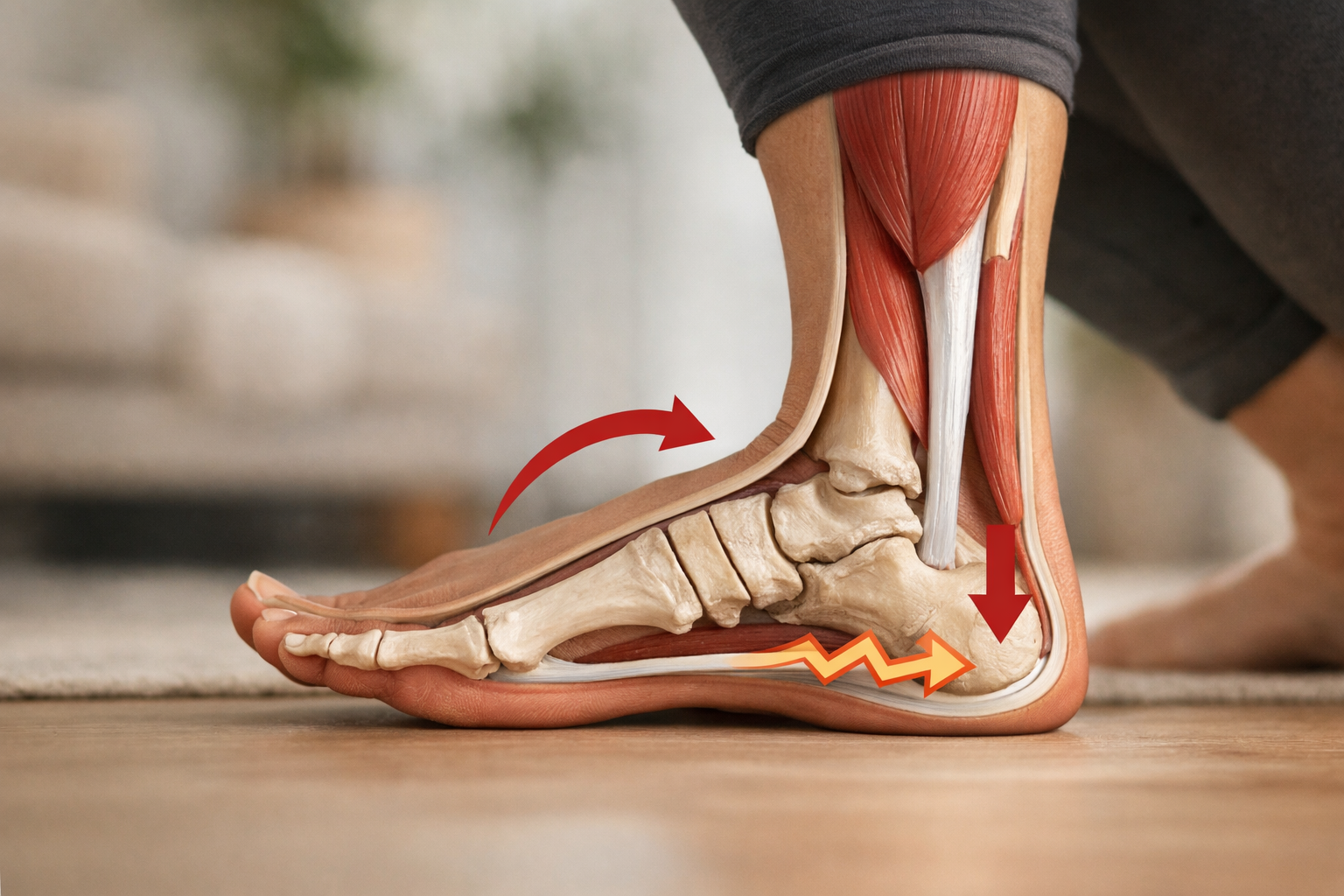
A stiff calf or Achilles limits how far your ankle bends forward as you walk. When the ankle gives you less motion, the midfoot and the fascia tend to take up more of it, and the heel gets loaded earlier and longer in each step.
This is one of the more consistent findings associated with plantar heel pain. It’s also one of the more workable ones.
Weak or under-trained foot and lower leg muscles
The small muscles of the foot and the calf complex share the job with the fascia. When they’re capable, the fascia carries less. When they aren’t, it carries more.
Most of us have never intentionally trained our feet. We’ve trained around them.
Foot shape and mechanics
Flat feet, high arches, a leg length difference, the way your foot rolls in during stance: these come up in every article about plantar fasciitis causes, and they do matter. They influence how the load is distributed.
But here’s the caution. Millions of people have flat feet and no heel pain. The shape of your foot has been the same for decades and the pain started in March. So the shape isn’t the trigger. It’s a background condition that can make a given amount of walking cost your fascia more than it costs someone else’s. It shifts the threshold, it doesn’t set the date.
That distinction matters, because foot shape is the part you can change least, and the loading history is the part you can change most.
“Why Do You Suddenly Get Plantar Fasciitis?”
The suddenness is usually in the symptoms, not the process.
Tissue tolerates being loaded slightly beyond its comfort zone for a while without complaining. It absorbs the excess. It accumulates. And then one morning you stand up and the first few steps feel like a bruise under your heel, and it seems to have come from nowhere.
It didn’t. It came from the preceding weeks. If you look back honestly, you can often find the shift: the new job started six weeks ago, the shoes were replaced in April, the mileage went up before the race, the walking picked up when the weather got nice. Occasionally there’s a single big day that tipped it, but even that day landed on a foot that was already running close to its limit.
So when people say it appeared overnight, what I hear is that the warning phase was silent. That’s normal. It doesn’t mean something is structurally wrong in a way that can’t change.
Why Only One Foot?
This is one of the most common questions, and it’s a good one, because it seems to undercut the whole load explanation. You walk on both feet. Why did only one break down?
A few reasons, usually.
Your two legs aren’t doing identical work. Most people have a side they favor for pushing off, standing, taking stairs. It’s subtle and you don’t feel it. Over tens of thousands of steps, subtle adds up.
One side is stiffer or weaker than the other. An old ankle sprain, a knee that doesn’t fully straighten, a hip that doesn’t extend well. The other side compensates, and compensation is just load with a nicer name.
One side started from a lower point. Previous injury on that side, or more time immobilized, means less capacity going into the same activity.
Chance. Sometimes one side crossed the threshold first, and the other one was close behind and you caught it in time.
Plantar fasciitis can absolutely occur in both feet, and when it does, it often points toward something systemic in the load picture: a big jump in standing hours, a substantial change in activity, a footwear change affecting both sides equally. Bilateral heel pain, especially in a younger person or when it comes with joint pain, stiffness elsewhere, or symptoms in the back or other joints, is also worth mentioning to a clinician, because a handful of inflammatory conditions can present that way. That’s not a reason for alarm. It’s a reason for a proper look rather than an assumption.
Can Plantar Fasciitis Be Just in the Heel?
Yes, and that’s the most typical presentation. The fascia’s attachment point at the inside of the heel bone is where tension concentrates, so that’s where the tissue most often becomes sensitive. Many people never feel anything along the arch at all.
Others feel it spread through the arch, or feel a tight, ropey ache along the bottom of the foot after a long day. Both patterns can be consistent with plantar fasciopathy, which is the more accurate term for the persistent version of this problem. It reflects a change in the tissue’s structure and tolerance more than an ongoing fire of inflammation, which matters because it points treatment toward rebuilding rather than just calming.
What Gets Mistaken for Plantar Fasciitis?
Heel pain gets labeled plantar fasciitis by default, and it’s right often enough that the default is reasonable. It’s not right always.
Other things that can look similar:
- Fat pad irritation or thinning. Pain sits more in the center of the heel, feels more like a deep bruise, and often hurts most on hard surfaces rather than specifically in the first steps of the morning.
- Nerve irritation. Entrapment of a small nerve branch near the inside of the heel can cause burning, tingling, or pain that doesn’t follow the usual first-step pattern. Nerve irritation coming from the low back can also refer into the foot.
- Achilles or insertional tendon problems. Pain at the back of the heel rather than underneath.
- A stress reaction in the heel bone. Worth considering when pain is worsening steadily despite sensible load management, is present with most weight bearing, and follows a significant jump in running or marching.
- Inflammatory arthritis. Especially with both heels involved, morning stiffness that lasts a long time, or symptoms in other joints.
The practical point: if your heel pain doesn’t behave the way plantar fasciitis usually behaves, or it isn’t responding at all to reasonable changes over several weeks, that’s information. It’s worth getting evaluated rather than continuing to treat an assumption.
What About the Heel Spur?
Someone gets an X-ray, sees a spur, and reasonably concludes that the pointy thing is stabbing them. It’s an intuitive story and it’s almost always wrong.
Spurs form in response to long-term tension at the attachment. They’re a footprint of stress, not the source of pain. Plenty of people have spurs and no symptoms at all. Plenty of people have significant heel pain and no spur. And recovery looks about the same either way.
Same with a thickened fascia on ultrasound. Thickening reflects tissue that’s been adapting to stress. It tells us something about what the tissue has been through. It does not sentence you to anything. A scan can show structural changes, but it doesn’t always tell us why you hurt.
How Do You Make Plantar Fasciitis Go Away?
Since the problem developed from a mismatch between demand and capacity, it resolves by closing that gap. There are only two directions to work from, and most people who improve work from both.
Bring the demand down, temporarily and partially. Not to zero. Reduce the specific things that spike it: cut the long walk in half, change the shoe back to what worked, trim the running volume, break up standing time where you can. The goal is to get your daily total under the level that keeps the tissue irritated, so it can settle enough to be trained.
Then bring the capacity up, deliberately. This is the half that gets skipped, and it’s the half that determines whether the pain stays gone when you go back to your life. Loading the fascia and the calf progressively, over weeks, is what changes what the tissue can tolerate. Stretching and rest reduce sensitivity while the foot isn’t being asked to do much, which is exactly why symptoms often return the moment normal activity does. Comfort came back. Capacity didn’t.
A few principles that tend to hold for most people:
- Some discomfort during loading is usually acceptable. A common working guideline is keeping it at or below roughly a 4 out of 10 during and after, with symptoms settling back to your normal baseline within about a day.
- Stay at a given level long enough to adapt before advancing. Adding difficulty every session is how people ride a flare-up loop for months.
- Meaningful structural change tends to take something like 8 to 12 weeks, often longer if the problem is well established. Early improvements in the first couple of weeks are real but mostly reflect your nervous system settling down, not the tissue being rebuilt.
- Judge progress by what you can do, not only by the pain number. Walking farther before symptoms show up, recovering faster the next morning, standing through a shift: those count.
Recovery is built. The calendar gives you structure, but how your foot responds is what tells you what comes next.
Does Plantar Fasciitis Ever Go Away?
For most people, yes, in the sense that matters: it stops limiting what you do, and it stops occupying your mornings.
What I’d rather not promise is that the tissue reverts to some pristine original state, or that you’ll never feel that heel again after a heavy week. Tissue that has been through this sometimes retains a bit of memory. A long travel day or a sudden mileage jump might remind you.
That’s not relapse. That’s a foot telling you the day was big, and a foot with rebuilt capacity handles that conversation and moves on.
If you’ve had heel pain for a year or two, I want to be clear about something. Persistent doesn’t mean permanent. It usually means you’re starting from a lower point and the progression needs more patience. The path is the same, it’s just longer. Many people who’d been told to live with it improve substantially once there’s an actual plan for building back up rather than a rotating collection of things to try.
The Worst Things You Can Do
A few genuine missteps, in the sense that they predictably keep people stuck:
Complete rest as the strategy. Backing off calms irritation, and that’s useful. But a foot that hasn’t been asked to do anything for six weeks is a foot with less capacity than when you started. The pain comes back the moment life resumes, and it feels like proof that nothing works.
Pushing through hard, unchanged. The opposite error. Repeatedly loading well above what the tissue tolerates keeps it sensitized, and nothing gets a chance to adapt.
Restarting from zero every time it flares. A flare-up is not erased progress. Symptoms went up, which usually means the day was bigger than the foot was ready for, or something else changed. Look at what shifted, pull back a notch, keep going. Abandoning the plan each time you get sore is why some people spend two years at the starting line.
Chasing relief without ever building. Ice, rolling, night splints, taping, orthotics, injections: each can help in the right context, and I’ll use several of them. They manage symptoms. If nothing in your plan is progressively increasing what your foot can handle, the underlying mismatch is still there waiting for you.
What’s the Worst That Can Happen?
Honestly, not much catastrophic, which is worth hearing if you’ve been anxious about it.
The realistic worst case for most people is a long, grinding version of what they already have: heel pain that persists for many months, limits walking and standing, and changes how they move in ways that can annoy the knee, hip, or back over time. That’s a meaningful cost to quality of life. It is not tissue destruction.
Outright rupture of the plantar fascia is uncommon and is usually associated with a sudden forceful event or with repeated corticosteroid injections into the area, which is one reason those injections are used thoughtfully rather than routinely.
What should prompt a visit rather than more self-management: pain that’s steadily getting worse despite sensible adjustments, heel pain after a fall or a specific traumatic moment, numbness or tingling into the foot, significant swelling, redness or warmth, fever, night pain that wakes you, or an inability to bear weight. Also see someone if you’ve been at this for a while with no direction, because the missing piece is often not another treatment but a way to progress.
And a fair note: everything here is general reasoning. Feet are individual, and figuring out which parts of the load-and-capacity picture apply to yours is what an in-person evaluation is for.
Where This Leaves You
Go back through the last two or three months before the pain started. Look for what changed. New shoes, new job, new route, new mileage, a trip, a stretch of time off, a hill you started adding. Something shifted, either in what you were asking of your foot or in what your foot was ready for.
That’s your cause, and more importantly, that’s your first lever.