Calf Strain Recovery: Timeline, Dos and Don'ts, and Red Flags
A practical look at what calf strain recovery actually involves week by week, how to load the muscle without setting yourself back, and the warning signs that mean you should get evaluated rather than wait it out.
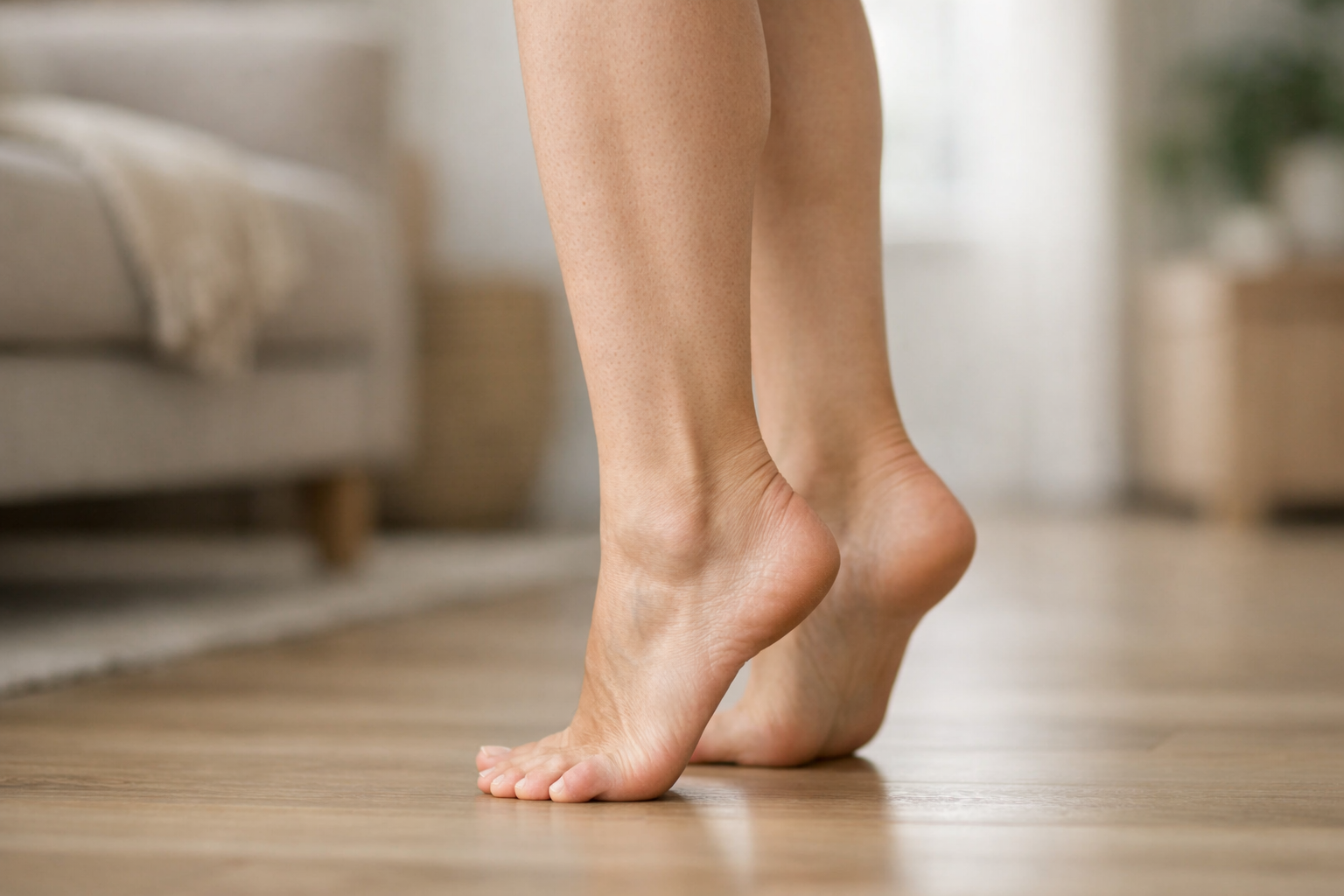
Most people who strain a calf tell me some version of the same story. It happened fast. A push off a curb, a sprint for the ball, the first hard hill on a run. Something grabbed in the back of the leg. Maybe you thought someone kicked you. You limped for a few days, it started feeling better, so you went back to normal, and then it grabbed again.
That second part is the part worth talking about. The initial injury is usually straightforward. What determines how the next two or three months go is what you do between “it stopped hurting” and “it can handle what I need it to do.” Those are not the same moment, and the gap between them is where most re-injuries live.
So let’s talk about what calf strain recovery actually looks like, day by day and week by week, and where people tend to get stuck.
What Actually Happened in There
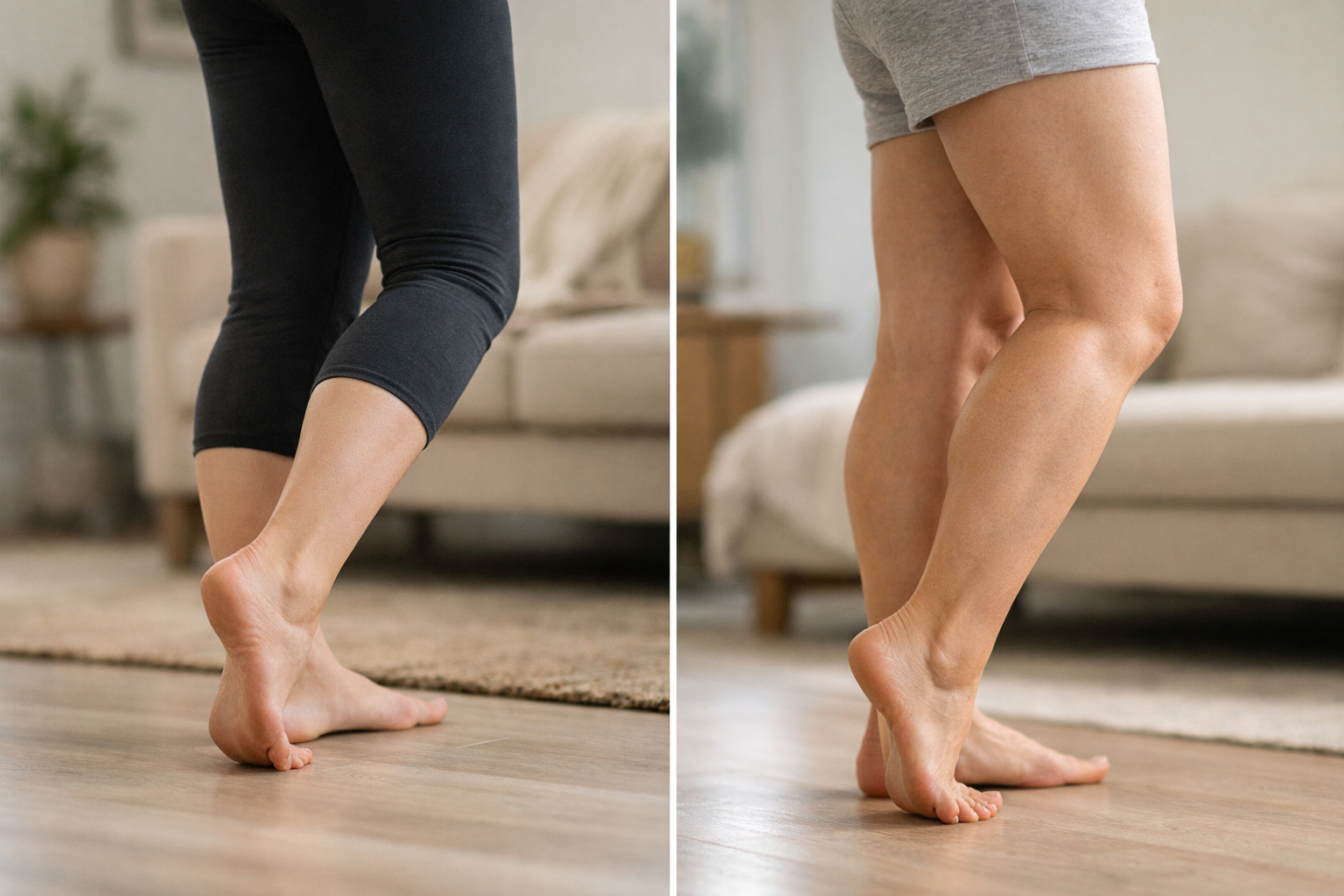
A calf strain is a muscle injury. Muscle fibers were asked to produce or absorb more force than they could handle at that instant, and some of them gave way. Usually this happens when the muscle is lengthening while it’s also contracting, which is exactly what your calf does every time your heel drops during a stride.
Two muscles make up the bulk of the calf. The gastrocnemius sits on top, crosses both the knee and the ankle, and is the one most often involved in the sudden “someone shot me in the leg” type of strain, usually right where it meets the inner part of the calf. The soleus sits underneath, crosses only the ankle, and tends to produce a duller, more gradual ache that builds over a run rather than announcing itself in one moment. That distinction matters more than it sounds. Soleus strains are often mistaken for a lingering tightness, dragged out for weeks, and are notorious for being slower to settle than people expect.
One useful thing about muscle: it has excellent blood supply. That’s a real advantage compared to tendon. It’s also why the early healing feels fast, which sets up a trap.
How Long Does a Calf Strain Usually Last?
Honest answer: it depends on how much tissue was involved and what you need to get back to.
The common ranges you’ll see quoted are roughly:
- Mild strain (a small number of fibers): discomfort settles substantially over about one to three weeks.
- Moderate strain (a partial tear, clear pain, visible bruising, a real limp): often four to eight weeks before full activity feels genuinely available.
- Severe strain (a large or complete tear): several months, and this one warrants an in-person evaluation.
Those numbers are useful for calibrating expectations, and they’re also incomplete. They describe when tissue healing is largely done. They don’t describe when your calf can absorb repeated impact at speed without complaining. A runner and someone who mostly walks the dog have the same tissue healing but very different finish lines.
Here’s the piece the timeline charts leave out. Pain typically resolves well before capacity returns. You can be walking normally, stairs feel fine, no morning stiffness, and the muscle still cannot tolerate forty minutes of running or a full basketball game. That’s not a failure of healing. It’s just that comfort and capability are two different measurements, and only one of them shows up in how you feel on a Tuesday afternoon.
Why Do Calf Muscles Take So Long to Heal?
They often don’t, in a tissue sense. What takes long is getting them back to full duty, and there are a few reasons for that.
Your calf does more work per step than almost any other muscle group in your body. Walking asks it to control your body weight over a small base. Running asks for several times your body weight, thousands of times per session. Even standing still involves constant small corrections. There’s no such thing as resting your calf while going about a normal day, which means the tissue is being loaded during healing whether you plan for it or not.
Then there’s the fact that you can’t easily avoid using it. A strained hamstring can be protected by walking a bit slower. A strained calf gets used with every step to the bathroom. So the daily background load stays high while the tissue’s ability to handle load is temporarily lower.
And finally, the demand at the end of recovery is enormous compared to the demand at the beginning. Getting from “can’t walk without limping” to “walks fine” is a small climb. Getting from “walks fine” to “can sprint and change direction” is a much bigger one, and most people stop building right at the base of that second climb.
How to Tell If a Calf Muscle Is Torn or Strained
Technically, a strain is a tear. Grade one, two, and three are just descriptions of how much tissue is involved. But when people ask this question, they usually mean: is this the ordinary kind, or the kind that needs a doctor today?
Some patterns that suggest a more significant injury:
- You couldn’t put weight on the leg at all right after it happened.
- Substantial bruising appeared over the next day or two, sometimes tracking down toward the ankle.
- There’s a visible dent, gap, or an obvious change in the shape of the calf.
- You can’t push off, rise onto the ball of that foot even a little, or the heel raise strength difference between sides is dramatic.
- Pain is severe and not improving at all over several days.
Bruising alone isn’t alarming. Blood follows gravity, so a strain in the belly of the calf can produce a colorful ankle a few days later, and that’s usually just the body doing what it does.
What Does a Torn Tendon Feel Like in Your Calf?
Different enough that it’s worth knowing. An Achilles rupture usually announces itself with a distinct pop or snap low in the leg, just above the heel, often described as being struck from behind even when nobody’s there. Weight bearing is usually possible in a strange, unstable way, but pushing off is not. You typically cannot rise onto your toes on that leg at all.
A calf muscle strain tends to hurt higher up, in the meaty part of the leg, and while pushing off hurts, some ability to do it usually remains.
If you’re unsure which one you’re dealing with, that’s not a wait-and-see situation. Get it looked at. The distinction changes the plan entirely, and we’ve written more about sorting out the two in “Calf Strain or Achilles Injury? Why Location Changes Treatment.”
Is It Okay to Walk on a Strained Calf?
Usually yes, and usually sooner than people assume.
The useful question isn’t “should I walk” but “how much, and how does it respond?” If you can walk with a reasonably normal pattern, meaning you’re not lurching, hopping, or locking the knee to avoid using the calf, walking is generally helping. Gentle load early on tends to guide healing tissue in a more organized direction than complete stillness does.
If you can only walk by dramatically limping, that’s a signal to shorten the distance, slow down, or use a crutch or a heel lift for a few days until the pattern smooths out. Limping isn’t just uncomfortable. It reassigns the work to your other leg, your hip, and your lower back, and those places will eventually send you their own bill.
A practical way to judge: keep discomfort during walking at or below roughly a 4 out of 10 for most people, and pay attention to how the calf feels the next morning. If it’s about the same or better, that amount of walking was reasonable. If it’s clearly worse and stays worse, that was too much for right now. Not damaging. Just too much for right now.
How to Heal a Calf Strain Faster
Nobody can compress tissue healing beyond what biology allows. What you can do is remove the things that slow it down and add the things that build capacity efficiently. That combination is what makes the difference between an eight-week recovery and a five-month one.
The first few days
Calm things down without shutting things down. Compression from a sleeve or wrap often feels good and can help with swelling. Ice is fine if it makes you more comfortable, though it’s a comfort measure rather than a healing accelerator. Elevate when convenient. Avoid the temptation to test it repeatedly by stretching it, poking it, or trying to reproduce the pain to see if it’s still there. That test tells you nothing useful and irritates the tissue.
A temporary heel lift in both shoes can take some strain off during this window, which helps you walk more normally. Both shoes, not one, so you don’t create a leg length difference and trade one problem for another.
Keep moving in ways that don’t hurt. Ankle circles, gentle pumping, walking within your comfortable range. This is the small dose of rest that helps. The large dose is where trouble starts.
Should I Stretch Out a Calf Strain?
Not aggressively, and not early.
When a muscle has torn fibers, pulling those fibers apart is not what they need. Early aggressive stretching often makes the area more irritable and can extend the timeline. The tightness you feel in the first week or two is usually protective, not a shortening problem to be pulled out.
Gentle range of motion, moving the ankle through a comfortable arc without pushing into pain, is a different thing and is generally fine right away. Real stretching, taking the calf toward end range and holding, makes more sense once the tissue tolerates load, and even then it works best paired with strengthening rather than on its own. Stretching reduces how sensitive the area feels for a while. It doesn’t change what the muscle can handle. That’s why the relief tends to be short lived and the symptoms come back when you go back to running.
The part that actually changes the outcome
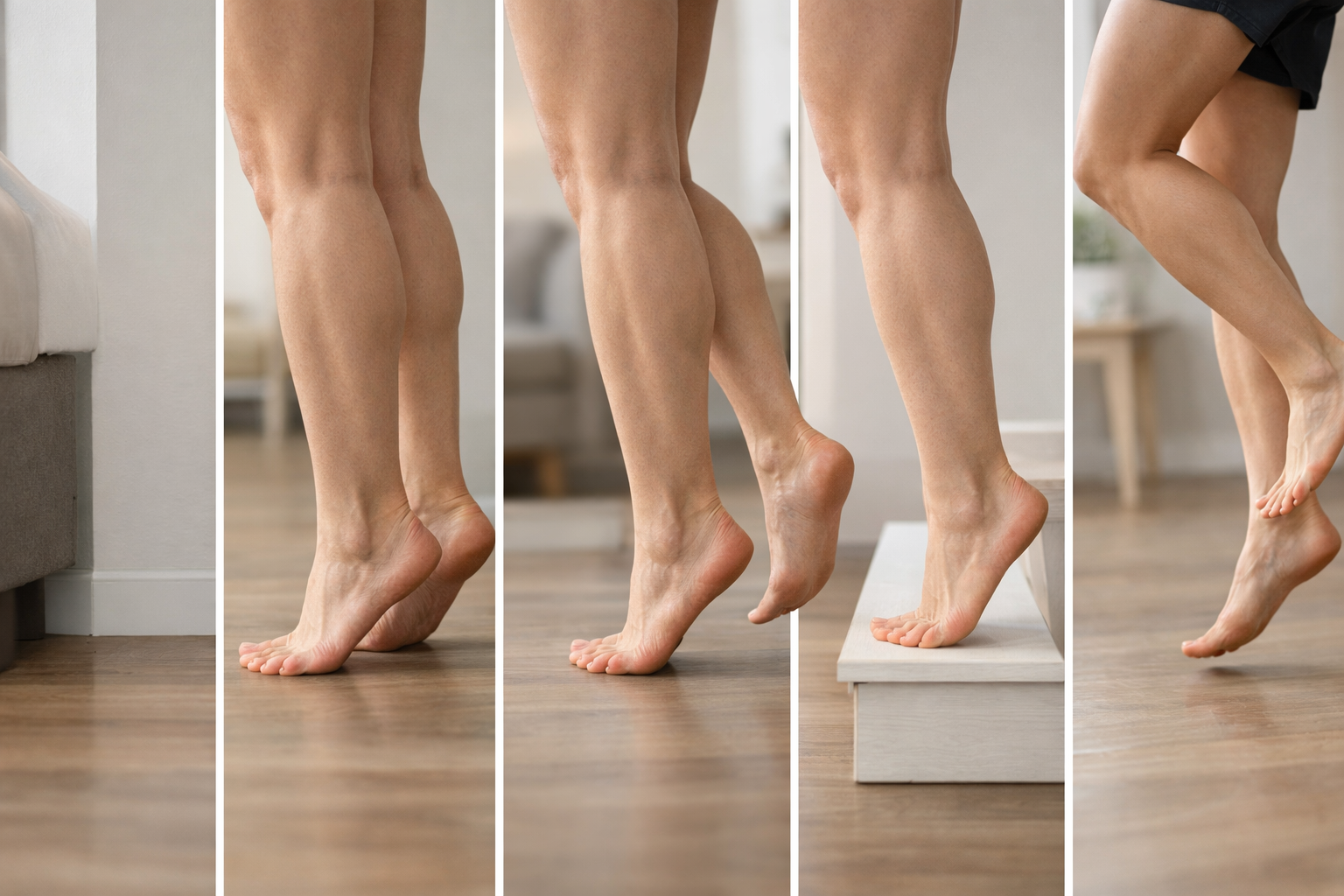
Strengthening, started early at a level the calf can handle, and increased gradually over weeks.
Recovery is built. Not waited out. The muscle needs progressively more demanding work to rebuild the tissue quality and force capacity it lost, and that process runs on a schedule of weeks to a couple of months, not days.
A typical progression looks something like this, though the specifics should be shaped around how your leg responds:
- Isometrics. Pushing into a wall or the floor with the foot, holding, no movement. Often tolerable within days, sometimes reduces pain, and starts loading the muscle without asking it to lengthen under tension.
- Double-leg heel raises. Both feet, flat ground, controlled up and controlled down. The lowering half matters more than most people think.
- Single-leg heel raises. Flat ground first. This is a big jump in load, so expect to spend real time here.
- Adding range. Heel raises off a step, letting the heel drop below level. This loads the muscle in its lengthened position, which is precisely the position it failed in.
- Adding speed and impact. Hopping, skipping, gradual return to running or sport-specific movement.
- Bent-knee work. Heel raises with the knee bent target the soleus specifically, and if that’s the muscle you strained, this step isn’t optional.
The skill is not in knowing the exercises. It’s in knowing when to move to the next one. A reasonable general rule: stay at a level long enough that it becomes genuinely easy, and only advance when the previous level no longer causes a meaningful next-day reaction. For many people that means several sessions at each stage rather than a day or two, and structural change in tissue typically needs something in the range of eight to twelve weeks of consistent loading to really take hold.
Consistency beats intensity here. Three moderate sessions a week for two months does more than one heroic session followed by five days of soreness.
Total Load Is the Whole Picture
Here’s something people miss constantly. Your calf doesn’t know the difference between rehab exercises and life. It just adds everything up.
If you did your heel raises, then walked the airport, then stood at a wedding for four hours, your calf experienced all of that as one large day. When symptoms flare the next morning, the exercises get blamed because they’re the deliberate part. Often they weren’t the problem.
So when you’re tracking your response, track the whole day. Steps, standing, stairs, the shoes you wore, whether you were carrying something heavy. Symptoms also lag. A hard day on Saturday might show up Sunday evening or Monday morning, which makes cause and effect harder to spot unless you’re paying attention across a couple of days rather than a couple of hours.
How to Know You’re Actually Progressing
Pain level on its own is a noisy signal. It moves with sleep, stress, weather, how much you did yesterday. Better markers:
- You walk farther before you notice it.
- The first few steps in the morning settle faster than they used to.
- You need less time to recover after a hard day.
- You can do more heel raises, or heavier ones, or through more range.
- Something that used to trigger it (a hill, a flight of stairs) now doesn’t.
Someone can still have some discomfort and be clearly getting better. Function matters as much as pain. If the number on the pain scale is flat but you’re walking twice as far to get there, you’re moving in the right direction.
A Flare-Up Is Not a Setback
At some point during this, you’ll do something and the calf will complain. This is normal and expected. It does not mean you re-tore it, and it does not erase the previous six weeks.
When it happens, don’t panic and don’t stop everything. Ask what changed. Longer distance? Faster pace? New shoes? A big day on your feet followed by an exercise session? Then dial back to the last level that felt manageable, spend a few days there, and rebuild forward. The trend over a month matters far more than any single bad day.
What would concern me is different: a new sudden onset of sharp pain during a specific movement, a return of significant weakness, or symptoms that keep climbing over a week or more despite backing off. That’s worth an evaluation rather than an adjustment.
My Calf Strain Isn’t Healing. What Should I Do?
If you’re months in and stuck, a few possibilities are worth considering.
You’ve been resting more than loading. This is the most common one by far. Rest reduces sensitivity while the tissue is unloaded, so it feels like progress, and then pain returns the moment you go back to activity because nothing about the muscle’s capacity changed. Rest equals rust. The calf has to be rebuilt, not just protected.
You progressed too fast, repeatedly. A cycle of feeling good, jumping back into full activity, flaring, resting, and repeating can go on for a long time without any net gain. Each round feels like starting over because, functionally, it is.
You never loaded it hard enough. Doing two sets of ten heel raises on flat ground indefinitely is maintenance, not progression. Running asks your calf for far more force than that. If the rehab never approaches the demand of the activity, the gap remains.
It isn’t a calf strain. This is worth taking seriously. A soleus strain can be missed because it presents so quietly. A tendon problem at the Achilles or where the muscle meets the tendon behaves differently and responds to a different plan. Nerve-related symptoms from the back or a compressed nerve in the leg can produce calf pain that no amount of calf strengthening will resolve. Chronic exertional compartment syndrome produces predictable tightness and pain at a specific point in a run that eases with stopping. And in a small number of cases, calf pain has a vascular cause.
An evaluation sorts this out fairly quickly. A few strength tests, a look at how you move, and some questions about the pattern of symptoms usually narrow the field considerably.
Preventing the Next One
A previous calf strain is one of the better predictors of a future calf strain, and the reason is usually straightforward. The muscle was returned to full activity before it was returned to full capacity.
The things that help most:
- Finish the rehab. Not when it stops hurting. When strength, endurance, and tolerance for your actual activity are back. Comparing single-leg heel raise capacity side to side, both in strength and in how many you can do before fatigue, is a reasonable practical checkpoint.
- Respect the ramp. Sudden jumps in training volume, a new hill route, switching to a much lower-heeled shoe, or starting a job where you’re standing all day all shift the demand on the calf quickly. Change one thing at a time.
- Keep loading it after you’re better. Calf work isn’t just rehab, it’s maintenance for anyone who runs or is on their feet a lot.
- Look above and below. Hip strength, ankle mobility, and how you’re moving all influence how much your calf has to absorb.
Body weight, occupation, and footwear all factor into total load on the system too. That’s not a judgment, it’s just arithmetic. More demand on the tissue means the capacity side of the equation needs to be built accordingly.
When to Get It Looked At
See a clinician if:
- You couldn’t bear weight after the injury, or still can’t several days later.
- You felt a distinct pop and cannot rise onto your toes on that leg.
- There’s a visible gap or deformity in the muscle.
- Symptoms are worsening over time rather than gradually improving.
- You have calf swelling, warmth, redness, or pain that came on without any clear injury, particularly after surgery, long travel, or a period of immobility. That combination should be evaluated promptly, since a blood clot can present this way.
- You’re weeks or months in and going in circles.
Most calf strains recover well. What separates the ones that recover cleanly from the ones that drag on for a year isn’t the severity of the original injury nearly as often as it’s whether anyone built a plan for getting the muscle back to full capability, and then followed it long enough for the tissue to catch up.