Calf Stretches That Actually Help: How to Reduce Tension and Build Capacity
A practical guide to calf stretches that explains why stretching alone often gives short-lived relief, how to perform the key stretches safely step by step, and how to pair them with gradual strengthening so your calves can handle walking, standing, and stairs again.
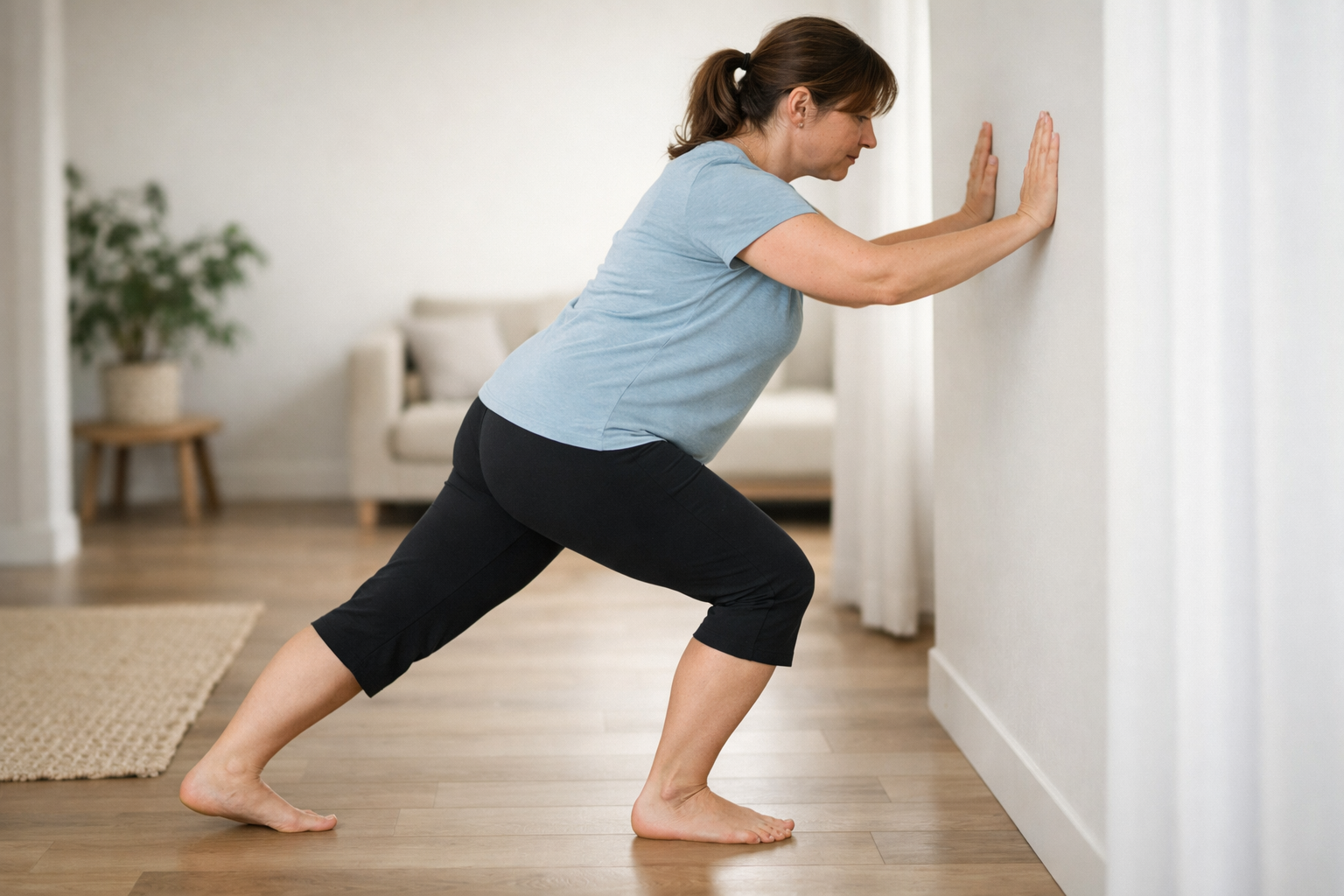
You stretch your calf against the wall. It feels better. Twenty minutes later, or the next morning, the tightness is back exactly where it was.
That frustration is one of the most common things I hear. People are not doing the stretch wrong. Most of the time they’re doing it fine. The issue is that stretching addresses how sensitive and stiff the tissue feels right now, and that’s a different problem from what the calf can actually handle over the course of a day.
Both matter. Let’s talk about how to stretch well, and then what stretching alone tends to leave undone.
Why your calves feel tight in the first place
A tight-feeling calf isn’t always a short calf.
Sometimes it truly is limited motion. The ankle doesn’t bend as far as it used to, and you can feel a hard stop when you try to bring your knee forward over your toes. That’s a range-of-motion issue, and stretching helps.
Often, though, tightness is a protective sensation. The calf is being asked to do more than it currently has the capacity for. Standing all day on concrete. A new job. A sudden jump in walking after a mostly seated winter. Vacation in flat sandals when you normally wear a shoe with a bit of heel. The muscle and tendon respond by feeling stiff, guarded, and achy. Stretching that tissue feels wonderful because it temporarily turns the volume down on sensitivity. Then load returns, and so does the tightness.
This is the same reason heel pain often comes back the moment you get busy again. Unloading calms things. It doesn’t build anything.
Signs of tight calves
People usually notice this in ordinary moments rather than during exercise:
- Stiffness in the back of the lower leg during the first few steps in the morning, easing after you move around
- Heel or arch pain when you first stand up, especially after sitting for a while
- A pulling or cramping feeling in the calf on hills, stairs, or long walks
- Difficulty squatting down with your heels flat on the floor
- Walking with your foot turned out, or feeling like you roll off the inside of the foot
- Trouble getting your heel down comfortably in flat shoes when you’re used to a heel
- Recurring Achilles soreness, calf cramps at night, or shin discomfort with running
- Limited ability to bring your knee forward over your toes without your heel lifting
A quick self-check many people find useful: stand facing a wall, place your foot about four inches back from it, and try to touch your knee to the wall while keeping your heel down. If your heel pops up or you feel a hard block, ankle motion is likely part of the picture. If you can do it easily but your calf still aches all day, tightness probably isn’t the main story. Capacity is.
The two muscles you’re stretching (and why the difference matters)
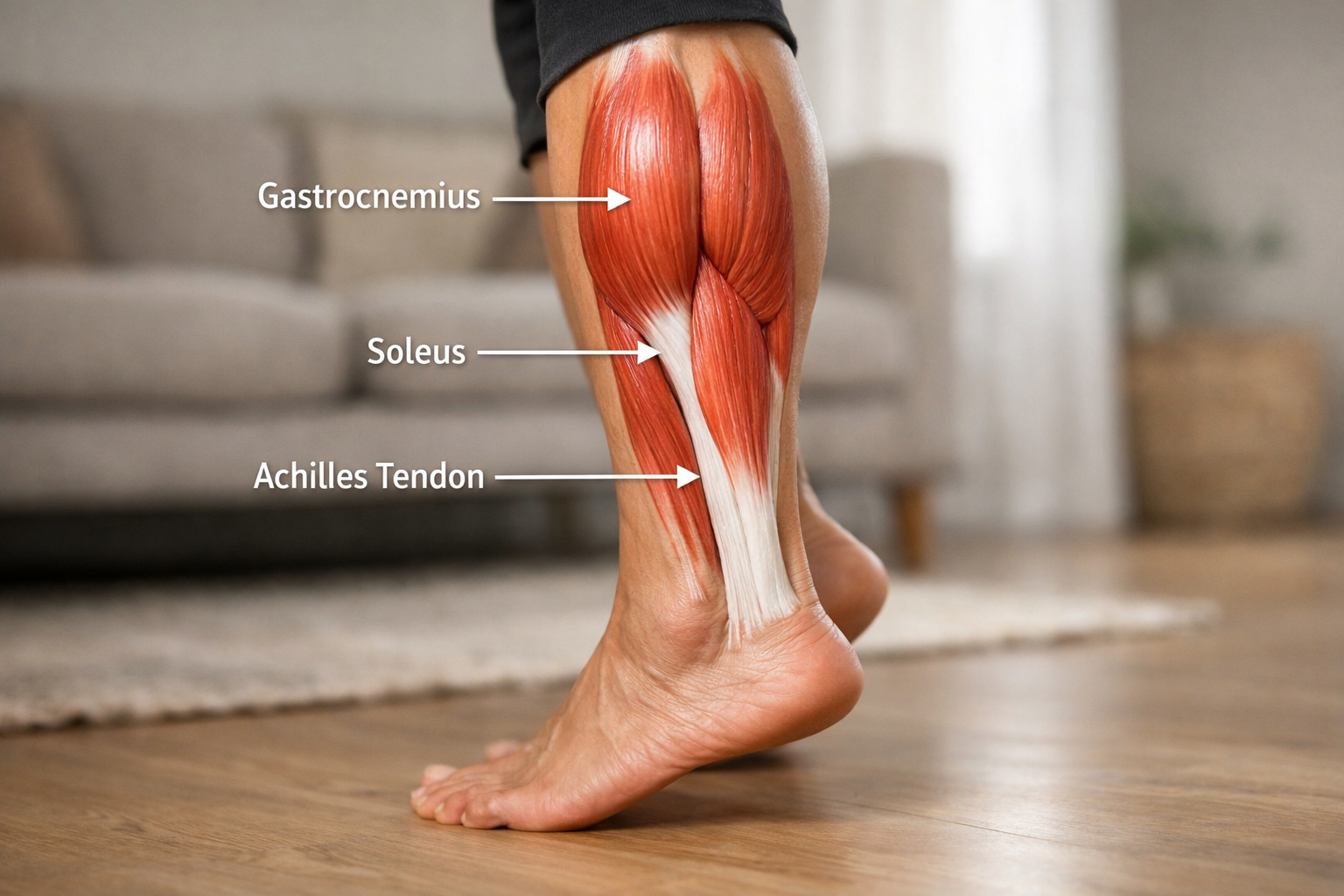
Your calf has two main players.
The gastrocnemius is the visible, diamond-shaped muscle high in the calf. It crosses behind the knee, so it only gets a real stretch when your knee is straight.
The soleus sits underneath and lower down. It doesn’t cross the knee. That means it gets stretched with the knee bent, and it’s easy to miss entirely if every stretch you do involves a straight leg.
Both feed into the Achilles tendon, which attaches to the heel bone. The plantar fascia along the bottom of your foot connects to that same area. That’s why calf stiffness, Achilles soreness, and heel pain so often travel together, and why calf work matters in what can be consistent with plantar fasciopathy (the more accurate name for persistent plantar fasciitis).
If you stretch only with a straight knee, you’re doing half the job.
How to stretch your calves yourself, step by step
No equipment needed beyond a wall, a chair, a step, and maybe a towel.
1. Wall calf stretch (gastrocnemius)
- Face a wall and place both hands on it at about chest height.
- Step one foot back roughly two to three feet. Keep that back knee straight and the toes pointing forward, not turned out.
- Press the back heel down toward the floor.
- Bend the front knee and lean your hips toward the wall until you feel a firm pull in the upper calf.
- Hold. Breathe. Don’t bounce.
Common error: letting the back heel drift up or the foot rotate outward. Both let the calf off the hook.
2. Bent-knee wall stretch (soleus)
Same setup, but bring the back foot in closer, maybe a foot behind you, and bend that back knee while keeping the heel pressed down. The stretch moves lower, closer to the Achilles. It feels less dramatic than the straight-leg version. It’s often the more useful one for heel pain.
3. Step or curb stretch
Stand on a step with the balls of both feet on the edge, holding a rail. Let your heels drop below the level of the step. Do a set with knees straight, then a set with knees slightly bent.
This one gives a deeper stretch, which also means it’s easier to overdo. If your heel or Achilles is currently irritable, start with the wall versions instead, or drop only one heel at a time while the other foot carries some weight.
4. Seated towel stretch
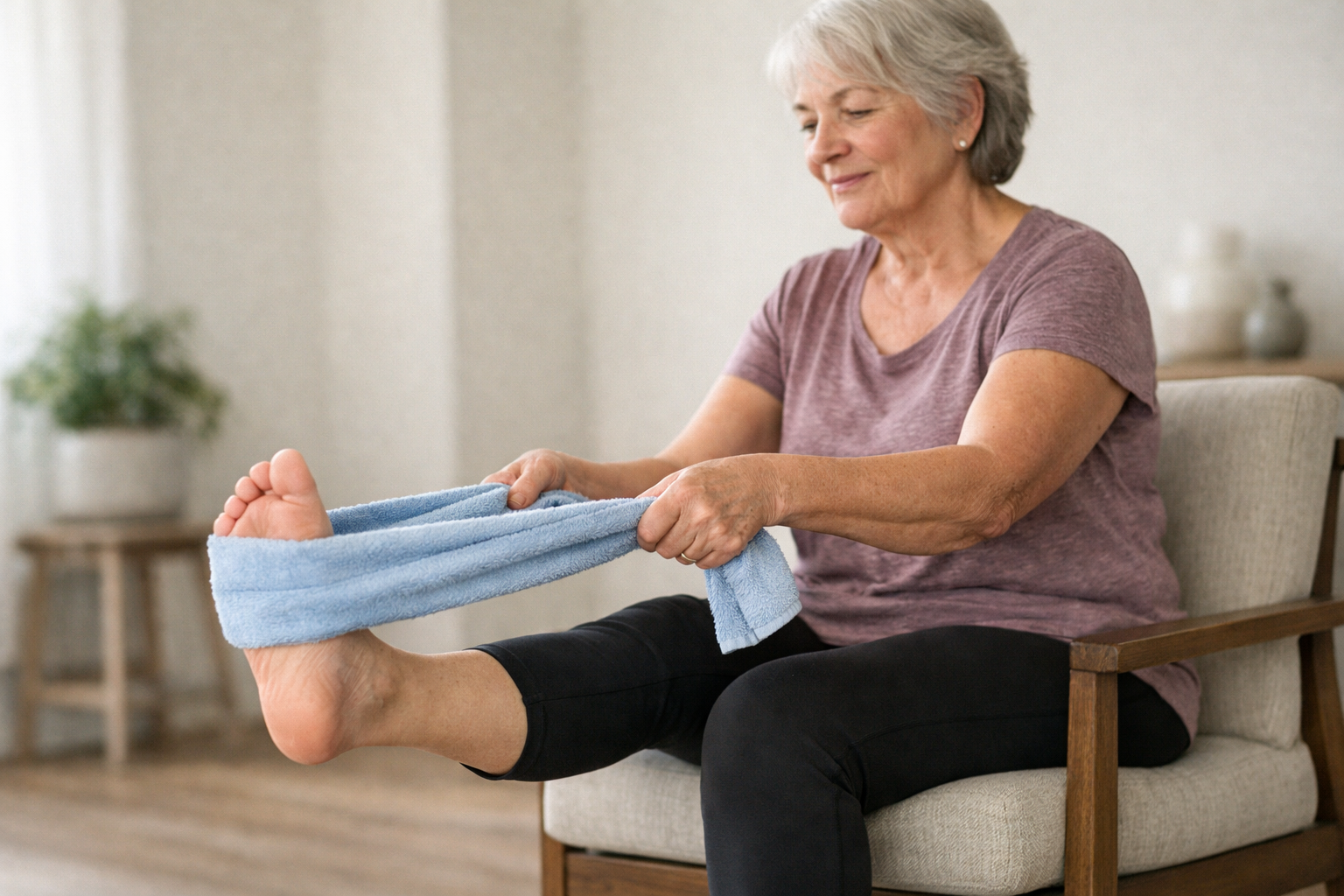
Sit with your leg straight out in front of you. Loop a towel, belt, or resistance band around the ball of your foot and gently pull your toes toward you, keeping the knee straight. Good for mornings before you stand up, and good if balance is a concern.
5. Standing on a slant or a rolled towel
Rolling a towel under the ball of your foot, or standing on a wedge, lets you hold a low-level stretch while doing something else, like brushing your teeth. Low intensity, easy to repeat.
How long and how often
For most people, holding each stretch around 30 to 45 seconds, two to three times per side, once or twice a day, is a reasonable place to start. Longer holds aren’t automatically better.
Two guardrails I use with almost everyone:
- Keep the intensity at or below about a 4 out of 10. A stretch should feel like a firm pull, not a sharp or nervy pain. Straining harder does not speed anything up.
- Check in about 24 hours later. If you feel roughly the same as before, or better, that dose was fine. If you’re noticeably more sore the next morning and it stays that way, the dose was too much. Back off a level, not all the way to zero.
How do you loosen tight calf muscles when stretching isn’t enough?
Here’s where I’d push back gently on most calf-stretching advice.
Stretching changes sensitivity fairly quickly. It does not do much to change what the tissue can tolerate. Muscle and tendon respond to being loaded, gradually and repeatedly, over weeks to months. That’s the part people usually skip, because as soon as the tightness eases they stop.
So alongside stretching, the calf needs to be asked to do work.
- Double-leg heel raises. Hold a counter, rise onto the balls of both feet, lower slowly under control. Slow lowering matters more than how high you get.
- Bent-knee (seated) heel raises. Sit with feet flat, knees bent around 90 degrees, and push through the balls of your feet. This targets the soleus, which does a huge share of the work in walking and standing.
- Single-leg heel raises, once double-leg feels easy and doesn’t stir symptoms the next day.
- Loaded versions, holding weight or a backpack, when bodyweight stops being challenging.
Start low. Stay at each level long enough for the tissue to adapt before adding more. For many people, meaningful changes in what the calf tolerates show up over something like 8 to 12 weeks of consistent work, with the first few weeks of improvement coming mostly from your nervous system getting better at recruiting the muscle, and the slower structural changes arriving later. That’s exactly why stopping when the pain quiets down, but before the tissue has adapted, so often ends in the same problem three months later.
Recovery is built. Stretching makes the building more comfortable; it isn’t the building.
Total load: the reason a flare often isn’t the exercise’s fault
Your calves don’t know the difference between a set of heel raises and a day at a trade show. It’s all load, and it adds up.
So when someone tells me their calves flared after they started stretching and strengthening, my first question isn’t about the exercises. It’s about the day. Did you walk the dog twice instead of once? Add a shift? Wear different shoes? Take the stairs at the airport with a bag?
Symptoms also lag. A flare on Wednesday morning may belong to Monday afternoon. That delay makes people blame the wrong thing constantly.
A flare-up is information, not a verdict. It doesn’t erase the progress you made. Look at what changed, scale back a step, and keep moving.
Calf stretches for seniors, and the questions that come with them
What causes tight calf muscles in the elderly?
Usually several things at once, and none of them are a personal failing.
Time spent sitting is a big one. Ankles that spend most of the day at one angle lose motion at that joint. Add decades of shoes with an elevated heel, which lets the calf sit in a shortened position. Add reduced walking distance, arthritis at the ankle or big toe that changes how the foot rolls through a step, past ankle injuries, and general loss of muscle mass over the years. Some medications and circulation issues can contribute to cramping too, which is worth mentioning to your physician.
The pattern I see most often is not aging tissue. It’s a leg that has slowly been asked to do less and less, and has obliged.
What are the best calf stretches for seniors?
The safest and most useful options are the ones you’ll actually do, with your hands on something solid:
- Seated towel stretch. Zero balance demand. Excellent first thing in the morning.
- Wall stretch with both hands on the wall. Straight back knee, then a second round with the knee bent.
- Chair-supported stretch. Hold the back of a sturdy chair, step one foot back, heel down, lean forward gently.
- Seated ankle pumps and circles before standing up, to wake the ankle before it takes weight.
I’d generally skip the step stretch with heels hanging off the edge if balance is at all uncertain. The extra range isn’t worth the risk of a fall.
Can a 70 year old regain flexibility?
Yes. Ankle motion responds to consistent work at 70 much as it does at 40, just often a bit more slowly and from a lower starting point. Tissue keeps adapting throughout life. What changes is the pace, not the possibility.
The realistic expectation is gradual. A few degrees more comfortable ankle bend over several weeks, noticed less in a measurement and more in real life: getting out of the car with less stiffness, walking to the mailbox without that first-few-steps ache.
How long does it take a 70 year old to build muscle?
Strength often starts improving within the first few weeks, and that early change comes largely from the nervous system learning to use the muscle you already have. Actual muscle growth is slower, and for many people takes something in the range of two to three months of consistent, gradually increasing work before it’s clearly noticeable. Two or three sessions a week, done reliably, beats an ambitious plan you abandon in ten days. Consistency beats intensity.
How far should a 70 year old walk every day?
There’s no single correct number, and I’m skeptical of anyone who offers one without knowing your starting point.
The better approach: find out what you currently do comfortably, then add a little. If ten minutes feels fine and you feel normal the next day, try twelve or thirteen. If you’re stiff and sore for two days afterward, that was too big a jump. Build from what your legs can already handle rather than from a target you read somewhere.
For most people who are already walking regularly without much trouble, somewhere around 20 to 30 minutes most days is a reasonable, sustainable place to be. If you’re starting from very little, that’s a goal, not a starting dose.
What is the number one best exercise for seniors?
I don’t think there’s one. But if I had to pick the movement that does the most for foot, ankle, and calf health across the widest range of people, it would be some version of a heel raise, held onto a counter, done slowly, progressed over time. It builds the calf, loads the Achilles and plantar fascia, and directly supports walking, stairs, and balance.
Sit-to-stands from a chair are a close second for the same reason. Both train something you do dozens of times a day anyway.
Morning pain, and why it doesn’t mean you got worse overnight
Many people with calf and heel stiffness feel worst in the first steps out of bed. It’s easy to read that as damage accumulating while you sleep.
It isn’t. Hours of no load make the tissue less tolerant of that first sudden demand. Once you move for a few minutes, it settles. A gentle seated stretch and a few slow ankle pumps before your feet hit the floor often take the edge off, and neither one is fixing structure. They’re easing the transition.
If morning stiffness is your main complaint, that’s actually useful information about how the tissue is responding to load, not a sign something is deteriorating.
Mistakes I see most often
- Only straight-knee stretches. The soleus gets ignored, and it does most of the work when you stand and walk.
- Stretching hard enough to hurt. More intensity does not equal faster change. It usually just makes the tissue more irritable.
- Stretching and nothing else. Relief without capacity means the tightness comes back every time life gets busy.
- Stopping the moment it feels better. This is the single most common reason problems recur.
- Big jumps in walking or activity after a quiet stretch of time. The calf hasn’t been told what’s coming.
- Assuming all heel or calf pain is one thing. Achilles problems, nerve irritation, stress reactions in bone, arthritis, and circulation issues can all feel similar. An in-person evaluation sorts that out.
When to get it looked at
Stretching and gradual loading are safe and sensible for most garden-variety calf tightness. Some things deserve a proper look instead:
- Calf pain with swelling, warmth, redness, or in one leg only after surgery, illness, or long travel (get this evaluated promptly)
- A sudden sharp pop or feeling of being kicked in the back of the leg, followed by weakness pushing off
- Numbness, tingling, or shooting pain rather than a muscular ache
- Night pain that doesn’t change with activity or position
- Pain that keeps escalating over weeks despite sensible activity adjustments
- Heel pain that has hung around for months without a plan for rebuilding what the foot can tolerate
And if you’ve had this for a long time already, that doesn’t mean it’s permanent. Persistent usually means a lower starting point and a more patient progression, not a closed door.
Start with the two wall stretches. Add slow heel raises. Watch what your legs tell you the next morning, and let that guide what you do next.