Calf Strain or Achilles Injury? Why Location Changes Treatment
A physical therapist's guide to telling a calf muscle strain apart from an Achilles tendon problem, including simple self-checks, realistic healing timelines, and why the rehab plans for muscle and tendon look very different.
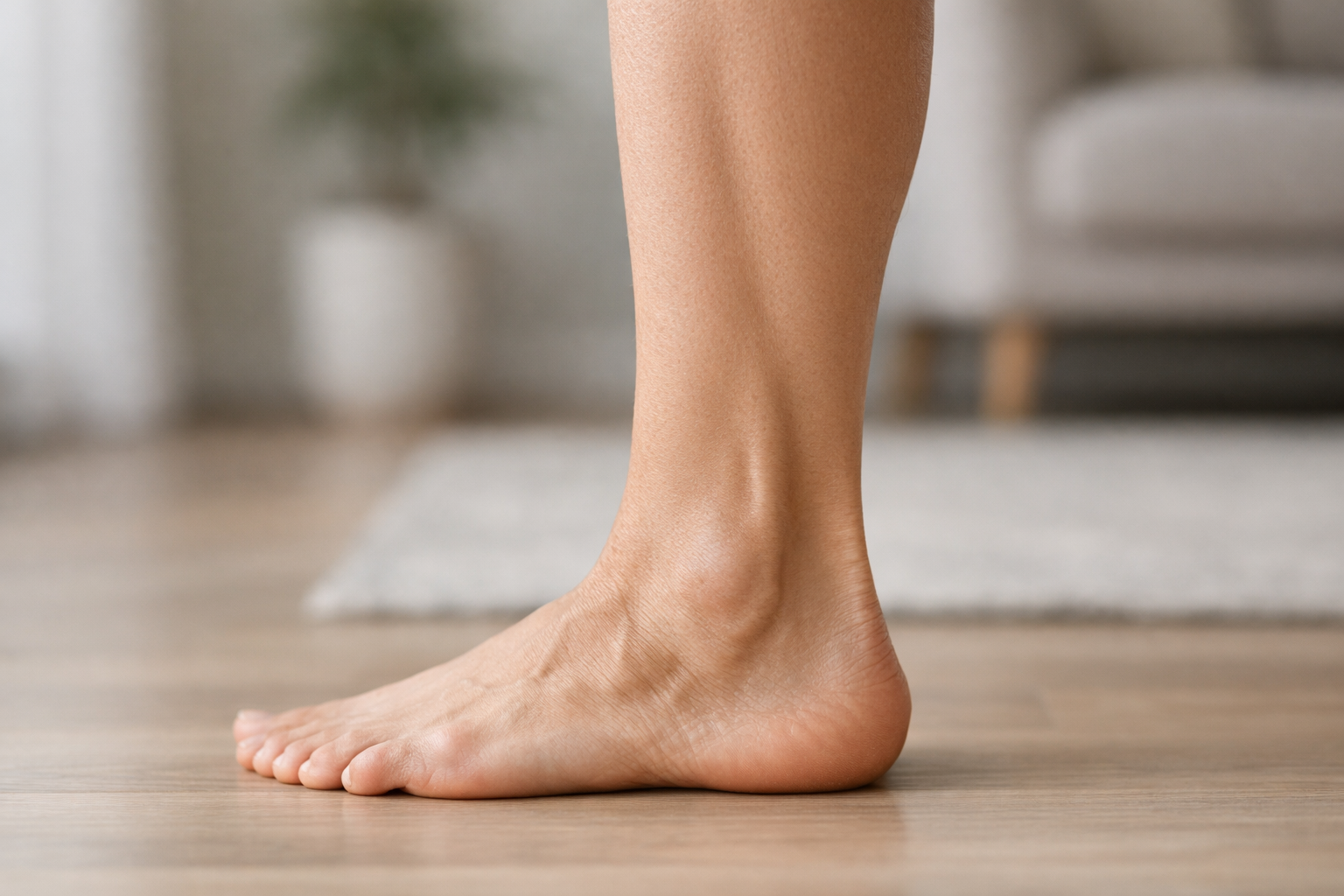
Most people who come in with this problem describe one of two stories.
The first: “I pushed off to sprint for the ball and something grabbed the back of my leg. It felt like I got hit from behind. I looked around and no one was there.”
The second: “Nothing really happened. It’s just been getting sore. Stiff in the mornings, loosens up once I’m walking, then aches after my run.”
Those two stories usually point to two different tissues. The first sounds more like a calf strain, an injury to the muscle. The second sounds more like a problem with the Achilles tendon. They live inches apart. They hurt in ways that overlap. And the rehab plans for them are genuinely different, which is why getting the location right early saves you weeks of guessing.
The Back of Your Lower Leg, Without the Anatomy Lecture
You have two main calf muscles that matter here.
The gastrocnemius is the visible one, the muscle that makes the diamond shape when you go up on your toes. It crosses behind the knee, which means it gets stretched more when your knee is straight. It’s built for quick, explosive push-off. It’s also the one that tends to tear when you sprint, jump, or change direction suddenly.
The soleus sits underneath it. It doesn’t cross the knee. It’s the workhorse: quieter, more endurance-oriented, doing a huge share of the work every step you take when you walk, stand, and run at a steady pace. Soleus problems tend to build slowly rather than pop.
Both of those muscles funnel down into the Achilles tendon, which anchors into your heel bone. Tendon is a different material than muscle. It’s built to store and return energy like a spring, it has a poorer blood supply, and it adapts on a slower clock. That last point is the one that drives most of the treatment differences.
How Can I Tell If My Calf Is Strained?
A few features point toward muscle rather than tendon.
- There was a moment. Calf strains usually have an onset you can name. A push-off, a sprint, a lunge for a shot, a misstep on a curb. Often a sudden sharp pain, sometimes an audible snap or the sensation of being kicked.
- The tenderness is in the meat of the muscle. If you press around, the sorest spot is somewhere in the muscle belly, often on the inner side partway down the calf, or where the muscle tapers into tendon. Tendon problems are usually most tender when you pinch the cord itself, either a couple of inches above the heel or right where it attaches.
- Bruising or a lump. Not always, but discoloration showing up over the following days, or a palpable divot or knot, leans muscle.
- Stretch and contract both hurt. Pulling the toes up toward your shin hurts. Pushing off hurts. Muscle strains typically complain about both.
Tendon problems have a different signature. Stiffness after inactivity that eases as you move. Pain that shows up early in a run, quiets in the middle, then returns worse afterward. Tenderness in a small, specific band of the tendon. Gradual onset over weeks with no single dramatic event.
There’s real overlap. Where the muscle blends into the tendon, the two categories blur, and it’s possible to have both a cranky tendon and a strained muscle at the same time. This is one of those situations where a hands-on exam sorts out in ten minutes what a month of self-diagnosis won’t.
What Would a Calf Strain Feel Like?
In the first day or two, most people describe tightness that won’t stretch out, a pulling sensation with each step, and difficulty pushing off the ball of the foot. Walking becomes flat-footed, or you keep the heel from coming up. Going up stairs is worse than going down. Standing on tiptoes is hard or impossible on that side.
Strains get graded, roughly:
- Grade 1: a small number of fibers involved. Sore and tight, but you can usually walk, and often perform a heel raise with some discomfort.
- Grade 2: a partial tear. Clear pain, noticeable weakness, often bruising, limping, real difficulty with heel raises.
- Grade 3: a complete tear. Uncommon in the calf muscle itself, more of a concern for the Achilles tendon.
The grade matters less than what your leg can currently do. Two people with the same imaging finding can be in very different places functionally, and function is what we build from.
How Can I Test If I Have a Calf Tear?
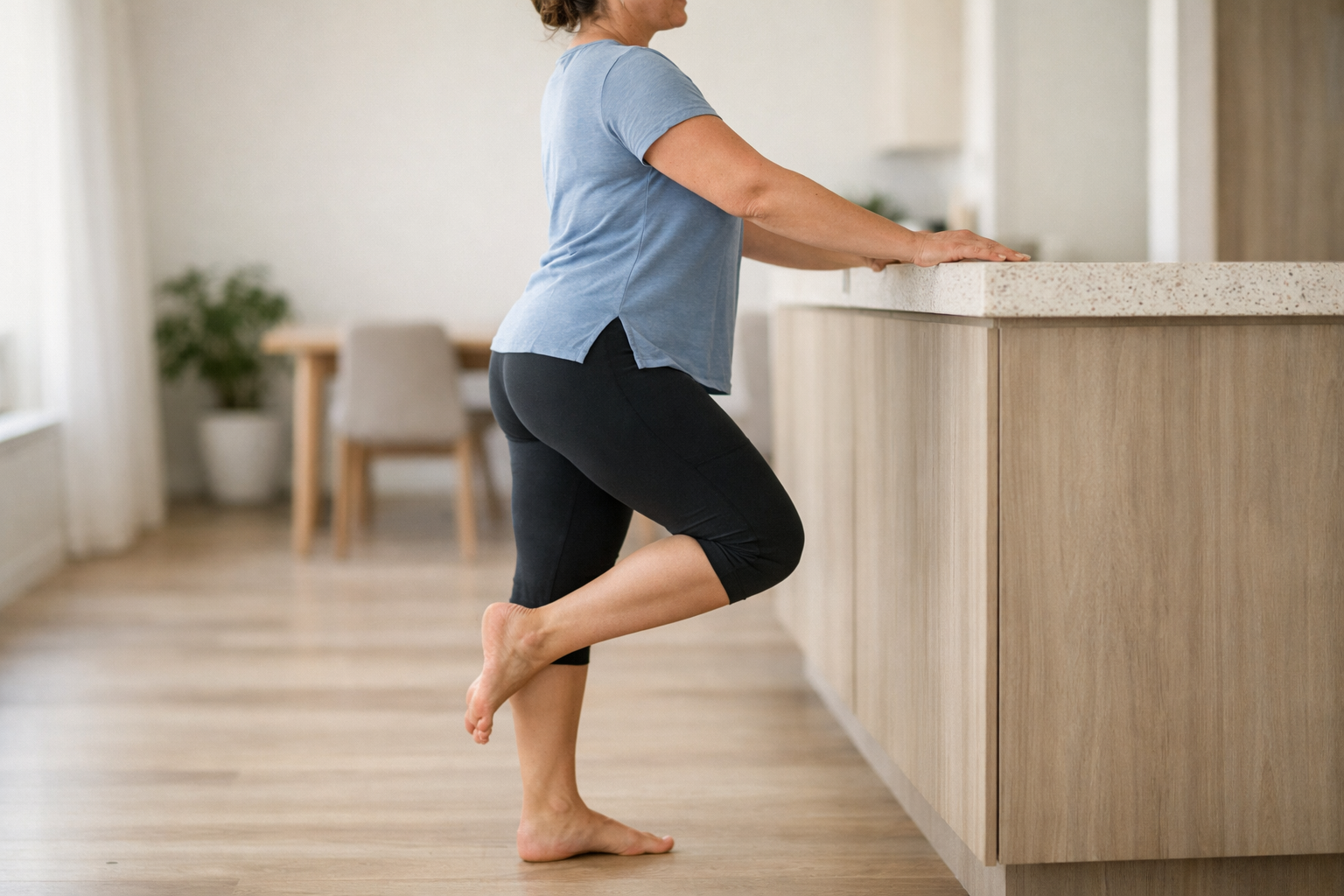
A few things you can check at home, gently, without trying to reproduce maximum pain:
- Single-leg heel raise. Hold a counter for balance. Can you get up onto the ball of the foot on the injured side? Fully, partially, or not at all? Then compare sides. A big difference is meaningful information.
- Knee straight versus knee bent. Do a calf raise with the knee locked straight, then with the knee bent about 20 to 30 degrees. Straight biases the gastrocnemius; bent shifts more onto the soleus. If one version is far worse, that tells us which tissue is unhappy.
- Pinch the tendon. Squeeze the Achilles cord between your thumb and finger, from the heel up a few inches. Sharp, localized tenderness right on the cord points toward the tendon rather than the muscle.
- Squeeze the muscle belly. Press through the calf muscle in several spots. A single hot spot suggests muscle.
What you cannot rule out at home is a complete Achilles rupture. Clinicians use a squeeze test with you lying face down, watching whether the foot moves when the calf is compressed. If you had a sudden pop at the back of the ankle, you genuinely cannot push off, and going up on your toes is impossible, that needs an in-person assessment promptly rather than a week of ice and hoping.
One more thing worth naming plainly: calf pain with swelling of the whole lower leg, warmth, redness, or pain that keeps building at rest, especially after surgery, a long flight, a period of immobilization, or a new medication, should be evaluated urgently. A blood clot can masquerade as a pulled calf muscle. That’s not a reason to panic every time your calf hurts. It’s a reason to get eyes on it if that pattern fits.
Is It Okay to Walk With a Pulled Calf?
Usually yes, and usually better than not walking.
The goal isn’t to protect the muscle from all effort. It’s to find the amount of walking your leg handles without stirring things up for the next day. For most people that means walking with a normal-ish gait at a shortened distance, rather than limping through a long walk you’ll pay for tonight.
A reasonable working rule: keep pain during and after activity at roughly a 4 out of 10 or below, and pay attention to how you feel about 24 hours later. If tomorrow morning is roughly the same as this morning, that amount was fine. If tomorrow is clearly worse, you took on more than the leg was ready for, and you dial back a notch. That’s not failure, that’s just calibration.
A small heel lift in both shoes, or temporarily choosing a shoe with more heel-to-toe drop, can take some of the demand off the calf and tendon in the first week or two while you get moving. Crutches have a place if you truly cannot bear weight, but they’re a short-term tool, not a plan.
Complete rest calms things down while you’re resting. The problem shows up the moment you go back to real life, because nothing about the leg’s actual capacity changed. Rest equals rust.
How Do I Get Rid of a Calf Strain?
Early on, the job is simple: settle the irritation without shutting the leg down. Compression can be comfortable. Ice can take the edge off if you like it. Keep moving within your tolerance.
Then the real work starts, and it’s loading. Not stretching your way out of it, and not waiting until the pain is gone before you start strengthening. For most calf strains, a progression looks something like this:
- Gentle, controlled contractions. Both feet on the floor, small-range heel raises. Isometric holds (pushing into the floor and holding) often feel good and are usually tolerated early.
- Two-leg heel raises through full range, then shifting more weight to the injured side.
- Single-leg heel raises, first with hand support, then without, and eventually with the knee bent to bring the soleus in properly.
- Added load. Weight in the hands, a backpack, a calf raise machine. This is the step people skip, and it’s the step that changes what the muscle can tolerate.
- Speed and spring. Hopping, skipping, jogging, then accelerations. Muscle strains happen at speed, so at some point rehab has to include speed.
Stay at each level long enough that it stops feeling hard before you advance. Early improvement is largely your nervous system learning to trust the leg again. The tissue itself changes more slowly, often over something like 8 to 12 weeks of consistent loading. That gap is exactly why people who stop as soon as pain resolves tend to re-injure the same calf the following season.
Consistency beats intensity here. Three honest sessions a week for two months does more than one heroic week.
Why the Achilles Plan Looks Different
If the problem turns out to be tendon rather than muscle, several things shift.
The timeline stretches. Tendon adapts more slowly than muscle. Meaningful change is usually measured in months, and progress is often uneven.
Slow beats explosive, at first. Tendon rehab typically leans on heavy, slow, controlled work: heel raises with real load, lowering under control, holds at end range. Fast, springy, plyometric work comes later and is introduced carefully, because that’s the load tendon finds hardest.
Stretching plays a smaller role, and sometimes no role. With pain right at the heel attachment, aggressive stretching and deep dorsiflexion can compress the tendon against the bone and keep it irritated. Working in a shorter range early is often more comfortable and more productive.
Some soreness during loading is expected and acceptable. With tendons especially, a mild ache during exercise that settles within about a day is usually a sign you’re in the right zone, not a sign of damage. Pain is information. An increase doesn’t automatically mean you re-injured something.
Meanwhile, calf muscle rehab wants range of motion restored earlier, tolerates gentle stretching sooner, and needs to arrive at genuine speed work before you return to sport. Same neighborhood, different construction project.
Heel pain in particular is where things get confused, because the underside of the heel and the back of the heel are different problems with different plans. If your pain is under the heel and worst with the first steps in the morning, our article on telling plantar fasciitis from tendonitis covers that territory in more depth.
Should I Massage a Calf Strain?
In the first few days after a clear tear, aggressive digging into the injured tissue isn’t doing you any favors. Gentle work above and below the sore area, and light compression, are fine if they feel good.
After that early window, hands-on work, foam rolling, and massage are reasonable comfort tools. They can reduce how sensitive and guarded the area feels, which sometimes lets you load better that same day. What they don’t do is rebuild the muscle’s capacity to sprint or stand for a ten-hour shift. Use them as the warm-up to the work, not as the work.
How Can I Relieve Calf Pain Fast?
Honest answer: some things reliably reduce symptoms in the short term, and none of them are the same as recovering.
What tends to help quickly:
- A temporary heel lift in both shoes to reduce demand on the calf and tendon
- Compression sleeve or wrap
- Short, frequent walks instead of long ones
- Isometric holds, which for a lot of people take pain down for a while afterward
- Ice or heat, whichever you prefer, for comfort
- Reducing the highest-demand activity temporarily (hills, stairs, sprinting, long standing) while keeping everything else
Those buy you comfort. The loading progression is what changes what your leg can handle in six weeks.
How Long Can It Take for a Calf Strain to Heal?
Ranges rather than promises, because the honest variables are the size of the injury, how irritable it is, what you need to get back to, and how consistently you load it.
For many people, a mild strain quiets down within a couple of weeks, and returning to running or sport typically takes a few weeks beyond that. A more significant partial tear often takes six weeks or more before the leg feels trustworthy at speed, sometimes longer. Achilles tendon problems commonly take longer than either, often several months of steady work.
And here’s the nuance that matters more than the number. “Healed” isn’t only about the pain rating. It’s about whether you can do a set of single-leg heel raises comparable to the other side, jog without changing your stride, push off hard without hesitating, and get through the day after without a flare. Function matters as much as pain. People who return based on comfort alone tend to come back through the same door a few months later.
My Calf Strain Isn’t Healing. What Should I Do?
When a calf strain drags on for months, there are a handful of usual explanations, and only one of them is bad luck.
The loading never progressed. This is the most common one by a wide margin. Someone did the early rehab, felt better, and stayed there. Gentle heel raises and stretching for eight weeks builds tolerance for gentle heel raises and stretching. If your goal is a soccer game or a twelve-hour shift on concrete, the plan has to climb toward those demands. Maybe the missing piece wasn’t another treatment, but a way to progress.
The soleus got skipped. Straight-knee calf raises are the default, so the soleus (which needs the knee bent) often gets underdone. It matters enormously for running and for prolonged standing. Lingering deep calf pain with distance work makes me want to look here.
The total load never got accounted for. Your calf doesn’t distinguish between rehab exercises and life. A day of travel, a move, a long shift, an unusual amount of walking in flat shoes: all of it adds up. Symptoms can also lag a day or two behind the thing that caused them, which makes people blame the wrong culprit. When someone flares, the first question isn’t “what exercise went wrong,” it’s “what did the whole week look like.”
A flare-up got treated as a setback. A temporary increase in symptoms doesn’t erase the progress you’ve built. It means something changed. We look at what, adjust, and keep going. Recovery is not a straight line, and expecting one is a reliable way to quit halfway.
It isn’t a calf strain. Other things produce calf and lower leg pain: a bone stress injury in the shin, nerve pain referred from the low back, a Baker’s cyst behind the knee, artery or circulation issues that produce cramping at a predictable distance, chronic compartment problems, or an Achilles tendon that was the real issue from the start. Persistent pain that never behaves like a muscle strain deserves a fresh look rather than more of the same rehab.
When to Get It Looked At
See a clinician if you couldn’t bear weight after the injury, if you heard or felt a pop at the back of your ankle and can’t push off, if there’s significant swelling of the whole leg with warmth or redness, if numbness or tingling is involved, or if you’re weeks in and not trending in the right direction. Persistent, severe, or worsening symptoms are worth an in-person evaluation, partly to confirm what tissue you’re dealing with and partly to build a progression that actually reaches your goals.
If you take one thing from this: the difference between a calf strain and an Achilles problem isn’t academic. It changes how fast you load, how heavy, how soon you add speed, and how much stretching belongs in the plan. Get the location right, then build from there.