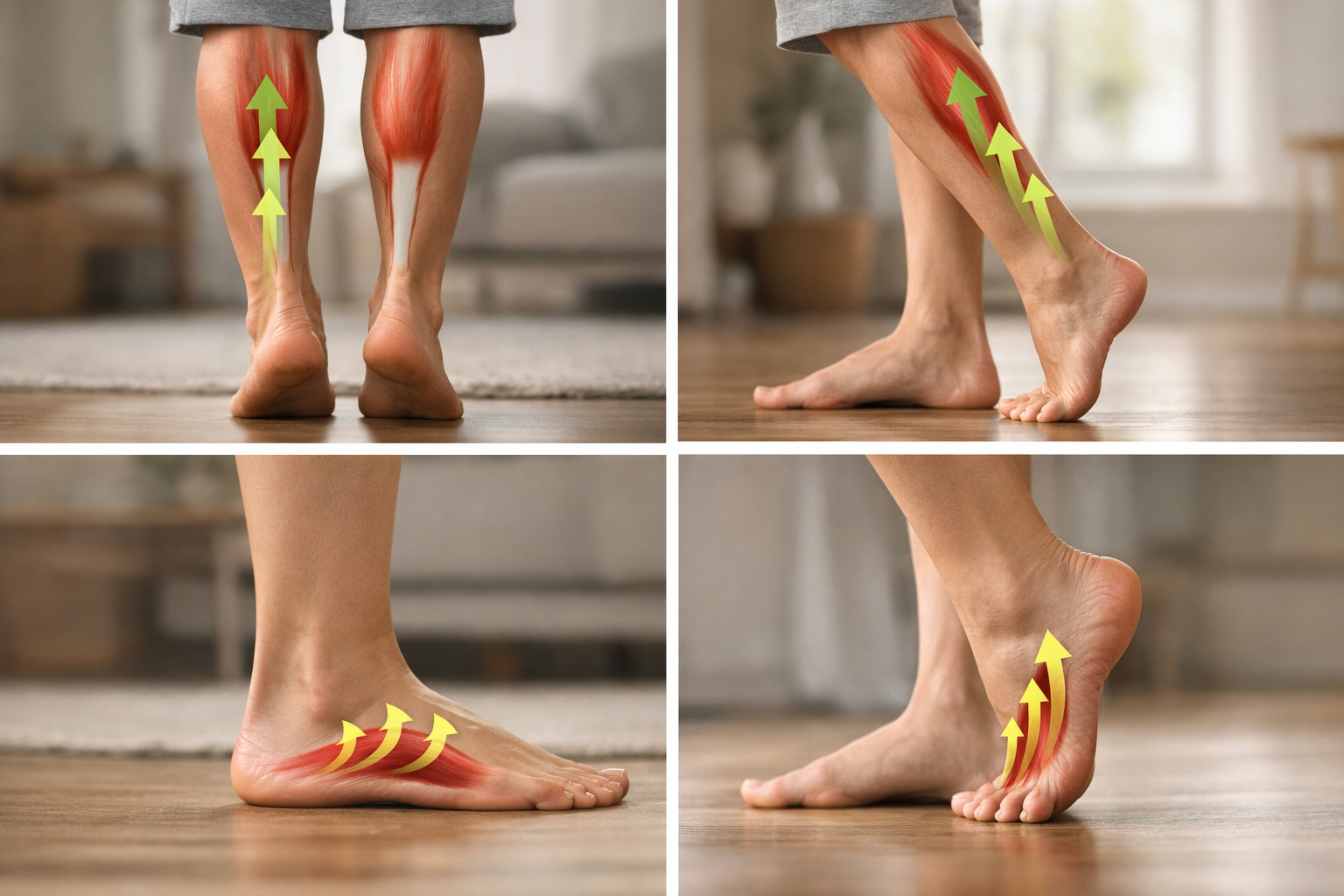
Arch Pain When Walking: Why It Happens and What Helps
Arch pain that shows up while you walk usually has less to do with damage and more to do with how much load your arch is being asked to absorb, step after step. Here's how to read the timing and location of your pain, and how to build walking tolerance back up.
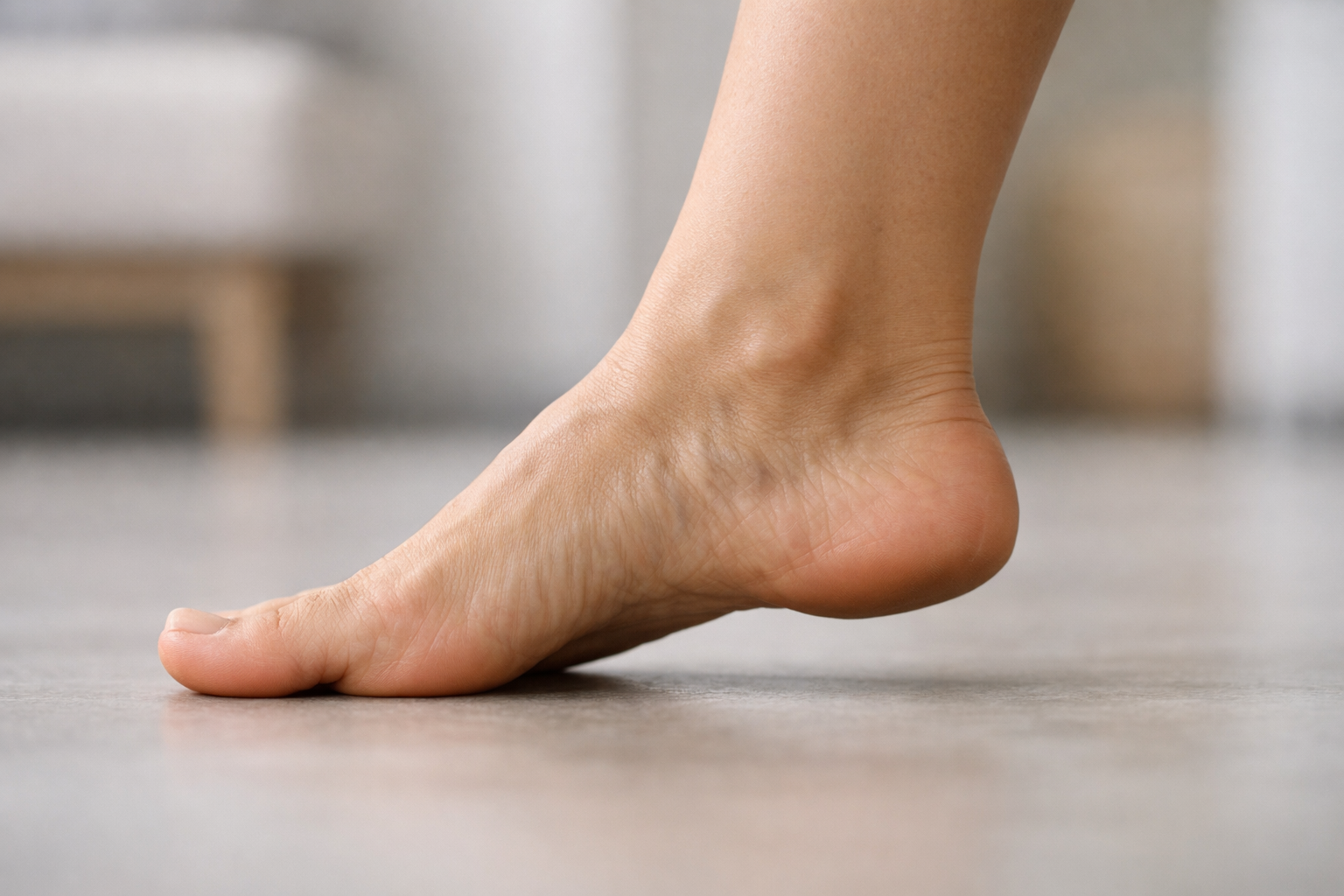
Most people don’t come in because their arch hurts. They come in because walking hurts, and walking is not optional. You have a dog, a job, a grocery store, an airport in three weeks. So the question isn’t really “what is this pain,” it’s “why does it show up when I walk, and what do I do about it?”
That’s a better question anyway, because when it hurts during walking tells us more than almost anything else.
Walking isn’t one big load. It’s thousands of small ones.
A mile of walking is roughly two thousand steps. On each one, your body weight passes through one foot, the arch flattens slightly to absorb it, then stiffens again to help push you off the ground. That happens over and over, all day, without you thinking about it.
This matters because it changes how we think about arch pain. A single step almost never hurts anybody. The problem is usually the total amount of work being asked of the arch relative to what it can currently handle. Pain that shows up with walking is often a capacity problem, not a damage problem.
And capacity isn’t just strength. Your arch might be plenty strong for twenty calf raises and still not have the endurance for a nine-hour shift on a concrete floor. Those are different demands. A foot builds tolerance for the specific thing you keep asking it to do.
So when arch pain appears during walking, one of two things has usually shifted: the demand went up, or the capacity went down. Sometimes both quietly at once.
Read the timing: when in the walk does it hurt?
This is the part most people have never been asked about, and it’s genuinely useful. Pay attention over the next few days.
It hurts for the first few minutes, then eases up
Stiff and sore out of the gate, better once you’re moving, sometimes to the point where you forget about it. This pattern is very common with plantar fascia irritation. After hours of no load (sleeping, sitting at a desk), the tissue is sensitive, and the first steps are the loudest. Once it warms up and gets used to load again, it quiets down.
Here’s the part worth hearing: that morning or start-up pain is a sensitivity pattern, not evidence that your foot got worse overnight. Nothing was damaged while you slept. The tissue was simply unloaded for a long stretch and complains when load returns.
It’s fine at first and gets worse the longer you walk
This one points more toward capacity. The first ten minutes feel fine. Around minute twenty or thirty, the arch starts aching. By the time you head home, you’re changing how you walk.
That’s a tissue running out of tolerance partway through the task. It’s not a reason to stop walking. It’s information about your current ceiling, and ceilings can be raised. Often the useful move is not “walk less” but “walk the amount that stays under the ceiling, more often, and nudge it up over weeks.”
It doesn’t hurt while walking. It hurts afterward, or the next morning
Symptoms can lag behind the load that caused them by a day or even two. This is why people swear their exercises caused a flare when the real trigger was Saturday’s four hours at a street fair.
A useful rough guide: notice how your foot feels about 24 hours after activity. If it has settled back to roughly where it was before, the load was probably reasonable. If it’s still noticeably worse a day later, that was more than your foot was ready for that day. Not a catastrophe. Just data.
It hurts regardless of walking, by the end of any day on your feet
Standing is load too. So is a stiff work shoe, a hard floor, a long drive, and the mile you walk around the house without counting it. Total load is cumulative. Exercise plus walking plus work plus life all land on the same foot.
This is why the person who “barely walked at all” still flares. They stood at a counter for six hours.
Read the location: which part of the arch?
The inside arch, near the heel, along a band
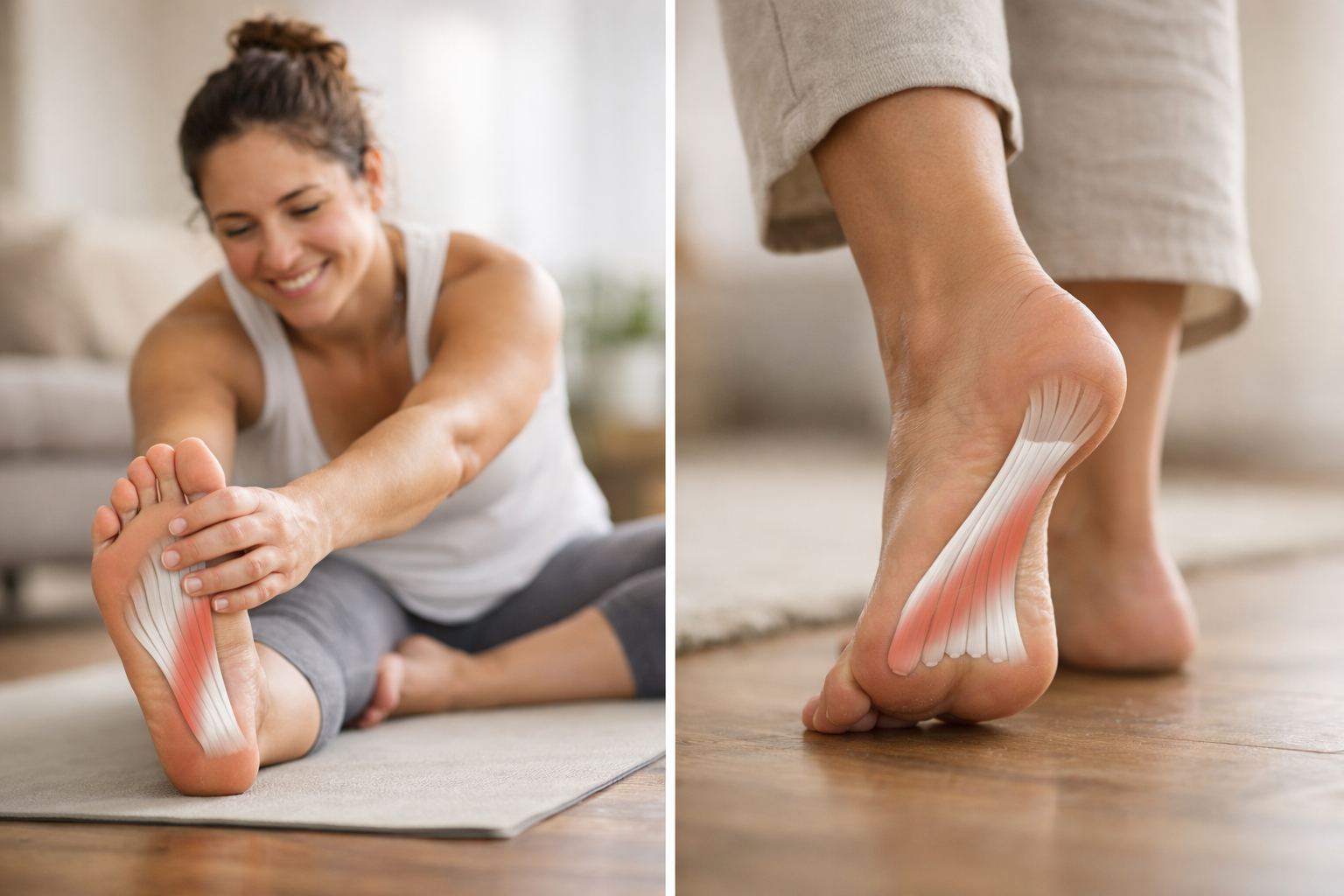
Pain that runs from the inner heel forward along the arch, tender to press on, worst with first steps, can be consistent with plantar fascia irritation (the persistent version is more accurately called plantar fasciopathy, which just means the tissue has changed in response to long-standing stress rather than being acutely inflamed).
If you want the detailed self-checks for sorting this out, we have a separate article on whether arch pain is plantar fasciitis or something else. I won’t repeat all of it here.
The middle of the arch and the top of the instep
Deep aching through the middle of the foot, sometimes with a sense that the arch is sagging or working too hard, can involve the tendon that runs behind the inner ankle bone and helps hold the arch up. When that tendon is irritated, walking on uneven ground and pushing off tend to feel worse, and it may be harder to rise onto that heel single-leg than the other side.
Sharp, pinpoint pain on the top of the midfoot that gets steadily worse with each day of walking, especially after a jump in mileage, deserves an in-person evaluation rather than a guess. Bone can get overloaded too.
Why does the outside arch of my foot hurt when I walk?
This is a common question and it usually has a different explanation than inner arch pain. A few possibilities:
- Load shifting outward. If the inside of your foot hurts, you unconsciously roll to the outside to protect it. Then the outside starts hurting. The original problem may have been on the inside.
- The tendons along the outer ankle and foot. They help control side-to-side motion. Walking on cambered roads, trail edges, or a lot of turning can overload them.
- The outer column of the foot and the fifth metatarsal. Very stiff-soled shoes, minimal shoes with no ramp, or a sudden increase in walking can leave this area sore.
- Midfoot joint stiffness or irritation through the outer part of the foot, which tends to feel worse on uneven surfaces.
Outside-arch pain that came on after an ankle sprain, or that comes with swelling and difficulty putting weight through the foot, should be looked at.
What’s commonly mistaken for plantar fasciitis?
Quite a few things: fat pad irritation under the heel, nerve irritation near the inner heel, tendon problems behind the inner ankle, bone overload, and referred symptoms from the low back or nerve. Not all heel and arch pain is plantar fasciitis. The distinctions matter because the loading plan changes. An in-person exam sorts this out faster than any amount of reading.
Why did this suddenly start?
Almost never because of one step. When I ask about the six weeks before symptoms started, something has usually changed:
- New shoes, or old shoes that finally gave up
- A switch to flatter, more minimal shoes without a transition period
- A vacation with a lot of walking in sandals
- A new job, a new floor, a change from sitting to standing
- A step-count goal from a watch, jumping from 3,000 to 10,000 daily
- Starting a running or walking program with enthusiasm and no ramp
- Weeks of less activity, then a return to normal (capacity quietly dropped while the demand waited)
That last one surprises people. A long stretch of reduced activity lowers what your foot can handle. When life resumes at the old level, the mismatch shows up as pain.
Body weight, standing jobs, and footwear are worth talking about honestly, but as inputs into total load on the system, not as personal failures. More load through the same tissue means we need more capacity in that tissue, or a smarter distribution of the load across the day. Both are workable.
Is walking good for arch pain and plantar fasciitis?
Yes, at the right dose. That qualifier is the whole answer.
Walking is load, and load is what builds tolerance in fascia, tendon, and muscle. Complete rest calms a foot down while it’s unloaded, which feels like progress right up until you walk again and the pain returns. Nothing was built during the time off. Rest lowers sensitivity; it doesn’t change what the tissue can handle. Rest equals rust.
But walking too much, too soon keeps the tissue irritated and stalls things out. So we’re not choosing between rest and walking. We’re choosing an amount.
A practical way to find it:
- Aim to keep pain at or below roughly a 4 out of 10 during the walk for most people
- Check in around 24 hours later; you want your foot back near baseline
- If it settles, that dose is a starting point. Repeat it for a week or so
- If it’s still angry a day later, walk a shorter distance or split it into two shorter walks
- Increase gradually, and stay at each level long enough for the tissue to adapt before you add more
Two fifteen-minute walks are often much better tolerated than one thirty-minute walk, especially early on. Same total, different demand.
How do you get rid of arch pain when walking?
There are two halves, and most plans I see only include the first one.
Half one: bring the irritation down.
- Temporarily reduce the loudest inputs. Not all walking. The specific things that reliably flare you (barefoot on hardwood, the unsupportive work shoe, the long uninterrupted standing block)
- Break up long stretches on your feet where you can
- Use footwear that feels good under your arch for now. A cushioned, supportive shoe or an over-the-counter insert is not cheating. It’s temporarily reducing the demand while capacity gets built
- Calf and arch stretching, massage, and rolling can reduce sensitivity and make movement more comfortable. Useful. Just not sufficient on their own
Half two: build what the foot can handle.
- Loading the calf and the foot’s own muscles, with resistance, progressed over time
- Building tolerance for the actual task you care about, which means walking is part of the plan, dosed deliberately
- Continuing past the point where pain resolves, because early improvement is largely your nervous system settling down. Structural change in fascia and tendon takes longer, often on the order of two to three months of consistent loading. Stopping the moment it feels better is the single most common reason this comes back
The missing piece for a lot of people isn’t a treatment they never tried. It’s a progression: something appropriate, watch how the foot responds over the next day, adjust, then ask for slightly more.
When a flare-up happens
It will, at some point. A busy weekend, a wedding, a travel day, a new pair of shoes. Your foot gets loud again and it feels like the whole thing unraveled.
It didn’t. A temporary increase in symptoms is not the erasure of eight weeks of work. Look at what changed in the two days before, back the load off a notch for a few days, then return to where you were. Then keep going. Recovery is not a straight line, and the trend over a month tells you far more than any single bad afternoon.
Also worth tracking something besides the pain number. Are you walking farther before it starts? Recovering faster afterward? Standing through a shift you couldn’t handle in July? Those are real gains even if there’s still some discomfort. Function counts.
Worth getting looked at
Most arch pain with walking responds well to intelligent loading. A few things deserve an in-person evaluation sooner rather than later:
- You can’t put weight through the foot, or the pain came on suddenly with a pop or a specific injury
- Swelling, bruising, or warmth in the midfoot
- Sharp, pinpoint pain on top of the foot that worsens each day you keep walking
- Numbness, tingling, or burning, especially spreading into the toes
- Pain that’s worse at rest or at night than with activity
- An arch that appears to be flattening progressively, or difficulty rising onto that heel
- Symptoms that haven’t budged after a few months of reasonable effort
That last one is less about danger and more about efficiency. If nothing is moving, either the diagnosis needs a second look or the progression does. Both are worth an hour with someone who can put hands on your foot and watch you walk.