Why Your Peroneal Tendonitis Won't Go Away
Peroneal tendon pain that lingers for months usually isn't a healing problem, it's a loading problem. Here's what tends to stall recovery on the outside of the ankle, and what actually moves it forward.
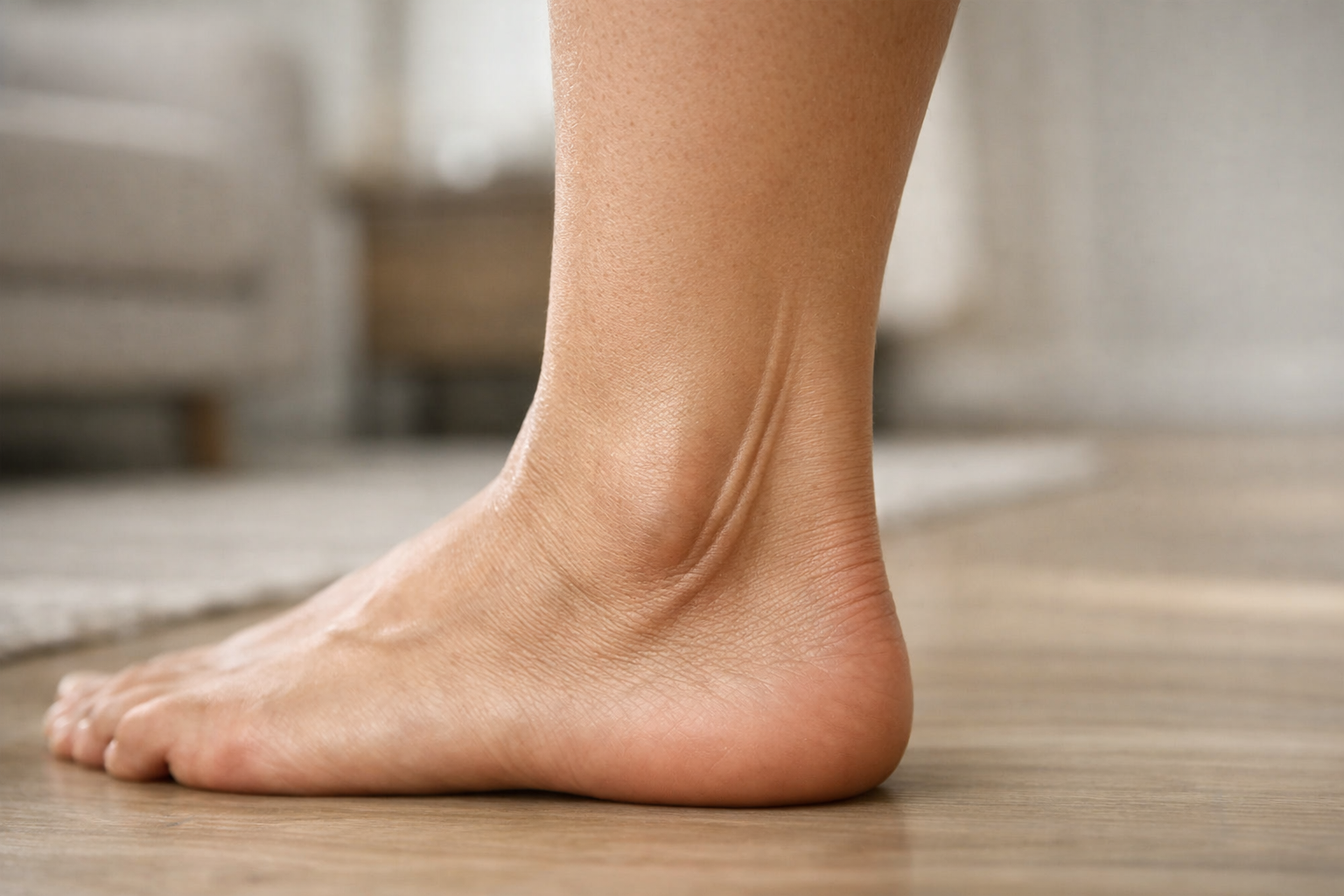
You rested it. Maybe six weeks, maybe six months, on and off. The outside of your ankle felt fine while you were doing nothing. Then you went back to running, or hiking, or just a longer day on your feet, and within a day or two that same ache along the outer ankle showed up again. Same spot. Same story.
So you rest again. And the cycle repeats.
If that’s where you are, the question isn’t really “why won’t my peroneal tendonitis go away.” The more useful question is: what did the rest actually change? Because in most cases where this drags on, rest calmed the tendon down without ever making it capable of the thing that irritated it. The pain left. The capacity never came back.
That distinction explains most of what follows.
What the peroneal tendons are doing all day
Two tendons run down the outside of your lower leg, behind the bony bump on the outer ankle, and wrap forward into your foot. They turn the sole of your foot outward, they help point the foot down, and, more importantly for most people, they’re a big part of how you keep from rolling your ankle every time you step on uneven ground.
They’re stabilizers. They work constantly, in small amounts, with every step you take on a curb, a trail, a cambered road, a gym floor. That matters because it means these tendons don’t get a day off just because you skipped your run. Walking to the mailbox loads them. Standing loads them. Which is one reason “rest” for peroneal problems is rarely as restful as people assume.
Pain here is usually along the outer ankle, sometimes just behind the bony bump, sometimes tracking forward along the outside of the foot toward the base of the little toe. It often shows up after activity rather than during it. Swelling, if present, is usually modest.
Worth saying plainly: outer ankle pain isn’t automatically a peroneal tendon problem. It can be consistent with one, but old ankle sprain damage, a small bone stress reaction, joint irritation deeper in the ankle, or nerve irritation can produce pain in the same neighborhood. An in-person exam sorts that out far better than a symptom list does.
The core reason it lingers: sensitivity got better, capacity didn’t
Here’s the frame that makes the whole thing make sense.
Every tendon has a certain amount of work it can currently handle before it gets grumpy. Call that its capacity. On the other side is the demand you place on it: your mileage, your hours standing, the terrain, your shoes, the sport, your body, your week.
A tendon problem starts when the demand outruns the capacity. Not always dramatically. Often it’s a small gap, repeated a few thousand times.
Now, when you rest, two things happen. The tendon becomes less sensitive, fairly quickly, which feels like healing. But its capacity also drifts downward, because tissue adapts to what you ask of it, and you’re asking for less. So after eight weeks off, you may feel better and be less capable at the same time. Then you return to the same activity that caused the problem, and the gap between demand and capacity is now wider than it was before.
That’s the loop. It isn’t a character flaw and it isn’t bad luck. It’s what happens when a plan addresses symptoms without ever rebuilding what the tendon can tolerate.
Rest equals rust, and it’s rarely more literal than with a stabilizing tendon that only stays strong if you keep asking it to stabilize something.
None of that means rest is the enemy. A few days of backing off during an angry flare is genuinely useful. It’s the second, third, and fourth month of protecting a tendon that stalls people out.
The mistakes that keep outer ankle pain around
Loading only when it doesn’t hurt at all
A lot of people wait for zero pain before doing anything. With a persistent tendon, zero pain at rest arrives long before the tendon is ready for real work, and full pain-free loading may never arrive on its own.
For many people, a workable rule is to allow some discomfort during and after loading, usually in the range of about a 4 out of 10 or less, as long as it settles back toward your baseline within roughly 24 hours. That gives you room to actually train the tendon instead of tiptoeing around it. Pain is information here, not a damage alarm.
Stopping the moment it feels better
This one is enormously common. Symptoms improve in three or four weeks, so the exercises stop. But early improvement is mostly your nervous system getting better at the movement and the tendon getting less irritable. The structural side of tendon adaptation, the slow remodeling that actually raises capacity, tends to take longer, often on the order of eight to twelve weeks of consistent loading, sometimes considerably more if it’s been going on a long time.
Quit at week four and you have a calmer tendon with roughly the same capacity you started with. Then you go hiking.
Loading too light, forever
There’s a version of rehab that’s all bands and small ranges and ten-minute sessions, never progressing. It’s comfortable. It also doesn’t change much after the first few weeks. Tendons respond to meaningful, gradually increasing load. If your exercises feel identical to what you did two months ago, that’s the problem to solve.
Counting only the exercises
Your tendon doesn’t distinguish between rehab and life. Total load is everything added up: the exercise, the walk from the parking garage, the eight-hour shift on concrete, the weekend at the amusement park, the new shoes. People often blame an exercise for a flare when the actual cause was Thursday’s travel day. Symptoms also frequently lag a day or two behind whatever caused them, which makes cause and effect harder to spot than you’d think.
Missing what’s above and below the ankle
The peroneals get overworked when other things aren’t contributing. A stiff ankle that won’t let the shin travel forward over the foot, weak hip and glute control that lets the knee and foot wander, a calf complex that gave up capacity during months of avoiding activity, an old ankle sprain that never got rehabbed past the point of walking normally. Any of those can quietly raise the demand on the outside of your ankle every single step.
Changing shoes or terrain and calling it a coincidence
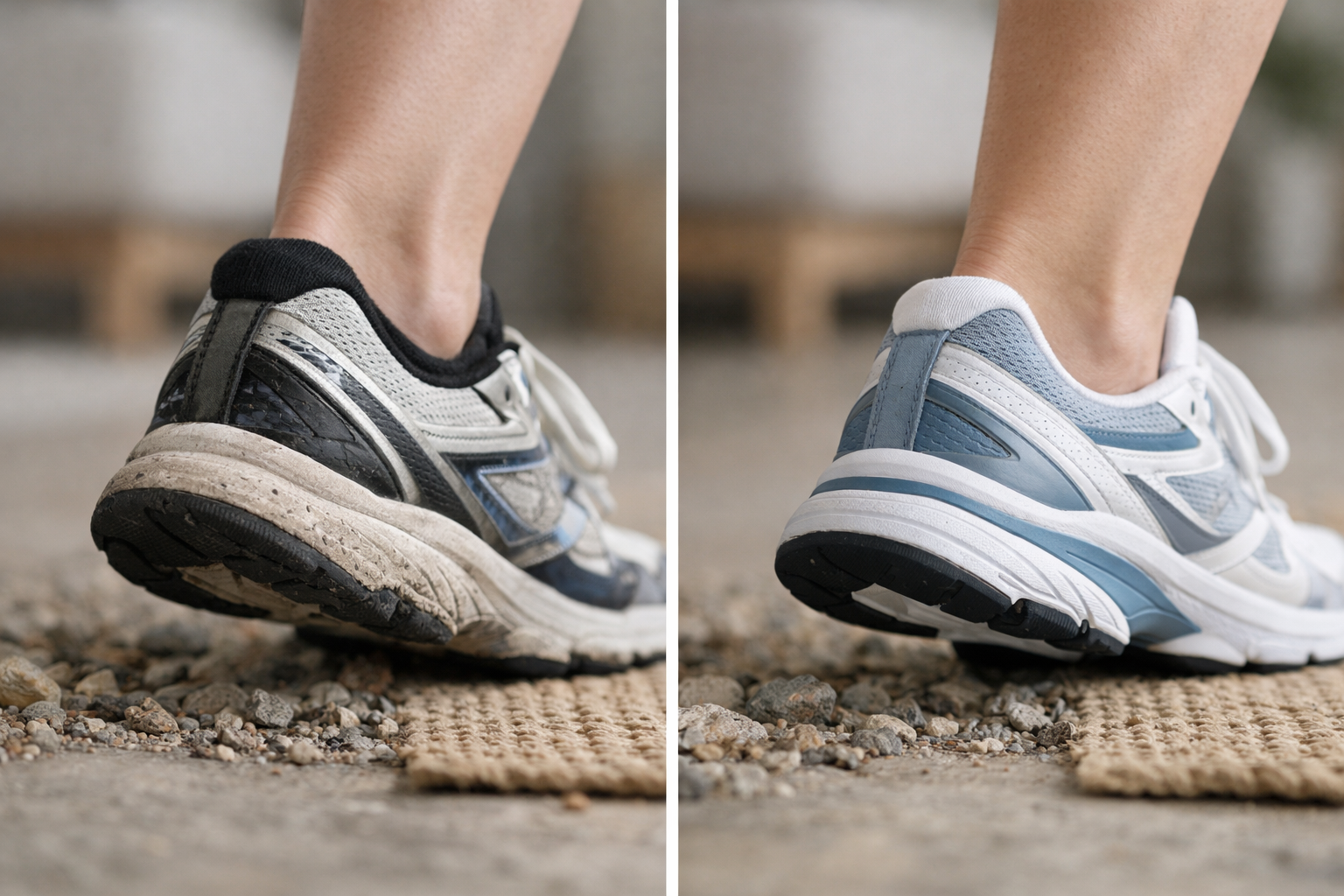
A new pair with a different heel height. A worn-out pair breaking down on the outer edge. Switching from treadmill to trail. Moving to a job with hard floors. A big drop in support after years in a supportive shoe. Any of these can shift load onto the peroneals faster than they can adapt. The shoe isn’t good or bad. The rate of change is what matters.
How long should peroneal tendonitis last?
Caught early, when the tendon is irritable but you haven’t been limping around for months, many people improve meaningfully in something like six to eight weeks with sensible load management and progressive strengthening. That number gets quoted a lot, and for a fresh, reactive tendon it’s reasonable.
It’s also where a lot of frustration comes from, because if you’re reading this you’re probably well past eight weeks.
When it’s been going on longer, the timeline stretches, mostly because you’re starting from a lower point. Three to six months of consistent, progressive work isn’t unusual for a stubborn peroneal problem, and people with a long history sometimes need longer. That’s not a prediction for you specifically. It’s a general pattern, and the honest version is that your response to loading tells us more about your timeline than the calendar does.
What should change along the way isn’t only the pain number. Watch these:
- How long you can walk or run before it speaks up
- How quickly it settles afterward
- How stiff it feels first thing in the morning
- Whether uneven ground still feels like a threat
- How much you’re bracing, taping, or avoiding
If you can walk twice as far as you could a month ago and it still aches a bit afterward, that’s progress. Function matters as much as pain.
How long is too long to have tendonitis?
If you’re still in the same place after about six to eight weeks of genuine, structured effort, that’s the point to get a second look. Not because something terrible is happening, but because “no change” usually means one of a small number of fixable things:
- The load never progressed, so nothing adapted
- The load was too high and the tendon stayed in a constant state of irritation
- The daily load outside of rehab swamped everything else
- Something else is driving the pain and the plan is aimed at the wrong target
Six months of the same pain with no upward trend deserves an evaluation, full stop. Not to receive bad news, but because a stalled plan is worth diagnosing.
Can peroneal tendonitis be permanent?
A long history doesn’t mean a permanent problem. Persistent does not mean untreatable.
What a long history usually means is that you’ll start lower and progress more patiently. Tendons keep the ability to adapt. That doesn’t disappear after a year, or after three. What often happens with long-standing cases is that the tendon has been protected so thoroughly, for so long, that both the tendon and the surrounding muscles are far weaker than the person realizes, and the starting point has to be honest about that.
The exceptions worth naming: an actual tear in the tendon, a tendon that’s subluxating or snapping out of its groove behind the outer ankle bone, or a bone-related issue driving the pain. Those change the plan, and sometimes involve imaging or a surgical opinion. They’re not the common story, but they’re real, and they’re a reason not to self-manage outer ankle pain indefinitely if it isn’t budging.
What’s the fastest way to get peroneal tendonitis better?

There’s no shortcut that skips the tendon’s biology. But there’s a fast way and a slow way to spend the same months, and the difference is mostly about whether you’re progressing or repeating.
The faster path tends to look like this:
Calm it enough to work, not enough to hide. A short period of reducing the aggravating activity, maybe modifying terrain or volume, sometimes temporary taping or a shoe change. Days to a couple of weeks, not months. The goal is a tendon quiet enough to load, not a tendon you never test.
Start loading at a level the tendon accepts. Isometrics (holding a contraction without moving) are often a reasonable entry point for an irritable tendon, because they let you generate real tension with less movement. From there, slow, controlled strengthening through range: turning the foot outward against resistance, calf raises progressing toward single leg, work with the foot in different positions.
Progress on evidence, not on the calendar. If yesterday’s session settled within a day and the tendon feels the same or better, you can add. If it’s still elevated 48 hours later, you overshot. Add a little, watch, adjust. The response determines the progression, not a printed protocol.
Train the things around it. Ankle mobility, calf capacity, hip control, single-leg balance on unstable and uneven surfaces. Peroneals live in a system.
Rebuild the specific thing you want to do. This is the part people skip. If you want to run trails, at some point you have to run, and then run on trails, in graded doses. Capacity is task-specific. A tendon strong in a gym exercise isn’t automatically ready for a cambered road at mile four.
Keep going past the point where it feels better. Probably the single highest-value habit in this whole article.
Consistency beats intensity here. Three good sessions a week for three months does more than two heroic weeks followed by a flare and a retreat.
Does walking help heal tendonitis?
Usually, yes, in the right dose.
Walking loads the peroneals gently and repeatedly, keeps the ankle moving, and maintains circulation and capacity. For most people with outer ankle tendon pain, walking is a tool, not a threat. The nuance is in surface, volume, and shoes. Flat, even ground is easier on these tendons than a rocky trail or a steeply cambered road. Ten minutes tolerated well beats forty that leave you limping tomorrow.
If walking clearly worsens things over 24 hours, shorten it rather than stopping it. Then build back up. Complete avoidance of walking is almost never the right answer, and it costs you capacity you’ll have to rebuild later anyway.
Does massage help tendonitis?
It can help, and it’s worth being clear about what it’s helping with.
Hands-on work, soft tissue work through the calf and peroneal muscles, and self-massage can reduce sensitivity, ease guarding, and make movement feel more comfortable. That’s genuinely useful. A less painful tendon is a tendon you can load, and loading is the part that changes capacity.
What massage doesn’t do is remodel the tendon. If your appointments are all hands-on and nothing progressively harder is being asked of the tissue, you’ll likely feel better for a day or two after each session and land back where you started. Use it as a door opener, not the whole room. And go easy directly over an angry tendon; aggressive digging on an irritated tendon tends to buy you a worse next morning.
How do I know if my tendonitis is severe?
Rough signs that things are on the more serious end, and that an in-person evaluation is worth arranging sooner rather than later:
- Pain that changes how you walk, and stays changed
- Symptoms that flare from ordinary daily activity, not just from sport
- Pain that takes more than 24 to 48 hours to settle after mild activity
- Obvious weakness turning the foot outward, or an inability to do a single-leg calf raise on that side
- Swelling or warmth that doesn’t come and go with activity
- A snapping or popping sensation behind the outer ankle bone, especially with a feeling that something is moving where it shouldn’t
- A sense of giving way or repeated ankle rolls
- Pain that started with a distinct injury rather than building gradually
- Night pain, or pain that isn’t clearly linked to loading at all
That last group, especially night pain, unexplained swelling, fever, numbness, or pain following a fall or twist, deserves prompt medical attention rather than a home plan. Most outer ankle tendon pain isn’t in that category, but it’s not something to guess about.
What to do with all of this
If you take one thing from this: the reason peroneal tendonitis lingers usually isn’t that the tendon can’t heal. It’s that the plan calmed things down and never got around to building the tendon back up, or built it back up and stopped too soon.
So look honestly at the last few months. Did the load actually increase over time, or did you cycle between resting and trying again? Was there ever a point where the exercises got harder? Did you account for your job, your terrain, your shoes, your week?
A few days of relative rest during a flare, some hands-on work to take the edge off, a supportive shoe while things settle: all of that has a place. The gap is usually in what comes after, when the tendon needs to be progressively asked to do more, in a dose you can tolerate, over enough weeks for the tissue to actually change.
A flare along the way isn’t a failure. It’s a data point about what the tendon was ready for that day. You adjust and keep going, and you judge the whole thing by the trend, not by any single bad morning.
If your outer ankle pain has been hanging around for months, is getting worse, or is limiting things you need to do, get it evaluated in person. A good exam can tell you whether you’re dealing with a tendon that needs a better loading plan or something that needs a different approach entirely, and that answer is hard to reach on your own.