What Feels Like Tendonitis but Isn't: Foot Pain Misdiagnoses
Tendon pain in the foot and ankle has several convincing impostors, from bursitis and nerve irritation to bone stress injuries and inflammatory disease. Here's how each one tends to behave, how an evaluation sorts them out, and why the right label changes what comes next.

You’ve had an ache behind your heel, or along the inside of your ankle, or on the outside just below the bone, for a few weeks now. It hurts when you push off. It’s stiff for the first few minutes in the morning. Someone told you it sounded like tendonitis, or you typed the symptoms into a search bar and that’s what came back.
Honestly, that’s often a reasonable first guess. Tendons in the foot and ankle work hard, and they’re a common source of pain. But “tendonitis” gets used as a catch-all for almost any ache near a joint, and several other things behave enough like it to fool a careful person. Some of those things respond well to the same approach. A few need something different, and a couple need to be caught early.
So let’s go through what actually tends to masquerade as tendon pain in the foot and ankle, and how you’d start to tell them apart.
First, the label itself is usually a little off
The “-itis” ending means inflammation. When a tendon has been bothering you for two months, active inflammation usually isn’t the main story anymore. What’s more often going on is a change in the tendon tissue itself: the fibers become disorganized, the tendon thickens, and it gets sensitive to load. Clinicians call that tendinopathy, or tendinosis when they’re describing the tissue changes specifically.
Why does this matter to you? Because it changes what helps. If you treat a two-month-old tendon problem like a fresh inflammatory injury, you end up chasing the inflammation with rest, ice, and anti-inflammatories. Those can take the edge off. They don’t make the tendon stronger. And a tendon that hasn’t been asked to do more won’t tolerate more, which is why pain so often returns the week you go back to your usual walking or running.
So before we even get to the impostors: one of the most common reasons “tendonitis treatment” fails is that the problem was never really an inflammation problem in the first place.
Does tendonitis hurt even when you’re resting?
This is one of the more useful questions you can ask yourself.
Classic tendon pain is load-dependent. It hurts when you use the tendon and settles when you don’t. It’s often worst at the start of activity, sometimes loosens up a bit as you warm into it, and then complains afterward, especially later that evening or the next morning. A truly irritable tendon can ache at rest, particularly after a big day. But pain that is significant while you’re sitting still, unchanged by what you do with your foot, is worth a second look.
Pain that wakes you at night, pain that doesn’t care whether you moved or not, pain with fever or redness or warmth, or sudden swelling that came out of nowhere: these are the patterns that make me think about something other than a tendon.
What could tendonitis be mistaken for?
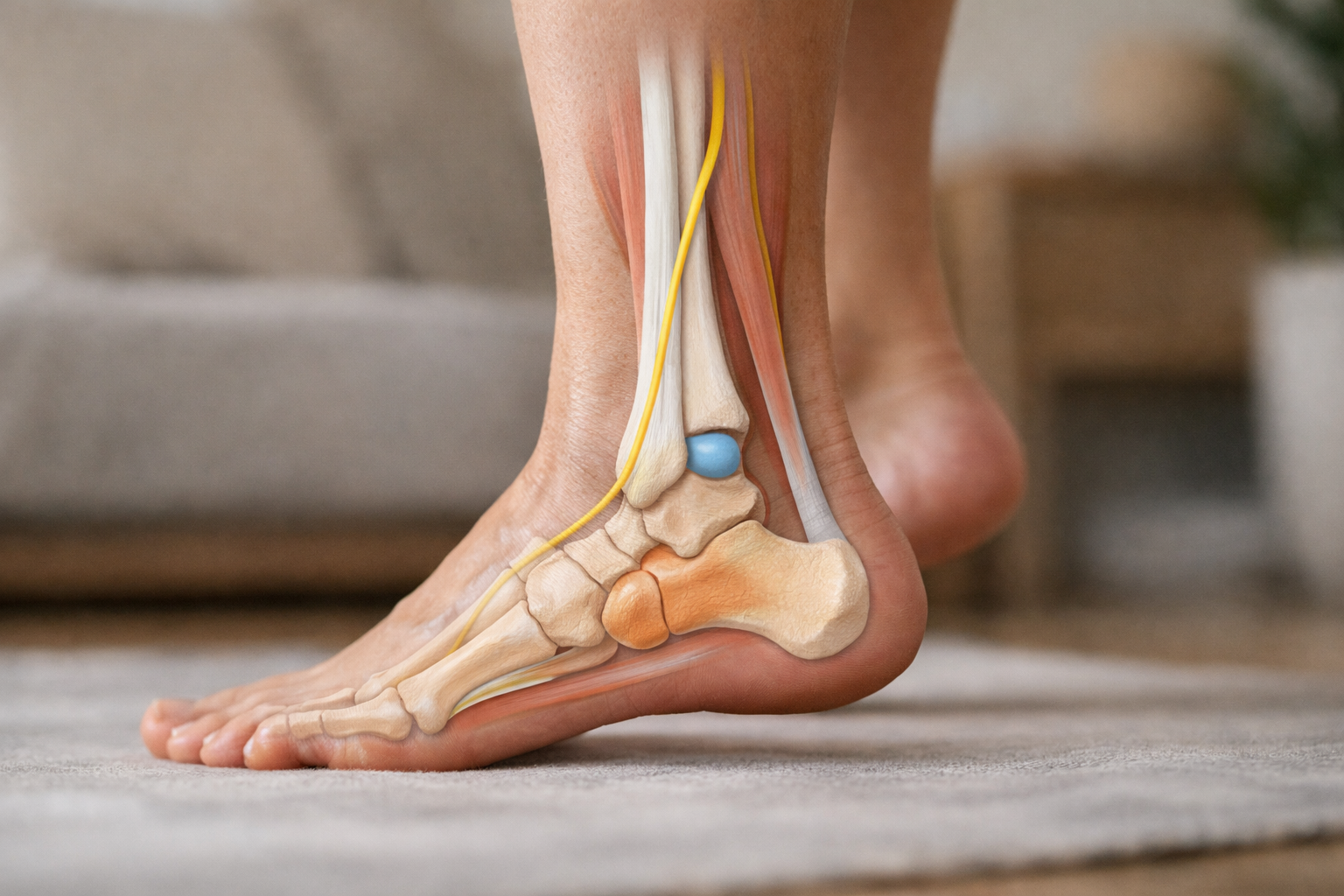
In the foot and ankle, here are the ones that come up most.
Bursitis
A bursa is a small fluid-filled sac that sits between tissues to reduce friction. There’s one behind the heel between the Achilles tendon and the heel bone, one just under the skin at the back of the heel, and others between the heads of the metatarsals in the ball of the foot. When a bursa gets irritated, it hurts in almost exactly the place a tendon would hurt. More on separating those two below, because it’s the single most common mix-up.
Nerve irritation
Nerves in the foot get compressed and irritated in predictable places: the tibial nerve and its branches on the inside of the ankle, the sural nerve along the outside, small nerves between the toes. Nerve pain tends to feel different if you pay attention to the words you reach for. Burning. Electric. Tingling. Numb patches. It often radiates rather than staying in one spot, and it can flare when you’re lying still, which tendons rarely do. Shoe pressure over the wrong spot can set it off in seconds.
Bone stress injuries
This is the one I most want to avoid missing. A stress reaction or stress fracture in the heel bone, the navicular, or a metatarsal can start as a vague ache with activity and feel exactly like an overuse tendon problem for the first week or two. The differences: bone stress pain tends to be pinpoint rather than spread along a line, it usually gets worse the longer you’re on it rather than warming up, it hurts with impact (hopping on that foot is often unmistakable), and it doesn’t improve the way a tendon does over a few weeks of sensible loading. If your pain is getting steadily worse week over week despite reasonable adjustments, that’s a reason to get imaging rather than push on.
The joint itself
Arthritis in the ankle, the joint below it, or the midfoot produces pain and stiffness that can sit right on top of a tendon’s path. The clue is usually in what provokes it. Joint pain often responds to position and weight-bearing generally, feels deep and achy, and comes with stiffness after sitting. Tendon pain is tied more specifically to the movement that tendon performs. A stiff, thickened big toe joint that hurts when you push off gets called tendonitis in the arch surprisingly often.
Muscle strain, and pain referred from elsewhere
A calf strain low down near the Achilles can feel like Achilles tendonitis. Irritation from the lower back or from tight structures higher up the leg can be felt in the foot. Not common, but it happens, and it’s a reason a good evaluation looks above the ankle instead of only where you’re pointing.
Inflammatory and autoimmune conditions
Here’s where the label really changes the plan.
What autoimmune disease causes tendonitis?
A family of conditions called the spondyloarthropathies has a particular fondness for the spots where tendons attach to bone. That includes psoriatic arthritis, ankylosing spondylitis, and reactive arthritis. Inflammation at a tendon’s attachment point is called enthesitis, and the Achilles insertion at the back of the heel is one of its favorite addresses. Rheumatoid arthritis and lupus can also cause tendon and sheath inflammation. Gout, which isn’t autoimmune but is inflammatory, can settle in and around foot tendons and mimic an overuse injury convincingly.
The patterns that raise my suspicion:
- Both heels or both ankles, without a training change to explain it
- Pain in several unrelated places (heel plus a finger joint plus low back)
- Morning stiffness that lasts well beyond a few minutes and involves more than the sore foot
- A whole toe that’s swollen, not just a joint
- A personal or family history of psoriasis, inflammatory bowel disease, or uveitis
- Symptoms that came on without any increase in activity
- Pain and stiffness that improve with movement and worsen with prolonged rest, in a way that feels systemic rather than local
None of those confirms anything on its own. They do mean blood work and a conversation with a rheumatologist may be more useful than another six weeks of calf raises. Worth mentioning too: certain antibiotics in the fluoroquinolone class have been associated with tendon problems, so if your Achilles pain started shortly after a course of medication, tell whoever is evaluating you.
How to tell if it’s bursitis or tendinitis
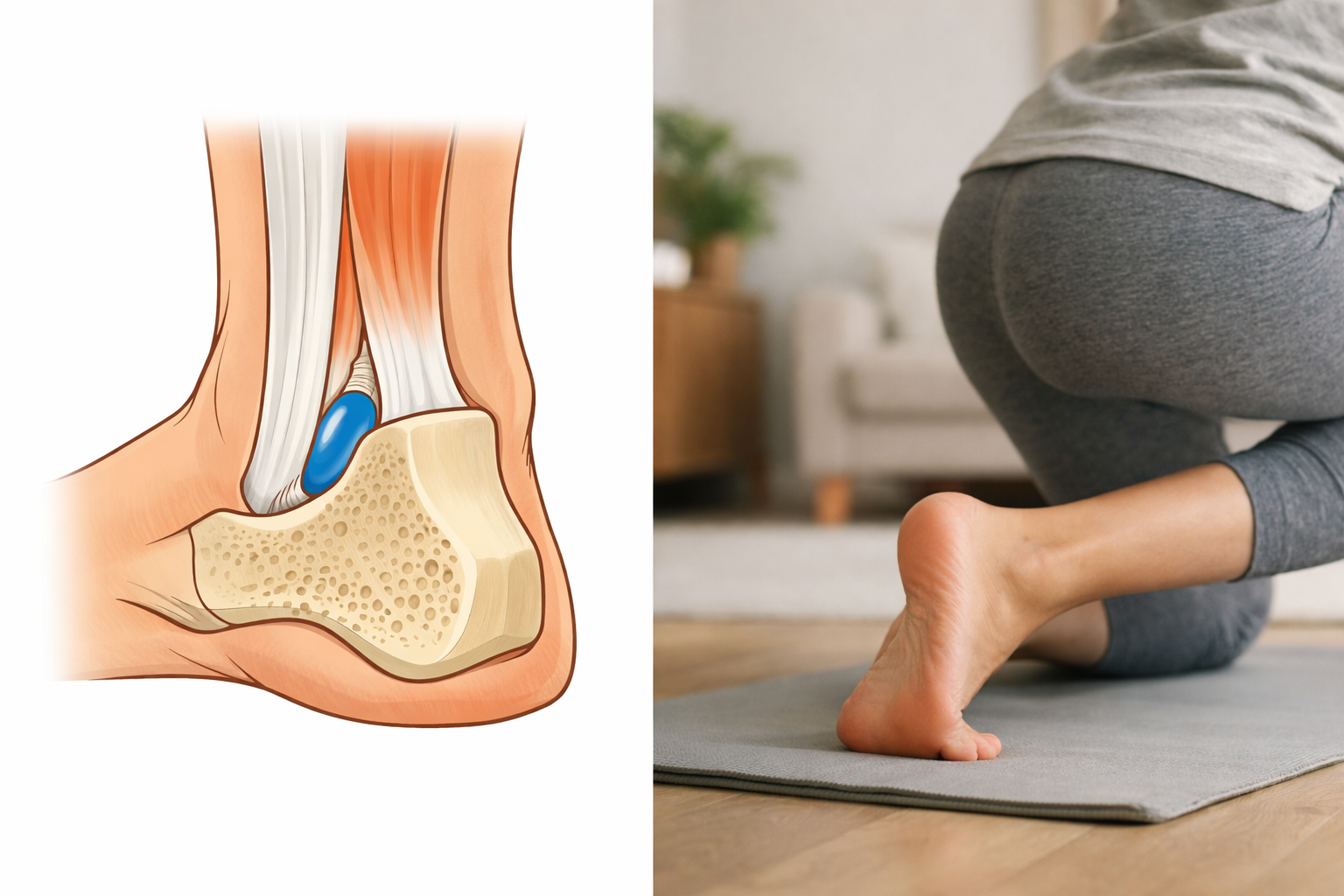
Behind the heel, this comes up constantly, because the retrocalcaneal bursa sits directly between the Achilles tendon and the heel bone. Same neighborhood, different tissue.
A few things help separate them:
Where it hurts when you press. Tendon pain is usually tender along the tendon itself, and you can often trace it up and down like a cord. Bursal pain behind the heel is deeper and slightly in front of the tendon. Squeezing the soft spot just above the heel bone from both sides at once tends to light up a bursa while pinching the tendon front-to-back tends to light up the tendon.
How it responds to loading that specific tendon. Tendons hurt in proportion to the work you ask them to do. A heel raise, a hop, a push-off. Bursitis is provoked more by direct compression and by end-range positions that pinch the sac, so deep ankle bending or the back of a stiff shoe can be worse than the loading itself.
Swelling. Visible, localized puffiness that feels slightly squishy is more typical of a bursa. Tendons thicken, which feels firm and fusiform rather than fluid.
Behavior at rest. Bursitis is a bit more likely to ache and feel tender even when you’re sitting, because pressure alone bothers it.
In practice, the two often travel together. A stiff shoe counter or a sudden increase in hill walking can irritate both the tendon and the bursa behind it. That’s fine. It doesn’t need to be an either/or answer to be treated sensibly, as long as we know what’s driving the irritation.
What does stage 1 bursitis feel like?
You’ll see “stages” of bursitis online. There isn’t one universally used staging system that a clinician would apply to your heel, so don’t get too attached to the number. What people usually mean by early bursitis is this: a small, warm, slightly puffy, locally tender spot. It hurts when something presses on it. It hurts at the end of a long day and fades overnight. You can still do most things, but you’ve become aware of the back of your heel in a way you weren’t a month ago.
What separates early irritation from the version that hangs around for months is usually whether the mechanical cause gets removed. A bursa that keeps getting compressed by the same shoe, the same stride, the same hill, stays angry.
How do you confirm you have bursitis?
Mostly through a good history and hands-on exam: where the tenderness sits, what reproduces it, whether there’s a palpable pocket of fluid, whether loading the tendon is provocative or not. Ultrasound is genuinely useful here because it shows fluid in real time and lets the clinician compare the tendon next to it. MRI shows it clearly too, though it’s rarely necessary for a straightforward case.
One exception matters. If a bursa is hot, red, rapidly swollen, and painful out of proportion, especially with fever or a break in the skin nearby, infection has to be ruled out, and that can require drawing fluid from the bursa. That’s an urgent same-week question, not a wait-and-see one.
And like any scan, imaging answers a narrow question. Fluid in a bursa, or thickening of a tendon, shows up in plenty of people who have no pain at all. A scan can show structural changes. It doesn’t always tell us why you hurt. The story and the exam decide how much weight the picture deserves.
What gets mistaken for bursitis?
Running it the other direction is just as useful:
- Tendinopathy at the insertion, where the Achilles attaches to the bone, which behaves differently from tendon pain a few centimeters higher and often dislikes deep stretching
- A prominent heel bone shape (sometimes called a pump bump) that irritates the skin and soft tissue against shoe backs
- Bone stress injury of the heel, again
- Nerve irritation along the outside or inside of the heel
- Inflammatory arthritis at the tendon attachment, as above
- In the ball of the foot, a nerve growth between the metatarsals versus an irritated bursa versus a metatarsal stress reaction, all of which produce forefoot pain that’s worse in tight shoes
The honest summary is that the back of the heel and the ball of the foot are crowded places. Several structures sit within a centimeter of each other, and they don’t read each other’s mail.
What’s the quickest way to get rid of bursitis?
The fastest progress I see comes from taking pressure off the irritated sac while keeping the rest of the foot and leg working. Practically, that means looking hard at what’s compressing it. Shoes with a rigid back edge that digs in. A heel counter that’s too low or too high for your heel shape. A sudden jump in hill running or speed work, both of which drive the ankle into deep bending under load. A small heel lift, a shoe with a softer back, or briefly cutting the hills can do more in a week than any treatment applied to the heel itself.
Beyond that: short-term calming measures are fine. Relative rest, not complete rest. Then rebuilding, because a bursa that’s calm inside a system that still can’t handle your usual mileage will simply get irritated again the moment you return to it. Rest calms irritation. It doesn’t build capability. Recovery is built.
I won’t give you a number of days. Anyone who does is guessing. What I can say is that many people improve meaningfully over several weeks when the mechanical irritant is addressed and loading is rebuilt in a stepwise way, and that people who only calm the symptoms tend to meet the same problem again.
How do you know if it’s tendonitis or something else?
Here’s the reasoning I’d walk through with you.
Is the pain tied to what you asked that tendon to do? Tendon pain is usually predictable. Same activity, same amount, similar pain. It often shows up after, not during, and sometimes the next morning. Symptoms can lag a day or two behind the load that caused them, which is why people blame the wrong thing.
Is it in one spot, along a line, or spread out? A line suggests a tendon. A pinpoint on bone suggests bone. Burning that travels suggests a nerve. Diffuse deep ache with stiffness suggests a joint.
Did the pain follow an increase in load, or arrive from nowhere? New mileage, new shoes, a new job on your feet, a move to a house with stairs, a vacation with long days of walking on hard surfaces. Total load is cumulative, and it includes everything, not just exercise. If nothing changed and the pain still came, I get more curious about inflammatory or bone causes.
Is it trending the right way at all? Give reasonable adjustments a few weeks. Tendon problems tend to respond, even slowly, to sensible loading. Something that’s clearly worse every week despite backing off is telling you it isn’t a straightforward overuse tendon problem.
Is there anything systemic in the picture? Other joints, rashes, gut symptoms, eye inflammation, fatigue, morning stiffness lasting an hour. Those move the investigation elsewhere.
One more thing: heel pain underneath the foot has its own set of impostors, which I’ve written about separately in “What Gets Mistaken for Plantar Fasciitis (And How to Tell).” If your pain is on the bottom of the heel rather than behind or beside it, that’s the more useful place to start.
Why getting the label right actually changes something
It would be easy to conclude that the name doesn’t matter much, since so much of foot and ankle rehab comes down to the same principle: figure out what the tissue can currently handle, work at that level, and gradually ask it to do more.
That principle is broadly true. But the starting point and the guardrails change with the diagnosis.
- A bone stress injury needs impact reduced for a period before loading progresses, and pushing through it can turn a small problem into a long one.
- Inflammatory arthritis needs medical management alongside loading. Exercise alone chases an inflammation you can’t out-train.
- Nerve irritation often responds to changing what’s compressing the nerve and to gentle movement of the nerve itself, and can get worse with aggressive stretching that a tendon would tolerate.
- Insertional tendon problems frequently dislike the deep stretching that mid-tendon problems handle fine.
- Bursitis needs the compression removed, or everything else you do gets undone by your shoe.
Same general philosophy, different early decisions. That’s the whole argument for a real evaluation rather than a label from a search result.
What loading actually looks like once you know
When the problem is genuinely a tendon, the work is fairly clear in principle and slow in practice. Find a level of loading your foot tolerates. For many people that means keeping discomfort at or below roughly a 4 out of 10 during the work, and checking in about a day later to see whether things settled back to baseline. If they did, that load was reasonable. If your foot is still grumpy two days later, it was a bit much, so you adjust and go again.
Stay at each level long enough to actually adapt before advancing. Early improvements come quickly and are mostly your nervous system getting more comfortable. The tissue itself changes over a longer window, often something like eight to twelve weeks of consistent work, sometimes longer if the problem has been around for a year. That gap explains the most common pattern I see: someone stops as soon as the pain goes quiet, months before the tendon has actually become more capable, and the pain returns with the first busy week.
And if you have a flare along the way, it doesn’t mean you undid your progress. Look at what changed in the previous day or two. Adjust. Keep the overall trend in view rather than the last 48 hours.
When to get it looked at
Get an evaluation sooner rather than later if you have pinpoint bone pain that’s worsening, pain that wakes you at night, a hot and red swollen area with fever, a sudden pop followed by weakness or an inability to push off, numbness that’s spreading, or pain in multiple joints alongside stiffness and fatigue. Also if you’ve been doing reasonable things for six to eight weeks and nothing is moving in the right direction.
That isn’t meant to worry you. Most foot and ankle pain that feels like tendonitis is a load problem in a tissue that got asked for more than it could handle at the time, and most of it improves. Knowing which tissue, and what it needs first, is just how you stop guessing.