Stretches for Ankles and Feet: Where Flexibility Meets Strength
Stretching can make tight ankles and feet feel better, but the relief often fades once you start walking again. Here's why that happens, which stretches are actually worth your time, and how to pair them with loading so the change holds.

Most people who come in asking about stretches for ankles and feet have already been stretching. Sometimes for months. They stretch the calf against the wall, roll the arch on a ball, pull the toes back in the morning, and it feels better for about twenty minutes. Then they stand up, walk to the car, get through a shift at work, and the tightness creeps back.
That pattern isn’t a sign you’re stretching wrong. It’s a clue about what stretching actually does, and what it doesn’t.
So let’s start there, because it changes how you’d use everything else in this article.
What stretching is actually doing
When you hold a calf stretch or pull your toes back, a few things happen at once. The tissue lengthens temporarily. The nervous system turns down its guarding response in that area. Blood flow increases. You feel looser.
What is not happening, in that thirty seconds, is a structural change in your calf, your Achilles, or the fascia along the bottom of your foot. Tissue doesn’t remodel that fast. Fascia, tendon, and muscle change their structure in response to being loaded, repeatedly, over weeks and months. Stretching mostly changes sensitivity and tolerance in the short term.
That’s why stretching feels great and also why the relief has a short shelf life. You unloaded the tissue and calmed it down. Then you asked it to carry your body weight for eight hours, and the demand came back.
This is not an argument against stretching. Stretching is genuinely useful. It’s an argument for knowing what job you’re giving it, and pairing it with something that builds the tissue’s ability to handle load. Both. Not one instead of the other.
Why would my ankles feel tight?
Tightness is a sensation, not a diagnosis. Several very different things produce it, and they call for different responses.
Actual limits in the joint or muscle length. Your ankle needs a certain amount of bend (dorsiflexion, where the shin moves forward over the foot) to walk, squat, and go down stairs normally. If the calf and Achilles are genuinely short, or the joint itself doesn’t glide the way it should, you’ll feel a hard stop. This one responds well to stretching and to mobility work over time.
Protective stiffness. When a tissue is irritated, the surrounding muscles tend to tighten up. The tightness is a symptom of the irritation, not the cause. Stretching into it can feel good briefly, and can also feel like poking a bruise. Here, calming the irritation and then gradually loading matters more than aggressive stretching.
Fatigue tightness. Muscles that are being asked to do more than they’re currently built for feel tight. This is the person with a standing job whose calves and arches feel like cables by hour six. Stretching gives temporary relief. Building capacity is what changes the hour-six experience.
Swelling and joint restriction after an injury. Old ankle sprains commonly leave behind stiffness that lingers well past when the pain went away, partly from the joint itself and partly from a nervous system that stopped trusting that ankle.
Long stretches of no movement. Sitting at a desk, a long flight, a night’s sleep. Tissue that has been still gets stiff. Nothing sinister about it.
Morning stiffness deserves a note here, because it confuses a lot of people. If your heel or arch hurts most in the first steps out of bed, that pattern is often consistent with plantar fasciopathy, the persistent state of the plantar fascia. The pain isn’t telling you the tissue got worse overnight. It’s telling you the tissue sat with no load for hours and became sensitive, and the first few steps are a sudden reintroduction of load. That’s why it eases after a few minutes of walking. Same tissue, different sensitivity.
What causes your ankles to be tight in the first place
Most of the time it comes down to a mismatch between what you’re asking your foot and ankle to do and what they’re currently built to handle.
Common contributors:
- A change in volume. More steps, more standing, a new job, a return to running, a vacation with six hours of walking a day.
- A change in surface or footwear. Going from cushioned shoes to flat ones, or from supportive work shoes to sandals for a summer, shifts where load lands. Neither shoe is wrong. The change is what your tissue notices.
- Not much variety. Feet that only ever walk on flat, hard, even ground on a predictable stride don’t get asked to do much else. Then a hike, a beach, or a basketball game asks for something new.
- Limited ankle bend feeding problems elsewhere. If the ankle doesn’t bend well, the foot and knee tend to find other ways to get through the step.
- Total daily load, all sources combined. This is the one people underestimate. Body weight, hours on your feet, the workout, the dog walk, the errands. It all lands on the same tissue. Talking about weight or a standing job here isn’t blame; it’s arithmetic about how much the system is carrying.
And symptoms often lag. You can do the thing on Saturday and feel it Monday. If you only look at what you did the day the pain showed up, you’ll blame the wrong activity.
What is the best stretch for ankles?
There isn’t one, and I’d be suspicious of anyone who names one. But if I had to pick the two that give the most return for the time spent, they’d be these.
The knee-bent calf stretch (for the deeper calf muscle)
Most people stretch the calf with the back knee locked straight, which targets the big showy part of the calf. Useful. But the deeper muscle underneath, the soleus, is the one doing quiet heavy work every time you walk, and it’s stretched with the knee bent.
Stand facing a wall, hands on it, one foot back. Now bend the back knee and drive it forward while keeping that heel down. You should feel it low, near the Achilles, not up in the belly of the calf. Hold 30 to 45 seconds. Two or three rounds per side.
If you only have time for one calf stretch and you’re on your feet all day, this is the one I’d choose.
The half-kneeling ankle rock
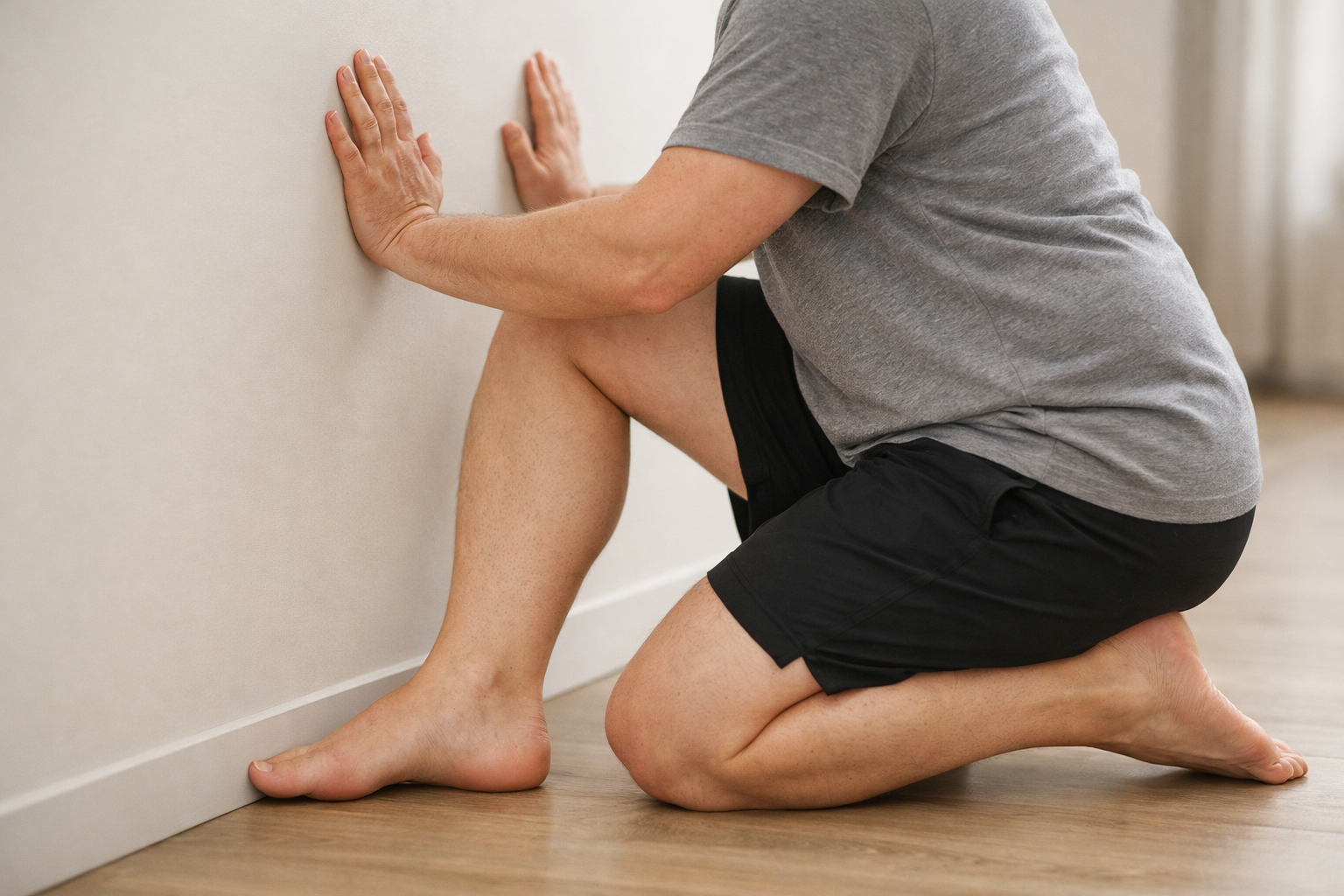
This is a mobility drill more than a static stretch, and I like it for the ankle joint itself.
Half-kneeling, front foot flat, a few inches from a wall. Keeping the heel glued down, drive the front knee forward toward the wall, then back. Slow reps, ten to fifteen. Then scoot the foot back an inch and repeat. You’re working the ankle through the range it uses in walking and stairs, actively, which tends to stick better than holding still.
Worth adding for the foot itself
- Toes-back fascia stretch. Sitting, cross one foot over the opposite knee, pull the toes back toward the shin with your hand until you feel a firm stretch along the arch. This is one of the few times I’ll suggest stretching before your feet hit the floor in the morning, because it makes those first steps less startling.
- Big toe extension. Your big toe needs to bend upward substantially for you to push off normally. Sitting, gently lift and hold the big toe back while keeping the others down. Stiff big toes quietly change how the whole foot loads.
- Toe splay and towel scrunch. Spreading the toes apart, or scrunching a towel toward you with your toes, wakes up the small muscles inside the foot. These are as much strength as flexibility, which is exactly the point.
Skip aggressive ankle circles as your main event. They feel productive and don’t ask much of the tissue. Fine as a warm-up, not a program.
How to loosen tight feet and ankles, and make it last

Here’s the part most stretching articles leave out. Loosening is step one. Keeping it is a different job.
After you create range, use it. Otherwise your body has no reason to keep it. The sequence I’d suggest:
- Reduce sensitivity first if things are angry. Gentle range of motion, a bit less standing that day, shoes that feel better rather than worse. This isn’t the treatment. It’s making room for the treatment.
- Create range. Calf stretch with the knee bent, half-kneeling rocks, big toe work.
- Load into the new range immediately. Heel raises done slowly through the fullest range you can control. Heel raises with the toes propped on a folded towel so the big toe is extended, which brings the arch into it. Slow, controlled step-downs. Balance work on one leg, and eventually on something less predictable than a hardwood floor.
- Then progress it. More reps, then more weight, then more speed, then more unpredictability. A step every week or two rather than every day.
That fourth step is where most home programs quietly stop. People do the same three exercises at the same difficulty for two months, feel better but not fixed, and conclude the exercises don’t work. The exercises worked. The progression was missing. Maybe the piece you’ve been missing isn’t another stretch, but a plan for asking your foot to do a little more over time.
How hard should any of this feel? A reasonable guide for most people: discomfort during and after that stays at or under about a 4 out of 10, and settles back to your normal baseline within roughly a day. If you’re still elevated two days later, the dose was too much. Not damage. Just information about where your foot is right now. Adjust and go again.
How long does it take to loosen tight ankles?
Two honest answers, on two timelines.
Short-term looseness: minutes. You’ll feel a difference in a single session, sometimes within one stretch. That’s your nervous system relaxing its guard, and it’s real, but it’s temporary.
Range you keep without having to re-earn it every morning: typically several weeks of consistent work. For many people the noticeable shift shows up somewhere in the two-to-six-week range, and the deeper tissue adaptation that makes it durable tends to accumulate over something like 8 to 12 weeks. These are general patterns, not a schedule anyone can promise you.
The reason for the longer timeline is worth understanding. Early improvement is mostly your nervous system getting more comfortable and more coordinated. Actual structural change in tendon and fascia comes later. If you stop when the pain resolves but before the tissue has adapted, you’ve collected the first gain and skipped the one that holds. That’s a big part of why these problems come back after they seemed handled.
If you’ve had this for a year, the timeline usually stretches out. Persistent doesn’t mean permanent. It usually means starting lower and progressing more patiently.
Frequency matters more than heroics. Ten focused minutes most days beats forty minutes twice a week. Consistency beats intensity.
What could be causing a tight feeling in my ankle and foot, or pain when I walk?
Stretching helps a lot of things. It doesn’t help everything, and some things it can aggravate. So it’s worth knowing what else can produce that tight, achy, sore-with-walking picture. This is orientation, not self-diagnosis; an in-person exam sorts these out in a way an article can’t.
- Plantar fasciopathy. Heel and arch pain, worst with first steps in the morning or after sitting, better with a few minutes of movement, worse late in a long day on your feet.
- Achilles tendinopathy. Pain and stiffness at the back of the heel or a few inches above it. Often stiff in the morning, warms up with activity, complains afterward. Loads well with slow, progressive heel raises. Doesn’t love being stretched aggressively when it’s irritated.
- Posterior tibial tendon irritation. Pain along the inside of the ankle and into the arch, sometimes with the arch feeling like it’s collapsing as the day goes on.
- Old ankle sprain that never fully rebuilt. The ligament healed, the pain faded, the ankle’s confidence and control didn’t come back. Feels stiff, feels unreliable on uneven ground. Strength and balance work matter more than stretching here.
- Nerve-related symptoms. Burning, electrical, pins and needles, numbness, or symptoms that travel. Tarsal tunnel and nerve irritation from higher up the chain can both show up in the foot. Stretching an irritated nerve tends to make it louder, not quieter.
- Joint arthritis. Ankle, big toe, or midfoot. Stiffness that’s worst after rest, deep aching, sometimes a grinding sensation. Movement usually helps; the goal shifts toward keeping range and building strength around the joint.
- Bone stress. A focal, precise spot of pain that gets worse the longer you’re on it and doesn’t calm down with rest days, especially after a jump in training volume, deserves a proper evaluation rather than a stretching routine.
What disease is related to ankle pain?
Several, and this is where I’d rather you get looked at than guess. Inflammatory arthritis (including rheumatoid arthritis and the spondyloarthropathies) can cause foot and ankle pain, often with prolonged morning stiffness, multiple joints involved, or swelling that doesn’t track with activity. Gout classically hits the big toe joint with sudden, intense pain, redness, and heat. Diabetes affects the foot through nerve changes and altered sensation, which changes how foot problems should be managed. Peripheral artery disease can produce leg and foot pain with walking that eases with rest. Thyroid conditions and some medications also affect tendon health.
These are less common than plain overuse. But if your foot pain comes with swelling in multiple joints, morning stiffness lasting hours, fever, redness and heat, numbness, or symptoms in both feet with no clear cause, that’s a conversation with a physician rather than a stretching plan.
Building the routine
What this looks like in practice, minus the exercise-library format:
Morning, two minutes, in bed or on the edge of it. Toes-back fascia stretch, both sides. A few ankle pumps. This takes the edge off the first steps. It’s symptom management, and that’s a fine thing to want.
Once during the day, five to ten minutes. Knee-bent calf stretch. Half-kneeling ankle rocks. Then slow heel raises, and single-leg balance while you brush your teeth or wait for the kettle. The stretching opens the door; the loading is what walks through it.
Every week or two, ask a harder question. More reps. Then load in a backpack or hold a dumbbell. Then raises on one leg. Then off the edge of a step for more range. Then a bit of speed or a small hop, if that’s relevant to what you want to get back to. Your response tells you when to move up, not the calendar. If a step up leaves you sore for two days, hold there another week and try again.
On your feet all day? Spread it out. Change positions. Get a calf stretch in mid-shift. The problem with a standing job isn’t any single hour, it’s eight of them stacked with no variation.
If strength is the part you feel least clear on, we’ve written separately about the best way to strengthen ankles, and it goes deeper into which exercises actually build stability and how to progress them.
When a flare-up happens
It will, somewhere in the process. You’ll have a good week, do more than usual, and wake up sore.
A flare-up is not lost progress. It’s usually the sum of a day: the exercises plus a long walk plus different shoes plus more standing than normal. Look at what changed, dial back to a level you handled well, hold there a few days, then rebuild. The overall direction over a month tells you far more than any single bad morning.
And watch function, not just the pain number. Are you walking farther before it bothers you? Standing longer at work? Recovering faster the next day? Those can improve while some soreness is still hanging around, and they’re real progress. Pain matters. It’s just not the only measurement we’ve got.
A note on when to get it looked at
Stretching and gradual loading are reasonable starting points for a lot of foot and ankle tightness. Get an in-person evaluation if pain has been going for more than a few weeks without improving, if it’s severe or worsening, if you can’t put weight through the foot, if you’ve had a fall or a twist you can’t walk off, or if there’s numbness, significant swelling, redness and warmth, or symptoms in both feet without an obvious explanation. An exam sorts out what an article can only list.
And if you’ve been diligently stretching for months with nothing sticking, that’s worth a look too. Usually nothing is wrong with your stretches. Something is missing after them.