How to Strengthen Ankles to Prevent Rolling (and Keep It From Happening Again)
A practical guide to why ankles keep rolling, what actually reduces that risk, and how to build ankle capacity that holds up on curbs, trails, and tired legs. Includes how to progress balance and strength work, and how long it usually takes.

You stepped off a curb you have stepped off a thousand times. Or your foot landed half on a tree root. And your ankle went over again, the same way it always does, with that hot flash of pain and the sinking thought: not again.
If that has happened more than once, you have probably been told your ankles are weak. That is part of it. But it is rarely the whole story, and it is not usually the part that explains why the roll happens so fast that you never had a chance to catch it.
Let me walk you through what is actually going on, and what changes it.
Why do I keep rolling my ankle so easily?
Most rolled ankles are inversion sprains. The foot turns inward and under, and the ligaments on the outside of the ankle take the strain. It happens in a fraction of a second, faster than you can consciously react.
That timing matters. When people ask how to strengthen ankles to prevent rolling, they are usually picturing brute strength: an ankle so strong it refuses to bend the wrong way. That is not really how it works. No amount of calf strength will out-muscle your body weight dropping onto a badly positioned foot.
What actually protects you is a combination of three things:
Position before contact. Your nervous system pre-positions the foot before it lands, based on what it expects the ground to do. After a sprain, that prediction gets less accurate. The foot arrives in a slightly worse position, and the margin for error shrinks.
Speed of the correction. The muscles on the outside of your lower leg (the peroneals, running down the outside of the calf to the outer foot) are the main brake on the ankle rolling inward. They need to fire fast and hard. After an injury, they often fire late.
How much the tissue can take. Ligaments, tendons, and muscles all have a limit to the force they can absorb. Fresh legs handle more than tired legs. This is why so many sprains happen in the last ten minutes of a game or the last mile of a hike.
So the honest answer to “why does this keep happening” is usually: the first sprain left behind changes in all three, and none of them fully rebuilt on their own. Time heals the swelling. It does not automatically restore the timing.
The part almost nobody rehabs
Here is something worth knowing. After a significant ankle sprain, a lot of people are told to rest, ice, wrap it, and return to activity when it stops hurting. That advice is reasonable in the first week or two. The gap opens after that.
Pain resolves in a few weeks. The changes in balance, in reaction speed, in confidence on uneven ground, those can hang around for months or years if nothing specifically addresses them. That is why the single biggest risk factor for spraining an ankle is having sprained that ankle before.
Not because the ligament is permanently ruined. Because the rebuilding step got skipped. Recovery is built, not waited for.
What are the signs of weak or unstable ankles?
You do not need a test to notice these. See how many sound familiar:
- Your ankle gives way on flat ground, curbs, or when you turn quickly
- You avoid trails, gravel, grass, cobblestones, or anything uneven
- You cannot stand on one leg for 30 seconds without a lot of wobbling or putting a hand out
- One ankle feels noticeably different from the other, even if it does not hurt
- Standing on one leg with your eyes closed is dramatically harder on one side
- You have a lingering sense that the ankle is not trustworthy, even when it feels fine
- Your ankle swells or aches after a long day, without a specific injury
- You cannot do as many single-leg calf raises on one side as the other
That last one is a useful home check. Stand on one leg, hold a wall lightly for balance only, and rise all the way up onto the ball of your foot with a straight knee. Count clean, full-height reps. Then compare sides. A clear difference between legs tells you something even if neither side hurts.
The “it does not feel trustworthy” item deserves its own mention. That feeling is real information, not anxiety. It usually reflects genuine changes in how well your brain is reading position from that joint. And it responds well to training.
Can weak ankles actually be strengthened?
Yes. Reliably, in most people, with consistent work.
The part that surprises people is how much of the improvement is not muscle bulk. Early on, the gains come from your nervous system learning to recruit the muscles you already have, faster and in better order. That is why balance work can feel meaningfully easier within two or three weeks even though nothing about your leg looks different.
Structural change comes later. Tendons and muscles remodel slowly, over roughly two to three months of consistent loading for many people. This is worth knowing because it explains the most common way ankle rehab fails: things feel good after a month, the exercises stop, and six months later the ankle rolls again.
The confidence came back before the tissue finished changing.
Does walking a lot strengthen your ankles?
Somewhat, and less than you would hope.
Walking on flat, predictable surfaces asks very little of the muscles that stop your ankle from rolling. Your foot lands the same way every step. There is no surprise to react to. Walking is good for you for a hundred reasons, and it does keep the ankle moving and loaded, but it does not train the specific thing that fails during a sprain.
What does help: walking on varied ground. Grass, sand, gravel, trails, uneven sidewalks. Every irregular surface forces small corrections, and small corrections are exactly what you are trying to rebuild.
The caution is dose. If your ankle is currently sensitive or you have rolled it recently, jumping straight onto a rocky trail is asking for the thing you are trying to avoid. Uneven ground is a training tool. Like any training tool, it works when the amount matches what you can currently handle.
The progression that actually reduces rolling
Here is how I think about building this, in stages. The point is not to collect exercises. The point is to move through stages, staying at each one long enough that it becomes genuinely easy before you advance.
Stage 1: Restore the motion and calm the joint
If your ankle is currently stiff, swollen, or painful, start here. Strength work on a joint that cannot move well tends to stall.
The motion that matters most is dorsiflexion, your ability to bring your knee forward over your toes with your heel down. It is limited in a huge number of people after an ankle sprain, and it changes how you land. Less forward motion at the ankle means the body finds it somewhere else, often by rolling the foot inward.
A simple way to check: put your foot about four inches from a wall, keep the heel flat, and try to touch your knee to the wall. Compare sides. If one side cannot get close and the other can, that gap is worth working on.
A knee-to-wall stretch, held gently and repeated daily, addresses it for most people. So does spending time in a deep, heel-down squat position if that is comfortable for you.
Stage 2: Build the muscles that stop the roll
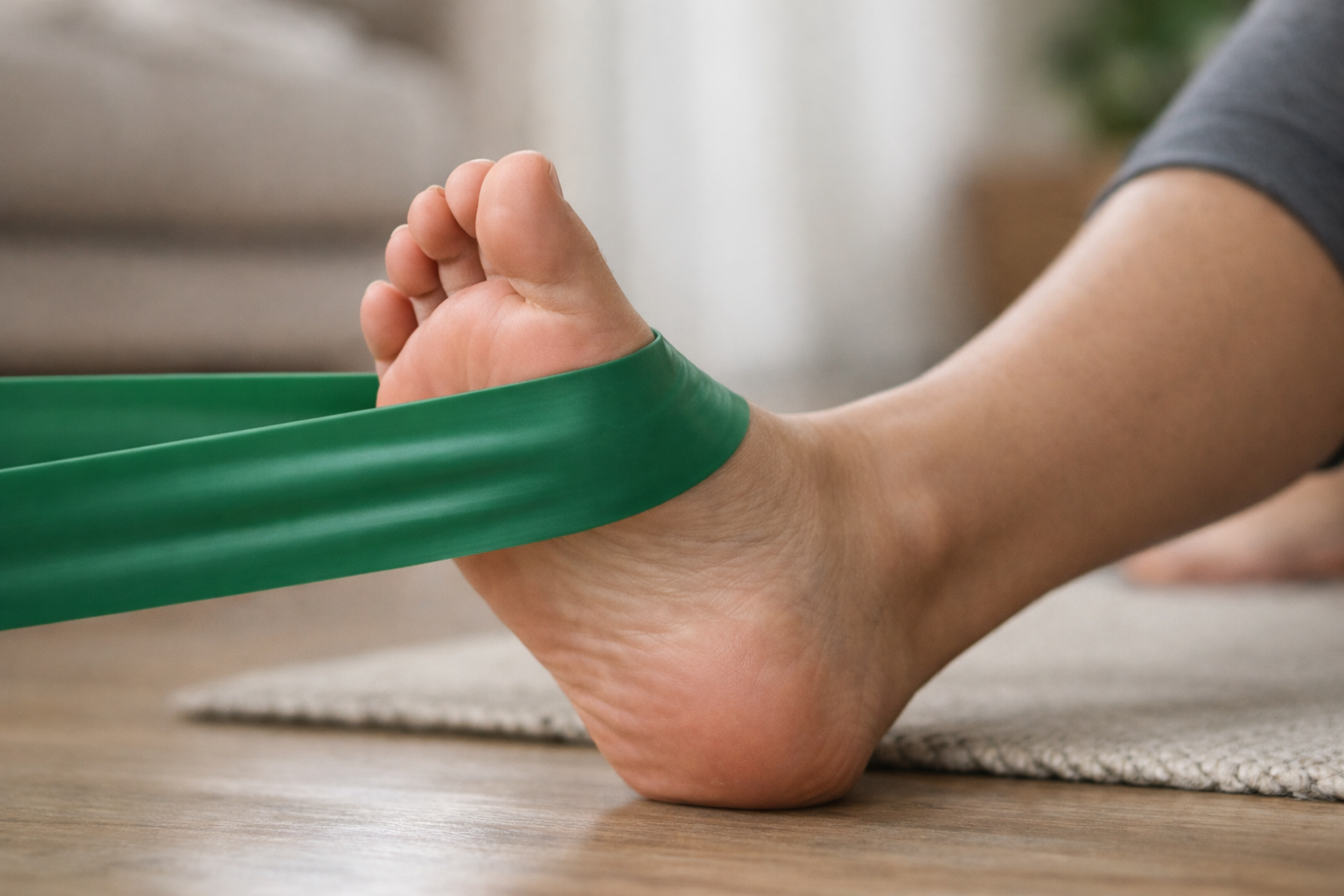
Now load the tissue directly.
Resisted eversion. This is the one most directly tied to preventing an inversion sprain. Loop a resistance band around the outside of your foot, anchored to your other side. Turn the sole of your foot outward against the band, then return slowly. Slowly is the important word. The lowering phase is where the muscle does the most work.
Resisted inversion. Train the opposite direction too. A joint that is only strong one way is not a stable joint.
Single-leg calf raises. Full range, all the way up, all the way down under control. Then progress to doing them off a step so the heel can drop below level. Building here matters because the calf complex absorbs an enormous amount of force every step you take.
Tibialis anterior work. Stand with your back against a wall, feet out in front, and lift your toes and forefoot toward your shins. This trains the muscle on the front of your shin, which controls how your foot lowers to the ground. When it fatigues, foot control gets sloppy.
My general rule for load: you want the exercise to feel genuinely hard by the last few reps, and you want your ankle to feel about the same the next morning as it did before. If it is clearly angrier 24 hours later, that was too much. Not damage, just information about where your current limit is. Adjust and go again.
Stage 3: Retrain the balance system

This stage does more to prevent rolling than anything else on the list, and it is the stage most often skipped.
Start with single-leg standing. Not as a party trick, as deliberate practice. Aim for something like 30 to 60 seconds per side, and progress in this order:
- Eyes open, on the floor, hand near a wall
- Eyes open, no hand
- Eyes open while turning your head side to side, or tossing a ball against a wall
- Eyes closed (this one is dramatically harder, and it is the one that most directly trains the position sense coming from your ankle)
- On a cushion, folded towel, or pillow
- Eyes closed on a cushion
Then add movement. Standing on one leg while reaching your other foot forward, out to the side, and behind you, tapping the floor lightly each time and returning to balance. This is closer to what your ankle has to do in real life, where you are almost never balancing while standing still.
A note on wobble boards and balance discs: they are useful, but they are not required. A pillow works. What matters is that the surface is unpredictable enough that your ankle has to make constant small corrections.
Stage 4: Teach it to react at speed
An ankle sprain happens in about the time it takes to blink. Training that only happens slowly does not fully prepare you for that.
Once the earlier stages feel solid, add speed and impact. Small hops in place on one leg. Hopping forward and back over a line, then side to side. Landing quietly and holding the landing for a beat before the next rep. Then hopping onto slightly unstable surfaces, or hopping and landing with a turn.
Quiet landings are the goal. Noise means you are crashing into the ground rather than absorbing it.
This stage is not optional if you play sports, run trails, or work on uneven ground. It is where all the earlier work gets translated into something your body can actually use at game speed.
Stage 5: Make it look like your real life
If you hike, get on trails, deliberately and progressively. If you play basketball, do cutting and jumping drills before you are back in a live game. If your job has you on ladders or scaffolding or a boat deck, your training should eventually include something that unstable.
The body adapts specifically to what you ask of it. An ankle that is excellent at standing on one leg in a quiet room is not automatically excellent at absorbing a bad landing on a wet field.
What is the most effective single exercise?
People want one answer here, and I understand why. The honest answer is that no single exercise does this job, because rolling an ankle involves position, reaction speed, and strength all at once.
If I had to pick the highest-value item for someone who has rolled an ankle before, it would be single-leg balance work progressed to challenging versions: eyes closed, unstable surface, with movement added. Balance training has the strongest track record for reducing repeat sprains specifically.
But it works better alongside strength. Balance training teaches the ankle when to react. Strength training gives it something to react with.
If you want a deeper look at which strength exercises build real capacity and how to load them, the article on the best way to strengthen ankles on this site goes further into that side of it.
Why do my ankles roll inward when I walk? (This is a different question)
Worth separating two things that get mixed up constantly.
Rolling your ankle is an acute event. The foot turns under, ligaments get stressed, it hurts.
Pronation is a normal, necessary motion where the arch lowers and the foot rolls slightly inward as you take weight. Every functioning foot does this. It is how your foot absorbs shock and adapts to the ground. A foot that does not pronate at all is a stiff, poor shock absorber.
So when someone asks how to strengthen their ankles to prevent pronation, my first question is: what is actually bothering you? Because pronation itself is not a problem to be eliminated. If you have looked down at your feet and noticed your arches flatten, and nothing hurts, there is likely nothing to correct.
When pronation genuinely becomes relevant is when there is a lot of it, it happens quickly, and it is paired with symptoms: inner-ankle or arch pain, shin pain, knee pain on the inside, or a pattern of overuse problems that keeps coming back.
In that case, strengthening does help, but it is not usually the ankle in isolation:
- Foot intrinsic muscles. Short foot exercises, where you gently draw the ball of your foot toward the heel without curling your toes, build the small muscles that support the arch from underneath.
- Posterior tibialis. This tendon runs behind the inner ankle bone and is the main active support for the arch. Resisted inversion and single-leg heel raises with the heel controlled load it well.
- Hips. A large amount of what looks like foot pronation starts higher up. If the thigh bone rotates inward because the glutes are not controlling it, the foot flattens as a consequence. Training the hip often changes the foot.
And orthotics are not the enemy here. They can be genuinely helpful, especially as a way to reduce symptoms while you build capacity. The gap I see is when they are used as the entire plan, with nothing being built underneath them.
How long does it take to strengthen your ankles?
A reasonable set of expectations, with the caveat that people vary a lot:
Two to three weeks: balance noticeably improves. Single-leg standing gets easier. Most of this is your nervous system, not new tissue.
Six to eight weeks: measurable strength changes. Calf raise numbers even out between sides. The ankle feels more solid during activity.
Three months and beyond: the tendon and muscle changes that actually shift what the ankle can tolerate over a long day or a long season. This is the timeline that matters most for not rolling it again.
Someone rehabbing a first sprain in an otherwise healthy ankle usually moves faster. Someone with a history of five or six sprains over a decade typically starts lower and progresses more patiently. A long history does not mean it will not work. It usually means the starting point is lower and the build takes longer.
And frequency beats heroics. Ten focused minutes most days will do far more than one long session a week. Consistency beats intensity.
What about braces and taping?
Fair question, and the answer is more favorable than some people expect.
External support does reduce sprain risk during high-risk activity, particularly for people who have sprained before. It is not a crutch and it does not make your ankle weaker in any meaningful way over a season of sport.
Where I would push back is using a brace as the whole plan. A brace protects you while you are wearing it. It does nothing on the morning you step off a curb in your work shoes. Use the support during the risky stuff, and build capacity underneath it so the ankle is more robust on its own.
Same logic with shoes. High-tops and stiffer footwear can help on uneven ground. They also do not train anything. Both things can be true.
When your ankle rolls anyway
It will happen sometimes, even to well-trained ankles. Landing on someone’s foot in a game is not a training failure.
A mild roll that hurts for a couple of days and settles down does not erase the work you did. What I would watch for is the pattern afterward: do not simply wait for the pain to go and resume. That is the loop that produces the fifth and sixth sprain. Back off the load, let the irritation settle over a few days, and then walk back through the stages, starting a little below where you were. You will move through them much faster the second time.
A flare in symptoms is information about what the ankle was ready for that day. It is not a verdict on your progress.
When to get it looked at
A few situations deserve an in-person evaluation rather than a home program:
- You could not put weight on it at all right after the injury, or there is bony tenderness right on the ankle bones
- Significant swelling or bruising that is not improving after a week or so
- The ankle gives way repeatedly during normal walking, not just during sport
- Pain that is getting worse over weeks instead of better
- Numbness, tingling, pins and needles, or the foot changing color
- Pain in the mid-foot or along the outer edge of the foot, which can point somewhere other than the usual ligaments
Also worth saying: not everything that feels like a rolled ankle is a simple sprain. High ankle sprains, small fractures, tendon problems on the outside of the ankle, and cartilage injuries inside the joint can all feel similar and take different paths. If your ankle has been unreliable for months and a home program has not moved the needle, an evaluation is a better use of your time than more repetitions of something that is not working.
Most of the time, though, this is a rebuilding problem. The ligament healed. The system around it never got asked to do more. Start where your ankle is today, ask for a little more each week, and watch how it answers.