Can Weak Ankles Be Fixed? What Physical Therapy Can Achieve
A clear look at whether weak, unstable ankles can actually change, what "fixed" realistically means, and how strength, balance, and footwear decisions fit together. Covers timelines, barefoot and shoe questions, and the signs that something other than weakness is going on.

Most people who ask this question have a history with it. You rolled an ankle years ago, maybe more than once. It swelled, you limped for a couple of weeks, then life moved on. But something never quite came back. Now curbs make you cautious. Gravel paths feel like a risk. You step off a stair wrong and your ankle wobbles in a way the other one doesn’t, and you’ve quietly decided you’re just someone with weak ankles.
So: can weak ankles be fixed?
The honest answer is that most people can change this a great deal, and that the word “fixed” is doing you a disservice. Let me explain what I mean, because the distinction changes what you actually do about it.
What “fixed” is really asking
When someone says they want their ankle fixed, they usually mean one of a few different things:
- I want it to stop hurting after I’m on my feet all day.
- I want to stop rolling it.
- I want to trust it on uneven ground, on a ladder, on a trail, on a court.
- I want to stop thinking about it.
Those are different goals with different paths. And they’re all about capability, not about restoring the ankle to some original factory condition. Some tissue changes stick around. A ligament that got stretched in a bad sprain doesn’t shrink back to its old length. That fact tends to sound like a verdict, and it isn’t, because ligament tightness is only one part of how an ankle stays under you.
Stability comes from three layers working together. The passive layer is ligaments and joint shape. The active layer is the muscles around the ankle, foot, and hip that generate force to keep you upright. The control layer is the nervous system deciding, in a fraction of a second, which muscles fire and how hard, based on what the foot is sensing from the ground.
You can’t stretch a ligament back. You can absolutely improve the other two. For a lot of people, that is enough to walk trails, play sports, work on their feet, and stop bracing for the next roll.
Why an old sprain leaves an ankle feeling weak years later
After a significant sprain, the ankle usually gets a few weeks of rest and protection, and the pain settles. That’s the point where most people go back to normal life. Pain resolving feels like healing finishing.
But the ankle’s reporting system takes longer to come back than the swelling does. The joint’s sensors were disrupted, the calf and the muscles running down the outside of the ankle got weaker while you limped, and nobody ever asked that ankle to handle side-to-side, rotational, or single-leg demands again in a graded way. So it works fine on flat, predictable ground and gets caught out on anything else.
That gap is where the feeling of weakness lives. It is not usually a matter of a hopelessly damaged joint. It’s a matter of capacity that was never rebuilt after the pain went away. Rest calmed things down and then nothing asked the ankle to become capable again.
Repeated rolling, ongoing swelling, and the sense that the ankle gives way can be consistent with what clinicians call chronic ankle instability. That label matters less than the two questions underneath it: how much does this ankle currently tolerate, and does it improve when we ask for a bit more?
What to do if your ankles are weak
Start by sorting out which problem you actually have, because the answer shapes everything after.
Does it give way, or does it hurt, or are you just afraid of it? All three are real. An ankle that genuinely buckles needs strength and control work plus, sometimes, temporary external support. An ankle that aches after long days is usually a load-tolerance issue. An ankle that feels fine but that you don’t trust needs graded exposure to the situations you’re avoiding, which is its own kind of training.
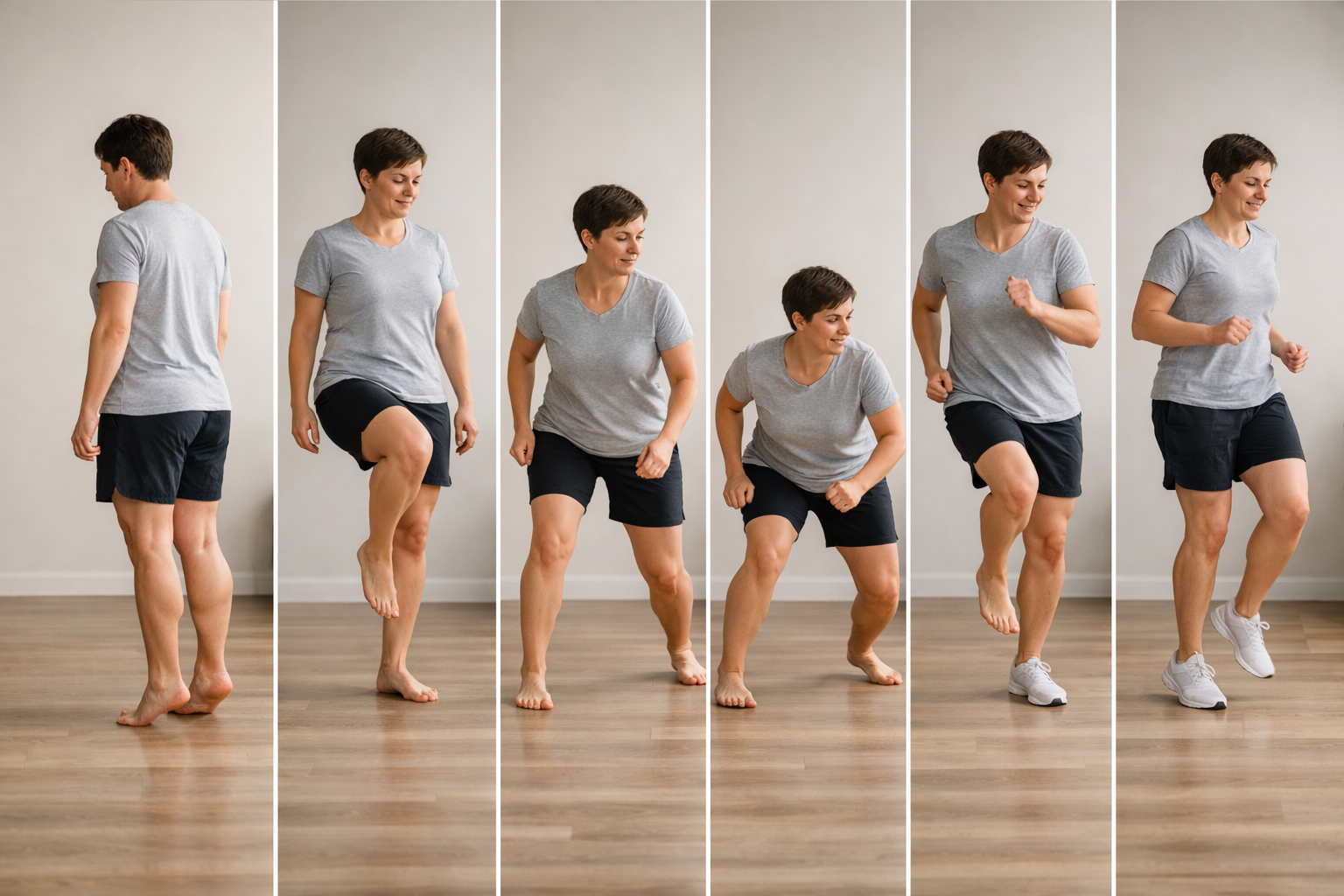
Then start loading it, at a level it can handle. Not a heroic level. A workable one. Calf raises, single-leg balance, controlled work in the directions that feel sketchy, and eventually hopping and landing if you want the ankle to handle sport or trail running. The specific menu matters less than the progression. If you want the exercise detail, we’ve written about that separately in “Best Way to Strengthen Ankles: What Actually Builds Real Stability.”
Use two practical guardrails. For many people, it works well to keep discomfort at or below roughly a 4 out of 10 during and right after the work, and to check in about 24 hours later. If the ankle has settled back to its usual baseline by the next day, that dose was reasonable. If it’s still noticeably worse two days out, it was too much, and you trim it rather than abandoning it.
Keep walking and living in the meantime. Complete rest is the one strategy that reliably makes a weak ankle weaker. Rest in small doses calms an irritated joint. In large doses it just lowers the bar further.
How long will it take to strengthen my ankles?
You’ll usually feel something within two to three weeks. That early change is mostly your nervous system getting better at recruiting muscle you already had. It’s real, and it’s encouraging, and it is not the finish line.
Actual tissue adaptation, muscle and tendon getting genuinely more capable, typically unfolds over something like eight to twelve weeks of consistent work, and often longer if this has been going on for years. A longer history usually means a lower starting point and a more patient build, not a worse outcome.
The most common reason ankle rehab fails is stopping at week four. Symptoms are gone, confidence is back, the exercises feel easy, so they stop. The nervous system got sharper, but the tissue never finished adapting, and the next awkward step on a curb finds the same gap it found before.
Watch function, not just pain, to know it’s working:
- How long can you stand on one leg before the ankle starts hunting for balance?
- Can you do more calf raises than a month ago before the calf gives out?
- How do you feel the day after a long day, compared with a month ago?
- Are you walking on grass, gravel, and slopes without doing the mental math first?
Those measures move even in weeks when pain doesn’t. Function matters as much as pain.
Are weak ankles ever a sign of something else?
Sometimes, and this is worth checking rather than assuming.
Ankle weakness can trail behind an old sprain, but it can also come from calf weakness, hip and glute control that isn’t holding the leg steady, generally loose joints (some people are simply built with more mobility everywhere), nerve issues that dull the foot’s sensation, or arthritis in the joint. Recurring swelling that shows up without an obvious cause, a joint that catches or locks, sharp pain deep in the front of the ankle, numbness, or a foot that feels like it drops when you walk all deserve an in-person look. Those patterns point somewhere other than plain deconditioning, and an evaluation sorts them out faster than guessing does.
Does walking a lot strengthen your ankles?
Walking maintains more than it builds. It keeps the ankle moving through a modest, predictable range on mostly even ground, and that’s genuinely worth having. But your ankles handle walking already. Asking them to do more of what they already tolerate doesn’t push capacity upward much.
Do your feet get stronger the more you walk? To a point, yes, especially if you’ve been mostly sedentary or you add hills, uneven surfaces, and load like a backpack. The adaptation is real but it plateaus, and it plateaus below what a trail, a court, or a fall on a curb will ask of you. Walking is the floor. It’s not the ceiling.
The footwear questions

What shoes are best for strengthening ankles? No shoe strengthens an ankle. Shoes change how much work your foot and ankle have to do. A stiff, high-collared, heavily cushioned shoe does more of the stabilizing for you, which is useful when an ankle is irritated or when you’re on your feet for ten hours, and less useful as your only long-term strategy. A flatter, more flexible shoe lets your foot and ankle work harder, which builds capacity if you get there gradually. Neither category is right or wrong. They’re tools with different jobs.
What I’d avoid is switching your daily shoes abruptly because you read that minimal footwear is better. Changing footwear changes the demand on your foot overnight, and total load is cumulative. That’s a common way to trigger a flare in the arch, heel, or Achilles.
Is walking barefoot good for ankle strength? Being barefoot at home is a reasonable, low-cost way to give your foot more sensory information and let the small muscles work. It’s a good environment for balance practice. It won’t build the strength you need for sport on its own, and it’s not for everyone: if you have diabetes, reduced sensation in your feet, or a foot that’s currently painful, keeping supportive shoes on more of the time is the smarter call.
Is it better to walk with socks or barefoot? Barefoot, mostly, and for a boring reason. Socks slide on hardwood, tile, and stairs. If your ankle already gives way sometimes, removing traction is adding risk for no benefit. Skin also gives your nervous system better feedback about what the floor is doing. On carpet, socks are fine. On slick floors, go barefoot or wear grip socks.
What about braces and tape? They help in the right context. A brace can let you get back on a court sooner, get through a shift with less symptoms, or hike with more confidence while you’re still building. The problem isn’t the brace, it’s using it for two years without ever addressing what’s underneath. Support plus building beats support alone.
When people start asking about surgery
Surgery for ankle instability exists and it helps some people, usually those with significant ligament laxity who keep giving way despite a real, progressive strengthening effort over a matter of months. The key words are “a real, progressive effort.” Plenty of people arrive at the surgical conversation having done four weeks of theraband exercises two years ago. That isn’t the same trial.
And even after surgery, the rebuilding work follows. The ligament gets tightened; the muscles and the control still have to be trained. Which tells you something about how much of ankle stability was always going to come from the training.
Flare-ups and rolled ankles along the way
You will probably tweak it at some point during this. You’ll step off a curb, feel that familiar lurch, and think you undid everything.
You almost certainly didn’t. A single roll on an ankle that’s been getting stronger for eight weeks is not the same event as a roll on an ankle that’s been avoided for eight years. Calm it down for a few days, keep moving as much as the ankle allows, then step back into the progression a level below where you left off. Look at what changed that day: new shoes, a long hike, a bad night of sleep, a heavier week than usual. Recovery is not a straight line, and a bad week doesn’t erase two good months.
If you can’t bear weight after an injury, if there’s significant swelling and bruising, if the joint feels like it’s catching or shifting, or if things are steadily getting worse rather than fluctuating, get it evaluated. Not everything that feels like weakness is weakness, and it’s worth knowing which one you’re dealing with.
What a genuinely strong ankle feels like
Not invincible. Nobody has an ankle that can’t be rolled with enough bad luck. What changes is the margin. You step wrong, the ankle wobbles, the muscles catch it, and you keep walking without a second thought. That’s not the absence of a problem. That’s an ankle that got capable enough to absorb a mistake.
Recovery is built. It takes longer than most people expect and less heroic effort than most people fear, and consistency beats intensity every time in this particular project.