Best Way to Strengthen Ankles: What Actually Builds Real Stability
A practical, evidence-grounded look at which ankle exercises actually build strength and stability, and how to progress them so the gains hold up on stairs, uneven ground, and everyday life.

You go down a curb wrong, or step off a sidewalk onto grass, and your ankle just… gives. Not a full sprain. Just that lurch where it feels like the joint isn’t quite trustworthy anymore. Maybe it’s happened enough times that you’ve started watching the ground when you walk, or avoiding trails you used to enjoy. That’s usually what brings someone in asking how to strengthen their ankles, not a diagnosis, but a loss of confidence in a joint that’s supposed to just work without thinking about it.
The good news is that ankle strength and stability respond well to the right kind of training. The less good news is that most lists of “ankle exercises” skip the part that actually matters most: how you progress them over time. Doing eight reps of the same calf raise for six weeks isn’t a strengthening program. It’s a warm-up that never became one.
What “weak ankle” actually means
When people say their ankle is weak, they’re usually describing one of three different problems, sometimes all three at once.
The first is genuine muscle weakness: the calf, the muscles that run along the outside and inside of your shin, and the small stabilizers around the joint simply haven’t been asked to do much work in a while. The second is a balance and proprioception issue, meaning your brain and nervous system have gotten slower at sensing where your foot is in space and correcting for it. The third is tissue tolerance, particularly if you’ve sprained that ankle before. The ligaments may have healed a bit lax, and the joint hasn’t rebuilt the capacity to handle a sudden twist or an uneven step.
These three things get addressed differently. Strength needs load. Balance needs practice under manageable challenge. Tissue tolerance needs graded exposure to the kinds of movements that used to cause trouble. A good ankle program touches all three, not just the one that’s easiest to demonstrate in a video.
What are weak ankles a symptom of?
Ankle weakness rarely comes out of nowhere. Some common contributors:
- A previous ankle sprain that healed but was never fully rehabbed. This is the most common one I see. The pain went away in a couple of weeks, so people stopped doing anything about it, but the strength and balance work that actually restores full function takes longer than the pain does.
- General deconditioning, especially after a period of being less active than usual, whether from an injury elsewhere, illness, or just a busy stretch of life.
- Footwear that doesn’t ask much of the foot and ankle, particularly very supportive or stiff shoes worn constantly.
- Flat or highly mobile feet that place more demand on the ankle stabilizers to control motion.
- Certain neurological or nerve conditions that affect signal to the lower leg muscles, which is less common but worth ruling out if weakness is significant, one-sided, or accompanied by numbness.
If your ankle gives way frequently, swells without a clear cause, or feels unstable even with careful strengthening, that’s worth having evaluated rather than worked around indefinitely.
The exercises that actually build ankle strength
Think of this less as a checklist and more as a ladder. You want to start at a level your ankle can currently handle, and move up only once that level feels genuinely manageable, not just tolerable.
Calf raises (yes, they’re on every list for a reason)
Calf raises load the muscles that control your ankle’s push-off, and they’re genuinely useful, which is why they show up in nearly every ankle program you’ll find. The progression matters more than the exercise itself:
- Double-leg heel raises, both feet on the ground, rising onto your toes and lowering slowly.
- Single-leg heel raises, once double-leg raises feel easy and pain-free.
- Slow, controlled lowering (a 3 to 4 second descent) rather than dropping down, which asks more of the muscle and tendon.
- Heel raises off the edge of a step, allowing the heel to drop below the step level, which increases the range and the demand.
Most people can start with two to three sets of ten to fifteen, adjusting based on how the ankle and calf feel that day and the next.
Tib raises and resisted ankle motion
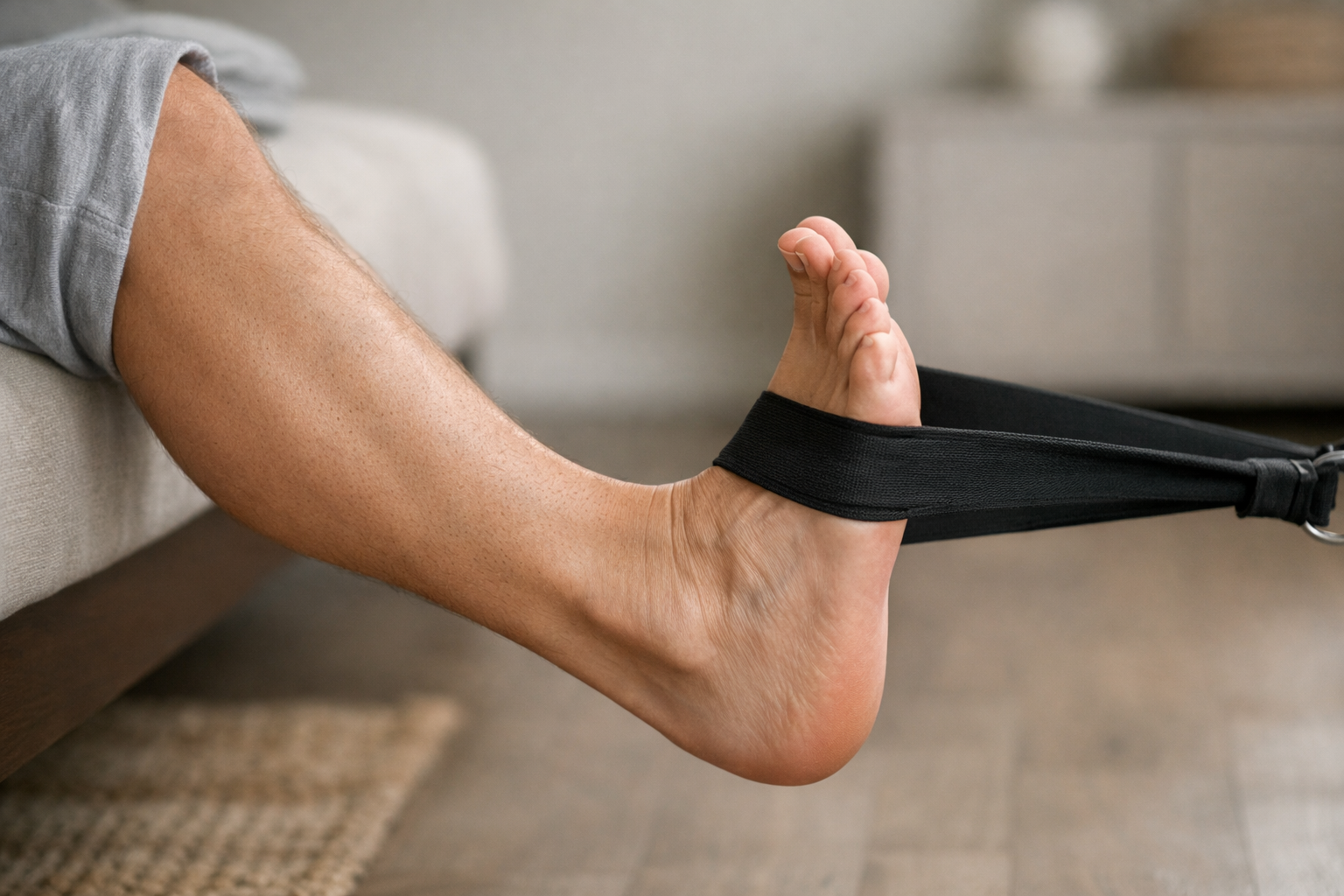
The muscle on the front of your shin (the tibialis anterior) lifts your foot and controls how it lands, and it’s easy to neglect because it doesn’t get much daily use in supportive shoes. Standing with your heels against a wall and lifting just your toes and forefoot off the ground, or doing the same movement seated with a resistance band, trains this directly.
Eversion and inversion work, meaning resisting your foot as it rolls outward or inward against a band, targets the muscles on the sides of the ankle that resist rolling. This is particularly relevant if a previous sprain is part of the picture, since these are often the muscles that were asked to do an emergency save the day you rolled the ankle and never got specifically retrained afterward.
Balance and single-leg work
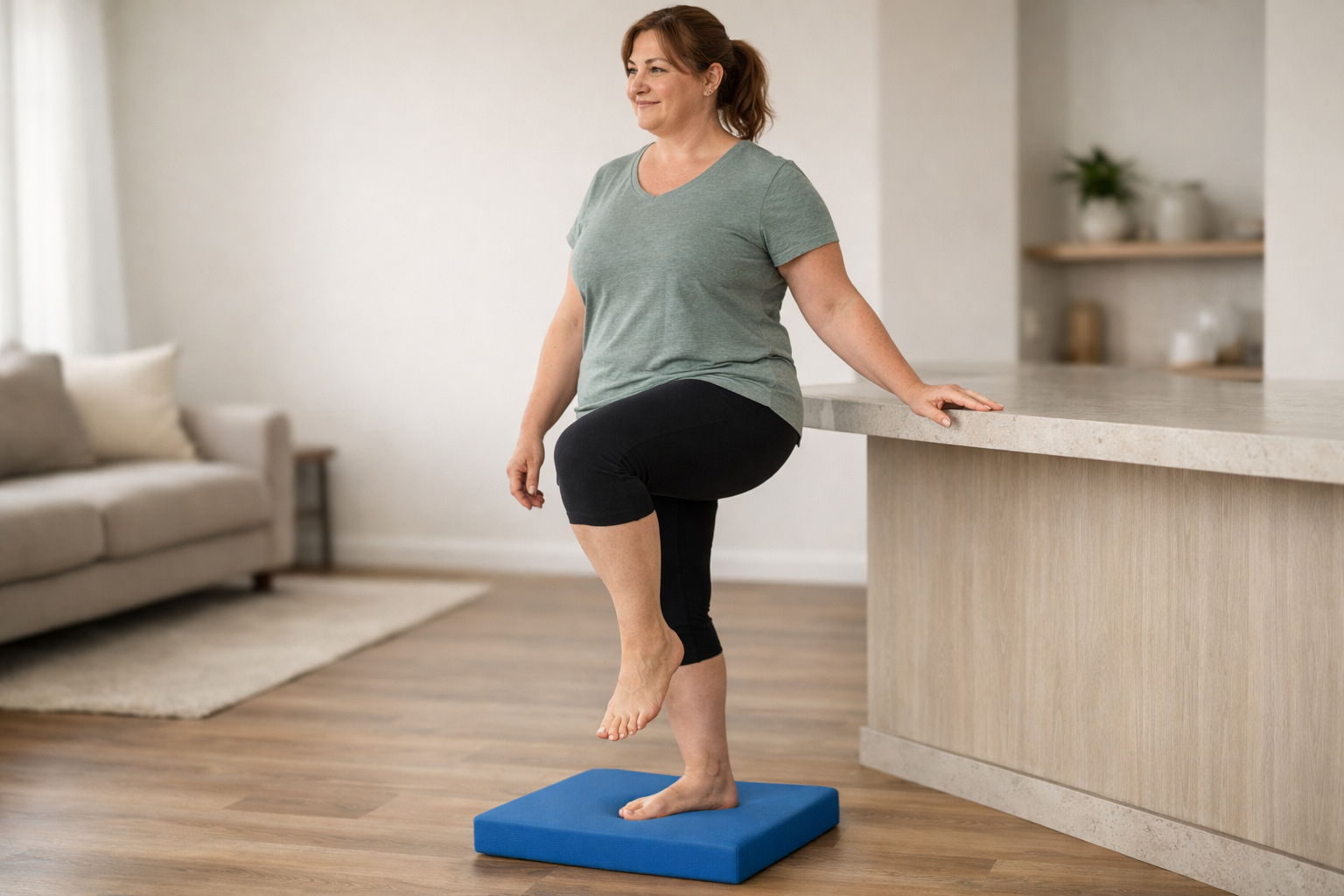
Standing on one foot sounds too simple to matter, and yet it’s one of the more effective things you can do, because it directly retrains the proprioception piece, not just strength. Start with:
- Single-leg stance on firm ground, eyes open, near a counter for safety.
- The same, eyes closed, once the first version is easy.
- Single-leg stance on a folded towel, pillow, or foam pad, which increases the balance demand.
- Single-leg stance with small reaches or ball tosses, adding a task on top of the balance challenge.
Step-ups and functional loading
Step-ups onto a low step, done slowly and with control, ask the ankle to stabilize under real body weight in a pattern that mimics stairs and uneven ground. This is where strength and balance work start to translate into the actual situations that made you worried about your ankle in the first place.
Does walking on your tiptoes strengthen your ankles?
Yes, in the sense that it’s a variation of loaded calf and ankle work, similar in principle to a heel raise held or moved through space. It asks the calf and the small stabilizing muscles to control your balance while under load, which is genuinely useful. It’s not a replacement for a full progression, but as one piece of a broader routine, walking on your toes for short distances is a reasonable addition once basic heel raises feel solid.
Does rolling your ankle make it stronger?
An actual ankle roll, the kind where the joint moves suddenly and forcefully beyond what it can control, is an injury event, not a training stimulus. That’s an important distinction, because it gets confused with something that is genuinely useful: controlled instability training.
Standing on a wobble board, foam pad, or uneven surface introduces small, manageable amounts of the kind of motion that a roll involves, but at a level your ankle can control and adapt to. Over time, this builds the reflexive stabilizing response that helps prevent an actual roll. The difference is dose and control. A little controlled wobble, repeated and gradually increased, builds capacity. An uncontrolled twist that exceeds what the ligaments and muscles can manage causes damage. Same general motion, completely different outcome, which is really the whole story of load versus capacity applied to one specific movement.
Will walking strengthen ankles?
Walking is a reasonable baseline. It keeps the ankle moving through its natural range and provides some load to the calf and stabilizing muscles, and for someone who’s been quite sedentary, simply walking more can produce a noticeable improvement.
But for most people asking how to strengthen weak ankles, walking alone isn’t enough of a challenge to keep building capacity past a certain point. Your ankle adapts to the demand you consistently place on it, and a flat, predictable sidewalk at a steady pace stops being much of a demand fairly quickly. This is why people can walk regularly for years and still feel unstable the moment they step onto a trail or a curb they didn’t see coming. The terrain and the movement pattern matter, not just the total steps.
Are calf raises good for strengthening ankles?
Genuinely, yes, they’re one of the more evidence-supported exercises for this, which is why virtually every reputable program includes them. The caveat is progression. Calf raises done the same way, at the same difficulty, for months on end will maintain what you have but won’t necessarily build much more. Moving through the single-leg, slow-lowering, and elevated-range progressions described above is what keeps the tissue adapting.
How long does it take to strengthen weak ankles?
Early improvements, particularly in balance and confidence, often show up within a few weeks. That early phase is largely your nervous system getting better at coordinating the muscles you already have, which is a real and meaningful change, but it’s not the same as the muscle and connective tissue itself becoming structurally stronger.
That deeper adaptation, the kind that holds up under real stress like an uneven trail or a long day on your feet, typically takes longer, often somewhere in the range of eight to twelve weeks of consistent, progressively challenging work. This varies quite a bit based on how deconditioned the ankle was to start, whether there’s a history of sprains, and how consistently the program is followed. If you stop as soon as things feel better but before that structural adaptation has had time to happen, it’s common for the instability to creep back a few months later.
Can weak ankles be fixed?
Many people meaningfully improve their ankle strength and stability with a structured, progressive approach, to the point where the day-to-day instability that brought them in is no longer something they think about. “Fixed” isn’t quite the right word for a joint that will always need some baseline of use to maintain its capacity, but durable, real improvement is the realistic and common outcome.
The exception is if there’s an underlying structural issue, significant ligament laxity from a severe sprain that was never addressed, or a mechanical problem in the joint itself, in which case exercise is still part of the answer but might need to be paired with other care. A clinical evaluation can sort out which situation you’re in.
Do ankles get weaker with age?
Strength and balance both tend to decline gradually with age if they aren’t specifically maintained, similar to what happens throughout the rest of the body. Reaction time in the stabilizing muscles slows a bit, and muscle mass decreases without targeted work to counter it.
This isn’t a reason to assume decline is inevitable or unchangeable. Ankle strengthening and balance work remain effective at any age, and the same progressive principles apply, just often starting from a slightly lower point and progressing a bit more patiently. Age changes the starting line, not whether the approach works.
How can I make my weak ankles stronger, practically speaking
Putting this together into something you’d actually do:
- Start with double-leg calf raises and basic single-leg standing balance, tracking how your ankle feels that day and the next.
- Once that feels genuinely manageable, not just bearable, add single-leg calf raises and eyes-closed balance work.
- Layer in tib raises and band work for the muscles on the front and sides of the ankle.
- Progress to unstable-surface balance work and step-ups as those earlier stages solidify.
- Reintroduce the real-world situations you’ve been avoiding, uneven ground, stairs, hiking, gradually and in small doses, watching how the ankle responds rather than avoiding them indefinitely or diving back in all at once.
Some mild fatigue or awareness in the ankle after a new exercise is normal. Sharp pain, real swelling, or a sense that the joint is actually giving way is different, and worth backing off from and having looked at rather than pushing through.
The person doing this work is the one who determines how it goes, because the response to each stage tells you when to move to the next one and when to hold steady a bit longer. There’s no fixed calendar that applies to every ankle. There’s just a direction: a little more capacity, built consistently, week over week.