How to Improve Your Balance: A Practical Guide for All Ages
Balance is a trainable skill, not a fixed trait, and it improves when you challenge it in the right way and often enough to adapt. Here's how to test where you stand, how hard the work should feel, and how to progress it safely at home.
Most people don’t come in saying “my balance is bad.” They say something more specific.
They reach for the wall in a dark hallway. They skip the gravel path at the park and take the paved loop instead. They put a hand on the counter to pull on socks. They stopped carrying laundry down the stairs. Nobody has fallen. Nothing dramatic has happened. But somewhere along the way, they quietly stopped trusting their own feet.
That’s usually the real question behind searching how to improve your balance. Not “am I about to fall,” but “why do I feel less steady than I used to, and can I get that back?”
Usually, yes. Balance is a skill. Skills respond to practice. What most people are missing isn’t effort or willingness. It’s a way to challenge balance hard enough to matter, and a plan for making it harder over time.
Balance isn’t one thing, which is why generic advice misses
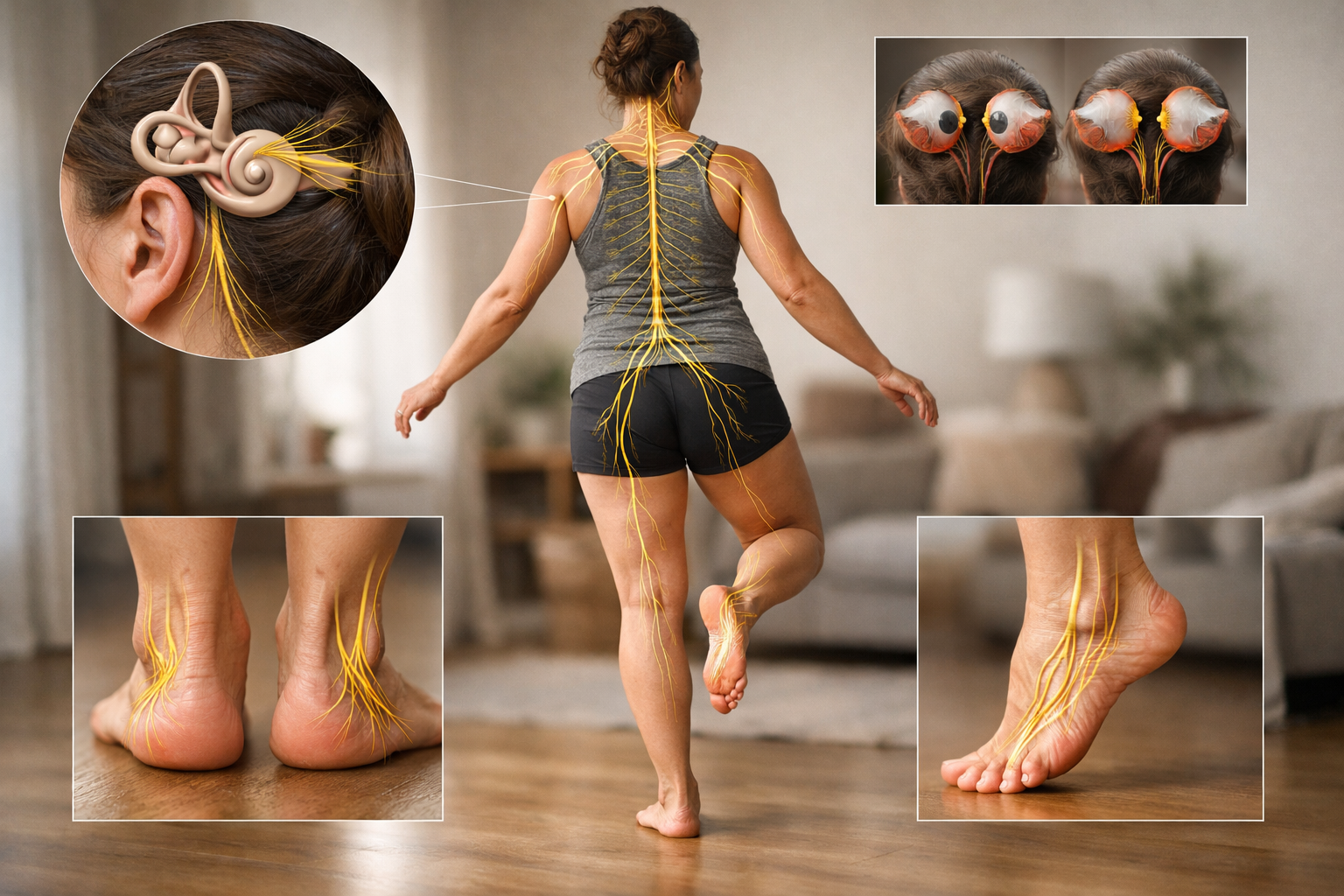
Standing upright is a constant, unnoticed negotiation between a few systems.
Your eyes tell you where you are relative to the world. They’re excellent, which is a problem: most of us over-rely on them. Close your eyes in the shower and you’ll find out how much.
Your inner ear senses head position and movement, especially acceleration. It’s why rolling over in bed or looking up at a high shelf can feel different than standing still.
Sensation from your feet, ankles, and joints reports pressure, angle, and micro-shifts in weight. This channel is fast and detailed, and it’s the one that quietly fades with age, thick-soled shoes, nerve issues, or a foot that hurts and gets guarded.
Then there’s the output side. Sensing a sway does nothing if you can’t produce force quickly enough to correct it. That means ankle strength, hip strength, and the ability to take a fast, well-placed step.
When balance declines, one or two of those channels usually dropped off while the others covered for it. Which is why “do the one-leg stand for 30 seconds” helps some people and does almost nothing for others. The training has to touch the part that’s actually struggling.
What are the signs of poor balance?
The obvious sign is falling. The useful signs show up long before that.
- Your feet drift wider apart when you stand or walk, because a wider base feels safer
- You touch walls, counters, or furniture without thinking about it
- You need your hands to get out of a chair or off the floor
- You avoid uneven ground: grass, gravel, cobblestones, sand, curbs, dim rooms
- Turning your head while walking makes you veer or feel briefly unsure
- Stepping over something (a curb, a dog, a garden hose) feels like it requires planning
- You trip more, or catch yourself more, even without going down
- Escalators, standing on a moving bus, or looking up at high shelves feel less comfortable than they used to
- Talking while walking takes more attention than it should
That last one matters more than people expect. Balance should be mostly automatic. When it starts requiring conscious attention, you have less left over for everything else, and that’s when a distraction turns into a stumble.
Also worth naming: the fear itself is a sign. Once you start moving cautiously, you move less, and the systems you’re not using get less capable. The avoidance becomes part of the problem.
Find out where you actually stand
Before training, get a baseline. Do these next to a counter or in a doorway where you can catch yourself, and have someone nearby if you’re at all unsure.
Single-leg stand, eyes open. Time how long you can hold it on each side without grabbing anything or letting the lifted foot touch down. Note the difference between sides. A big asymmetry is often more informative than the raw number.
Single-leg stand, eyes closed. Only with support within arm’s reach. This one drops dramatically for most people, which tells you how much you’ve been leaning on vision.
Tandem stance. Heel directly in front of the other toe, narrow as a tightrope. Hold for up to 30 seconds. Then try it with eyes closed.
Five sit-to-stands. From a standard chair, arms crossed over your chest, stand and sit five times as quickly as you safely can. Time it. This is a strength and power test more than a balance test, and the two are tangled together.
How long should a 70-year-old be able to balance on one leg?
This is the most common version of the question, so here’s an honest answer.
As a rough clinical marker, many healthy adults in their seventies can hold a single-leg stand with eyes open for somewhere around 10 to 20 seconds. Under about 5 seconds is generally treated as a signal worth paying attention to, not a diagnosis. Younger adults often manage 30 seconds or more with eyes open and should be able to do it without visible struggle.
Those are general patterns, not standards you pass or fail. Someone with a stiff ankle, an old sprain, neuropathy, or a foot that’s currently sore can post a low number and still be quite functional. And a single measurement on one morning means less than the direction it moves over six weeks of practice. That trend is the part I care about.
Same for five sit-to-stands. Many older adults complete it in roughly 10 to 15 seconds. Slower than that, or needing hands to push off, usually points toward leg strength as the limiter rather than balance itself. Worth knowing, because it changes what you train.
How do you fix poor balance? Make it hard enough to be worth doing
Here’s the part most home programs get wrong.
Balance improves when your system is forced to work at the edge of what it can currently handle. If you can stand on one leg for 30 seconds while holding a counter and chatting, you’re not training balance. You’re rehearsing something you already own.
The wobble is the work. You want to be at the point where you’re genuinely correcting, occasionally touching a finger down for support, sometimes stepping out of it. That’s the signal your nervous system responds to.
So set it up so failing is safe and boring. Stand in a corner of the kitchen. Put a sturdy counter in front of you, a wall behind. Wear shoes or go barefoot, but not socks on hardwood. Then let yourself be bad at it.
If you’re doing this alongside a painful foot, ankle, or knee, the rule changes slightly. Keep discomfort at or below roughly a 4 out of 10 during the work, and expect it to settle within about a day. Wobbling should feel unsteady, not painful.
And here’s the frequency question people always ask. A few minutes most days beats a heroic session on Saturday. Balance is a motor skill, and skills are built by repetition spread out over time. Consistency beats intensity.
The progression ladder
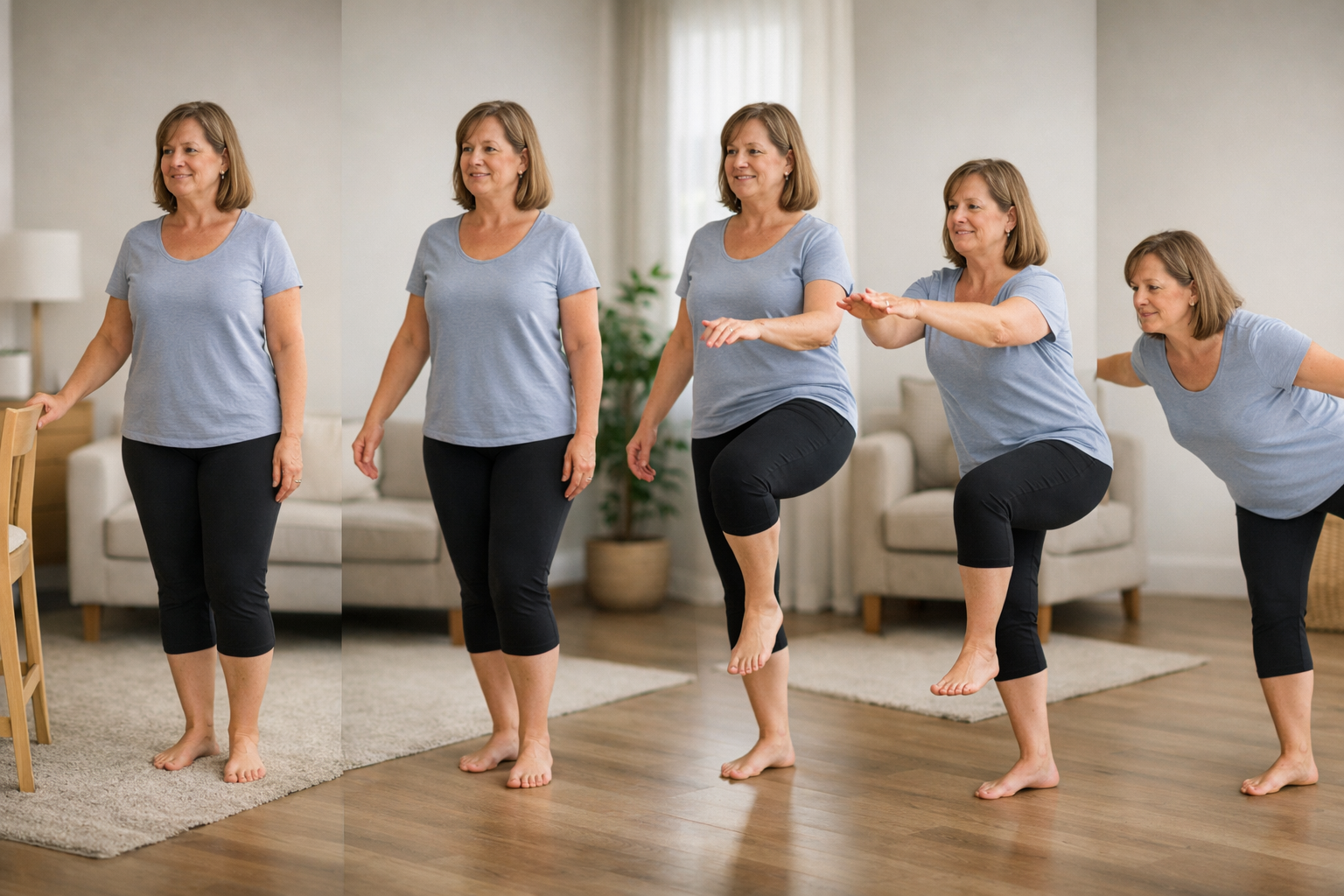
This is what turns a list of exercises into an actual plan. Pick any balance task and make it harder by changing one variable at a time.
1. Narrow the base. Feet apart, then together, then staggered, then tandem (heel to toe), then one leg. Each step up is a real jump in difficulty.
2. Take away vision. Eyes open, then eyes closed, or in a dim room. This forces your inner ear and your foot sensation to carry more of the load. It’s one of the fastest ways to make a too-easy exercise genuinely challenging.
3. Change the surface. Carpet, a folded towel, a couch cushion, grass, sand. Softer and less predictable means more work for the ankle and foot.
4. Move your head. Look left and right, up and down, slowly, while holding a position. Head movement challenges the inner ear directly, and it’s the version most connected to real life. You turn your head constantly when you walk.
5. Move your arms and limbs. Reach across your body, lift and lower a weight, pass an object hand to hand, slowly swing the free leg.
6. Add a thinking task. Count backward by threes, name states alphabetically, hold a conversation. This trains balance to be automatic again instead of something you have to concentrate on.
7. Make it reactive. More on this next, because it’s the piece most people skip.
Stay at each level long enough to actually get comfortable, usually one to two weeks of regular practice, then change exactly one variable. Change three at once and you’ve just made it unsafe rather than harder.
The piece almost everyone skips: reacting fast
Holding still on one leg is a fine place to start. It is not what saves you when you catch a toe on a rug.
Real-world balance is reactive. Something unexpected happens, and you have a fraction of a second to either correct at the ankle or get a foot out there fast enough to catch yourself. That stepping reaction is trainable, and it’s separate from static holding.
Things that build it:
- Fast, deliberate steps. Standing tall, step quickly forward, back, and out to the side, then return to center. Quick out, controlled back. Do it in a safe space where you can grab something.
- Step-ups and step-downs onto a low step, with a slow, controlled lowering. Controlling descent is exactly what you need on stairs and curbs.
- Weight shifts to the limit. Lean forward onto the balls of your feet, and back onto your heels, going far enough that you have to work to come back. You’re mapping the edges of your own stability.
- Turns and direction changes while walking, including stopping suddenly on command.
- Getting strong, and getting strong quickly. Squats, sit-to-stands, heel raises, hip work, carrying something heavy in one hand. Strength is the engine behind every correction you make. Sensing a sway is useless if your calf can’t answer.
For younger and athletic readers, this is also where returning from an ankle sprain goes wrong. Pain settles, swelling goes down, and the training stops before single-leg control on an unstable surface has been rebuilt. That’s a large part of why sprained ankles tend to become repeat sprained ankles. Structure heals. Capacity has to be built back.
Good balance exercises you can do at home
You don’t need equipment. You need a counter, a chair, a doorway, and a few minutes.
Foundation (hold 20 to 30 seconds, work up to 3 rounds each)
- Feet together, eyes closed
- Tandem stance, eyes open, then eyes closed with support nearby
- Single-leg stand, fingertips on the counter, then one finger, then hands free
- Single-leg stand with slow head turns
Strength and control (8 to 12 reps)
- Sit-to-stand from a chair, no hands, slow down on the way back
- Heel raises, both legs, then one leg
- Step-ups onto a low step, with a controlled lowering
- Side steps along a counter, sinking slightly into the hip
Dynamic
- Heel-to-toe walking along a hallway (the wall is your friend)
- Slow marching in place with a pause at the top of each lift
- Walking and turning your head side to side on purpose
- Walking on grass or a soft lawn once the indoor version feels easy
A 10-minute version
If you want something you’ll actually repeat, keep it short and do it most days. One practical template:
- Minutes 1 to 2: feet together eyes closed, then tandem stance each side
- Minutes 3 to 5: single-leg stand, 3 holds per leg, using as little hand support as you safely can
- Minutes 5 to 7: sit-to-stands and heel raises
- Minutes 7 to 9: heel-to-toe walking and quick steps forward, back, and sideways
- Minutes 9 to 10: one harder challenge of your choice, such as single-leg on a cushion or a hold with head turns
Ten minutes, five or six days a week, is enough to change things for a lot of people. Two hours once a month is not.
If you’re an older adult looking for a more detailed, safety-first version of this, we’ve written a separate guide on how older adults can improve their balance safely at home. And if your unsteadiness shows up mainly when you’re walking rather than standing still, our article on improving balance when walking gets into the foot and ankle side of that specifically.
How long does it take to improve balance?
You’ll usually notice something within two to four weeks. That early change is mostly your nervous system getting better at using the information it already has: faster corrections, better coordination, more confidence. It’s real, and it’s encouraging, and it’s not the whole job.
The deeper changes, the strength, the tissue tolerance, the reactions that hold up when you’re tired or distracted, generally take something more like 8 to 12 weeks of consistent work. That’s the typical window for meaningful adaptation, though it varies a lot with your starting point and what else is going on.
And this part is important: balance is a use-it-or-lose-it quality. It doesn’t bank permanently. People who stop entirely after three good months tend to drift back. The good news is that maintaining is much easier than building. Once you’ve got it, folding a couple of balance challenges into things you already do (brushing teeth on one leg, heel raises while the kettle boils, standing on one foot while you’re on the phone) keeps most of the gain for almost no extra time.
Can poor balance be restored, including later in life?
For most people, meaningfully yes.
The systems involved in balance stay adaptable across the lifespan. Muscle responds to training in your eighties. The nervous system keeps learning motor skills. Foot and ankle sensation sharpens with use. People who’ve been unsteady for years often improve, and the fact that it’s been a long time usually means starting lower and progressing more patiently, not that it can’t change.
Where honesty matters is the causes that need their own attention. Nerve damage in the feet, inner ear disorders, low blood pressure on standing, vision changes, certain medications, neurological conditions, and joint problems all affect balance in specific ways. Training still helps in almost all of those cases, and sometimes helps a lot, but it works better alongside addressing the underlying issue than instead of it. Someone whose dizziness comes from the inner ear needs a different emphasis than someone whose feet have lost sensation. That’s a large part of what an evaluation is for: figuring out which channel is struggling so the work targets it.
What won’t restore balance is waiting for it to feel safe first. Confidence follows capability. You build the capability, sometimes while still feeling a bit shaky, and the trust arrives afterward.
When to get it looked at
Balance training is generally safe and worth starting. Some situations deserve a proper evaluation before or alongside it:
- A sudden or rapid change in your steadiness, rather than a slow drift over years
- True spinning vertigo, especially with nausea, hearing changes, or ringing
- Lightheadedness when you stand up quickly, which may be a blood pressure or medication issue
- Numbness, tingling, burning, or loss of feeling in your feet
- A fall you can’t explain, or falls that are becoming more frequent
- New weakness, changes in vision or speech, or new severe headaches (these need urgent attention)
- Foot, ankle, knee, or hip pain that’s limiting what you’re able to practice
None of that means something is seriously wrong. It means the picture is worth sorting out, because the right training depends on knowing what you’re training.
Start where you are today. Find the version of a balance task that makes you wobble but not panic, do it most days, and change one thing about it every week or two. That’s genuinely most of it. Recovery of steadiness is built the same way any other physical capability is built: a little at a time, repeatedly, with attention to how your body answers back.